
Why Businesses Use Artificial Intelligence Today More Than Ever
Businesses use artificial intelligence today because it delivers clear, measurable value — cutting costs, saving time, boosting revenue, and helping teams focus on what humans do best. From tiny startups to global enterprises, companies of all sizes turn to AI for practical advantages that were out of reach just a few years ago. Affordable tools, powerful cloud platforms, and ready-to-use models mean any business can start seeing benefits quickly, whether automating routine work or gaining sharper insights from data. The result is a competitive edge that feels essential in 2026.
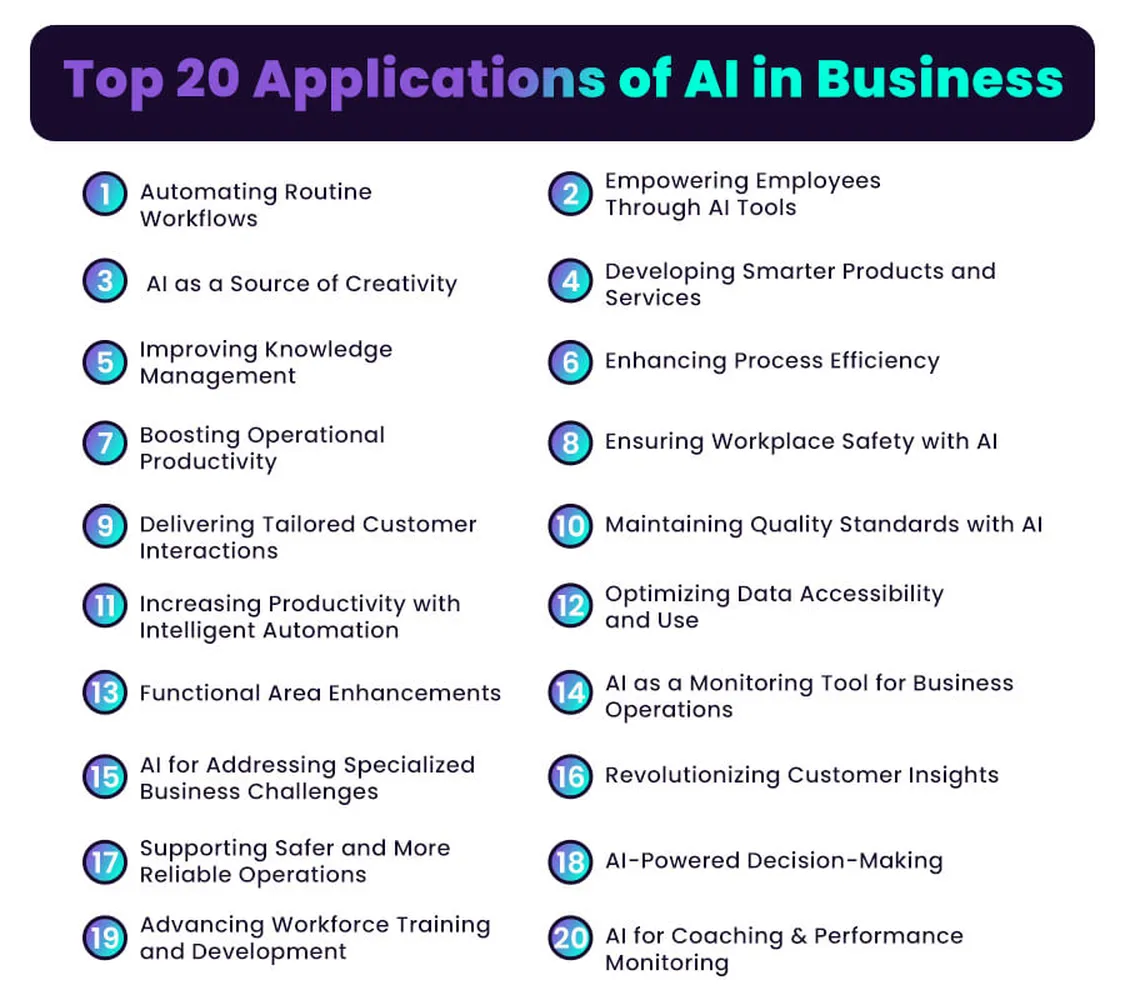
20 Practical Ways Businesses Use Artificial Intelligence Today
1. Automating Repetitive Administrative Tasks
Businesses use artificial intelligence today to handle data entry, invoice processing, scheduling, and report generation automatically. This frees employees for creative or strategic work and reduces errors that happen with manual handling. Many companies cut admin time by 30-50%, allowing faster operations without adding headcount.
2. Powering Intelligent Customer Support Chatbots
Businesses use artificial intelligence today with advanced chatbots that answer questions 24/7, resolve common issues, and hand off complex cases to humans seamlessly. Satisfaction scores often rise while support costs drop significantly — some firms handle 60-80% of inquiries automatically.
3. Delivering Hyper-Personalized Marketing Campaigns
Businesses use artificial intelligence today to analyze customer behavior and preferences, then send tailored emails, ads, and offers that feel made just for each person. Conversion rates frequently improve by 15-35%, and customers feel more valued.
4. Predicting Customer Needs and Churn
Through predictive models, businesses use artificial intelligence today to spot patterns that signal when someone might leave or what they'll buy next. Proactive outreach keeps more customers loyal and opens upsell opportunities that boost lifetime value.
5. Optimizing Pricing and Dynamic Offers
Businesses use artificial intelligence today for real-time pricing adjustments based on demand, competition, inventory, and customer data. Retailers and services see revenue lifts of 5-15% without losing customers to bad pricing decisions.
6. Enhancing Fraud Detection in Transactions
Businesses use artificial intelligence today to monitor payments and flag suspicious activity instantly with far better accuracy than rule-based systems. Losses drop dramatically — often by 40-70% in finance and e-commerce.
7. Streamlining Supply Chain and Inventory Management
Businesses use artificial intelligence today to forecast demand accurately, optimize routes, predict maintenance needs, and reduce stockouts or overstock. Logistics costs fall 10-25%, and delivery reliability improves noticeably.
8. Accelerating Product Recommendations
Businesses use artificial intelligence today in recommendation engines that suggest exactly what customers want based on past behavior. Online stores report sales increases of 10-30% from smarter suggestions.
9. Improving Hiring and Talent Matching
Businesses use artificial intelligence today to screen resumes, match candidates to roles, and even conduct initial assessments. Time-to-hire shortens, and better fits reduce turnover in competitive job markets.
10. Generating Content and Creative Assets Quickly
Businesses use artificial intelligence today to draft blog posts, social captions, emails, product descriptions, and even images or videos. Marketing teams produce more content faster while maintaining brand voice.
11. Analyzing Data for Faster Decisions
Businesses use artificial intelligence today to process huge datasets and surface key insights in seconds. Leaders make evidence-based choices on strategy, budgets, and market moves with greater confidence.
12. Predicting Equipment Failures Proactively
In manufacturing and field services, businesses use artificial intelligence today for predictive maintenance that spots issues before breakdowns occur. Downtime drops sharply, saving thousands in repairs and lost production.
13. Personalizing Employee Training Programs
Businesses use artificial intelligence today to create custom learning paths that adapt to each person's pace and needs. Employees upskill faster, engagement rises, and companies build stronger internal talent.
14. Monitoring Brand Sentiment in Real Time
Businesses use artificial intelligence today to scan social media, reviews, and news for customer opinions. Quick alerts let teams respond to issues or capitalize on positive buzz before it fades.
15. Automating Financial Forecasting and Reporting
Businesses use artificial intelligence today to generate accurate forecasts, spot anomalies in spending, and prepare compliance reports automatically. Finance teams spend less time on routine tasks and more on strategy.
16. Enhancing Cybersecurity Threat Detection
Businesses use artificial intelligence today to identify unusual network patterns and stop attacks early. Response times shrink, and breaches become far less likely in an increasingly hostile digital world.
17. Supporting Virtual Try-Ons and Experiences
Businesses use artificial intelligence today for augmented reality features like virtual makeup, clothing fitting, or furniture placement. Customers buy with more confidence, reducing returns significantly.
18. Optimizing Energy Use and Sustainability
Businesses use artificial intelligence today to analyze consumption patterns and suggest efficiency improvements. Energy bills drop 10-30%, and companies meet green goals more effectively.
19. Running A/B Tests and Experiments Automatically
Businesses use artificial intelligence today to test website layouts, ad creatives, or email subjects at scale and pick winners instantly. Optimization cycles speed up, improving results continuously.
20. Building AI Agents for Complex Workflows
Businesses use artificial intelligence today with agentic systems that handle multi-step processes independently — like research, planning, and execution. Teams delegate entire projects, unlocking major productivity leaps.
AI Adoption Impact Table
| Area | Typical Benefit | Avg. Improvement | Common Tools |
|---|---|---|---|
| Customer Service | Automation | 60-80% | Chatbots |
| Marketing | Personalization | 15-35% | Recommendation |
| Operations | Cost Reduction | 10-40% | Automation |
| Analytics | Decision Speed | 50-70% | Predictive |
| Fraud/Security | Loss Prevention | 40-70% | Detection |
| Supply Chain | Efficiency | 10-25% | Forecasting |
Qualitative Insights: How Leaders View AI Today
Businesses use artificial intelligence today with growing excitement mixed with practical caution. Leaders praise how AI removes drudgery, sharpens focus, and opens creative possibilities. At the same time, many stress the importance of starting small, training teams, protecting data, and keeping humans in the loop for ethical decisions. The consensus is that AI works best as a powerful partner — not a replacement — helping businesses move faster while staying true to their values.
Quantitative Data: Real Numbers Behind AI Use
- 88% of organizations use AI in at least one function in 2026.
- Companies see average 20-40% productivity gains from AI tools.
- Personalization via AI lifts revenue 10-30% in retail/e-commerce.
- AI cuts customer support costs by 30-60% in many cases.
- High adopters report 3-7× ROI on successful AI projects within 2-3 years.
Factors Driving Widespread AI Use Today
- Cheaper, more powerful models available to everyone.
- Clear proof of ROI from early successes.
- Competitive pressure to keep up or fall behind.
- Easy-to-use no-code/low-code AI platforms.
- Growing customer demand for fast, personalized service.
Challenges Businesses Face When Using AI Today
While businesses use artificial intelligence today with great success, hurdles remain. Data quality issues, privacy regulations, bias in models, integration complexity, and talent shortages slow some efforts. High initial costs for custom builds and fear of job changes create hesitation too. Smart companies tackle these head-on with strong governance, gradual rollouts, and ongoing training — turning potential pitfalls into long-term strengths.
How AI Use Today Shapes the Future of Business
Businesses use artificial intelligence today as the foundation for tomorrow's winners. Those integrating AI thoughtfully — starting with clear problems, measuring results, and scaling what works — position themselves for sustained growth. The gap between adopters and non-adopters widens daily, making AI fluency a core competitive requirement in 2026 and beyond.
Experience AI-Enhanced Travel with Jaynevy Tours
Businesses use artificial intelligence today to revolutionize travel too — think personalized itineraries, smart recommendations, and seamless planning. At Jaynevy Tours, we apply these same principles to craft unforgettable Tanzania adventures, from Serengeti safaris and Mount Kilimanjaro climbs to relaxing Zanzibar getaways. Let us build your perfect trip — contact us now!
Frequently Asked Questions
What are the most common ways businesses use artificial intelligence today?
The top ways include customer service chatbots, predictive analytics for decisions, personalized marketing, process automation, fraud detection, and supply chain optimization — delivering efficiency and growth.
How do small businesses use AI effectively today?
Small businesses use AI for content creation, social media management, customer support automation, basic analytics, invoicing, and personalized outreach — often with affordable tools like ChatGPT or no-code platforms.
What benefits do companies see from using AI today?
Businesses report 20-40% productivity gains, 15-35% cost reductions in key processes, better customer satisfaction, faster decisions, and new revenue opportunities through personalization and insights.
Are there risks when businesses use artificial intelligence today?
Yes, common risks include data privacy issues, algorithmic bias, high setup costs for custom solutions, employee skill gaps, and over-reliance on AI without human oversight.
Which industries use AI the most right now?
Retail, finance, healthcare, manufacturing, marketing, logistics, and customer service lead in adoption, using AI for personalization, fraud prevention, diagnostics, predictive maintenance, and automation.