
Quick Answer: What Is a Good Affordable 6 Day Serengeti Ngorongoro Safari Deal?
A realistic affordable six-day deal is usually a road-based safari using camping, simple lodges or shared transport rather than fly-in transfers and premium camps. On Jaynevy Tours pages checked in August 2026, a 6-day Serengeti camping safari is published around USD 1,500–1,800 per person, while the broader 6-day Serengeti safari guide places budget trips around USD 1,500–2,000 per person. Treat these as planning benchmarks, not a fixed quote for every date.
- Best value format: road safari, shared or budget private 4x4.
- Best budget target: roughly USD 1,500–2,000 pp for a basic/camping structure, subject to exact inclusions.
- Main route: Arusha → Serengeti → Ngorongoro → Arusha.
- Recommended wildlife time: at least 2 full Serengeti game-drive days plus 1 crater day.
- Best saving lever: share vehicle costs with 2–6 travelers and travel outside the highest-demand weeks.
- Most important check: get every fee, overnight, meal and transfer written into the quotation.
Affordable 6 Day Serengeti Ngorongoro Safari Deals at a Glance
| Safari style | Published planning benchmark | How it saves money | Best for |
|---|---|---|---|
| Shared / camping | About USD 1,500–1,800 pp | Shared vehicle + simpler camps | Backpackers, solo travelers, value seekers |
| Budget safari | About USD 1,500–2,000 pp | Basic accommodation + road transfers | Couples and friends prioritizing wildlife |
| Two-person budget benchmark | One Jaynevy 6-day budget page publishes USD 1,615 pp for 2 travelers | Vehicle, guide and fuel shared by two | Couples who want a private setup |
| Mid-range | About USD 2,000–4,000 pp | Comfort improves, but lodge choice drives cost | Travelers wanting ensuite lodge/tented-camp comfort |
Price note: these figures are published Jaynevy planning benchmarks visible in August 2026. They are not a promise that every Serengeti–Ngorongoro departure will be available at the same rate. Season, group size, lodge inventory, park/conservation charges, pickup point and optional activities can change the final quotation.
Why 6 Days Is a Strong Value Length for Serengeti and Ngorongoro
Six days sits in a useful middle ground. A shorter trip can reach Serengeti and Ngorongoro, but road transfers begin to dominate the schedule. A longer trip gives more flexibility, yet every extra night adds accommodation, park time and vehicle costs. With six days, a well-built route can give you several meaningful Serengeti drives and still reserve a dedicated day for Ngorongoro Crater.
The key is to avoid turning six days into a race through four or five parks. If the search intent is specifically Serengeti + Ngorongoro, concentrating the itinerary on those two ecosystems often gives better wildlife time for the money than collecting destination names.
Recommended Affordable 6-Day Serengeti and Ngorongoro Itinerary
This is a value-focused road itinerary rather than a luxury fly-in plan. It assumes the safari starts in Arusha. If you land at Kilimanjaro International Airport on the same morning, discuss timing carefully because the first road day is long.
| Day | Route | Main activities | Budget logic |
|---|---|---|---|
| 1 | Arusha → Serengeti | Scenic overland transfer through the highlands, enter via Naabi Hill, afternoon game drive toward central Serengeti | Drive instead of buying a domestic flight |
| 2 | Central Serengeti | Full-day game drive for lions, cheetahs, elephants, giraffes, hippos and plains game | One accommodation base reduces unnecessary moves |
| 3 | Serengeti | Full-day game drive; adjust direction to seasonal wildlife concentrations | Use the same vehicle/guide rather than adding specialist transfers |
| 4 | Serengeti | Sunrise game drive, predator-focused areas, kopjes, river systems or seasonal migration zone | More wildlife time without another park entry pattern |
| 5 | Serengeti → Ngorongoro | Morning game drive, exit Serengeti and continue toward Ngorongoro; overnight near the crater or Karatu depending budget | Karatu can be better value than premium crater-rim lodging |
| 6 | Ngorongoro Crater → Arusha | Early crater descent, game drive and picnic lunch, then return to Arusha | One focused crater day captures the key experience without an extra night |
Jaynevy's current 6-day Serengeti safari page gives roughly 254 km and about 5 hours from Arusha to Naabi Hill Gate before allowing for gate procedures, stops and additional driving inside the Serengeti. That is why an early departure matters on Day 1.
What Makes a Safari Deal Truly Affordable?
A cheap headline is not automatically a cheap safari. The useful question is: what will the trip cost after all mandatory services are added? Safari pricing is unusually sensitive to fixed vehicle costs, protected-area charges and accommodation location. A slightly higher all-inclusive quotation can therefore be better value than a low base price with large compulsory extras.
1. Group size and vehicle sharing
A safari vehicle, driver-guide and fuel cost money whether one person or several people are inside. This is why per-person prices generally fall as more travelers share the same vehicle. Jaynevy's 6-day Tanzania budget trip currently illustrates this effect by publishing a higher one-traveler figure and a lower per-person figure for two travelers.
2. Accommodation category and location
Public camping is usually the lowest-cost option. Basic tented camps and simple lodges cost more but provide beds, private bathrooms or better facilities. Inside-the-park or migration-positioned properties can carry a premium compared with accommodation farther from the most expensive wildlife zones.
3. Travel season
Demand is generally strongest in the classic dry season and around festive dates, while parts of the rainy or shoulder seasons can bring better lodge value. The trade-off is weather: April and May can have heavier rain, some roads become slower, and wildlife distribution changes.
4. Road versus fly-in safari
For most budget travelers, road transport is the obvious saving. Flying can save hours and improve comfort, but it adds airfare and sometimes transfer costs. If your aim is the lowest sensible six-day total, keep the route overland unless time is more valuable than price.
5. Optional activities
Hot-air balloon flights, cultural visits, private sundowners and other add-ons can be excellent experiences, but they are not necessary for a strong core safari. Protect the budget first, then add activities only if they matter to you.
Budget Safari vs Group Joining vs Private: Which Deal Gives Better Value?
| Option | Price tendency | Flexibility | Main trade-off |
|---|---|---|---|
| Group joining | Usually lowest for solo/2 travelers | Low | Fixed schedule, shared decisions, luggage limits may apply |
| Private budget safari | Higher for 1–2; improves with 3–6 travelers | High | You carry more of the vehicle cost |
| Private mid-range | Higher | High | Accommodation can move the total quickly |
| Fly-in safari | Highest of these structures | High | Airfare buys time, not budget savings |
If you are traveling alone, start by checking the 6-day Tanzania sharing safari. If you are a couple, family or group of friends, compare the shared price against a private vehicle quote—the private option may narrow the gap once fixed costs are divided among several people.
What Should Be Included in an Affordable 6-Day Safari Quote?
Before paying anything, ask for a written line-by-line confirmation. A strong quotation should clearly say whether each of the following is included:
- 4x4 safari vehicle and professional driver-guide.
- Fuel for the confirmed itinerary.
- Serengeti National Park fees and relevant Ngorongoro conservation/crater charges.
- Five nights of accommodation, with exact names or at least a clearly defined category.
- Meals and meal basis for each night.
- Drinking water during game drives.
- Government taxes or levies applicable to the booked services.
- Arusha/Moshi pickup and final drop-off if agreed.
- Any camping equipment and cook/crew services for a camping safari.
Also ask what is not included. Common exclusions can include international flights, visa, travel insurance, tips, alcohol, personal purchases, optional balloon safari, extra hotel nights and route changes requested after confirmation.
Best Months for Affordable Serengeti Ngorongoro Safari Deals
| Period | Value outlook | Wildlife / weather notes | Who it suits |
|---|---|---|---|
| January–March | Medium to high demand in southern migration areas | Calving-season interest around southern Serengeti/Ndutu; exact herd position varies | Travelers prioritizing migration and predator action |
| April–May | Often strongest accommodation value | Long-rain period; greener landscapes, fewer vehicles, some muddy roads | Flexible budget travelers and photographers |
| June–October | High demand | Dryer conditions and widely popular game viewing; migration moves west/north seasonally | First-time visitors willing to pay peak-season rates |
| November | Often good shoulder value | Short rains can refresh the plains; fewer crowds than peak months | Value seekers comfortable with variable showers |
| December | Mixed; festive dates can be expensive | Green-season conditions developing; holiday demand raises some rates | Travelers tied to year-end holidays |
The Great Migration does not follow a reservation calendar. Rainfall and grazing influence herd movement, so any company promising a guaranteed river crossing or guaranteed herd location should be treated cautiously. A better approach is to choose the right Serengeti zone for your travel month and allow the guide some daily flexibility.
How Much Wildlife Can You Realistically See?
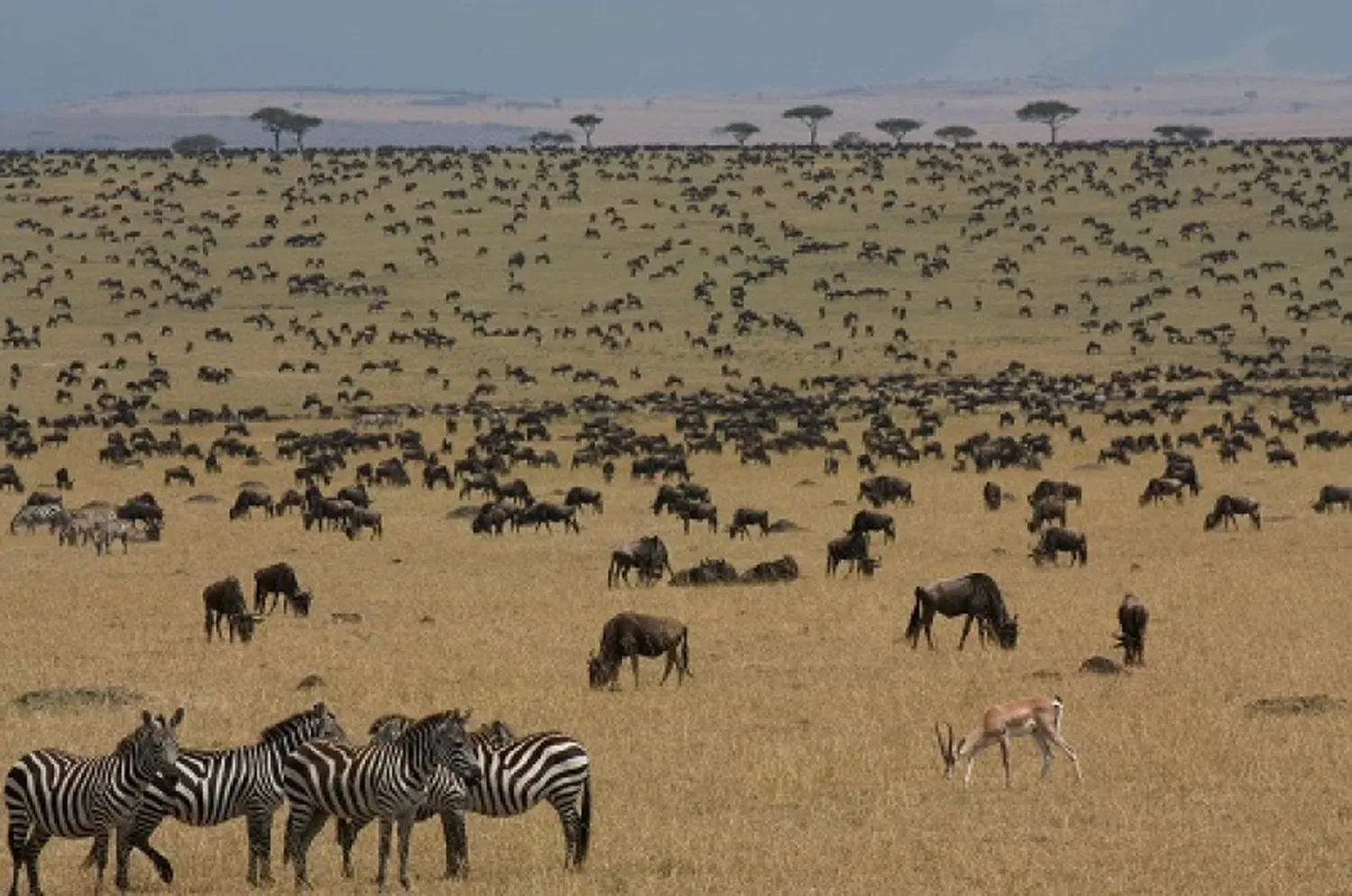
The Serengeti is vast. UNESCO describes Serengeti National Park as roughly 1.5 million hectares (about 15,000 km²) and highlights an annual migration involving around two million wildebeest plus hundreds of thousands of zebras and gazelles. Frankfurt Zoological Society similarly describes the wider migration as more than two million wildebeest, zebra and gazelle moving through the ecosystem.
Ngorongoro offers a very different viewing pattern. The Ngorongoro Conservation Area Authority's wildlife page reports more than 25,000 large animals in the area, including black rhinos, wildebeest, zebras, buffalo, lions and other species. This concentration is one reason a single crater day can add a lot of wildlife value to a six-day itinerary.
Those numbers explain the potential, but they are not a sighting guarantee. Wildlife is wild. Your actual experience depends on season, weather, animal movement, guide decisions, time of day and simple luck.
Can You See the Big Five on This 6-Day Safari?
You can have a strong chance of seeing lion, elephant and buffalo, while leopard and black rhino are less predictable. Ngorongoro is particularly useful for black-rhino chances, but no responsible operator should guarantee all five. Treat “Big Five” as a search goal, not a contractual promise.
How to Cut Cost Without Ruining the Safari
- Travel with more people. Sharing one 4x4 is often the single strongest way to reduce per-person cost.
- Choose camping or simple accommodation. Spend on guiding and wildlife time before spending on room luxury.
- Use Karatu strategically. On the Ngorongoro side, a well-chosen Karatu overnight can be cheaper than a premium crater-rim lodge.
- Drive instead of fly. A road safari uses more transfer time but normally costs less.
- Avoid peak holiday weeks if your dates are flexible. Accommodation can be more competitive outside the highest-demand windows.
- Skip optional activities first. Keep the main game drives, park time, good vehicle and guide.
- Compare identical inclusions. A USD 1,500 quote excluding major mandatory charges is not cheaper than a USD 1,800 quote that includes them.
- Read the Tanzania safari budget tips before choosing accommodation and route.
Red Flags in “Cheap” Serengeti and Ngorongoro Deals
- No written list of park/conservation fees and mandatory charges.
- Accommodation described only as “lodge” without names, standard or location.
- An itinerary that claims full-day game drives on days dominated by long transfers.
- Guaranteed migration, Big Five or rhino sightings.
- No explanation of whether the vehicle is private or shared.
- Very low headline price followed by compulsory “local payments.”
- No cancellation terms, payment schedule or supplier-change policy in writing.
Affordable Does Not Mean the Same as Budget Camping
“Affordable” is relative. For one traveler, a group camping safari may be the rational choice. For four friends, a private mid-budget safari can produce a similar per-person figure while giving much more control over stops and game-drive timing. For a family with young children, paying extra for ensuite rooms and a private vehicle may deliver better overall value even if the headline price is higher.
If you want to compare the wider range, browse Tanzania safari packages, the Northern Tanzania safari collection, and the longer multi-park 6-day Tarangire, Serengeti, Ngorongoro, Manyara and Lake Eyasi safari.
Sample Decision Guide: Which 6-Day Deal Should You Choose?
| Your priority | Best-fit structure | Why |
|---|---|---|
| Lowest possible per-person cost | Group joining + camping | Maximum sharing of vehicle and accommodation costs |
| Couple wanting privacy | Private budget safari | Flexible stops and no strangers in the vehicle |
| Family of 4–6 | Private safari with budget/mid-range lodges | Fixed vehicle cost is shared across more travelers |
| Photography | Private vehicle | Better control over positioning, waiting time and departure times |
| Comfort but still price-conscious | Mid-range tented camps + road transfers | Improves sleep and bathrooms without paying for flights/luxury extras |
| Maximum Serengeti time | Fewer parks, 3–4 Serengeti nights | Reduces park-hopping and keeps the trip focused |
How to Request a Quote That Is Easy to Compare
Send the same information to every operator: exact dates, number of adults and children, preferred start point, preferred accommodation level, whether you accept group joining, and any must-have activity. Then ask each company to quote the same structure. This makes comparison much more useful than asking only, “How much is a six-day safari?”
For Jaynevy options, you can also review the dedicated 6-day camping safari, 6-day sharing safari and tailor-made Tanzania safari pages before requesting the final written quotation.
Research Notes: Where the Key Numbers Come From
- Serengeti size and migration scale: UNESCO World Heritage Centre – Serengeti National Park.
- Serengeti ecosystem and migration context: Frankfurt Zoological Society – Serengeti.
- Ngorongoro wildlife figures: Ngorongoro Conservation Area Authority – Craters & Wildlife.
- Budget price benchmarks: current Jaynevy Tours pages linked throughout this guide; final price must be reconfirmed for the travel dates.
Frequently Asked Questions About Affordable 6 Day Serengeti Ngorongoro Safari Deals
How much does an affordable 6 day Serengeti and Ngorongoro safari cost?
As a planning benchmark checked in August 2026, Jaynevy currently publishes a 6-day Serengeti camping range of about USD 1,500–1,800 per person and a broader 6-day Serengeti budget range of about USD 1,500–2,000 per person. Exact Serengeti and Ngorongoro pricing depends on group size, season, accommodation, park charges and the services confirmed in your written quote.
What is usually the cheapest way to do a 6 day Serengeti Ngorongoro safari?
Shared transport plus public or basic camping is usually the lowest-cost structure because vehicle, guide and fuel costs are divided among more travelers. A private safari can become better value per person when four to six travelers share one vehicle.
Which months are best for cheaper Serengeti and Ngorongoro safari deals?
April, May and parts of November can offer stronger accommodation value than the busiest dry-season and festive periods, although rain can affect road conditions and wildlife distribution. Ask for rates for your exact dates rather than assuming every “low season” property discounts equally.
Can I see the Great Migration on a 6 day safari?
Possibly. The migration is a moving natural event rather than a fixed attraction. Match the Serengeti zone to the expected seasonal movement and recent field conditions, but do not expect a guaranteed river crossing or herd location.
Is Ngorongoro Crater worth including in an affordable safari?
Yes. The crater gives access to a concentrated wildlife-viewing area and complements the much larger Serengeti landscape. For a six-day itinerary, one well-timed crater day is usually enough to add major variety without overloading the route.
Should I choose a group safari or a private safari?
Choose group joining if the lowest per-person price matters most and you accept fixed departure times and shared decisions. Choose private if you value flexible game-drive pacing, family privacy, photography stops or the ability to adjust the route to seasonal wildlife.
Are park fees included in the advertised safari price?
Do not assume they are. Ask for a written quotation that clearly states park and conservation fees, crater-related charges, accommodation, meals, transport, guide services, taxes and any airport transfers.
How do I avoid a cheap safari deal becoming expensive later?
Compare total inclusions, not only the headline price. Confirm accommodation names or category, room basis, vehicle sharing, park fees, meals, drinking water, pickup and drop-off points, optional activities and all exclusions before paying a deposit.
Bottom Line
The best affordable 6 day Serengeti Ngorongoro safari deal is not the one with the smallest number at the top of the page. It is the trip that gives you enough Serengeti time, a proper Ngorongoro day, a safe and reliable vehicle, good guiding, suitable accommodation and a written price that does not hide mandatory costs. For a budget-focused traveler in 2026/2027, published Jaynevy benchmarks around USD 1,500–2,000 per person provide a useful starting point for camping or basic safari planning, but the exact deal should always be rebuilt around your dates, party size and confirmed accommodation.