
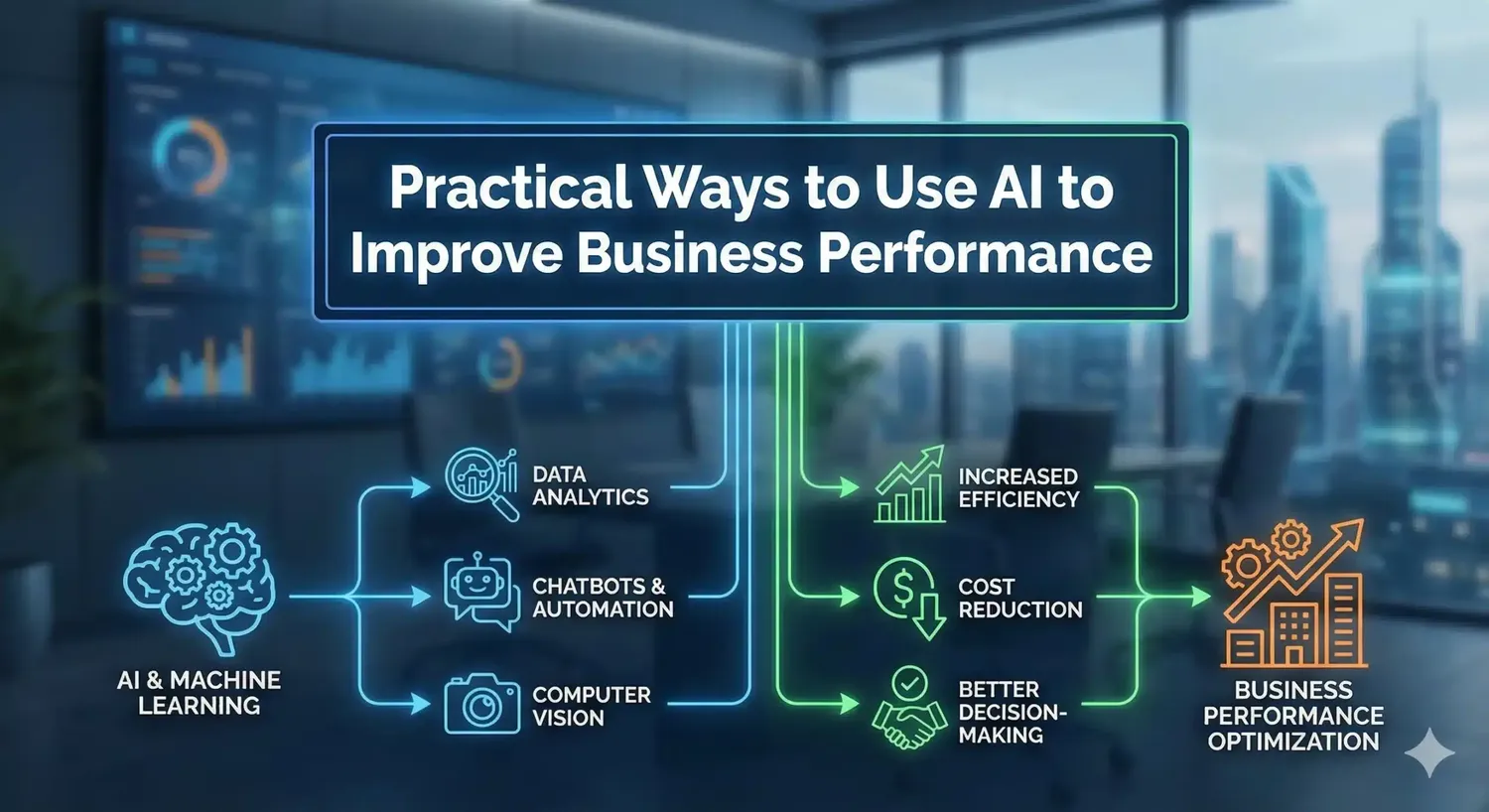
Why AI Technology That Improves Business Performance Is a Game-Changer in 2026
Businesses today compete on speed, efficiency, insight, and customer obsession — not just effort. AI technology that improves business performance powers all of these by handling repetitive tasks perfectly every time, analyzing data at scale humans can’t match, predicting outcomes with high accuracy, personalizing interactions instantly, optimizing every dollar spent, and continuously learning to get better without extra headcount. Companies using AI technology that improves business performance report faster revenue growth, lower operating costs, higher customer loyalty, stronger margins, quicker pivots, and teams that feel empowered instead of overwhelmed. In 2026 the divide is clear: businesses that embrace AI technology that improves business performance pull far ahead of those still relying on manual processes and guesswork.
10 Core Ways AI Technology That Improves Business Performance Drives Results
1. Revenue Growth Through Personalization & Upsell
AI technology that improves business performance analyzes behavior to deliver tailored recommendations, dynamic pricing, and timely upsell/cross-sell offers. Conversion rates rise 15–50%, average order value increases 10–35%, and customer lifetime value grows significantly.
2. Cost Reduction via Automation & Waste Elimination
AI technology that improves business performance automates admin, support, content, reporting, and workflows — reducing labor needs 20–60%, cutting SaaS overlap, minimizing errors/rework, and lowering operational costs 15–50% without sacrificing quality.
3. Faster & More Accurate Decision Making
AI technology that improves business performance provides real-time insights, predictive forecasts, scenario simulation, and anomaly detection. Decisions happen 3–10× faster with 20–60% higher accuracy, reducing missed opportunities and costly mistakes.
4. Improved Customer Retention & Loyalty
AI technology that improves business performance predicts churn risk, triggers proactive outreach, personalizes experiences, and resolves issues before escalation. Retention rates rise 15–35%, repeat purchases increase, and lifetime value compounds.
5. Marketing & Sales Efficiency Gains
AI technology that improves business performance optimizes targeting, creative testing, lead scoring, email timing, and call coaching. CPA drops 20–70%, ROAS rises 1.5–5×, pipeline velocity improves 2–5×, and win rates increase 15–40%.
6. Operational & Supply Chain Optimization
AI technology that improves business performance forecasts demand, optimizes inventory/routes, predicts maintenance, and flags disruptions. Stockouts/overstock drop 20–60%, logistics costs fall 10–35%, and uptime improves dramatically.
7. Employee Productivity & Capacity Boost
AI technology that improves business performance augments knowledge workers with copilots, research agents, summarization, and task automation. Output per person rises 20–60%, billable hours increase, and teams handle more without burnout.
8. Risk Reduction & Compliance Improvement
AI technology that improves business performance detects fraud, flags compliance gaps, monitors contracts, and predicts regulatory risks. Losses decrease 40–85%, fines avoided save thousands to millions, and trust strengthens.
9. Scalability Without Proportional Headcount
AI technology that improves business performance lets businesses grow revenue 2–5× while keeping teams lean — delaying hires, handling volume surges, and expanding markets without linear cost increases.
10. Innovation & New Revenue Streams
AI technology that improves business performance powers new features (smart recommendations, predictive subscriptions), usage-based pricing, AI-as-a-service offerings, and faster product iteration — unlocking fresh high-margin revenue.
AI Technology That Improves Business Performance – Impact Table
| Area | Typical Improvement | Time/Cost Gain | Revenue/ROI Impact |
|---|---|---|---|
| Personalization & Upsell | 15–50% conv ↑ | — | ↑↑↑ |
| Automation & Cost Cut | 20–60% labor ↓ | 15–50% | ↑↑ |
| Decision Speed/Accuracy | 3–10× faster | 20–60% better | ↑↑↑ |
| Customer Retention | 15–35% ↑ | — | ↑↑↑ |
| Marketing/Sales ROI | CPA 20–70% ↓ | — | ↑↑↑ |
| Operations Efficiency | 10–35% cost ↓ | 20–60% | ↑↑ |
| Productivity Boost | 20–60% output ↑ | 10–40h/wk | ↑↑ |
Real Stories – How AI Technology That Improves Business Performance Wins
E-commerce brands use AI technology that improves business performance for recommendations → sales lift 20–45%. SaaS companies predict churn → retention +25–50%, saving millions. Manufacturers apply predictive maintenance → downtime -60%, costs -millions. Agencies optimize campaigns → ROAS doubles. Small service firms automate support → tickets -70%, capacity doubles. The pattern is consistent: AI technology that improves business performance targets high-leverage areas → results compound quickly and visibly.
Quantitative Gains from AI Technology That Improves Business Performance
- Revenue growth 10–40% (personalization, upsell, faster sales cycles)
- Cost reduction 15–50% (automation, waste elimination, leaner teams)
- Productivity per employee +20–60%
- Customer retention/LTV +15–35%
- ROI on AI investments often 2–5× within 12–24 months
Challenges When Adopting AI Technology That Improves Business Performance
AI technology that improves business performance delivers massive value but has hurdles: poor data quality → unreliable outputs, skill gaps/learning curve, over-automation losing human touch, privacy/security concerns, measuring true ROI beyond time saved, change resistance, and balancing speed with accuracy. Smart adopters start small (one function), use no-code/low-code tools, measure obsessively, train continuously, keep humans in strategic roles, and combine AI technology that improves business performance with strong fundamentals.
How Any Business Can Start Using AI Technology That Improves Business Performance Today
- Identify highest-leverage pain/opportunity (revenue leak? high costs? slow decisions? low retention?)
- Choose 1–2 mature, accessible tools targeting it (Zapier for automation, Claude for insights, Jasper for content, etc.)
- Run 30–60 day pilot — track revenue lift, cost drop, time saved, key metrics
- Measure before/after rigorously — expand only proven winners
- Build data habits & team fluency so AI technology that improves business performance becomes core strength
Achieve More & Travel Smarter with Jaynevy Tours
AI technology that improves business performance also powers smarter travel. We use intelligent systems to optimize every detail — best-value Serengeti safaris, efficient Mount Kilimanjaro itineraries, and seamless Zanzibar escapes. Work smarter & travel better — contact Jaynevy Tours today!
Frequently Asked Questions
How does AI technology improve business performance in 2026?
AI technology improves business performance by automating repetitive tasks, delivering predictive insights, personalizing customer interactions, optimizing operations, reducing costs 15–50%, increasing revenue 10–40%, improving decision speed & accuracy, and enabling scalable growth without proportional headcount increases.
What are the biggest measurable gains from AI technology that improves business performance?
Typical results: revenue growth 10–40%, cost reduction 15–50%, productivity per employee +20–60%, customer retention +15–35%, operational efficiency +25–70%, faster decision cycles (hours/days → minutes), and ROI on AI investments often 2–5× within 12–24 months.
Which industries see the strongest results from AI technology that improves business performance?
Retail/e-commerce (personalization & inventory), finance (fraud & risk), SaaS/tech (churn & upsell), manufacturing (maintenance & supply chain), marketing/agencies (campaign ROI), healthcare (admin & outcomes), logistics (routing & forecasting), and professional services (billable hours & quality).
Can small businesses benefit from AI technology that improves business performance?
Absolutely — affordable/no-code tools (Zapier Central, Notion AI, Claude, Jasper, Tidio, Rows AI, Motion, Fireflies) give small businesses enterprise-level automation, insights, personalization & efficiency without large teams or budgets — often delivering 2–5× better ROI than manual methods.
What are common challenges when adopting AI technology that improves business performance?
Frequent hurdles include poor data quality leading to unreliable outputs, skill gaps & learning curve, over-reliance reducing human judgment, privacy/security concerns, high initial setup for custom solutions, measuring true ROI beyond time saved, and balancing automation with human touch.