
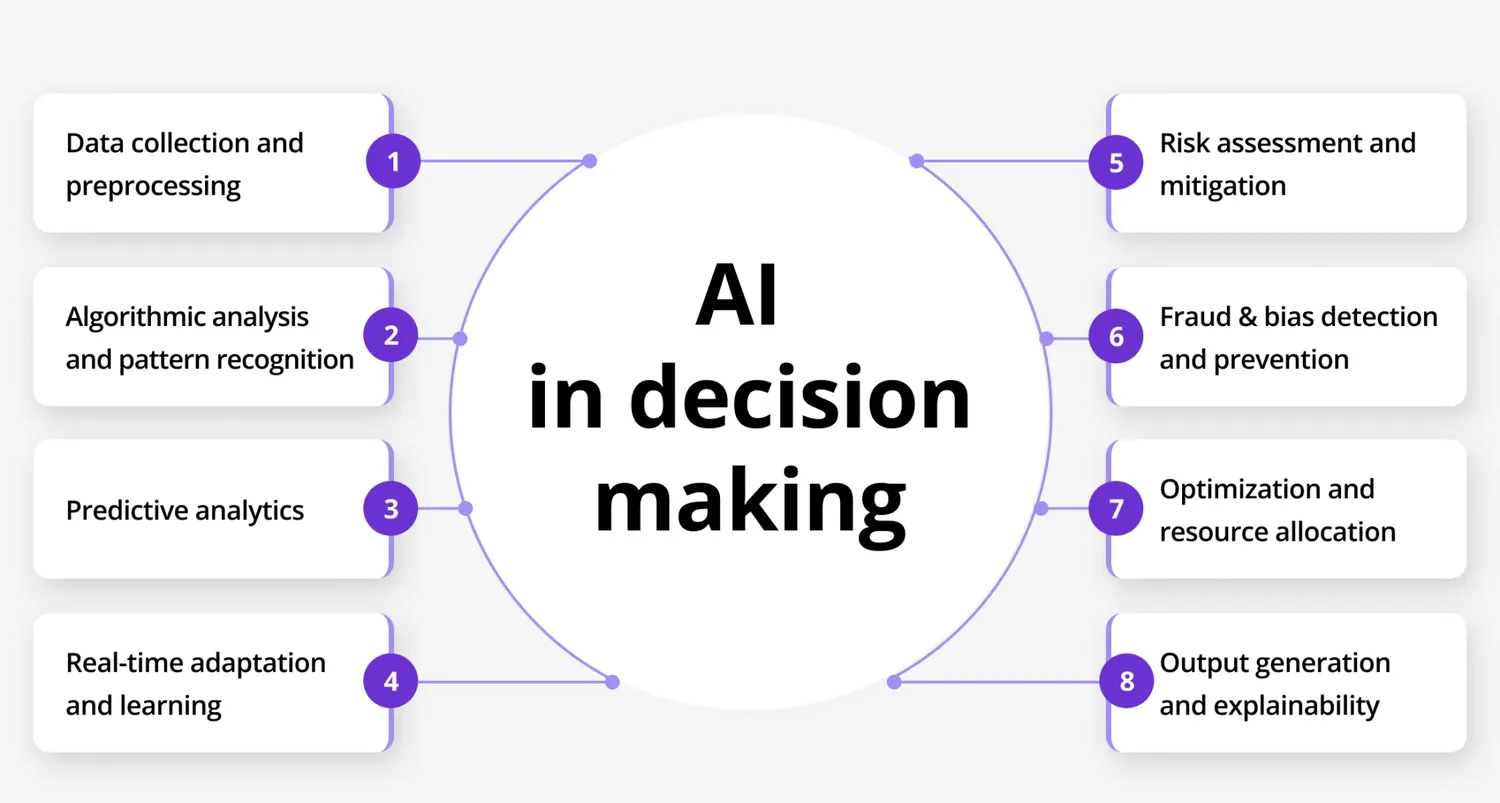
Why AI Technology That Improves Decision Making Matters in 2026
Decisions drive everything — pricing, hiring, inventory, marketing spend, product direction, risk tolerance. Bad ones cost thousands or millions; good ones compound into growth. AI technology that improves decision making processes vast data instantly, spots patterns humans miss, removes emotional bias, simulates future scenarios, predicts outcomes with high accuracy, and delivers clear, explainable recommendations in seconds instead of days or weeks. Businesses using AI technology that improves decision making consistently report higher confidence, faster pivots, lower losses, bigger wins, and teams that spend less time arguing and more time executing. In 2026 the companies pulling ahead aren’t always the ones with the most data — they’re the ones using AI technology that improves decision making most effectively.
10 Core Ways AI Technology That Improves Decision Making Delivers Results
1. Real-Time Data Aggregation & Insight Generation
AI technology that improves decision making pulls from CRM, sales, finance, marketing, operations, and external sources to create instant dashboards and alerts. Leaders see what’s happening right now — not last month — enabling decisions 3–10× faster with far greater context.
2. Predictive Forecasting & Trend Detection
AI technology that improves decision making forecasts demand, revenue, churn, cash flow, market shifts, and customer behavior with 20–60% higher accuracy than traditional methods. Companies avoid stockouts, overstaffing, missed opportunities, and cash crunches.
3. Scenario Simulation & What-If Analysis
AI technology that improves decision making runs thousands of simulations instantly — price changes, marketing budgets, hiring plans, supply disruptions — showing probable outcomes and risks. Strategic choices become evidence-based instead of hopeful guesses.
4. Bias Reduction & Objective Recommendations
AI technology that improves decision making removes emotional, recency, and confirmation bias from analysis. Hiring, promotion, investment, and pricing decisions become fairer and more consistent, reducing costly mistakes driven by human flaws.
5. Anomaly Detection & Risk Flagging
AI technology that improves decision making spots unusual patterns in transactions, operations, customer behavior, or performance metrics before they become crises. Early warnings prevent fraud, downtime, churn, or compliance issues — saving thousands to millions.
6. Personalized & Contextual Decision Support
AI technology that improves decision making tailors recommendations to the specific user, role, goal, and current context — sales reps get next-best-action, managers get team performance insights, executives get strategic summaries. Decisions become relevant and actionable instantly.
7. Automated Option Ranking & Trade-Off Analysis
AI technology that improves decision making evaluates dozens of alternatives (vendors, campaigns, hires, features) against multiple criteria (cost, ROI, risk, speed) and ranks them clearly. Teams stop debating endlessly and move faster with confidence.
8. Continuous Learning & Feedback Loops
AI technology that improves decision making learns from every outcome — which choices worked, which failed — and refines future recommendations automatically. Accuracy and relevance improve over time without manual retraining.
9. Democratized Expertise Across Teams
AI technology that improves decision making puts advanced analytics, forecasting, and scenario tools in the hands of non-experts — salespeople, ops managers, marketers — so good decisions happen everywhere, not just at the top.
10. Faster Iteration & Experimentation
AI technology that improves decision making accelerates A/B testing, multivariate experiments, and pilot analysis — giving instant readouts on what works. Companies test more ideas, kill losers faster, and double down on winners sooner.
AI Technology That Improves Decision Making – Impact Comparison Table
| Application | Typical Improvement | Speed Gain | Accuracy/Risk Impact |
|---|---|---|---|
| Predictive Forecasting | 20–60% better | Days → seconds | ↑↑↑ |
| Scenario Simulation | Thousands of runs | Instant | ↑↑↑ |
| Anomaly Detection | Early warnings | Real-time | ↓↓↓ risk |
| Bias Reduction | Objective scoring | — | ↑↑ |
| Decision Speed | 3–10× faster | Hours → minutes | ↑↑ |
| Personalized Support | Contextual advice | Instant | ↑↑ |
| Experiment Analysis | Instant readouts | Weeks → hours | ↑↑↑ |
Qualitative Wins — How Leaders Describe the Change
Executives using AI technology that improves decision making often say decisions “feel clearer,” “fear is replaced by data,” or “we stop arguing and start acting.” The biggest shift is psychological — less second-guessing, fewer crises from surprises, more trust in choices, and excitement about possibilities instead of dread about risks. Teams report feeling empowered rather than overwhelmed by data, and companies move from reactive firefighting to proactive strategy.
Quantitative Results Companies Achieve with AI Technology That Improves Decision Making
- 20–60% higher forecast accuracy (demand, sales, churn)
- 3–10× faster decision cycles (hours/days → minutes)
- 30–70% reduction in costly errors & surprises
- 15–40% improvement in key metrics (ROI, margins, retention)
- 20–50% increase in confidence & speed of execution
Real-World Examples — How Companies Use AI Technology That Improves Decision Making
- Retail chain uses predictive demand AI → inventory accuracy +45%, stockouts -60%
- SaaS company deploys churn prediction → retention up 28%, saves $2M+/year
- Manufacturer adds predictive maintenance → unplanned downtime -65%, saves $1.2M/year
- Marketing team uses scenario simulation → campaign ROI doubles, wasted spend -40%
- Financial services firm uses fraud anomaly detection → false positives -70%, losses -55%
Common Challenges When Adopting AI Technology That Improves Decision Making
AI technology that improves decision making delivers huge value but comes with hurdles: poor data quality producing garbage insights, black-box models eroding trust, over-reliance dulling human judgment, privacy/security concerns with sensitive data, high setup effort for custom solutions, bias amplification from flawed training data, and difficulty measuring true decision impact vs correlation. Smart adopters start small (one high-stakes area), use explainable tools, keep humans in the loop for final calls, clean data relentlessly, pilot rigorously, and combine AI technology that improves decision making with experience and intuition.
How Any Business Can Start Using AI Technology That Improves Decision Making Today
- Identify your most painful or expensive decisions (pricing? inventory? hiring? campaigns? risk?)
- Choose 1–2 accessible tools targeting that area (Claude/Perplexity for analysis, Rows AI for spreadsheets, Power BI AI for dashboards, etc.)
- Run a 30–60 day pilot — track accuracy, speed, confidence, outcomes
- Measure before/after — only scale when gains are proven & consistent
- Build data hygiene & human oversight habits so AI technology that improves decision making becomes reliable
Make Smarter Travel Decisions with Jaynevy Tours
AI technology that improves decision making also powers better travel planning. We use advanced systems to help you choose the perfect Tanzania adventure — optimal timing for Serengeti safaris, best routes up Mount Kilimanjaro, and ideal Zanzibar relaxation. Make confident choices — contact Jaynevy Tours today!
Frequently Asked Questions
How does AI technology improve decision making in 2026?
AI technology improves decision making by processing massive data instantly, uncovering hidden patterns, providing predictive forecasts, reducing human bias, simulating scenarios, offering real-time recommendations, and enabling faster, evidence-based choices — often increasing accuracy 20–60% and speed 3–10×.
What are the biggest benefits of AI technology that improves decision making?
Key benefits include 20–60% higher decision accuracy, 3–10× faster analysis, reduced cognitive bias, real-time insights, scenario simulation, predictive foresight, better risk assessment, data-driven confidence, and scalable expertise across teams.
Which industries benefit most from AI technology that improves decision making?
Finance (risk & trading), healthcare (diagnostics & treatment), retail/e-commerce (inventory & pricing), manufacturing (maintenance & supply chain), marketing (campaigns & targeting), logistics (routing & forecasting), HR (talent & performance), and executive leadership (strategy & forecasting) see the strongest gains.
Can small businesses use AI technology that improves decision making effectively?
Yes — affordable tools like Claude, Perplexity Pro, Rows AI, Coefficient, Google Looker Studio AI, Microsoft Power BI AI, Notion AI, and free/low-cost predictive platforms give small businesses near-enterprise-level forecasting, insights, and scenario planning without large teams or budgets.
What challenges exist when using AI technology that improves decision making?
Common challenges include poor data quality leading to bad outputs, over-reliance reducing human judgment, black-box decisions lacking explainability, privacy/security risks, high setup effort for custom models, bias amplification if training data is flawed, and difficulty measuring true decision impact.