
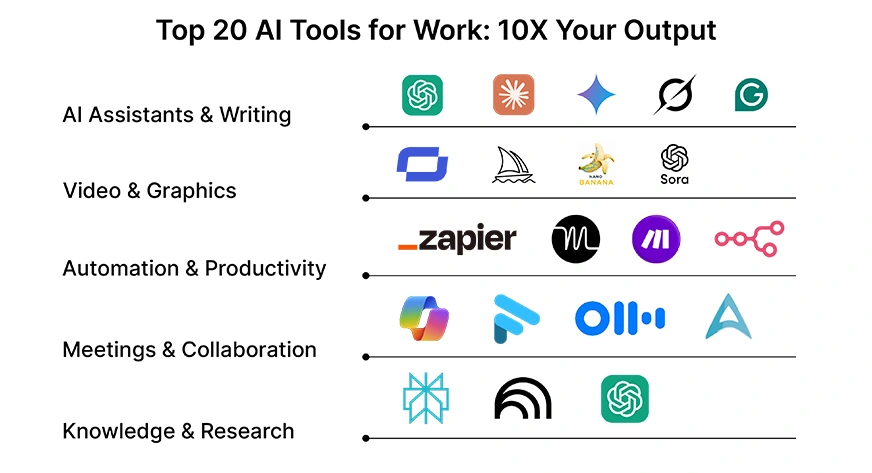
Why AI Tools Are Transforming Workflows in 2026
AI has evolved from basic chat helpers to integrated workflow enhancers. Modern tools reason across apps, automate multi-step processes, summarize long discussions, and even anticipate needs based on patterns. Recent reports show knowledge workers using AI reclaim significant time – often 10–20 hours weekly – while improving output quality. The difference comes from choosing tools that fit your specific bottlenecks rather than adopting everything new. Focus on automation for routines, intelligence for analysis, and collaboration for teams to see real workflow improvements.
Quick Comparison: AI Tools to Improve Your Workflow
| AI Tool | Best For | Efficiency Gain | Starting Price |
|---|---|---|---|
| Zapier | Automation | High (10–25 hrs/wk) | Free / $20/mo |
| Notion AI | Organization | Medium-High | $10/mo add-on |
| Claude | Reasoning & Writing | High | $20/mo |
| Otter.ai | Meetings | Medium | Free / $8.33/mo |
| ClickUp AI | Project Mgmt | Medium-High | $5/user/mo |
| Microsoft Copilot | Office Suite | High | $30/user/mo |
| Perplexity | Research | Medium | Free / $20/mo |
| Grammarly | Writing Polish | Medium | Free / $12/mo |
Top AI Tools That Can Improve Your Workflow
1. Zapier – Connect Apps and Automate Repetitive Steps
Zapier remains a cornerstone for anyone wanting to improve workflow without coding. It links thousands of apps to create automated sequences – think saving email leads to CRM, generating reports from data, or posting updates across platforms. Teams using Zapier for core processes often cut manual handoffs dramatically, reclaiming hours that used to go to copy-paste tasks.
2. Notion AI – Turn Notes into Structured, Actionable Plans
Notion AI embeds intelligence directly into your workspace. It summarizes pages, generates ideas, improves drafts, and auto-organizes databases. For knowledge workers drowning in notes and tasks, this tool brings clarity and speed, making it easier to find information and turn thoughts into executable plans without extra apps.
3. Claude – Deep Thinking for Complex Tasks and Writing
When you need thoughtful analysis, strategy brainstorming, or high-quality writing, Claude delivers nuanced, context-aware responses. It handles long documents and multi-step reasoning better than many alternatives, helping professionals produce better work faster and reduce revision cycles significantly.
4. Otter.ai – Make Meetings Productive Instead of Draining
Otter transcribes conversations in real time, identifies speakers, highlights action items, and generates summaries. Post-meeting cleanup that once took hours now happens automatically, letting teams focus on implementation rather than note-taking and follow-up chasing.
5. ClickUp AI – Smarter Project Management and Task Handling
Inside ClickUp, AI generates tasks from descriptions, writes status updates, suggests priorities, and provides insights on bottlenecks. It brings intelligence to project tracking, helping teams stay aligned and hit deadlines with less manual oversight.
Additional Powerful AI Tools for Workflow Enhancement
- Microsoft 365 Copilot: Embeds AI across Word, Excel, Teams – great for enterprise teams needing seamless integration.
- Perplexity: Fast, source-backed research that cuts hours from information gathering.
- Grammarly: Real-time writing improvements for clearer, more professional communication.
- ChatGPT / Gemini: Versatile starting points for brainstorming, drafting, and quick problem-solving.
- n8n / Make: Advanced automation options for custom, high-volume workflows.
Quantitative Benefits: How Much Can AI Really Improve Workflow?
- Automation platforms: Up to 10–25 hours saved weekly on repetitive tasks.
- Meeting tools: Reduce post-meeting admin by 50–70% (common user reports).
- Writing & research AI: 40–60% faster drafting and information gathering.
- Overall productivity: 75% of knowledge workers now use AI, with average efficiency gains of 20–40% in optimized setups (2026 trends).
- Team coordination: Tools like Copilot and ClickUp cut email/meeting overload by 30%+.
How to Integrate AI Tools and See Real Workflow Improvements
Start small: Identify your top 2–3 pain points (e.g., too many meetings, slow research, scattered notes). Test free tiers for a week, measure time saved, then scale to paid features. Combine tools thoughtfully – Zapier to connect, Claude for deep work, Otter for capture – to create a flywheel effect. Avoid tool overload; a focused stack delivers far better results than collecting dozens. Regularly review and refine to keep your workflow evolving with your needs.
Frequently Asked Questions
What are the best AI tools that can improve your workflow in 2026?
Standouts include Zapier for automation, Notion AI for organization, Claude for reasoning and writing, Otter.ai for meetings, and ClickUp AI for project management. Many professionals see 20–40% efficiency gains by integrating 2–4 of these.
How do AI tools improve workflow efficiency?
They automate repetitive tasks, summarize information, generate content, transcribe meetings, and connect apps seamlessly. Studies show average time savings of 10–20 hours weekly, with automation tools delivering the biggest impact on routine processes.
Which AI tools are best for team workflow improvement?
Tools like Microsoft 365 Copilot, ClickUp AI, Notion AI, and Zapier shine in collaborative settings. They enhance shared docs, automate approvals, assign tasks intelligently, and reduce email overload for smoother team coordination.
Are there free AI tools that can improve your workflow effectively?
Yes – ChatGPT, Gemini, Perplexity (free tiers), and basic Zapier plans deliver strong results for writing, research, and simple automations. Paid upgrades add speed, limits, and advanced features for heavier use.
How many AI tools should I use to improve my workflow without overload?
Start with 2–4 that target your main pain points (e.g., one for automation, one for writing, one for meetings). Overloading with too many creates complexity; focused integration yields better results and sustainable habits.