
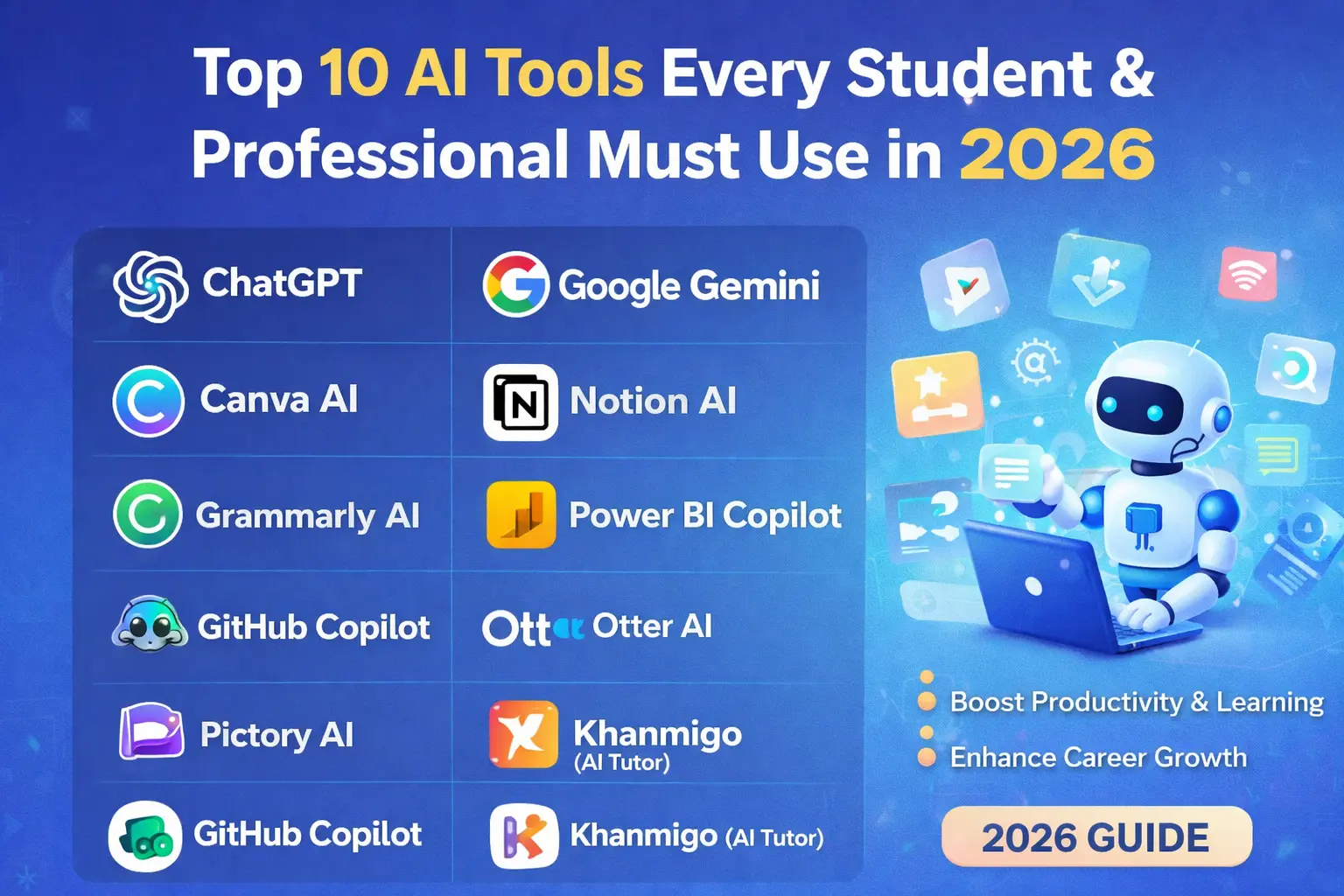
Why These Are the Best AI Tools for Students and Professionals Right Now
AI in 2026 isn't about gimmicks – it's about practical help. Tools understand context better, cite sources reliably, integrate with daily apps, and handle multimodal inputs (text, PDFs, images). Students use them to grasp tough concepts faster; professionals automate drudgery and boost output quality. Recent surveys show average users reclaim 1–2 hours daily, with combined stacks pushing toward 15+ hours weekly saved.
Comparison Table: Top AI Tools at a Glance
| AI Tool | Best For | Est. Hours Saved/Week | Free Tier? |
|---|---|---|---|
| ChatGPT | All-purpose tutor & brainstorming | 6–14 | Yes |
| Claude | Writing, analysis & long docs | 8–15 | Yes (limited) |
| Perplexity | Accurate research with sources | 5–12 | Yes |
| Grammarly | Editing & tone improvement | 3–8 | Yes |
| Google Gemini | Multimodal & Google integration | 5–11 | Yes |
| NotebookLM | Study notes & summaries from uploads | 4–10 | Yes |
| Notion AI | Organization & project planning | 5–12 | Add-on |
| Microsoft Copilot | Office apps (Word, Excel, Teams) | 6–13 | With M365 |
| Canva Magic Studio | Presentations & visuals | 4–9 | Yes |
| Otter.ai | Meeting/lecture transcription | 4–10 | Yes |
Top Categories & Best AI Tools for Students and Professionals
1. All-Purpose Assistants – ChatGPT, Claude, Google Gemini
These form the foundation. ChatGPT shines for quick explanations, brainstorming essay ideas, or practicing interview questions. Claude handles longer writing and complex reasoning – perfect for thesis outlines or professional reports. Gemini integrates seamlessly with Google Workspace for students using Docs/Sheets. Many switch between them based on task – saving hours on trial-and-error.
2. Research Powerhouses – Perplexity & NotebookLM
Perplexity delivers concise, sourced answers instantly – no more endless tabs for literature reviews or market research. NotebookLM turns uploaded PDFs, lecture recordings, or notes into summaries, timelines, FAQs, or even audio overviews. Students love it for cramming; professionals use it to digest reports fast.
3. Writing & Editing – Grammarly & Jasper (for pros)
Grammarly catches errors and suggests clearer phrasing in real time – essential for essays, emails, or proposals. For marketing/content pros, Jasper scales blog posts or reports. Together, they cut revision time by 50–70% while improving quality.
More Essential Picks for Learning & Work
- Notion AI: Organizes notes, generates to-do lists from lectures/meetings, summarizes pages – great for student planners and professional knowledge bases (5–12 hrs saved).
- Microsoft Copilot: Embeds in Word/Excel/PowerPoint for pros; helps draft, analyze data, create slides (ideal if your workplace uses Microsoft 365).
- Canva Magic Studio: Text-to-design for presentations, posters, infographics – students nail group projects; professionals create visuals quickly.
- Otter.ai: Transcribes lectures or meetings, highlights action items – frees you to listen instead of scribble (huge for busy schedules).
Quantitative Benefits: How Much Time These Tools Really Save
- Research tools: 60–75% faster than traditional searching (user reports 2026).
- Writing aids: Cut drafting/editing by 50–80% (common in academic & professional surveys).
- Transcription & notes: Reclaim 4–10 hours/week for frequent note-takers or meeting-heavy roles.
- Overall: Students average 8–15 hours/week saved; professionals 10–20+ with integrated stacks.
Tips for Choosing & Using AI Tools Ethically
For students: Treat AI as a tutor – use it to understand, not copy. Always check school policies and cite assistance where needed. For professionals: Focus on tools that integrate with your stack (e.g., Copilot for Microsoft users). Start with free tiers, track your time savings for a week, then upgrade 1–2 favorites. Combining 3–4 creates the biggest impact without overload.
Frequently Asked Questions
What are the best AI tools for students in 2026?
Top picks include ChatGPT and Claude for tutoring and writing, Perplexity for cited research, Grammarly for editing, NotebookLM for study notes, and Notion AI for organization – helping students save hours on assignments and learn more effectively.
Which AI tools are most useful for professionals in 2026?
Professionals benefit from Claude for deep analysis and writing, Microsoft Copilot for Office integration, Zapier for automation, Notion AI for workflows, and Perplexity for quick research – often saving 10–20+ hours weekly on repetitive tasks.
Are there free AI tools suitable for both students and professionals?
Yes – strong free options include Google Gemini, ChatGPT (limited), Perplexity, Grammarly (basic), and NotebookLM. They handle most everyday needs without cost, with paid upgrades for heavier use.
How can students use AI tools ethically in 2026?
Use them for brainstorming, summarizing readings, improving drafts, and understanding concepts – always cite AI help if required, avoid submitting generated work as your own, and focus on learning rather than shortcuts.
Which AI tool is best for research in 2026?
Perplexity stands out for fast, cited answers without ads or fluff. NotebookLM excels at synthesizing uploaded documents or lecture notes into study guides – ideal for both academic and professional research.