
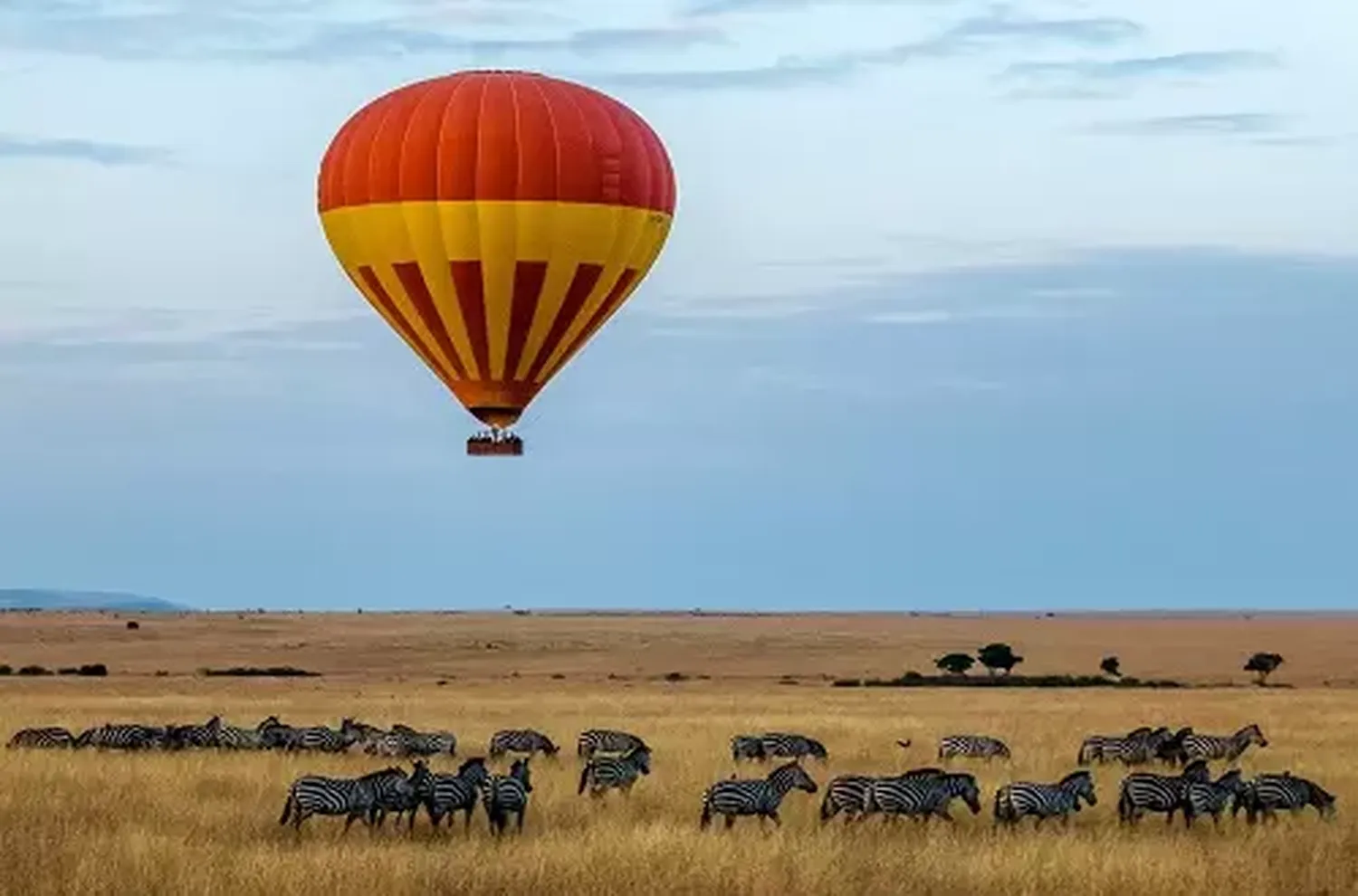
Quick Answer: How Do You Add a Balloon Ride to a 6-Day Serengeti Safari?
Put the balloon on the morning after a full Serengeti overnight, preferably in the same sector as the launch site. For a classic road itinerary, Day 4 works especially well: Day 1 Tarangire, Day 2 transfer to Central Serengeti, Day 3 full Serengeti game drive, Day 4 balloon plus afternoon game drive, Day 5 Serengeti to Ngorongoro, Day 6 crater and return to Arusha.
As a current market reference, Serengeti Balloon Safaris publishes USD 599 per person for a shared balloon, approximately one hour in the air, and about five hours for the full experience. Always reconfirm the price, launch sector, transfer, child rules, cancellation terms and what your safari package already includes.
- Typical flight: about 1 hour.
- Whole experience: about 5 hours.
- Current shared rate reference: USD 599 pp.
- Take-off: planned around sunrise.
- Central Serengeti: current operator schedule runs year-round.
- Western/Northern sectors: commonly seasonal, around Jun–Oct.
- Ndutu/south: commonly late Dec–Mar.
- Important: wind determines the exact flight path.
What Is a Serengeti Hot Air Balloon Safari Actually Like?
The experience begins long before sunrise. A balloon team collects guests from their lodge or tented camp in the dark and drives to the launch site. After a safety briefing, the crew inflates the envelope while the pilot checks conditions. Take-off is planned around dawn because early-morning winds and temperatures are generally more suitable for ballooning.
Once airborne, the pilot can change altitude to use different wind currents, but a balloon cannot be steered like a safari vehicle. That matters for expectations: you may drift over zebra, wildebeest, giraffe, elephant or predators, or you may spend part of the flight over landscapes with little visible wildlife. The value is the aerial perspective, scale, silence and changing light—not a guaranteed close wildlife encounter.
After landing, established operators normally include a celebration and bush breakfast before returning guests to their guide so the regular safari can continue.
Serengeti Balloon Safari Cost in 2026: What Does USD 599 Include?
USD 599 per person is a useful current shared-balloon reference, not a universal fixed price for every company or package. Both Serengeti Balloon Safaris and Miracle Experience currently publish USD 599 for their Serengeti product. Package quotes can be higher or lower depending on the operator, age policy, private charter, camp transfer, park arrangements and whether the balloon is already bundled into your six-day safari.
| Item | Normally included? | What to verify |
|---|---|---|
| Pre-dawn camp/lodge pickup | Usually yes within the operator's flight area | Confirm your exact camp is inside the pickup zone. |
| Balloon flight | Yes | Normally about one hour, weather permitting. |
| Landing celebration | Usually yes | Product wording differs by operator. |
| Bush breakfast | Usually yes | Confirm dietary requirements in advance. |
| Return to guide/rendezvous | Usually yes | Confirm exact drop-off location and timing. |
| Park entry fees | Not always part of the balloon ticket | Your main safari often already covers park entry; confirm in writing. |
| Private balloon | No | Requires a separate, much higher quotation. |
Jaynevy's existing 6 Days Serengeti Balloon Safari currently publishes a package starting from USD 3,000 per person. That is a complete safari-package starting figure, not the standalone balloon ticket.
Best Serengeti Balloon Launch Area by Season
Choose the launch sector that matches both your accommodation and the seasonal wildlife geography. A balloon ride loses practical value if you spend hours transferring before dawn simply to reach a famous sector.
| Area | Typical operating period | Best reason to choose it | Planning caution |
|---|---|---|---|
| Central Serengeti / Seronera | Year-round | Best all-round choice for a six-day itinerary; strong resident wildlife and many camps. | Do not assume the migration will be in central Serengeti on your exact date. |
| Western Corridor | Commonly Jun–Oct | Useful when your safari follows western migration movement. | Exact seasonal value changes with rain and herd movement. |
| Northern Serengeti | Commonly Jun–Oct | Pairs with northern migration and Mara River-focused itineraries. | Long road transfers from central Serengeti can waste a short trip; fly-in can be better. |
| Ndutu / southern ecosystem | Roughly late Dec–31 Mar | Excellent for calving-season landscapes and predator-prey context. | Ndutu spans the wider Serengeti–Ngorongoro ecosystem; permits and camp location matter. |
Best Day for a Hot Air Balloon Ride During a 6-Day Serengeti Safari
For most road-based itineraries, Day 4 is the cleanest balloon day. You have already slept in Serengeti, you are familiar with the area, and you still have enough safari time afterward if weather forces a change. Putting the balloon on the very first Serengeti morning can work, but it leaves less operational margin if you arrive late the night before.
Recommended 6-Day Serengeti Safari with Hot Air Balloon
Day 1: Arusha to Tarangire National Park
Drive from Arusha to Tarangire for an afternoon game drive among baobabs, elephants and riverine habitat. Overnight near Tarangire or Karatu. Starting outside Serengeti keeps the route varied without compressing the balloon morning.
Day 2: Tarangire/Karatu to Central Serengeti
Travel through the Ngorongoro highlands to Serengeti. Use the late afternoon for your first central game drive and overnight in a camp or lodge that is practical for the confirmed balloon pickup zone.
Day 3: Full-Day Serengeti Game Drive
Spend the day at ground level. This is important because the vehicle offers what the balloon cannot: stopping at lion, leopard or cheetah sightings, changing direction, waiting for behavior and using roads to search specific habitats. Return early enough to prepare for the pre-dawn wake-up.
Day 4: Sunrise Hot Air Balloon + Serengeti Game Drive
Wake before dawn, transfer to the launch site, complete the safety briefing and fly at sunrise if weather permits. After landing and breakfast, rejoin your driver-guide around mid-morning and continue the safari. Keep the afternoon flexible; many travelers appreciate a slower pace after the early start.
Day 5: Serengeti Morning Drive to Ngorongoro Highlands
Use the morning for one more Serengeti game drive before heading toward Ngorongoro. Overnight on the crater rim or around Karatu depending on accommodation level and budget.
Day 6: Ngorongoro Crater and Return to Arusha
Descend early into the crater for concentrated wildlife viewing, then return to Arusha. This preserves the balloon as one high-value Serengeti experience without letting it consume the entire six-day safari.
Fly-In Alternative: Better When the Balloon Is the Main Priority
If budget allows, fly from Arusha directly to Serengeti, spend four or five nights in the park, and fly out after the balloon and game-drive program. This removes long road transfers and makes it easier to position the itinerary around Central, Northern or seasonal Serengeti launch areas. Compare Jaynevy's 6-Day Luxury Migration Safari and 6-Day Luxury Great Migration Safari.
Balloon Safari vs Game Drive: Which Is Better?
Neither replaces the other. The balloon gives perspective; the game drive gives control and wildlife detail.
| Factor | Balloon safari | Game drive |
|---|---|---|
| Viewpoint | Aerial, panoramic | Ground-level, close behavioral observation |
| Route control | Limited; wind is dominant | High within road and park rules |
| Duration | About 1 hour airborne | Several hours to full day |
| Wildlife close-ups | Unpredictable | Much better potential |
| Landscape photography | Exceptional | Strong but lower perspective |
| Cost | High optional supplement | Normally core safari inclusion |
| Best role | One special sunrise experience | Main wildlife-viewing method |
Can You See the Great Migration from a Balloon?
Yes, sometimes—but it must never be guaranteed. Seasonal balloon operations are positioned to improve the chance of flying over relevant migration landscapes, yet both the herds and the balloon are moving systems. Wildebeest respond to rain and grass, while the balloon follows wind. You can book the right region for the season and still have the main herd several kilometres away on flight morning.
For migration timing, use Jaynevy's Serengeti migration and river-crossing guide together with your confirmed camp and operator launch map.
Balloon Safety: What Should You Verify Before Paying?
Book through a properly authorized commercial operator and read the passenger restrictions before payment. Tanzania Civil Aviation Authority regulates commercial aviation and publishes air-service licensing and certification material. Balloon operations are also weather-dependent, and the pilot has final authority over launch, flight duration and landing decisions.
- Ask for the exact balloon operator name, not only “balloon included.”
- Confirm the operator's current license/authorization status where applicable.
- Read the weather cancellation and refund policy.
- Declare pregnancy, recent surgery, significant back/neck problems or mobility limitations.
- Provide accurate passenger weights if requested; basket loading is a safety calculation.
- Confirm minimum age/height rules for children because policies differ between operators.
- Listen carefully to the landing-position briefing and follow the pilot's instructions.
Important: Age and Weight Rules Are Operator-Specific
Do not publish one universal Serengeti rule. Serengeti Balloon Safaris says children under six do not fly, while Miracle Experience publishes a 5–7-year accompanied-child rule, a minimum height of 1.2 m, and a surcharge above 120 kg. Pregnancy and some mobility or recent-surgery situations are restricted. Jaynevy should confirm the actual booked operator's conditions for every passenger.
What Should You Wear and Carry?
- Warm removable layer: the pre-dawn transfer can be cold.
- Long trousers and long sleeves: practical for early morning and bush conditions.
- Closed, sturdy shoes: launch and landing sites are natural ground.
- Hat: useful after landing and can help with burner heat depending on basket position.
- Camera: use a secure strap and avoid loose items.
- Binoculars: useful for spotting distant wildlife below.
- Minimal bag: use a small secure camera bag or backpack if the operator allows it.
Is the Balloon Ride Worth USD 599?
It is worth it when the aerial experience itself is a priority, not when you are buying it only because it appears on a “must-do” list. For two adults, a USD 599-per-person reference means about USD 1,198 before any package-specific differences. That same money could sometimes fund an extra safari night, a domestic flight, a room upgrade or additional private-vehicle time.
| Traveler | Recommendation | Why |
|---|---|---|
| First-time Serengeti visitor with comfortable budget | Strong yes | Offers a perspective impossible from the road. |
| Landscape photographer | Strong yes | Sunrise, patterns, rivers, kopjes and herds from above. |
| Big-cat photographer seeking close behavior | Optional | Spend most time in the 4x4; balloon route is not controllable. |
| Budget-limited traveler | Compare alternatives | An extra night or longer game drive may deliver more total wildlife time. |
| Traveler uncomfortable with early starts or landing posture | Consider skipping | The experience begins before dawn and requires safety-position compliance. |
Common Mistakes When Adding a Balloon to a 6-Day Safari
- Booking the wrong launch sector. Your camp, migration plan and balloon site must match.
- Treating USD 599 as a permanent universal price. It is a current operator reference and can change.
- Expecting the balloon to chase wildlife. Wind determines direction.
- Removing too much game-drive time. The balloon should complement the 4x4 experience.
- Ignoring weather cancellation risk. Keep itinerary flexibility where possible.
- Not checking passenger restrictions before paying. Age, height, weight, pregnancy and mobility policies matter.
- Assuming the Great Migration is guaranteed below the basket. It is not.
Useful Jaynevy Tours Internal Links
- 6 Days Serengeti Balloon Safari
- Serengeti Hot Air Balloon Safaris: 3–10 Days
- 6-Day Serengeti Safari
- 6-Day Tarangire, Manyara, Serengeti & Ngorongoro Safari
- 5-Day Serengeti Hot Air Balloon Luxury Safari
- 6-Day Luxury Migration Safari
- 6-Day Luxury Great Migration Safari
- Serengeti National Park Guide
Frequently Asked Questions
Is a hot air balloon ride worth adding to a 6-day Serengeti safari?
Yes for travelers who value a once-per-trip aerial perspective and can justify the extra cost. It complements rather than replaces a game drive because the balloon follows the wind, lasts about an hour, and cannot stop beside wildlife the way a safari vehicle can.
How much does a Serengeti hot air balloon ride cost in 2026?
A current published shared-balloon rack rate from Serengeti Balloon Safaris is USD 599 per person, and Miracle Experience also lists USD 599 for Serengeti. Final package pricing can differ by operator, child policy, transfers, park arrangements and the way the balloon is bundled into your safari.
How long is the balloon flight?
The flight is normally about one hour, but the pilot may land earlier or later depending on wind and safe landing options. One established operator says the full experience takes about five hours from pre-dawn collection through briefing, flight, landing celebration, breakfast and return to the safari rendezvous.
What time does the balloon safari start?
Collection is before dawn, often around 04:00–05:00 depending on the distance from your lodge or camp to the launch site. Take-off is planned around sunrise, usually close to 06:00, but exact timings vary by season, camp location and operator.
Which day is best for the balloon ride on a 6-day safari?
Place the balloon on a morning when you have slept in the same Serengeti sector as the launch site and do not need a long transfer immediately afterward. In a road-based six-day itinerary, Day 4 is often the cleanest choice after a full Serengeti day on Day 3.
Where do Serengeti balloon safaris launch?
Current operator schedules include Central Serengeti year-round, Western Corridor and Northern Serengeti mainly from June to October, and the Ndutu/southern ecosystem from roughly late December to the end of March. Exact operating dates and launch sites can change.
Can a balloon follow the Great Migration?
Only indirectly. Operators position seasonal launch sites where wildlife is expected, but a hot air balloon is carried by the wind and cannot be steered like a vehicle. Migration location also changes with rainfall, so no flight can guarantee that the main herds will pass directly below.
Can children fly in a Serengeti hot air balloon?
Rules vary by operator. Serengeti Balloon Safaris does not fly children under six, while Miracle Experience lists conditions for children from age five and a minimum height of 1.2 metres. Always confirm the exact operator's age, height and mobility rules before booking.
Are there weight or health restrictions?
Yes, and they vary by operator. Miracle Experience currently requires a supplement for passengers over 120 kg and does not permit pregnant passengers; recent surgery, spine or neck problems and mobility limitations require assessment. The pilot and operator have the final safety decision.
What happens if weather cancels the balloon flight?
Balloon flights are weather-dependent. The pilot decides whether conditions are safe and where to land. Rebooking and refund terms depend on the operator, so the cancellation policy should be confirmed in writing before payment.
Research Notes and Trusted Sources
This article separates current operator information from general safari planning advice. The USD 599 rate, approximate one-hour flight, five-hour experience and seasonal launch areas are current published operator references checked in August 2026. They can change, so Jaynevy should reconfirm them for every departure.
- Serengeti Balloon Safaris FAQs — flight duration, total experience, passenger restrictions and current price.
- Serengeti Balloon Safaris booking page — current seasonal launch areas and USD 599 shared-balloon rate.
- Miracle Experience FAQs — current USD 599 reference, age/height/weight and health-related conditions.
- Tanzania Civil Aviation Authority: Air Operator Certification — commercial aviation oversight framework.
- TCAA Civil Aviation Regulations — current aviation regulations and amendments.
Editorial note: Balloon routes, wildlife sightings, migration location, take-off time and flight duration are weather- and wind-dependent. No balloon company or safari operator can guarantee that a particular animal or migration herd will be directly below the aircraft.