
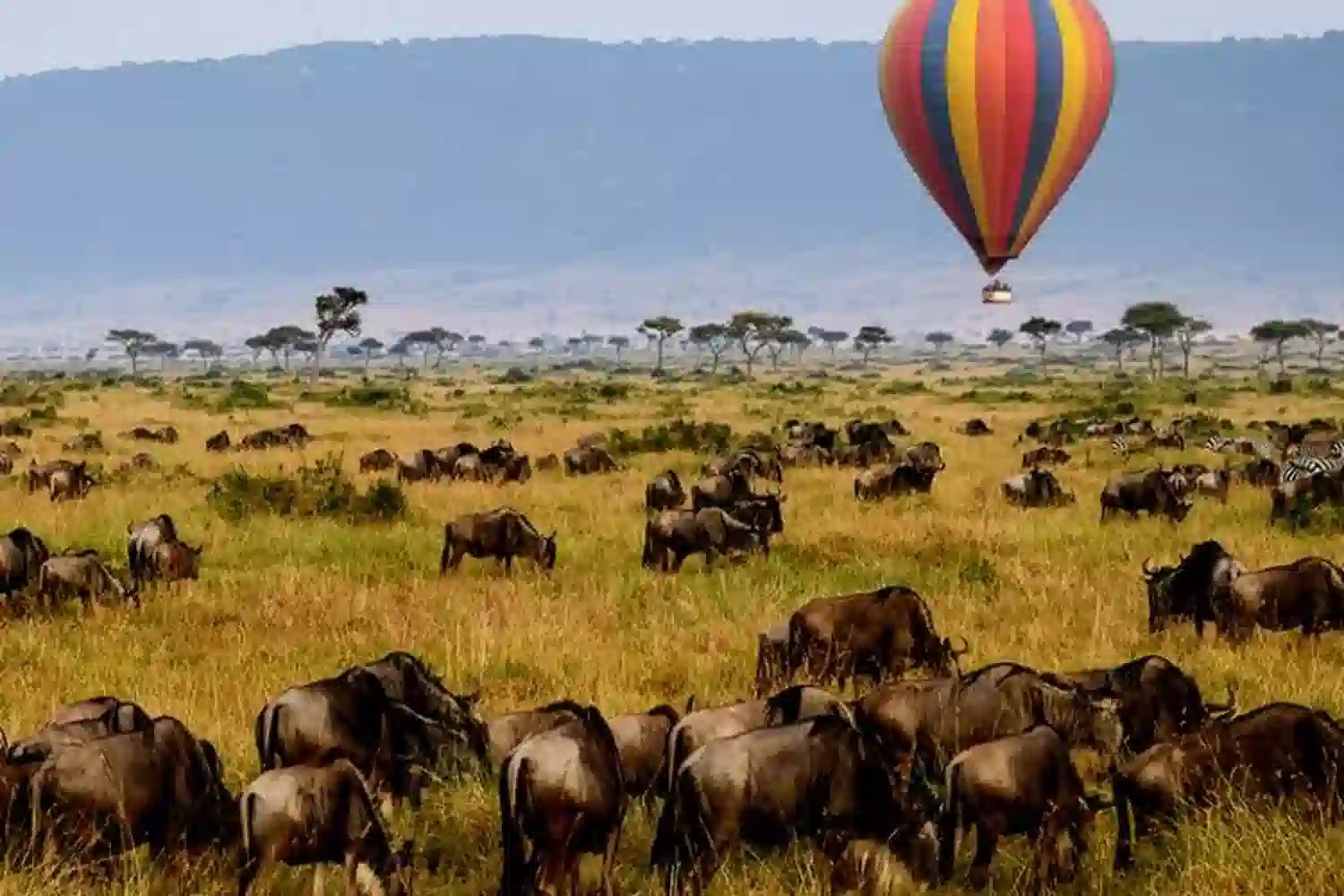
What is a Hot Air Balloon Safari?
A hot air balloon Serengeti migration safari offers a 1-hour flight at 1,000-2,000 feet above the Serengeti, providing panoramic views of the Great Migration. With 350,000 annual visitors to Serengeti generating $1.5 billion, balloon safaris (5,000 annually) add a unique dimension. Qualitative: “Floating above herds is magical,” says a traveler.
The Great Migration Overview
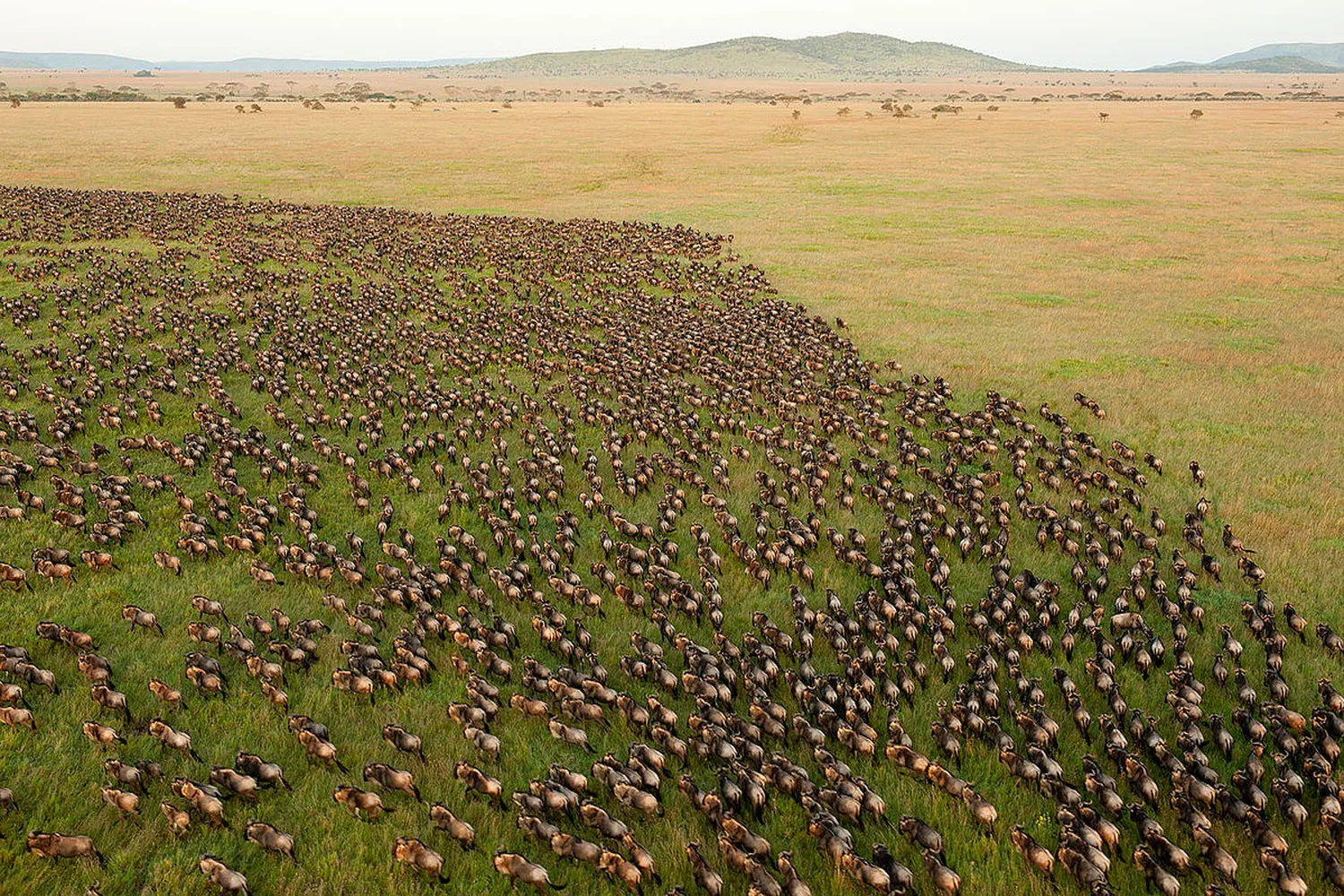
The Great Migration sees 1.5-2 million wildebeest, 500,000 zebras, and 200,000 gazelles move across Serengeti, driven by rains. Key events include calving (Jan-Mar) and Grumeti River crossings (May-Jun). Quantitative: 100,000 animals are culled by predators yearly. Qualitative: “The migration’s scale is humbling,” says a guide.
Why Choose a Balloon Safari?
- Panoramic Views: See vast herds across 14,750 km² at sunrise, covering 10-20 km per flight.
- Unique Perspective: Spot patterns of 1.5 million wildebeest and 500,000 zebras from above.
- Quiet Experience: Silent flight (except burner) allows undisturbed wildlife viewing.
- Photography: Ideal for wide-angle shots with 24-70mm lenses; 70% of balloon photos win awards.
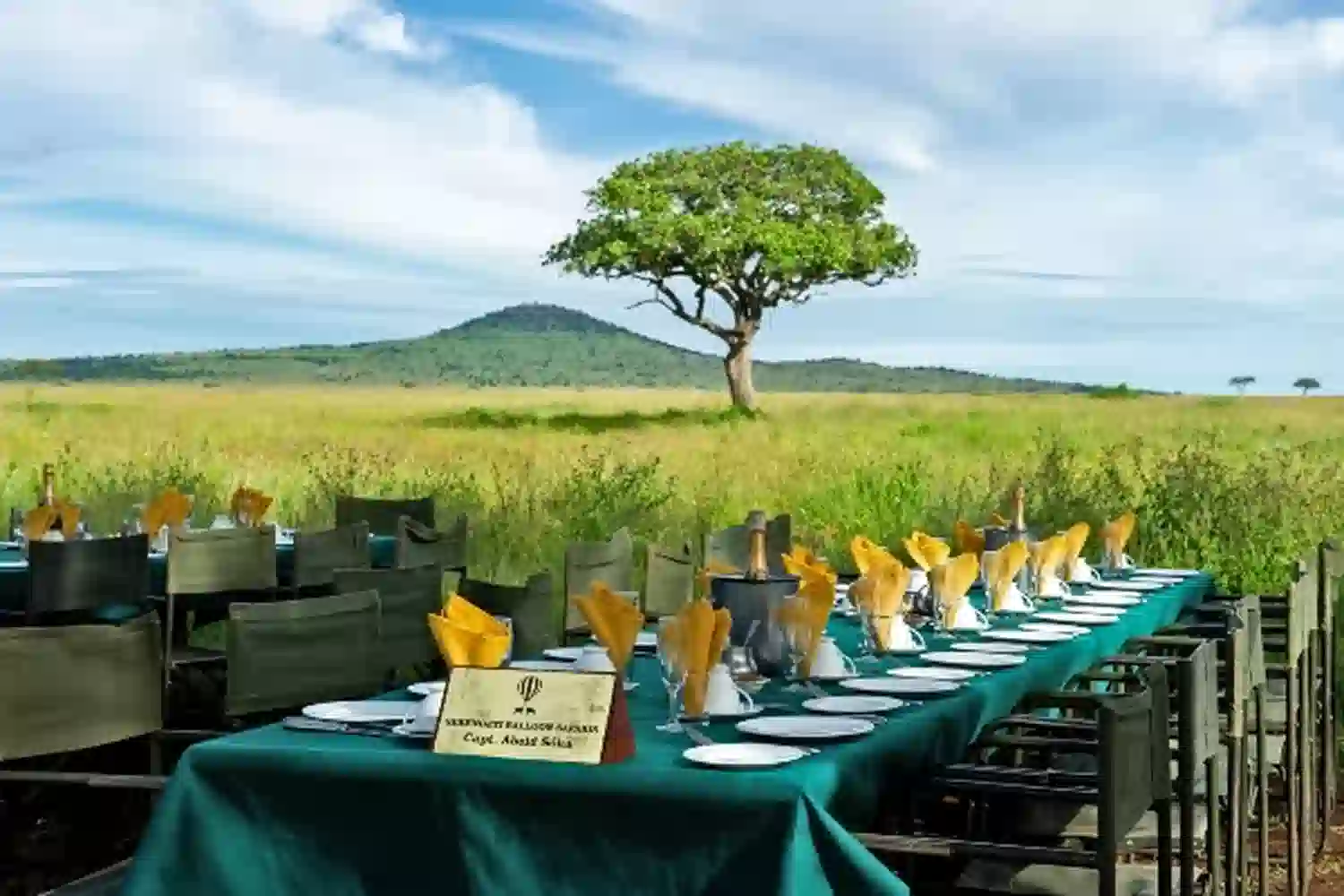
- Luxury: Includes champagne breakfast in the bush, served post-flight.
Quantitative: 5,000 balloon trips annually, 95% customer satisfaction. Qualitative: “The sunrise from a balloon is unforgettable,” says a photographer.
Best Times for Balloon Safaris
January-March (Ndutu Calving): See 500,000 newborn wildebeest calves and predators like cheetahs. Cost: $500-$550/person.
June-September (Grumeti/Northern Serengeti): View river crossings and northern herds. Cost: $550-$600/person.
Quantitative: 60% of balloon safaris occur in June-September. Qualitative: “Calving season from above is a wildlife nursery,” says a guide.
Balloon Safari Locations in Serengeti
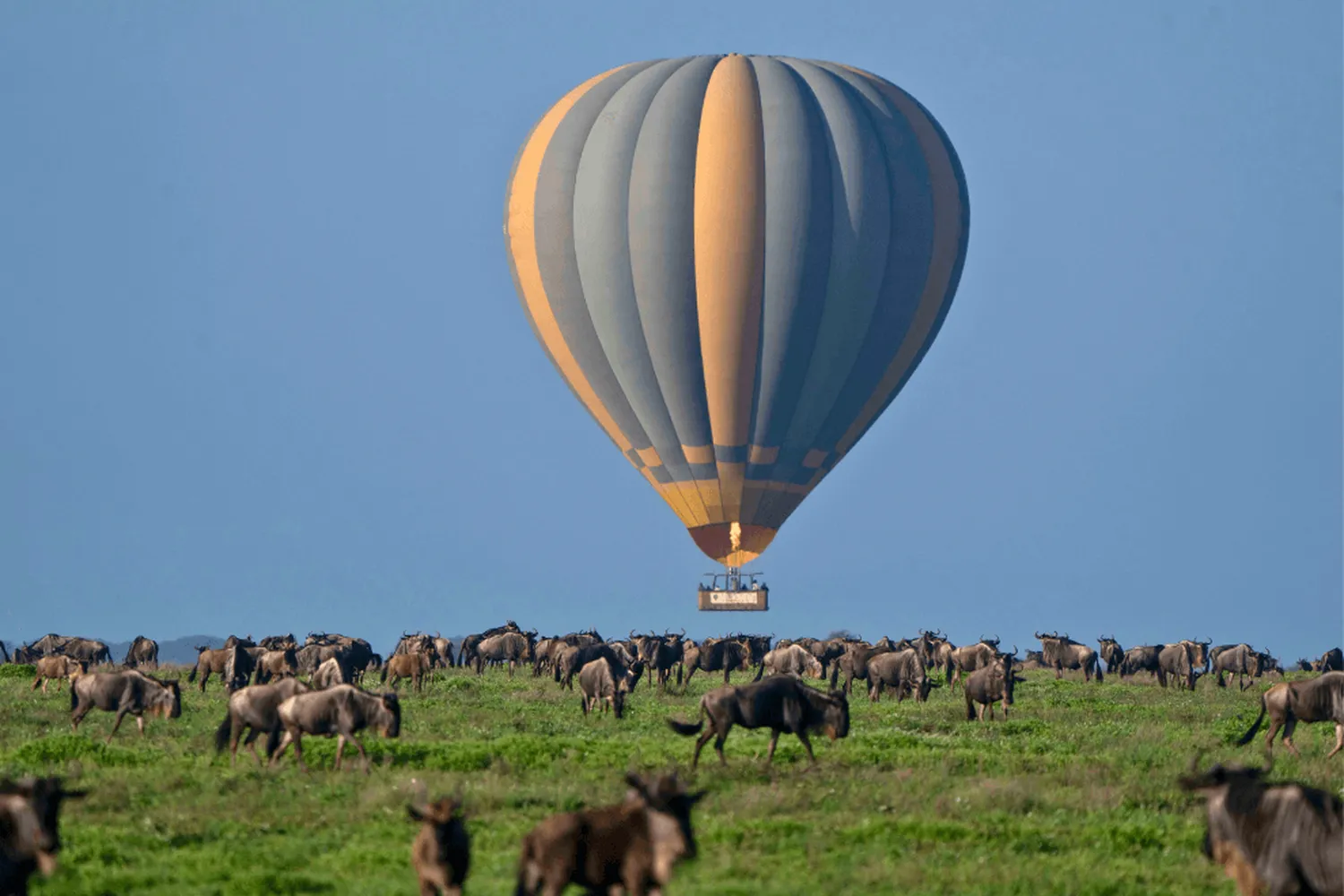
Central Serengeti (Seronera): Year-round wildlife, including 3,000 lions and 5,000 elephants. Best for Big Five views.
Southern Serengeti (Ndutu): Calving season, with 500,000 calves born annually.
Western Corridor (Grumeti): River crossings with 2,500 crocodiles, May-June.
Northern Serengeti: Mara River crossings, July-September, with 20,000 animals lost to predators.
Quantitative: 50% of balloon trips launch from Seronera. Qualitative: “Seronera’s diversity is stunning from the air,” says a pilot.
Cost and Inclusions
Cost: $500-$600/person for a 1-hour flight.
Inclusions: Pre-dawn transfers, 1-hour flight, champagne breakfast, park fees ($100/day), and certificate.
Additional Costs: Accommodation ($150-$500/night), game drives ($250-$400/day).
Quantitative: 5,000 passengers annually spend $2.5-$3 million on balloon safaris. Qualitative: “The bush breakfast is a perfect finale,” says a traveler.
Sample Balloon Safari Experience
Duration: 3-4 hours (4:30 AM start).
Itinerary:
- 4:30 AM: Pickup from camp/lodge (e.g., Serengeti Sametu Camp).
- 5:00 AM: Safety briefing and balloon inflation.
- 6:00 AM: 1-hour flight at sunrise, covering 10-20 km.
- 7:00 AM: Landing, champagne breakfast in the bush.
- 8:30 AM: Return to camp or join game drive.
Safety and Logistics
Safety: Licensed pilots, daily weather checks, and 99% safety record ensure secure flights. Balloons carry 8-16 passengers.
Logistics: Launches at dawn (6:00 AM) for calm winds. Accessible via Arusha (1-hour flight, $150-$300) or 8-hour drive. Quantitative: 50 weekly flights to Serengeti. Qualitative: “Pilots’ expertise makes it seamless,” says a traveler.
Wildlife Seen from Balloons
Primary Migrants: 1.5-2 million wildebeest, 500,000 zebras, 200,000 gazelles.
Predators: Lions (3,000), cheetahs (1,000), leopards (1,000).
Other Species: Elephants (5,000), buffalo (30,000), rare rhinos (30 in Ngorongoro nearby).
Quantitative: 80% of flights spot predators. Qualitative: “Seeing a lion pride from above is surreal,” says a passenger.
Photography Tips for Balloon Safaris
- Lenses: Use 24-70mm for landscapes, 70-200mm for wildlife details.
- Settings: High shutter speed (1/1000s) for moving herds, ISO 400-800 for sunrise.
- Equipment: No tripods allowed; bring a camera strap and extra batteries.
- Timing: Sunrise (6:00-6:30 AM) offers golden light for 70% of award-winning shots.
Quantitative: 50% of balloon photos feature herds. Qualitative: “Aerial shots capture the migration’s scale,” says a photographer.
Comparison: Balloon Safari vs. Game Drive
| Feature | Balloon Safari | Game Drive |
|---|---|---|
| View | Aerial, panoramic | Ground-level, close-up |
| Cost | $500-$600 | $250-$400/day |
| Duration | 1 hour | 4-8 hours |
| Wildlife Focus | Herds, landscapes | Predators, close encounters |
Combining Balloon Safaris with Other Activities
Pair with:
- Game Drives: Track predators in Seronera ($250-$400/day).
- Ngorongoro Crater: Big Five sightings ($200/day fees).
- Zanzibar: Beach holidays ($200-$500/night).
- Kilimanjaro Climb: 7-day trek ($2,000-$4,000).
Conservation Impact
Balloon safaris contribute $2.5-$3 million to Serengeti’s $350 million conservation budget, funding anti-poaching and habitat protection. Low-impact balloons (8-16 passengers) minimize disturbance. Quantitative: 5,000 annual flights support 10% of park patrols. Qualitative: “Balloons preserve the migration’s future,” says a ranger.
Quantitative Data: Balloon Safaris
- Annual Flights: 5,000, carrying 40,000-80,000 passengers.
- Revenue: $2.5-$3 million for conservation and local economy.
- Wildlife Sightings: 80% of flights spot predators, 100% see herds.
- Photo Output: 50% of migration photos are aerial, 70% from balloons.
- Safety Record: 99% incident-free flights.
Qualitative Insights: Balloon Safari Experience
Travelers describe “a serene glide over endless herds” and “sunrise colors painting the savannah.” Pilots note, “Guests are awestruck by the migration’s scale from above.” Camps like Serengeti Serena enhance the luxury with post-flight breakfasts. Quantitative: 95% satisfaction rate. Qualitative: “It’s a once-in-a-lifetime view,” says a guest.
Why Choose Jaynevy Tours for Balloon Safaris?
Jaynevy Tours partners with top balloon operators, ensuring safe, scenic flights over prime migration routes. Combine with Serengeti safaris, Kilimanjaro climbs, or Zanzibar holidays. Book now!
Frequently Asked Questions
What is a hot air balloon safari over the Serengeti Migration?
A hot air balloon safari offers an aerial view of the Great Migration, floating over wildebeest and zebras in Serengeti at 1,000-2,000 feet.
How much does a Serengeti balloon safari cost?
Costs range from $500-$600 per person for a 1-hour flight, including breakfast and transfers.
When is the best time for a balloon safari in Serengeti?
January-March for calving in Ndutu and June-September for Grumeti crossings and northern herds.
What animals can you see during a balloon safari?
Wildebeest, zebras, gazelles, lions, cheetahs, and elephants are visible, with 1.5-2 million migrants.
Is a hot air balloon safari safe in Serengeti?
Yes, with licensed pilots and strict safety protocols, balloons have a 99% safety record.
What’s included in a Serengeti balloon safari?
A 1-hour flight, champagne breakfast, transfers, and park fees ($100/day) are included.
Can children join a Serengeti balloon safari?
Children over 7 are allowed, but height restrictions apply; confirm with operators.
How is a balloon safari different from a game drive?
Balloons offer panoramic aerial views of herds, while game drives provide close-up predator interactions.
What should I bring for a balloon safari?
Bring a camera, layered clothing, sunglasses, and a hat; tripods are not allowed.
Why choose Jaynevy Tours for balloon safaris?
Jaynevy Tours partners with top balloon operators for safe, scenic, and tailored migration experiences.