
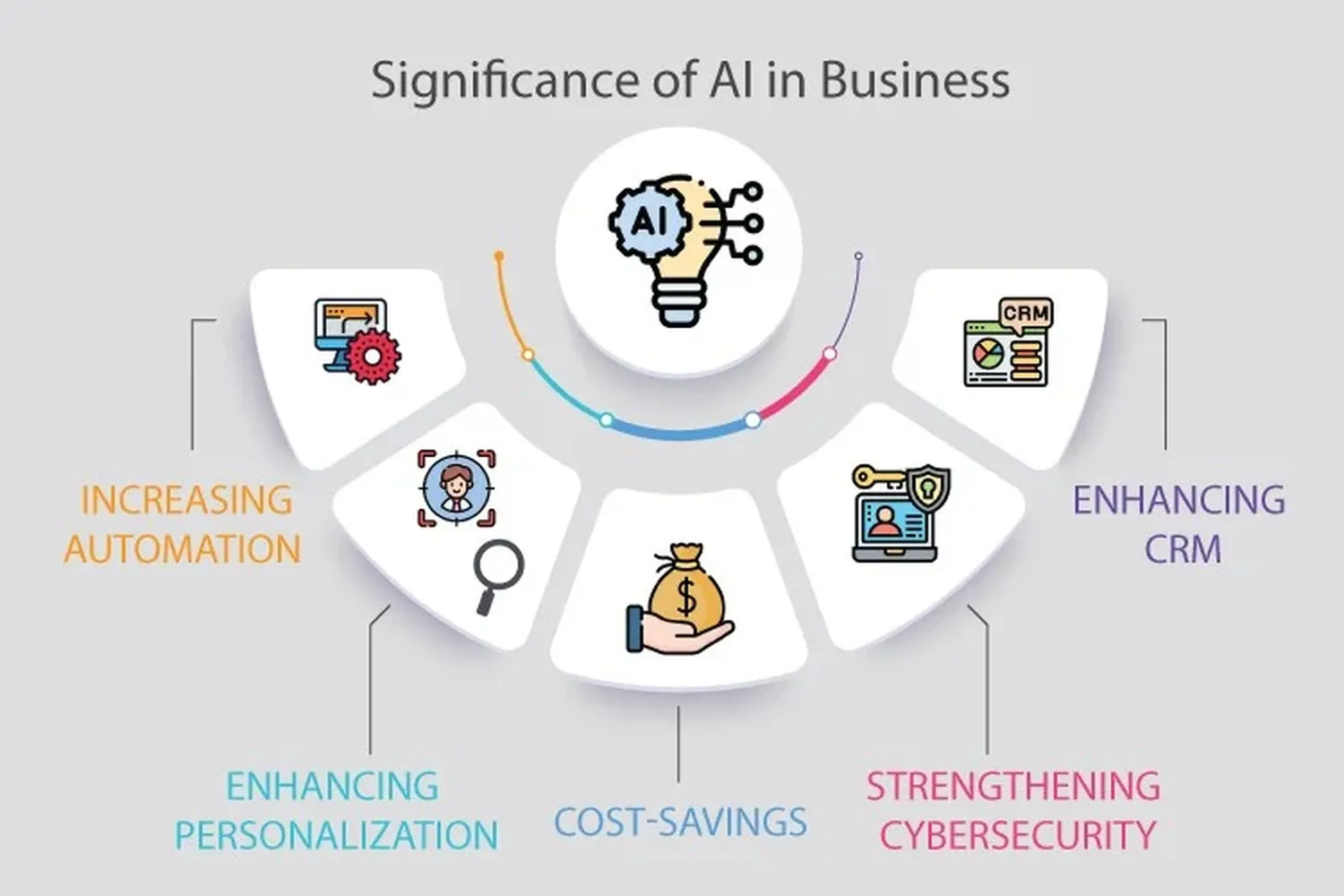
Why Artificial Intelligence Is Transforming Businesses So Rapidly
Artificial intelligence is transforming businesses because it combines massive data availability, affordable computing power, mature algorithms, and clear ROI in almost every department. Companies that integrate AI early are seeing 2–4× faster process improvements and significantly higher customer retention rates compared to slower adopters. The gap between AI leaders and laggards is widening quickly — and in 2026 that difference is already measurable in market share and profitability.
10 Powerful Ways Artificial Intelligence Is Transforming Businesses Today
1. Intelligent Automation of Repetitive Work
Artificial intelligence is transforming businesses most visibly through automation of rule-based, repetitive tasks — invoice processing, data entry, report generation, basic customer support. Companies report 25–45% reduction in time spent on these activities, allowing staff to focus on judgment-intensive and creative work that actually drives growth.
2. Predictive Analytics & Smarter Forecasting
By analyzing historical and real-time data, artificial intelligence is transforming businesses' ability to predict demand, customer churn, equipment failure, and market shifts with 75–90% accuracy in many cases — far better than traditional methods.
3. Hyper-Personalized Customer Experiences
Artificial intelligence is transforming businesses by enabling true 1-to-1 personalization at scale. Recommendation engines, dynamic pricing, tailored email campaigns, and individualized content increase conversion rates by 15–35% and customer lifetime value by 20–60% in many sectors.
4. Next-Generation Supply Chain Optimization
Artificial intelligence is transforming businesses in logistics and manufacturing through real-time route optimization, demand sensing, predictive maintenance, and automated inventory management — often cutting logistics costs by 10–25% while improving on-time delivery to 95%+.
5. Faster, More Accurate Business Decisions
Executives now use artificial intelligence transforming business dashboards that surface insights in seconds instead of weeks. AI-powered scenario planning helps leaders simulate hundreds of outcomes before committing resources.
6. Revolution in Product & Service Innovation
Artificial intelligence is transforming businesses' R&D pipelines — generative design in manufacturing, AI-assisted drug discovery in pharma (reducing timelines by years), personalized learning in education, and creative content generation in media.
7. Advanced Fraud Detection & Risk Management
In finance and e-commerce, artificial intelligence is transforming businesses by catching sophisticated fraud patterns in real time, reducing false positives by 40–70% while catching 85–95% of fraudulent transactions.
8. 24/7 Intelligent Customer Service
Conversational AI and virtual agents powered by large language models are handling 60–80% of routine inquiries with high satisfaction scores, freeing human agents for complex, emotional, or high-value interactions.
9. Sustainability & Energy Efficiency Gains
Artificial intelligence is transforming businesses toward greener operations — optimizing energy consumption in data centers and factories (10–30% savings), reducing waste in agriculture and retail, and improving carbon footprint tracking.
10. New AI-Native Business Models
Artificial intelligence is transforming businesses by enabling entirely new offerings: AI-as-a-service platforms, predictive maintenance subscriptions, personalized health & wellness plans, autonomous logistics networks, and more.
AI Impact Comparison Table
| Industry | AI Maturity 2026 | Avg. Cost Saving | Productivity Gain |
|---|---|---|---|
| Finance | High | 25–40% | 30–50% |
| Retail / eCommerce | High | 15–30% | 20–45% |
| Manufacturing | Medium-High | 10–35% | 20–40% |
| Healthcare | Medium-High | 15–35% | 25–45% |
| Logistics & Supply Chain | Medium-High | 10–30% | 15–40% |
| Marketing & Sales | High | 20–40% | 25–50% |
| Customer Service | High | 30–60% | 40–70% |
Qualitative Insights: How Leaders Feel About AI Transformation
Most executives say artificial intelligence is transforming businesses faster than any technology since the internet. Early adopters describe it as a "once-in-a-generation" shift that separates winners from losers. However, many also express concern about talent shortages, ethical risks, regulatory uncertainty, and the pressure to move quickly without breaking existing processes. The prevailing mood is excited but cautious — companies know they must act, but they want to do it responsibly.
Quantitative Data: The Numbers Behind AI Transformation
- Companies using AI extensively are 2.3× more likely to outperform peers financially (2025–2026 studies)
- Average ROI on successful AI projects: 3.5–7× within 18–36 months
- 66–82% of large organizations have AI actively deployed in at least one function (2026)
- Expected net job creation from AI & automation by 2030: +12 to +97 million roles globally
- AI-driven personalization lifts revenue by 10–30% in retail & e-commerce
Key Drivers Accelerating AI Adoption in 2026
- Maturation of large language models and multimodal AI
- Sharp drop in inference costs (70–90% cheaper than 2023)
- Clear proof of ROI from early use cases
- Competitive pressure — "AI or die" mindset in many sectors
- Explosion of high-quality training data and open-source models
Major Challenges & Realistic Risks
While artificial intelligence is transforming businesses positively overall, real hurdles remain: data quality & privacy issues (top concern in 68% of surveys), high up-front costs for custom solutions, talent wars for AI engineers, potential for algorithmic discrimination, cybersecurity vulnerabilities in AI systems, and fear of over-reliance on black-box models. Responsible governance and continuous monitoring are now board-level priorities.
How Artificial Intelligence Is Transforming Businesses — Long-term Outlook
By the early 2030s most experts expect artificial intelligence transforming business operations to be as fundamental as electricity or cloud computing today. Organizations that build strong data foundations, invest in people, and adopt ethical AI practices early will capture disproportionate value. Those that delay or treat AI as just another IT project risk falling permanently behind.
Experience AI-Powered Travel with Jaynevy Tours
Artificial intelligence is transforming businesses — including travel. At Jaynevy Tours we already use AI to create highly personalized safari itineraries, optimize Kilimanjaro climb schedules according to weather & fitness data, and recommend the perfect Zanzibar beach escape tailored to your preferences. Book smarter, travel better — contact us today!
Frequently Asked Questions
How is artificial intelligence transforming businesses right now?
Artificial intelligence is transforming businesses by automating repetitive tasks, enabling predictive analytics, personalizing customer experiences at scale, optimizing supply chains, and accelerating innovation across every major industry.
What industries are being most changed by AI?
Healthcare (diagnostics & drug discovery), finance (fraud detection & trading), retail (personalization & inventory), manufacturing (predictive maintenance), logistics, marketing, customer service, and education are seeing the fastest and deepest transformation.
What are the biggest benefits companies get from AI?
The main benefits include 20–40% productivity gains, 15–35% cost reductions in targeted processes, much faster decision-making, dramatically improved customer satisfaction, new revenue streams, and stronger competitive positioning.
Are there real risks or downsides to adopting AI in business?
Yes — data privacy concerns, potential job displacement in routine roles, high initial implementation costs, algorithmic bias, cybersecurity vulnerabilities, and the need for continuous employee upskilling are the most commonly reported challenges.
Will AI replace most jobs or create more opportunities?
Most credible forecasts show AI will displace routine jobs but create more new roles in AI development, data science, ethics, implementation, and human-AI collaboration — net job creation is expected in the long run.