
Why Companies Use Artificial Intelligence More Than Ever in 2026
Companies use artificial intelligence because it delivers speed, scale, and intelligence that humans alone can’t match — processing massive data instantly, spotting patterns we miss, automating tasks perfectly every time, personalizing at millions of customers simultaneously, predicting outcomes with high accuracy, and continuously improving without fatigue. Businesses that effectively use artificial intelligence gain a lasting edge: faster decisions, lower costs, happier customers, more innovative products, and teams that focus on high-value work instead of drudgery. In 2026 the question is no longer “should we?” but “where and how fast?” — the gap between leaders and laggards is widening daily in revenue, efficiency, and market share.
12 Practical Ways Companies Use Artificial Intelligence Today
1. Automating Routine Operations & Admin
Companies use artificial intelligence to handle data entry, invoice processing, scheduling, reporting, email sorting, and workflow routing. Teams reclaim 10–40 hours per week, errors drop 70–95%, and operational costs fall 20–50% without adding headcount.
2. Delivering Hyper-Personalized Customer Experiences
Companies use artificial intelligence for tailored recommendations, dynamic pricing, customized emails, website content, and offers. Conversion rates rise 15–50%, customer lifetime value increases 20–80%, and satisfaction scores improve significantly.
3. Powering Predictive Analytics & Forecasting
Companies use artificial intelligence to predict demand, sales, churn, cash flow, equipment failure, and market shifts. Inventory waste drops 20–60%, stockouts reduce 30–70%, and strategic planning becomes far more accurate.
4. Enhancing Customer Service & Support
Companies use artificial intelligence via chatbots, virtual agents, ticket triage, auto-replies, and sentiment analysis. 40–80% of routine inquiries resolve automatically, response time falls to seconds, and CSAT rises 10–35 points.
5. Optimizing Marketing & Advertising ROI
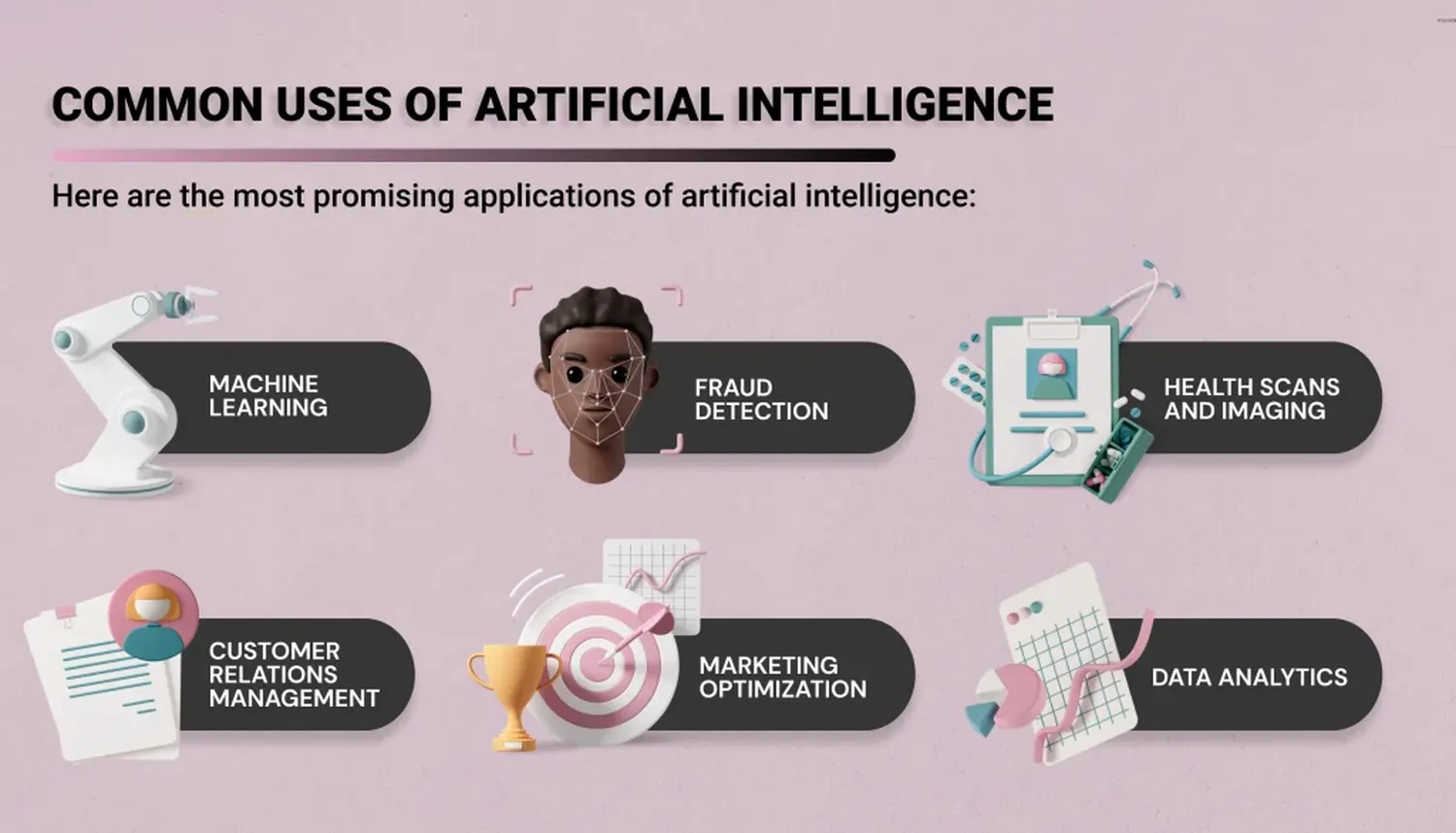
Companies use artificial intelligence for audience targeting, creative testing, bid management, content generation, and campaign optimization. CPA drops 20–60%, ROAS improves 1.5–4×, and marketing output scales 3–10× faster.
6. Improving Fraud Detection & Risk Management
Companies use artificial intelligence to spot anomalies in transactions, logins, claims, and behavior patterns. Fraud losses fall 40–85%, chargebacks reduce significantly, and compliance becomes more reliable.
7. Accelerating Product Development & Innovation
Companies use artificial intelligence for idea generation, prototype testing, user feedback analysis, A/B automation, and feature prioritization. Time-to-market shrinks 30–70%, and innovation velocity increases dramatically.
8. Streamlining Supply Chain & Logistics
Companies use artificial intelligence for route optimization, demand forecasting, supplier management, and predictive maintenance. Logistics costs drop 10–35%, delivery reliability rises, and disruptions decrease noticeably.
9. Boosting Employee Productivity & Collaboration
Companies use artificial intelligence via copilots, meeting summaries, knowledge search, task automation, and content drafting. Knowledge workers gain 20–50% more productive time, meetings shorten, and output quality improves.
10. Enabling Smarter Financial & Revenue Decisions
Companies use artificial intelligence for forecasting, anomaly detection, pricing optimization, expense auditing, and revenue leakage prevention. Margins expand 10–30%, forecasting accuracy rises, and financial health strengthens.
11. Creating New AI-Powered Products & Services
Companies use artificial intelligence to launch smart features, usage-based pricing, predictive subscriptions, personalized bundles, and AI-as-a-service offerings — unlocking fresh revenue streams with high margins.
12. Driving Continuous Process Optimization
Companies use artificial intelligence to monitor workflows, identify bottlenecks, suggest improvements, and auto-optimize in real time. Overall operational efficiency gains compound 15–45% year-over-year.
How Companies Use Artificial Intelligence – Efficiency & Impact Table
| Application | Typical Gain | Time/Cost Saving | Revenue/ROI Impact |
|---|---|---|---|
| Customer Personalization | 15–50% conv ↑ | — | ↑↑↑ |
| Support Automation | 40–80% auto-resolved | 30–70% cost ↓ | ↑↑ |
| Marketing Optimization | 20–60% CPA ↓ | — | ↑↑↑ |
| Operations & Supply Chain | 10–35% cost ↓ | 20–50% | ↑↑ |
| Employee Productivity | 20–50% time ↑ | 10–40h/wk | ↑↑ |
| Fraud & Risk | 40–85% loss ↓ | — | ↑↑ |
| Predictive Analytics | 30–70% accuracy ↑ | — | ↑↑↑ |
Real Stories – How Companies Use Artificial Intelligence to Win
Retailers use artificial intelligence for recommendations → sales lift 20–35%. SaaS firms use artificial intelligence for churn prediction → retention up 25–50%. Manufacturers use artificial intelligence for predictive maintenance → downtime cut 40–70%. Agencies use artificial intelligence for ad creative & bidding → ROAS doubles. Small service businesses use artificial intelligence for support chatbots → tickets drop 60–80%. The pattern is consistent: companies use artificial intelligence on high-impact, repeatable problems → results compound quickly.
Quantitative Benefits Companies See from Artificial Intelligence
- 20–50% average reduction in time on routine tasks
- 15–40% drop in operational/support costs
- 10–35% higher customer retention & LTV
- 20–60% improvement in marketing/sales ROI
- 30–70% faster process turnaround & decision speed
Challenges Companies Face When Adopting Artificial Intelligence
Companies use artificial intelligence successfully when they address common hurdles: poor data quality, skill gaps, privacy/security concerns, change resistance, over-customization too early, measuring true ROI beyond time saved, and balancing automation with human touch. Smart adopters start small (one high-pain area), use no-code/low-code tools, measure obsessively, train teams continuously, and keep humans in control of strategy, ethics, and exceptions.
How Any Company Can Start Using Artificial Intelligence Today
- Pick one high-pain, high-repetition process (support? marketing? admin? forecasting?)
- Choose 1–2 mature, easy tools (Zapier, Make, Claude, Jasper, Fireflies, etc.)
- Run a 30–60 day pilot — track time saved, cost reduction, output increase
- Measure before/after — expand only when gains are clear & consistent
- Build internal fluency so artificial intelligence becomes a core capability
Experience AI-Powered Travel with Jaynevy Tours
Companies use artificial intelligence to run smarter — and we use it to plan better adventures. At Jaynevy Tours, AI helps us craft ultra-personalized Tanzania trips: perfectly timed Serengeti safaris, fitness-matched Mount Kilimanjaro climbs, and ideal Zanzibar escapes. Get a smarter, smoother trip — contact us today!
Frequently Asked Questions
How do companies use artificial intelligence in 2026?
Companies use artificial intelligence for automation of routine tasks, predictive analytics, personalized customer experiences, process optimization, fraud detection, supply chain forecasting, content generation, employee productivity tools, decision support, and new revenue models — often achieving 20–50% efficiency gains and 10–40% revenue uplift.
Which industries benefit most from how companies use artificial intelligence?
Retail/e-commerce (personalization & recommendations), finance (fraud & risk), healthcare (diagnostics & admin), manufacturing (predictive maintenance), marketing (targeting & content), logistics (routing & forecasting), customer service (chatbots & automation), and professional services (research & analysis) show the strongest adoption and ROI.
What measurable results do companies see from using artificial intelligence?
Typical outcomes: 20–50% reduction in operational costs, 15–40% faster decision-making, 10–35% higher customer retention, 20–60% productivity increase in knowledge work, 30–70% drop in manual task time, and ROAS/ROI improvements of 1.5–4× in marketing & sales functions.
Can small companies effectively use artificial intelligence like larger ones?
Yes — affordable no-code/low-code tools (Zapier, Make, Notion AI, Claude, Jasper, Fireflies, Tidio, Google Cloud AI, Microsoft Copilot) allow small companies to achieve enterprise-level automation, personalization, insights & efficiency without large teams or budgets.
What challenges do companies face when starting to use artificial intelligence?
Common hurdles include poor data quality, lack of internal skills, privacy/security concerns, high initial setup time for custom solutions, resistance to change, risk of over-automation reducing human touch, and difficulty measuring true ROI beyond time saved.