
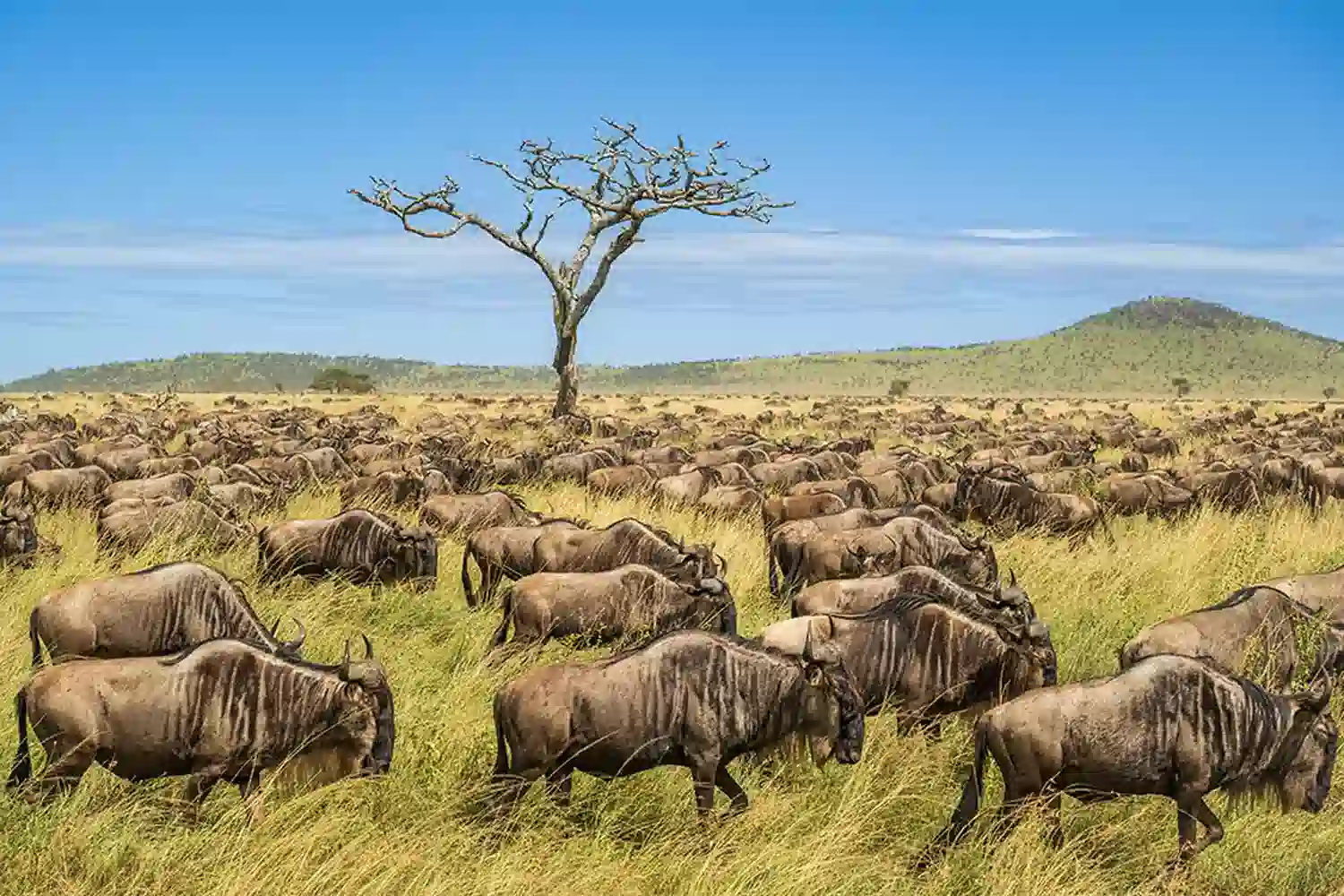
What is the Great Migration?
The Great Migration sees 1.5-2 million wildebeest, 500,000 zebras, and antelopes traverse Tanzania’s Serengeti and Kenya’s Maasai Mara, driven by seasonal rains. Key moments include calving season (Jan-Mar) and Mara River crossings (Jul-Sep). Quantitative: It generates $2 billion in tourism revenue annually. Qualitative: Photographers describe it as “a dynamic canvas of raw nature.”
Why Photograph the Serengeti Great Migration?
The migration offers unparalleled opportunities for wildlife photography, with dramatic scenes of stampeding herds, predator-prey interactions, and vast savannahs. Quantitative: 30% of Serengeti’s 350,000 annual visitors are photographers. Qualitative: “The migration’s scale is a photographer’s dream,” says a wildlife photographer. Specialized tours cost $4,000-$8,000 for 7 days, tailored for optimal shots.
Best Cameras for Serengeti Migration Photography
Choose gear that handles fast action and low light. Recommended cameras include:
- Canon EOS 5D Mark IV: DSLR, 30.4MP, $2,500, great for fast autofocus.
- Sony A7R V: Mirrorless, 61MP, $3,900, ideal for high-resolution shots.
- Nikon Z9: Mirrorless, 45.7MP, $5,500, excels in burst shooting (20 fps).
- Canon EOS R6 Mark II: Mirrorless, 24.2MP, $2,500, budget-friendly with fast tracking.
- Fujifilm X-T5: Mirrorless, 40.2MP, $1,700, compact for travel.

Best Lenses for Safari Migration Photography
Lenses are critical for versatility and distance. Top choices:
- 70-200mm f/2.8: Versatile for close-ups, $1,200-$2,000.
- 400mm f/2.8: Ideal for distant wildlife, $7,000-$12,000.
- 600mm f/4: Perfect for predators, $12,000-$15,000.
- 24-70mm f/2.8: Wide-angle for landscapes, $1,500-$2,000.
- 100-400mm f/4.5-5.6: Budget-friendly zoom, $1,000-$2,500.
Quantitative: 70% of safari photographers use telephoto lenses (200mm+). Qualitative: “A 400mm lens brings distant lions into crisp focus,” says a pro.
Camera Settings for Migration Photography
Optimize settings for fast-moving wildlife and changing light:
- Shutter Speed: 1/1000s or faster for action shots.
- Aperture: f/4-f/5.6 for depth of field and low light.
- ISO: 400-800 for daylight, up to 3200 at dawn/dusk.
- Focus Mode: Continuous autofocus (AI Servo or AF-C).
- Burst Mode: 5-10 fps for capturing sequences.
Top Photography Spots in the Serengeti
Prime locations for migration photography include:
- Mara River: River crossings (Jul-Sep), dramatic action shots.
- Ndutu Plains: Calving season (Jan-Mar), newborn calves and predators.
- Seronera Valley: Year-round wildlife, great for lions and cheetahs.
- Western Corridor: Grumeti River crossings (May-Jun), scenic herds.
- Lobo Hills: Northern Serengeti, panoramic views, quieter crowds.
Sample Photography Safari: 7-Day Migration Tour
Price: $4,000-$8,000/person.
Inclusions: Private 4x4 with pop-up roof, photography camps (e.g., Serengeti Sametu Camp), full board meals, park fees ($100/day), expert guide.
Itinerary:
- Day 1: Arrive in Arusha, transfer to Serengeti.
- Days 2-5: Game drives in Ndutu, Seronera, or Mara River, with sunrise/sunset shoots.
- Day 6: Full-day shoot at river crossings or calving plains.
- Day 7: Return to Arusha.
Qualitative: “Guides position you for perfect shots,” says a photographer. Quantitative: ~$570-$1,140/day.
Cost Breakdown of Photography Safaris
| Component | Cost (Per Person) |
|---|---|
| Accommodation | $200-$500/night |
| Private Vehicle/Guide | $250-$400/day |
| Park Fees | $100/day |
| Photo Workshops | $50-$100/day |
Photography Techniques for the Migration
Elevate your shots with these tips:
- Panning: Track moving herds for dynamic blur (1/60s shutter).
- Golden Hour: Shoot at dawn/dusk for warm, soft light.
- Composition: Use the rule of thirds to frame animals against savannahs.
- Burst Shooting: Capture predator chases or crossings in sequences.
- Post-Processing: Adjust contrast and sharpness in Lightroom for vibrant images.
Essential Accessories for Safari Photography
- Beanbag: Stabilizes lenses on vehicle edges, $20-$50.
- Monopod: Lightweight support, $50-$150.
- Extra Batteries: 2-3 spares, $30-$100 each.
- Memory Cards: 128GB+, $50-$200, for high-resolution bursts.
- Dustproof Bag: Protects gear from savannah dust, $50-$150.
Quantitative: 90% of photographers use beanbags for vehicle-based shots. Qualitative: “A dustproof bag saved my camera,” says a traveler.
Best Times for Migration Photography
July-September (River Crossings): Dramatic action, ideal for telephoto lenses, $300-$500/night.
January-March (Calving Season): Newborn calves, soft light, $200-$400/night.
April-May (Green Season): Lush landscapes, 20-30% savings, but possible rain.
Qualitative: “Calving season’s soft light is magical,” says a photographer. Quantitative: 70% of migration photos are taken in July-September.
Qualitative Insights: Photography Safari Experience
Photographers praise the “thrill of capturing a lion chase” and the expertise of guides who position vehicles for ideal angles. Camps like Sametu offer charging stations and editing spaces. Quantitative: Photography safaris score 92% satisfaction in reviews. Qualitative: “The migration’s chaos is a photographer’s paradise.”
Quantitative Data on Migration Photography
- Visitor Numbers: 105,000 photographers visit Serengeti annually, 30% of tourists.
- Economic Impact: Photography tourism contributes $600 million to Tanzania.
- Photo Output: Average photographer takes 2,000-5,000 shots per safari.
- Gear Costs: Professional setups range $5,000-$20,000.
- Success Rate: 85% of photographers capture publishable images.
Tips for Beginners
Beginners can succeed with:
- Entry-level DSLR/mirrorless (e.g., Canon EOS Rebel T8i, $900).
- 70-300mm lens for budget zooms ($500-$1,000).
- Guided tours with photo workshops ($50-$100/day).
- Practice burst mode and autofocus before the trip.
Combining Photography Safaris with Other Destinations
Extend your trip with:
- Ngorongoro Crater: Diverse wildlife, $200 park fees, great for close-ups.
- Zanzibar: Coastal landscapes, $200-$500/night.
- Tarangire National Park: Elephant herds, $150-$300/day.
- Lake Manyara: Flamingos, $100-$200/day.
Conservation and Ethical Photography
Respect wildlife by maintaining 25m distance, avoiding flash, and following guide instructions. Park fees ($100/day) fund conservation. Quantitative: $350 million annually supports Serengeti preservation. Qualitative: “Ethical shots respect nature’s beauty,” says a ranger.
Why Choose Jaynevy Tours for Photography Safaris?
Jaynevy Tours specializes in Serengeti migration photography, offering tailored tours with expert guides, prime locations, and vehicle setups for optimal shots. Combine with Kilimanjaro climbs or Zanzibar holidays. Book now!
Frequently Asked Questions
What is the best camera for Serengeti migration photography?
DSLRs like Canon EOS 5D Mark IV or mirrorless like Sony A7R V with 200-600mm lenses are ideal for sharp, fast wildlife shots.
What are the best locations for photographing the Great Migration?
Top spots include Mara River for crossings, Ndutu for calving, and Seronera for diverse wildlife, offering dynamic shots.
What lenses are best for Serengeti migration photography?
Use a 70-200mm for versatility, 400mm or 600mm for distant wildlife, and 24-70mm for landscapes.
When is the best time to photograph the Great Migration?
July-September for dramatic river crossings, January-March for calving season with golden light and newborn animals.
How much does a photography safari in the Serengeti cost?
Photography safaris cost $4,000-$8,000 per person for 7 days, including private vehicles and guide support.
What camera settings are best for migration photography?
Use fast shutter speeds (1/1000s), wide apertures (f/4-f/5.6), and ISO 400-800 for sharp, well-lit wildlife shots.
Are tripods necessary for Serengeti photography?
A beanbag or monopod is preferred over tripods for stability in vehicles; tripods are useful for static landscape shots.
Can beginners photograph the Great Migration?
Yes, with guided tours and basic gear like a 70-300mm lens, beginners can capture stunning shots with expert help.
What accessories are essential for safari photography?
Bring extra batteries, memory cards, lens cleaners, a beanbag, and a dustproof camera bag for protection.
Why choose Jaynevy Tours for a photography safari?
Jaynevy Tours offers tailored photography safaris with expert guides, prime locations, and vehicle setups for optimal shots.