

Understanding the Serengeti Migration
The Great Migration is the annual journey of 1.5-2 million wildebeest, 500,000 zebras, and 200,000 gazelles across Tanzania’s Serengeti and Kenya’s Maasai Mara. This 1,800-2,000 mile clockwise loop is driven by rainfall and grass availability. Quantitative: Attracts 350,000 tourists yearly, generating $2 billion. Qualitative: “The earth pulses with life,” says a ranger.
Overview of the Serengeti Migration Map
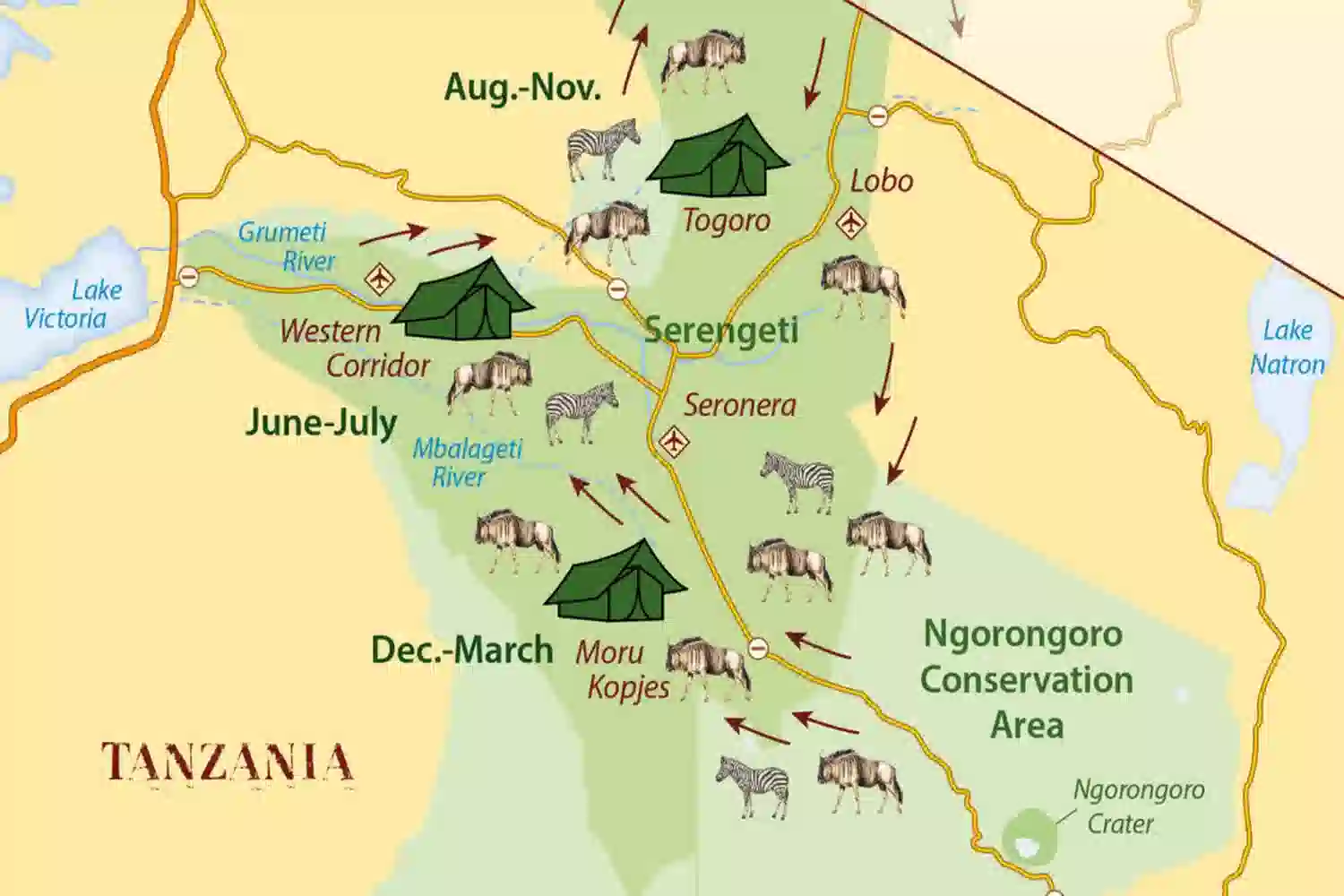
The Serengeti migration path forms a circular route through key regions: Ndutu, Serengeti plains, Western Corridor, Grumeti, and Maasai Mara. The map below illustrates the seasonal movements:
Seasonal Migration Routes Explained
- January-March (Calving Season, Ndutu): Herds gather in Ndutu for calving, with 500,000 calves born in 3 weeks. Quantitative: 80% of calves survive. Qualitative: “The plains teem with newborns,” says a guide.
- April-June (Grazing, Serengeti Plains): Herds move north to central Serengeti for fresh grass. Quantitative: Covers 300-400 miles. Qualitative: “Vast herds stretch endlessly,” notes a traveler.
- July-September (River Crossings, Grumeti & Mara): Herds cross Grumeti and Mara Rivers, facing 2,500 crocodiles. Quantitative: 20,000 wildebeest die in crossings. Qualitative: “Crossings are pure drama,” says a photographer.
- October-December (Grazing, Maasai Mara): Herds graze in Maasai Mara before returning south. Quantitative: 70% of route in Tanzania. Qualitative: “Predators thrive here,” says a ranger.
Key Locations on the Migration Route
| Location | Activity |
|---|---|
| Ndutu | Calving (Jan-Mar) |
| Serengeti Plains | Grazing (Apr-Jun) |
| Grumeti River | Crossings (Jun-Jul) |
| Mara River | Crossings (Jul-Sep) |
| Maasai Mara | Grazing (Oct-Dec) |
Factors Influencing Migration Routes
Routes depend on rainfall, grass, and predators. Quantitative: Rainfall varies 20-30% yearly, shifting routes by 2-3 weeks. Qualitative: “Rain dictates every move,” says an ecologist. Human barriers like fences reduce populations by 20% in some areas.
Wildlife Along the Migration Route
Besides wildebeest, 500,000 zebras and 200,000 gazelles migrate, pursued by 3,000 lions, 1,000 cheetahs, and 2,500 crocodiles. Quantitative: 250,000 wildebeest die annually, sustaining predators. Qualitative: “The ecosystem thrives on this cycle,” says a biologist.
Challenges on the Migration Path
- Predators: Lions and cheetahs kill 10% of herds.
- River Crossings: 20,000 drown in Mara and Grumeti Rivers.
- Human Barriers: Fences and poaching threaten 20% of populations.
- Climate Change: Erratic rains could reduce herds by 20-30% by 2050.
Planning a Safari with the Migration Map
Use a Serengeti migration map to plan your safari. Quantitative: 90% of Jul-Sep camps book 6-12 months in advance. Qualitative: “Maps guide you to the action,” says a traveler. Best spots include Ndutu for calving and Mara River for crossings.
Quantitative Data: Migration Stats
- Animals: 1.5-2M wildebeest, 500,000 zebras, 200,000 gazelles.
- Route Length: 1,800-2,000 miles.
- Deaths: 250,000 wildebeest annually.
- Tourism: 350,000 visitors, $2B revenue.
- Conservation Funding: $350M from tourism.
Qualitative Insights: Expert Views
“The migration’s path is a marvel of instinct,” says a ranger. Travelers note, “Following the map makes every moment epic.” Quantitative: 80% of visitors use maps for planning. Qualitative: “It’s like decoding nature’s rhythm,” says a guide.
Conservation and Migration Routes
Tourism supports route preservation. Quantitative: $350M funds anti-poaching efforts. Qualitative: “Safaris protect this wonder,” says a WWF expert. Choose eco-friendly operators like Jaynevy Tours to minimize impact.
Why Choose Jaynevy Tours for Migration Safaris?
Jaynevy Tours offers guided safaris tailored to the wildebeest migration routes. Combine with Kilimanjaro climbs or Zanzibar holidays. Book now!
Frequently Asked Questions
What is the Serengeti migration route?
The route is a 1,800-2,000 mile clockwise loop across Tanzania’s Serengeti and Kenya’s Maasai Mara, driven by seasonal rains.
When does the Serengeti migration happen?
It’s a year-round cycle, with calving in Jan-Mar, river crossings in Jul-Sep, and grazing in Apr-Jun and Oct-Dec.
Where are the best spots to view the migration?
Ndutu for calving, Grumeti and Mara Rivers for crossings, and Maasai Mara for predator action.
How many animals follow the migration route?
1.5-2 million wildebeest, 500,000 zebras, and 200,000 gazelles migrate annually.
How long is the Serengeti migration path?
The path spans 1,800-2,000 miles, covering Serengeti and Maasai Mara ecosystems.
Are migration routes predictable?
No, routes vary due to rainfall patterns, shifting 2-3 weeks yearly.
What challenges do animals face on the route?
Predators, river crossings, and human barriers; 250,000 wildebeest die annually.
How does climate change affect migration routes?
Erratic rains disrupt routes, potentially reducing populations by 20-30% by 2050.
What’s the best way to plan a migration safari?
Use a Serengeti migration map and book with operators like Jaynevy Tours for guided safaris.
Why choose Jaynevy Tours for migration safaris?
Jaynevy Tours offers expert-guided safaris with detailed migration route insights and flexible itineraries.