
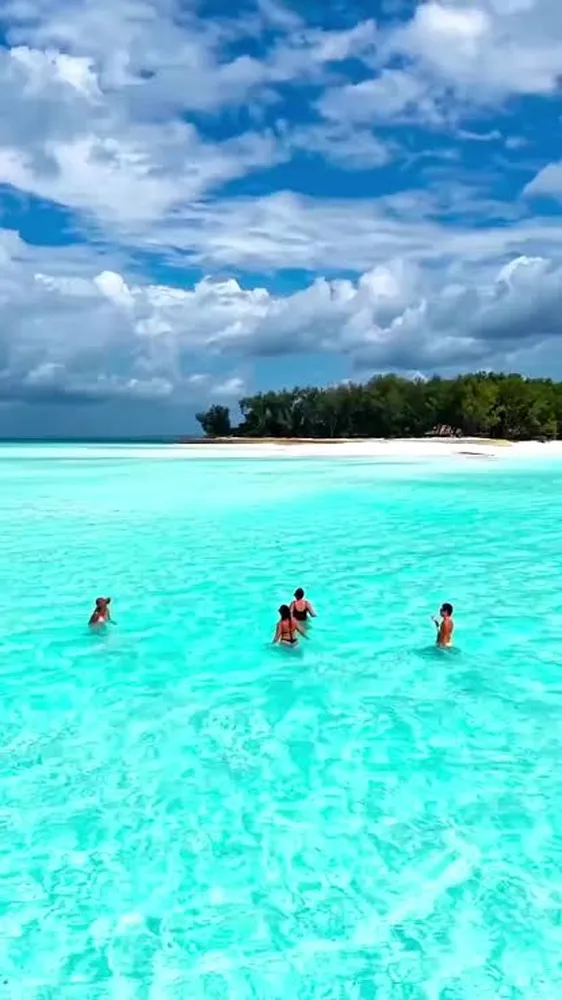
Quick Answer: Which Zanzibar Beaches Are Best for Swimming?
Kendwa is the safest first choice for travellers who want the least tide-disrupted swimming. Nungwi is a close second, especially if you also want restaurants, dive centres and evening activity. Both are on Zanzibar's northwestern side, where deeper water generally remains closer to shore than on the broad reef-flat beaches of the east and southeast coast.
Paje, Jambiani, Matemwe, Kiwengwa and much of the east coast can still be excellent beach destinations, but the swimming experience changes dramatically with the tide. At low tide, the sea may retreat hundreds of metres—and at some intertidal locations the exposed zone can extend toward 3 kilometres—leaving shallow pools, seagrass, coral rubble and seaweed farms. At high tide, the same beach can become warm, turquoise and highly swimmable.
| Swimming priority | Best first choice | Good alternatives | Main trade-off |
|---|---|---|---|
| Swim through more of the day | Kendwa | Nungwi, selected west-coast bays | More developed and often busier |
| Swimming plus restaurants and nightlife | Nungwi | Kendwa | Boat traffic and busy beach sections |
| Quiet couples' stay with planned swim windows | Pongwe | Matemwe, Michamvi, Bwejuu | Low tide may limit spontaneous swimming |
| Kitesurfing and active beach culture | Paje | Jambiani | Swimming is tide- and wind-dependent |
| Snorkelling/diving access | Matemwe area | Nungwi, Kiwengwa | Boat trips depend on tides, wind and sea state |
| Family resort with pool backup | Kendwa or Kiwengwa | Nungwi, Bwejuu | Check the exact beachfront, not only the village name |
For a wider comparison beyond tides, see our guide to the best Zanzibar beaches after safari and our Zanzibar beach holiday packages.
What Causes Zanzibar's Tides?
Tides are long-period ocean waves driven mainly by the gravitational pull of the Moon, with the Sun adding a secondary influence. Zanzibar experiences a strongly semidiurnal pattern: most tidal days bring two high tides and two low tides. A lunar day lasts about 24 hours and 50 minutes, so the time of high and low water shifts later from one calendar day to the next.
The interval between one high tide and the next is approximately 12 hours and 25 minutes, while the change from high tide to low tide is roughly half that. These are averages rather than a personal swimming timetable. Local seabed shape, wind, waves, atmospheric pressure and the exact beach profile can change how quickly water arrives, how far it retreats and whether the sea feels calm or rough.
Zanzibar Tide Numbers: How Large Is the Difference?
Scientific measurements around Zanzibar describe a strong tidal environment. Research on the island's coastal systems reports spring tidal ranges of roughly 3.2 metres and neap ranges around 0.9 metres. A long-term analysis at Zanzibar Harbour found strongly semidiurnal tides and calculated a mean spring range of about 3.65 metres. Other research notes that parts of the Zanzibar Channel can experience tidal differences of approximately 2.7 to 4.2 metres.
| Tide measure | Published Zanzibar figure | What a traveller may notice |
|---|---|---|
| Typical spring tidal range | About 3.2–3.65 m | Large difference between high and low water; east-coast lagoons may empty dramatically |
| Typical neap tidal range | About 0.9 m | Less dramatic daily change; often easier to plan swimming |
| Intertidal-zone width | Up to about 3 km at studied locations | The water can appear extremely far away at low tide |
| Tidal pattern | Two highs and two lows per lunar day | Usually two potential higher-water swimming periods each day |
| Lunar day | About 24 h 50 min | Tide times move later each day rather than repeating at the same clock time |
The vertical range is only part of the story. On a gently sloping reef flat, a fall of one metre can move the waterline a very long horizontal distance. On a steeper beach, the same vertical change may move the shoreline much less. This is why two beaches on the same island can feel completely different at the same stage of the tide.
Spring Tides and Neap Tides Explained
Spring tides: the biggest tidal differences
Spring tides occur around the new moon and full moon, when the Sun, Moon and Earth are more closely aligned. The name has nothing to do with the spring season. During these periods, high tides can be higher and low tides lower, producing a more dramatic transformation of Zanzibar's shallow lagoons.
Neap tides: the smaller tidal differences
Neap tides occur around the first- and third-quarter moon, when the solar and lunar influences partly offset each other. The tidal range is smaller, so east-coast swimming can feel less restricted, although the beach remains tidal. Spring and neap cycles each occur roughly twice in a lunar month.
| Cycle | Moon phase | Effect on Zanzibar beaches | Best planning response |
|---|---|---|---|
| Spring tide | New moon or full moon | Greater high-to-low difference; strong exposure of reef flats | Check exact tide heights and avoid fixing ocean swims at low water |
| Neap tide | First or third quarter | Smaller tidal difference; water may remain closer to shore | Still check times, but swimming windows are often more forgiving |
Why Zanzibar's East Coast Looks So Different at Low Tide
Much of the east and southeast coast sits behind coral reefs and broad, shallow lagoons. These areas contain seagrass beds, sand flats, tidal pools, coral patches and local seaweed farms. When the tide falls, water drains across the reef flat and exposes a huge section of seabed. This is a normal ecological process, not evidence that the beach has “lost” its sea.
Low tide can be visually beautiful and culturally interesting. It creates opportunities for reef-flat walks, photography and observing local seaweed farming. It is not automatically the best time to swim. The exposed seabed may contain sharp coral, shells, sea urchins, slippery algae, warm pools and working farm lines. Walk only where local staff say it is appropriate, use reef shoes and avoid stepping on living coral or cultivated plots.
Beach-by-Beach Tide and Swimming Comparison
| Beach area | Tide impact on swimming | Best swimming period | Best for | Editorial swim score |
|---|---|---|---|---|
| Kendwa | Low to moderate | Much of the day; verify local conditions | Swimming-first holidays, families, couples | 9/10 |
| Nungwi | Low to moderate | Much of the day, with section-specific variation | Swimming, restaurants, diving, sunsets | 8.5/10 |
| Pongwe | Moderate | Around high tide | Quiet couples and boutique stays | 7.5/10 |
| Kiwengwa | Moderate to high | Mid-to-high tide | Resorts, families, long beach walks | 7/10 |
| Matemwe | High | Around high tide | Quiet stays and marine excursions | 6.5/10 |
| Paje | High | Mid-to-high tide; wind matters | Kitesurfing, cafés, social travellers | 6.5/10 for swimmers; 9.5/10 for kiters |
| Jambiani | High | Mid-to-high tide | Village atmosphere and relaxed stays | 6.5/10 |
| Bwejuu | High | Around high tide | Quiet resorts and couples | 6.5/10 |
| Michamvi/Pingwe | Moderate to high | Property- and bay-specific; usually higher water | Seclusion, romance, sunset at Michamvi Kae | 7/10 |
| Fumba/west coast | Moderate and highly local | Check the exact bay and hotel | Quiet stays and boat excursions | 6.5/10 |
Scores are practical editorial comparisons, not official ratings. Conditions vary by the exact hotel frontage, moon phase, wind, swell, seasonal seaweed and boat activity. A property at the southern end of a named beach may behave differently from one several kilometres away.
Kendwa: Best Overall for Tide-Flexible Swimming
Kendwa is usually the strongest choice for travellers who picture themselves entering the ocean whenever they feel like it. The beach profile is steeper than the broad east-coast reef flats, so low tide is generally less disruptive. The waterline still moves, and rough weather can affect any beach, but Kendwa offers a more dependable swimming holiday than most of Zanzibar's eastern shoreline.
It suits families, couples and first-time visitors who do not want to study a tide table before every swim. The main trade-offs are popularity, higher demand for beachfront rooms and a more resort-oriented atmosphere. Travellers who want a short north-coast stay can review the two-night Nungwi beach escape as a nearby comparison.
Nungwi: Best for Swimming Plus Activity
Nungwi combines comparatively tide-flexible swimming with restaurants, sunset cruises, dive centres, shops and nightlife. It is a better fit than Kendwa for travellers who want to walk out for dinner or arrange activities easily. It is not one uniform beach: some sections have boats, moorings, rocks, busier water traffic or less sand at high tide.
Families should inspect the exact hotel section and ask whether the safest swimming area is directly in front of the property. Strong swimmers should still stay outside marked boat channels. Anyone interested in village life can combine the beach with the Nungwi village area.
Pongwe: A Small Bay That Works Best Around Higher Water
Pongwe's curved bay and quiet boutique properties make it attractive for couples. The shape of the bay can create a calm appearance, but it is still influenced by tide. At lower water the sea retreats and swimming becomes shallow or impractical in places. Around high tide, the bay can feel sheltered and inviting.
Choose Pongwe for privacy, not guaranteed all-day ocean access. A good pool is valuable. Confirm whether the hotel's swimming area is sandy, whether reef shoes are recommended and how many hours around high tide are normally suitable.
Kiwengwa: Family Resorts With Strong Tide Changes
Kiwengwa has a long, attractive beach and a concentration of larger resorts. It can suit families because hotels often provide pools, organised activities, meal plans and spacious grounds. Ocean swimming is usually best around mid-to-high tide. Low tide can expose a broad section of reef flat.
This is a good compromise for travellers who value resort facilities as much as spontaneous ocean access. A pool becomes part of the beach strategy rather than a consolation. Ask the hotel for a recent high- and low-tide photograph taken from its own frontage.
Matemwe: Beautiful, Quiet and Strongly Tidal
Matemwe offers a quieter northeast-coast atmosphere and convenient positioning for boat trips toward the Mnemba marine area. The beachfront is visually impressive, but low tide can move the water far away. Travellers who require repeated daily sea swims may find it frustrating; travellers who enjoy changing tidal scenery often love it.
Marine excursions operate according to tides, wind, waves and conservation rules—not simply your preferred departure time. Review a dedicated Zanzibar diving guide or the four-day Zanzibar diving package when marine activities are central to the trip.
Paje and Jambiani: Better for Lagoon Life Than All-Day Swimming
Paje and Jambiani have some of Zanzibar's most dramatic low-tide landscapes. The shallow lagoon is excellent for kitesurfing during suitable wind seasons, and the villages provide cafés, local restaurants and a social beach atmosphere. For a conventional swimmer, however, water depth and kite traffic can be limiting.
At high tide, swimming can be pleasant. At low tide, the sea may be far from shore. During windy periods, the lagoon can be busy with learners, instructors and experienced riders. Non-kiters should use the designated swimming zone recommended by the hotel or kite centre. Travellers focused on the sport can compare the three-night Paje kitesurfing break.
Bwejuu, Michamvi and Pingwe: Romantic but Property-Specific
Bwejuu is quieter than Paje and has a similar tide-dominated shoreline. Michamvi Peninsula offers both east-facing and west-facing settings; Michamvi Kae is particularly known for sunset, while Pingwe and the eastern side experience a stronger reef-flat rhythm. Beach suitability depends heavily on the precise property.
Couples should ask what “beachfront” means at both high and low tide. A sea-view room can overlook an expansive turquoise lagoon at high water and an exposed sand-and-seagrass flat six hours later. Both scenes are authentic Zanzibar; the right choice depends on whether you value scenery and seclusion or immediate swimming.
When Is the Best Time to Swim on a Tidal Beach?
On strongly tidal east-coast beaches, a useful starting guideline is approximately two hours before to two hours after high tide. This is a planning heuristic, not a safety guarantee. Some locations become deep enough earlier, while others have currents, reef edges, waves or boat channels that make a narrower window appropriate.
| Stage of tide | Typical east-coast appearance | Swimming implication |
|---|---|---|
| Low tide | Water far offshore; exposed reef flat, seagrass and pools | Usually poor for conventional swimming; good for guided walks where appropriate |
| Rising tide | Water moves back across the lagoon | Depth improves; watch for changing currents and submerged hazards |
| High tide | Water close to the beach and lagoon filled | Often the best swimming period, subject to waves and local advice |
| Falling tide | Water begins draining toward the reef | Swimming may remain good initially, then become shallower |
A Practical Three-Day Tide-Planning Example
Imagine a Paje hotel where high tide occurs at 8:00 a.m. on the first morning. The next comparable high tide will be around 8:50 a.m. the following day, although the exact shift varies. A sensible plan might look like this:
| Day | Approximate higher-water period | Plan |
|---|---|---|
| Day 1 | Early morning | Swim before breakfast; use low tide for Stone Town, spa or a land excursion |
| Day 2 | About 50 minutes later | Longer breakfast, then swim; book a flexible afternoon activity |
| Day 3 | Later again | Morning excursion first, then return for a late-morning or midday swim |
Use a current tide table for the exact village and dates. Do not copy tide times from a blog post written months earlier. Hotels and marine operators should confirm how the predicted tide translates to their local beach.
Which Beach Is Best for Families?
Kendwa is the easiest family recommendation when ocean swimming matters most. Nungwi works for active families who want restaurants and activities. Kiwengwa can be excellent when a full-service resort, kids' facilities and a large pool matter more than all-day sea access.
- Ask whether the beach has a marked swimming zone separate from boats and kites.
- Choose a property with a pool for low-tide hours.
- Check whether family rooms are genuinely close to the beach.
- Use reef shoes where the seabed is exposed.
- Keep children within direct reach; shallow water is not automatically risk-free.
Which Beach Is Best for Couples?
Couples who want frequent swimming should choose a quieter Kendwa property. Couples who value privacy, changing scenery and boutique hotels may prefer Pongwe, Matemwe, Bwejuu or Michamvi. A private plunge pool or strong hotel pool is especially useful on the east coast.
For a longer stay, one north-coast base and one quieter east-coast base can create contrast. Moving hotels is usually worthwhile only when the trip lasts at least seven or eight nights. Use our four-day Zanzibar itinerary or seven-day beach and Stone Town plan to judge whether a split stay fits.
Which Beach Is Best for Water Sports?
| Activity | Strong beach base | How tides affect it |
|---|---|---|
| Kitesurfing | Paje or Jambiani | Depth, wind and tide determine lesson times; low tide may expose shallow zones |
| Scuba diving | Nungwi or Matemwe area | Boat departure and dive-site choice may follow tide and sea state |
| Snorkelling | Matemwe/Mnemba excursions, Nungwi operators | Visibility and current can change with tide; wildlife is never guaranteed |
| Stand-up paddleboarding | Sheltered bays at calm higher water | Too little depth at low tide; wind can make return difficult |
| Swimming | Kendwa or Nungwi | Generally less restricted by low tide, but weather and local currents still matter |
Tides Versus Seasons: What Changes During the Year?
Tides occur throughout the year. June does not remove low tide, and the rainy season does not stop the lunar cycle. Seasons mainly change wind, rainfall, waves, cloud, visibility, seaweed accumulation and comfort on the beach.
| Period | Typical travel pattern | Tide-related advice |
|---|---|---|
| June–October | Main dry season; southeast winds can be stronger | Tides remain large; wind may make exposed water rougher and supports kitesurfing |
| December–February | Hot, popular beach period; northeast monsoon | Check tides for swimming and marine trips; midday heat can be intense |
| March–May | Long-rain season; some properties reduce operations | Tide cycle continues, but rain, runoff and storms may alter water quality or trip schedules |
| November | Short rains can be variable | Keep excursions flexible and verify weather alongside tide height |
Read the best time to visit Zanzibar guide for seasonal planning. Tide tables and weather forecasts answer different questions and should be checked together.
Approximate Transfer Times From Zanzibar Airport
Tide suitability should be weighed against travel time. The following are planning estimates for road transfers; traffic, weather, roadworks and the precise hotel can change them.
| Beach area | Typical airport transfer estimate | Swimming profile |
|---|---|---|
| Kendwa | About 75–100 minutes | Most tide-flexible all-round choice |
| Nungwi | About 75–100 minutes | Good access through more of the day; section-specific |
| Matemwe | About 60–80 minutes | Strongly tidal |
| Kiwengwa | About 45–65 minutes | Moderate-to-strong tide effect |
| Pongwe | About 45–65 minutes | Best around higher water |
| Paje | About 60–85 minutes | Strongly tidal; excellent for kiting |
| Jambiani | About 70–95 minutes | Strongly tidal |
| Michamvi | About 75–100 minutes | Bay- and property-specific |
How to Read a Tide Table Before Booking Activities
- Use the correct location. Zanzibar City or harbour predictions may not perfectly match a remote beach.
- Read the height as well as the time. Two high tides can occur at similar times on different days but reach different heights.
- Check the moon phase. New and full moon periods usually produce larger spring ranges.
- Ask what the operator needs. A snorkelling boat, reef walk and kite lesson may require different tide stages.
- Combine tide and weather. High tide does not guarantee calm water when wind or swell is strong.
- Reconfirm the evening before. Operators may adjust departure time after reviewing the latest conditions.
Swimming and Reef-Flat Safety
- Ask hotel staff which part of the beach is safest that day.
- Do not enter marked boat channels or kite-launch zones.
- Wear reef shoes on exposed coral, shells or rocky seabed.
- Never stand on living coral or remove marine animals from tidal pools.
- Do not walk alone far across a reef flat without knowing how quickly the tide returns.
- Use a life jacket on boat trips and choose a licensed operator with communication equipment.
- Supervise children continuously, including in shallow water.
- Follow local warnings about currents, sea urchins, jellyfish, weather or temporary water conditions.
Common Zanzibar Tide Myths
| Myth | Reality |
|---|---|
| “Kendwa has no tides.” | All ocean beaches have tides. Kendwa is simply less disrupted by shoreline retreat than many east-coast beaches. |
| “East-coast beaches are bad.” | They are beautiful, ecologically rich and excellent for certain travellers; they simply require tide-aware expectations. |
| “High tide is always safe.” | Wind, waves, currents, boat traffic and local hazards still matter. |
| “Tide times repeat every day.” | They move later because the lunar day is about 50 minutes longer than the solar day. |
| “A full moon means the beach is always flooded.” | Full moon is associated with spring tides, which create both higher highs and lower lows—not continuous high water. |
What to Ask a Zanzibar Hotel Before Paying
- Can guests normally swim directly in front of the hotel at low tide?
- How far does the sea retreat during spring tides?
- Is the seabed sandy, rocky, coral-based or covered by seagrass?
- Is there a safe swimming zone away from boats and water sports?
- Does the property have a full-size pool suitable for low-tide hours?
- Can the hotel send current photographs at both high and low tide?
- Are reef shoes recommended?
- How are activity times changed when tides or weather are unsuitable?
Final Recommendation: Choose the Beach by Your Daily Priority
Choose Kendwa when easy swimming is your non-negotiable priority. Choose Nungwi when you want swimming plus restaurants, diving and activity. Choose Pongwe for a quiet boutique bay and accept that swimming centres on high tide. Choose Matemwe for peaceful scenery and marine-excursion access rather than all-day bathing. Choose Paje or Jambiani for lagoon life, kitesurfing and atmosphere—not because you expect deep water at every hour.
A tide-aware traveller does not avoid Zanzibar's east coast. They book it for the right reasons, choose a hotel with a good pool, check the daily tide table and plan swimming around higher water. For sightseeing during low-tide hours, consider a Stone Town walking tour, a Jozani Forest tour or a Prison Island excursion.
Research and Data Notes
This guide combines published tidal science with practical beach-selection guidance. Tidal ranges are representative research values, not a forecast for every date or village. Swimming scores and transfer times are editorial planning estimates. Always use a current local tide table and advice from the hotel or licensed marine operator.
- NOAA: types and causes of tidal cycles for semidiurnal-tide definitions.
- NOAA: the lunar day and tide frequency for the 24-hour-50-minute cycle.
- Peer-reviewed Zanzibar seagrass habitat research for the approximately 0.9 m neap range, 3.2 m spring range and intertidal zones extending toward 3 km.
- University of Cape Town sea-level analysis for Zanzibar's semidiurnal pattern and spring–neap cycle.
- Met Office tide explanation for spring- and neap-tide timing.
Frequently Asked Questions
Which Zanzibar beach is least affected by tides?
Kendwa is generally the least tide-disrupted major resort beach and the strongest first choice for travellers who want to swim through more of the day. Nungwi is a close alternative.
Does Kendwa Beach have tides?
Yes. Every ocean beach has tides. Kendwa's steeper beach profile means the water usually remains more accessible than on broad east-coast reef flats.
Can you swim at Nungwi during low tide?
Often yes, but conditions vary by beach section. Boats, rocks, moorings and water depth differ, so ask the hotel for the safest local swimming area.
Can you swim at Paje Beach?
Yes, particularly around mid-to-high tide. At low tide the lagoon becomes very shallow and the sea may retreat far from shore. Wind and kite traffic also affect swimming comfort.
How many high tides occur each day in Zanzibar?
Zanzibar has a strongly semidiurnal pattern, normally producing two high tides and two low tides during each lunar day of roughly 24 hours and 50 minutes.
Why do Zanzibar tide times change every day?
The Moon returns to the same position in the sky about 50 minutes later each day. As a result, the tide schedule also moves later rather than repeating at the same clock time.
What is the tidal range in Zanzibar?
Published research reports spring ranges around 3.2 to 3.65 metres and neap ranges near 0.9 metres, with local variation by site and measurement period.
What is the best time to swim on Zanzibar's east coast?
A practical starting point is about two hours before until two hours after high tide, but the safe and comfortable window varies by beach, weather, current and seabed.
Are full-moon tides bigger in Zanzibar?
Full moon and new moon are associated with spring tides, when the difference between high and low water is generally greatest.
Is Matemwe good for swimming?
Matemwe can be beautiful for swimming around high tide, but it is strongly tidal. It suits travellers who accept changing water access and value quiet surroundings and marine trips.
Which Zanzibar beach is best for children?
Kendwa is the easiest all-round family choice for ocean access. Kiwengwa can also work well when the resort has a good pool, children's facilities and a clearly identified swimming area.
Do I need reef shoes in Zanzibar?
They are useful on tidal east-coast beaches where coral fragments, shells, sea urchins or seaweed-farm structures may be exposed. Follow local guidance and avoid walking on living coral.