
Quick Answer: Is a 6-Day Lake Manyara Flamingos and Serengeti Safari Worth It?
Yes—especially for travellers who want birdlife and habitat contrast without sacrificing meaningful Serengeti time. The best version gives Lake Manyara one focused game-drive day, then protects at least two nights in Serengeti. For a complete road circuit, Ngorongoro fits naturally on the return route and can turn Day 6 into a crater game drive instead of a long transfer-only day.
- Duration: 6 days / 5 nights.
- Main focus: Lake Manyara birdlife and seasonal flamingos + Serengeti wildlife.
- Best route: Arusha → Lake Manyara → Serengeti → Ngorongoro → Arusha.
- Serengeti time: ideally 2–3 nights depending on how much park variety you want.
- Flamingo reality: seasonal and variable, not guaranteed.
- Best for: first-time visitors, birders, couples, families and photographers who want ecological variety.
6-Day Lake Manyara and Serengeti Safari at a Glance
| Day | Route | Main wildlife focus | Suggested overnight |
|---|---|---|---|
| 1 | Arusha → Lake Manyara | Groundwater forest, elephants, primates, waterbirds and flamingo search | Karatu / Manyara area |
| 2 | Manyara / Karatu → Serengeti | Ngorongoro highlands transit and first Serengeti game drive | Serengeti |
| 3 | Serengeti | Full-day predator and plains-game safari | Serengeti |
| 4 | Serengeti | Second full wildlife day or seasonal migration positioning | Serengeti |
| 5 | Serengeti → Ngorongoro highlands | Morning Serengeti viewing and scenic eastbound transfer | Crater rim / Karatu |
| 6 | Ngorongoro Crater → Arusha | Crater game drive and return to Arusha | Safari ends |
This version gives the Serengeti three nights, which is stronger for wildlife depth than a four-park itinerary that spends one day in Tarangire. If you want maximum Northern Circuit variety, compare the 6-day Tarangire, Lake Manyara, Serengeti and Ngorongoro safari from Arusha.
Why Lake Manyara Adds More Than Flamingos
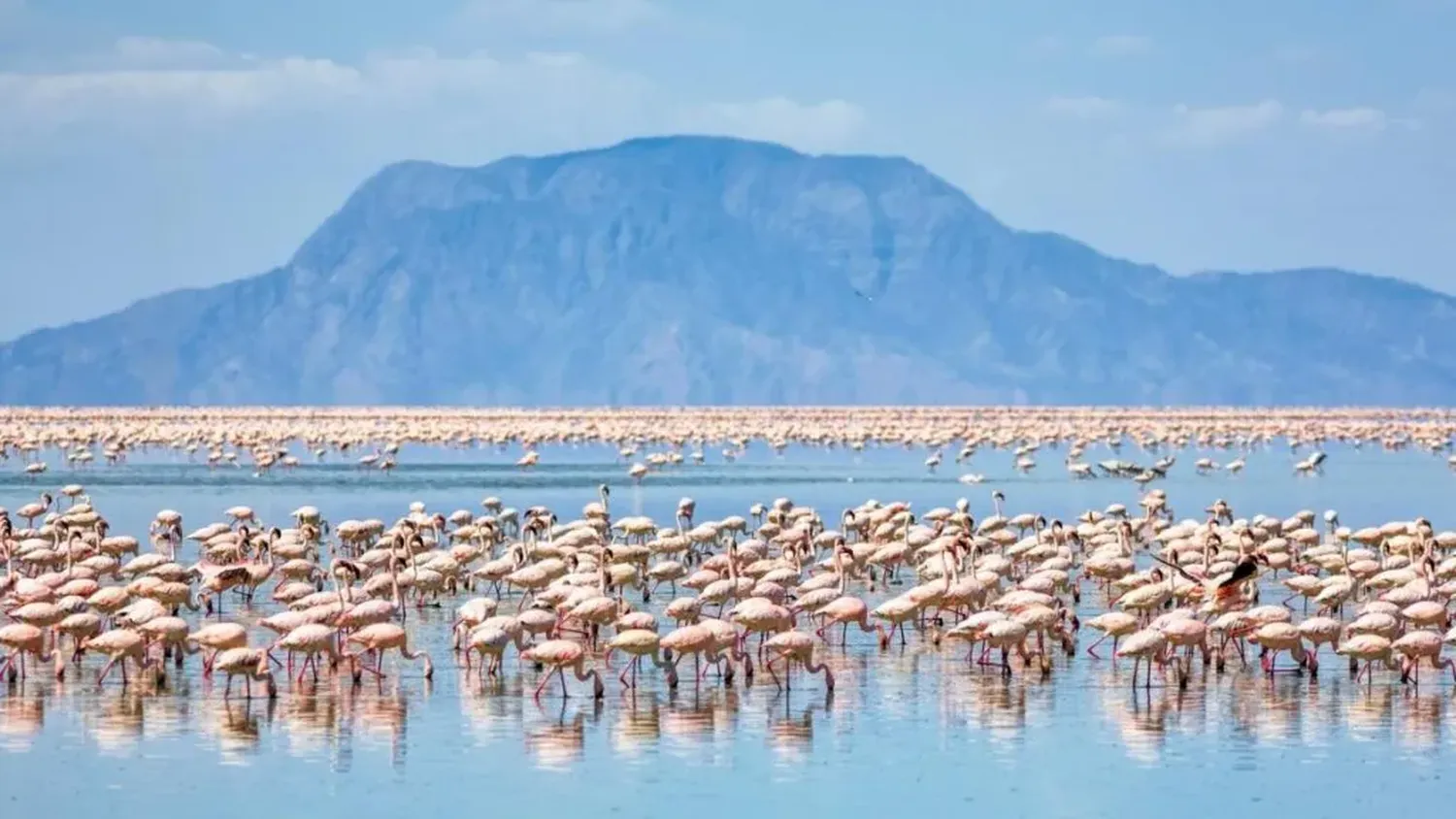
Lake Manyara is often marketed with one image: a pink band of flamingos. That is only part of the park. Tanzania National Parks describes a 648.7 km² protected area at the base of the Great Rift Valley escarpment, with groundwater forest, floodplain, woodland and soda-lake habitats. That tight ecological change makes Manyara useful in a six-day itinerary because one game-drive day feels completely different from the open Serengeti plains.
TANAPA records more than 400 bird species in Lake Manyara National Park. Alongside lesser and greater flamingos, visitors may look for pelicans, storks, herons, spoonbills, fish eagles and seasonal migrants. Away from the shore, the forest and woodland can produce elephants, buffalo, giraffes, hippos, baboons and blue monkeys. The park is also famous for tree-climbing lions, but that reputation should be treated as a possibility rather than a guaranteed sighting.
For deeper destination research before deciding how much time to allocate, see the Jaynevy guides to Lake Manyara bird watching, whether Lake Manyara is worth visiting and the wider Lake Manyara National Park guide.
Flamingos at Lake Manyara: What You Can Honestly Expect
The correct expectation is seasonal opportunity, not a guaranteed count. TANAPA's current wildlife guidance says the alkaline lake hosts seasonal gatherings of lesser and greater flamingos. Its Lake Manyara information also describes thousands of pink-hued flamingos when conditions support feeding. These statements matter because flamingos respond to ecology, not tour calendars.
Water depth, salinity, algae, shoreline exposure and recent rainfall can all influence where waterbirds feed. A lake that was vividly pink on one visit can look very different weeks or months later. That is why a useful safari plan asks the guide or operator about recent sightings close to departure instead of selling one month as an absolute “flamingo season.”
| Planning factor | Why it matters for flamingos | What the traveller should do |
|---|---|---|
| Water level | Changes accessible feeding flats and shoreline conditions | Ask for recent lake conditions |
| Salinity and algae | Influence food availability for flamingos | Avoid expecting a fixed annual timetable |
| Rainfall | Can alter lake size, chemistry and bird distribution | Keep birding expectations flexible |
| Time of day | Light, heat and bird movement can affect viewing quality | Use the guide's local advice |
| Vehicle access | Bird concentrations may be distant from roads | Carry binoculars and a longer camera lens |
Why Serengeti Should Receive Most of the Six Days
Serengeti is not a single wildlife stop; it is a vast ecosystem where distance, rainfall and season shape the experience. UNESCO describes the Serengeti plains as supporting the largest remaining unaltered animal migration in the world, with over one million wildebeest plus hundreds of thousands of other ungulates moving through an annual circular trek of roughly 1,000 km across Tanzania and Kenya.
Tanzania National Parks also describes the Serengeti as supporting more than 500 bird species, so the birding interest does not end after Lake Manyara. The difference is scale: in Manyara, birding happens inside a compact mosaic of habitats; in Serengeti, birdlife sits within enormous grassland, woodland, kopje and river systems alongside lions, leopards, cheetahs, hyenas, elephants, buffalo, giraffes, zebra, gazelles and wildebeest.
Travellers who want more Serengeti depth can compare the dedicated 6-day Serengeti Tanzania safari or the 6-day Serengeti Great Migration safari.
Detailed 6-Day Itinerary
Day 1: Arusha to Lake Manyara National Park
Leave Arusha after breakfast and drive toward Lake Manyara. The goal is not simply to “tick off” the park before lunch; give the habitat enough time to change around you. The entrance area introduces groundwater forest and primates, while the route opens toward floodplain, woodland, wetland and lake-edge viewpoints. Search for elephants, buffalo, giraffes, hippos and monkeys while the guide watches the shoreline and shallows for flamingos and other waterbirds.
If birding is important, tell the guide before entering the park. That changes how the game drive is paced: small wetlands, raptors, mixed bird flocks and distant shorelines deserve more attention than they would on a mammal-only drive. Binoculars are particularly useful because flamingos may feed well away from the closest accessible road.
Day 2: Lake Manyara / Karatu to Serengeti
After breakfast, climb through the Ngorongoro highlands and continue west toward Serengeti. This is a longer road sector, but the changing landscape is part of the Northern Circuit experience. Once you enter the Serengeti ecosystem, the route becomes an afternoon game drive rather than a simple transfer. Your exact overnight zone should match the travel month, road conditions and wildlife priorities.
Central Serengeti is a practical year-round base for many first-time visitors. If your trip is migration-focused, a seasonal camp may make sense, but only when the extra distance and lodge location work within a six-day schedule.
Day 3: Full-Day Serengeti Game Drive
Use the first full Serengeti day for depth rather than mileage. A professional guide can respond to fresh tracks, predator reports, grazing patterns and weather instead of forcing a rigid checklist. Lions, elephants, buffalo, giraffes, zebra, wildebeest, gazelles and hyenas are part of the wider ecosystem; leopard, cheetah and rarer species depend on luck, habitat and timing.
Photographers benefit from staying patient around productive areas instead of racing between distant sightings. Families may prefer a split morning-and-afternoon schedule if the lodge location allows it, while birders can use midday periods to widen the species list.
Day 4: Second Full Day in Serengeti
A second full day changes the quality of the safari because you no longer have to treat every sighting as your only chance. The guide can revisit productive kopjes, riverine habitat or open plains, or reposition toward a seasonal wildlife area when the drive is realistic. This is also the day that makes the itinerary clearly different from a fast four-park circuit with only two Serengeti nights.
If a hot-air balloon safari is part of your plans, it is usually scheduled around sunrise and must be booked separately unless your quotation includes it. Do not sacrifice the entire day's game drive unnecessarily; coordinate the balloon landing, breakfast and guide pickup in advance.
Day 5: Serengeti to Ngorongoro Highlands
Begin with another Serengeti game drive, then gradually work east toward Ngorongoro. Leaving at the right time is important. The final day is strongest when you sleep close enough to the crater for an early descent, so Day 5 must protect both useful Serengeti viewing and realistic transfer time.
Travellers who do not want Ngorongoro can instead use this day as another Serengeti experience and arrange a longer road transfer or a domestic flight, but that changes both the cost and the character of the safari.
Day 6: Ngorongoro Crater Game Drive and Return to Arusha
Descend into Ngorongoro Crater early for a final concentrated wildlife day before returning to Arusha. The crater adds a very different landscape and can provide opportunities for lion, buffalo, elephant, hippo and, with luck, black rhino. Wildlife remains free-ranging, so even in this high-density environment no species should be promised.
If your onward flight is the same evening, build enough buffer into the return. International departure timing should never depend on an unrealistically fast crater exit or road transfer.
Season-by-Season Planning for Manyara and Serengeti
The route works throughout the year, but the best emphasis changes. Flamingos respond to lake ecology, while Serengeti herd location responds largely to rainfall and grazing. That means one fixed “best month” is too simplistic for a trip combining both places.
| Period | Lake Manyara | Serengeti | Planning note |
|---|---|---|---|
| Jan–Feb | Birding remains valuable; flamingo numbers depend on lake conditions | Southern ecosystem can be important for calving-season herds | Consider southern Serengeti/Ndutu positioning if migration is the priority |
| Mar–May | Green landscapes, strong general birding; rain can alter shoreline conditions | Lush scenery, changing herd movement and fewer vehicles in some periods | Allow road-condition flexibility |
| Jun–Oct | Drier conditions can change waterbird distribution | Strong general game viewing; migration shifts north/west through the season | Book popular camps early |
| Nov–Dec | Short rains can rapidly change lake and wetland conditions | Herds begin shifting back toward eastern/southern areas as rains develop | Keep Serengeti camp location flexible |
Published Price Benchmark for a Comparable 6-Day Route
There is no single honest price for every Lake Manyara and Serengeti safari because accommodation, travel month, group size, private versus shared vehicle, Serengeti camp location and government fees all matter. As a current planning benchmark, Jaynevy Tours publishes the comparable six-day four-park safari from Arusha at the following per-person sharing rates:
| Accommodation | 2–3 travellers | 4–6 travellers | What to confirm |
|---|---|---|---|
| Mid-range | USD 2,150 pp | USD 1,850 pp | Exact lodges, season, room type and park fees |
| Luxury | USD 2,450 pp | USD 2,150 pp | Camp locations, room category and seasonal supplements |
These are published reference prices for a comparable route, not a promise that every six-day Manyara–Serengeti configuration will cost the same. A three-night Serengeti version may use different camps and transfers. Always compare the final written quotation line by line. For broader planning, see Tanzania safari cost guidance and Tanzania safari packages.
What Should Be Included in the Written Quotation?
- Private or shared 4x4 safari vehicle and maximum passenger count.
- Professional driver-guide and requested language.
- Five nights of accommodation with exact lodge or camp names.
- Meal plan for every safari day.
- Lake Manyara, Serengeti and Ngorongoro park/conservation charges included or clearly itemized.
- Drinking water during game-drive days.
- Arusha or Moshi pickup and final drop-off.
- Any seasonal Serengeti supplement, concession fee or domestic flight.
- Clear exclusions for tips, insurance, visas, drinks and optional activities.
Birding vs Big-Game Priorities: How to Adjust the Same 6 Days
| Traveller priority | Best adjustment | Trade-off |
|---|---|---|
| Flamingos and birding | Keep a full Manyara day and carry binoculars | One less possible Serengeti night |
| Predators and photography | Use 3 Serengeti nights as in the itinerary above | Less park variety |
| First Tanzania safari | Add Ngorongoro on Day 6 | Active road itinerary |
| Maximum park variety | Add Tarangire Day 1 and reduce Serengeti to 2 nights | Less Serengeti depth |
| Migration tracking | Position Serengeti camp around likely herd region | Longer seasonal transfers may be required |
Common Mistakes to Avoid
- Booking because a photo shows thousands of flamingos. The photograph may be genuine, but it does not guarantee the same lake conditions for your date.
- Giving Lake Manyara only a rushed hour. The value of Manyara is its habitat contrast, not only one shoreline stop.
- Trying to cover too many Serengeti regions. Six days are short; choose a lodge location that works for the season instead of chasing distant names.
- Comparing prices without inclusions. Private transport, concession fees, room category and park charges can materially change value.
- Counting arrival day as a full safari day after a late international flight. Add a pre-night if necessary so the six operational safari days remain intact.
Who Is This Safari Best For?
This route is particularly good for travellers who want to see Tanzania as a set of connected ecosystems rather than a single famous park. Birders get a focused Manyara day and continued bird diversity in Serengeti. First-time safari travellers get classic big-game areas without losing the wetland/forest contrast. Photographers benefit from three Serengeti nights, while families can break the trip into visually different landscapes instead of spending every day in similar terrain.
It is less suitable for travellers whose only goal is one specific Great Migration event such as a river crossing. In that case, a more focused Serengeti itinerary with fewer parks gives the guide more flexibility to position the safari around current herd movement.
Research-Based Wildlife Facts
| Fact | Verified figure / statement | Why it matters |
|---|---|---|
| Lake Manyara park area | 648.7 km² (TANAPA) | Shows how compact and habitat-diverse Manyara is compared with Serengeti |
| Lake Manyara birdlife | More than 400 bird species recorded by TANAPA | Explains why the park is valuable even when flamingo numbers are modest |
| Flamingos | Seasonal lesser and greater flamingo gatherings; TANAPA describes thousands under suitable conditions | Supports realistic, non-guaranteed flamingo planning |
| Serengeti migration | Over 1 million wildebeest plus hundreds of thousands of other ungulates (UNESCO) | Shows the ecosystem scale behind the migration |
| Migration circuit | Roughly 1,000 km annual circular trek (UNESCO) | Explains why herd location cannot be fixed to one park sector all year |
| Serengeti birdlife | Over 500 bird species according to TANAPA | Birders continue to have strong opportunities after leaving Manyara |
Useful Internal Pages for Planning
- 6-Day Tarangire, Manyara, Serengeti & Ngorongoro from Arusha
- 6-Day Northern Circuit from Moshi
- 6-Day Serengeti Tanzania Safari
- Lake Manyara Bird Watching Guide
- Is Lake Manyara Worth Visiting?
- Tanzania Safari Cost Guide
- Tanzania Safari Packages
Research and Official Sources
The ecological figures above are separated from practical itinerary estimates. Park size, bird diversity and flamingo descriptions come from Tanzania National Parks; migration figures come from the UNESCO World Heritage Centre. Drive times, lodge positioning and day-to-day routing are operational planning guidance and can change with roads, weather, gates, wildlife stops and accommodation.
- Tanzania National Parks — About Lake Manyara
- Tanzania National Parks — Lake Manyara Wildlife & Habitats
- Tanzania National Parks — Serengeti Attractions
- UNESCO World Heritage Centre — Serengeti National Park
Frequently Asked Questions
Can you see flamingos at Lake Manyara on a 6-day safari?
Yes, Lake Manyara is an important flamingo and waterbird habitat, but the spectacle is seasonal. Tanzania National Parks describes seasonal gatherings of lesser and greater flamingos, so numbers can vary with water level, salinity, algae and recent rainfall. Treat flamingos as a strong possibility rather than a guaranteed sighting.
How many days should be spent in the Serengeti on this itinerary?
For a six-day route, two to three Serengeti nights is the strongest balance. Two nights work in a four-park Northern Circuit itinerary; three nights are better if predators, photography or seasonal migration positioning matter more than visiting the maximum number of parks.
What is the best route for Lake Manyara and Serengeti in six days?
A practical road route is Arusha to Lake Manyara, then through the Ngorongoro highlands to Serengeti, followed by a final Ngorongoro Crater game drive before returning to Arusha. Travellers who want more park variety can add Tarangire on Day 1 and keep Lake Manyara on Day 2.
What is the best time to see flamingos at Lake Manyara?
There is no single month that guarantees flamingos. Their numbers respond to changing lake conditions and food availability. Current TANAPA guidance describes the flamingo spectacle as seasonal, so the best approach is to ask for recent local conditions close to travel rather than book around an absolute promise.
Is Lake Manyara worth including if Serengeti is the main priority?
Yes if you value birding, Rift Valley scenery, groundwater forest, wetlands and a compact ecosystem that contrasts with the Serengeti plains. If your main goal is migration tracking or photography, using the Manyara day as an extra Serengeti night can be a better choice.
How much does a comparable 6-day Northern Circuit safari cost?
Jaynevy Tours currently publishes a comparable private six-day Tarangire, Lake Manyara, Serengeti and Ngorongoro itinerary from Arusha from USD 1,850 per person sharing for 4 to 6 travellers in mid-range accommodation. The same published page lists USD 2,150 per person for 2 to 3 travellers. Final price depends on dates, accommodation, group size and the written quotation.
Can this safari start from Moshi instead of Arusha?
Yes. Moshi departures are practical for travellers staying near Kilimanjaro, but Arusha is normally the more efficient road start for Lake Manyara and the Northern Circuit. Jaynevy Tours also lists a dedicated six-day Tarangire, Manyara, Serengeti and Ngorongoro route from Moshi.
Are tree-climbing lions guaranteed at Lake Manyara?
No. Lake Manyara is well known for tree-climbing lions, but lions are free-ranging wildlife and sightings cannot be guaranteed. A responsible guide treats them as one possible highlight while also focusing on elephants, buffalo, primates, hippos, birds and the park landscape.
Does a 6-day Lake Manyara and Serengeti safari include Ngorongoro?
It can, and for road logistics it often makes sense. The route to and from Serengeti naturally passes through the Ngorongoro highlands. Adding a crater game drive on the final day creates a stronger six-day Northern Circuit itinerary without a major geographic detour.