
Quick Answer: Is June or July Better for a 6-Day Tanzania Migration Safari?
Choose June if you want the Great Migration moving through central and western Serengeti toward the Grumeti corridor; choose July if northern Serengeti and the possibility of Mara River crossings are your main goal. June is a transition month, so herds can be spread between central and western areas. By July, more herds often push north, but the exact timing changes with rainfall and grass conditions.
A six-day trip is long enough when you avoid trying to visit too many parks. For July, a flight out of northern Serengeti can be worth the extra cost because it prevents a long return drive from consuming your final safari day. River crossings should be treated as a possibility, never a guaranteed appointment.
June vs July Tanzania Safari: Which Month Matches Your Goal?
| Factor | June | July |
|---|---|---|
| Typical migration direction | Central Serengeti toward western corridor and permanent water | Northward movement toward northern Serengeti and Mara River |
| Best broad safari base | Central-western / western Serengeti, depending on current reports | Northern Serengeti around Kogatende; early July may still require flexibility |
| River interest | Grumeti-area movement can be relevant | Mara River crossing opportunities become more important |
| Crossing certainty | No guaranteed Grumeti crossing | No guaranteed Mara crossing |
| Weather feel | Drying, cool mornings, generally comfortable days | Drier and often dustier; mornings can be cold |
| Demand | High season begins building | Higher demand, especially in northern migration camps |
| Best for | Travellers who want migration movement plus slightly more routing flexibility | Travellers prioritising northern Serengeti and river-crossing potential |
For more month-specific detail, compare the dedicated Tanzania safari in June guide and Tanzania safari in July guide. Both pages are listed in the Jaynevy Tours sitemap.
Where Is the Great Migration in June and July?
The migration is driven by water and fresh grazing, not by a timetable. TANAPA's Serengeti migration map describes an April-to-June westward phase followed by a broader June-to-November northern phase. UNESCO's Serengeti documentation also notes that the spectacle is especially impressive in May and June when enormous herds move from the central plains toward permanent water on the western side of the park.
June: Central Serengeti to the Western Corridor
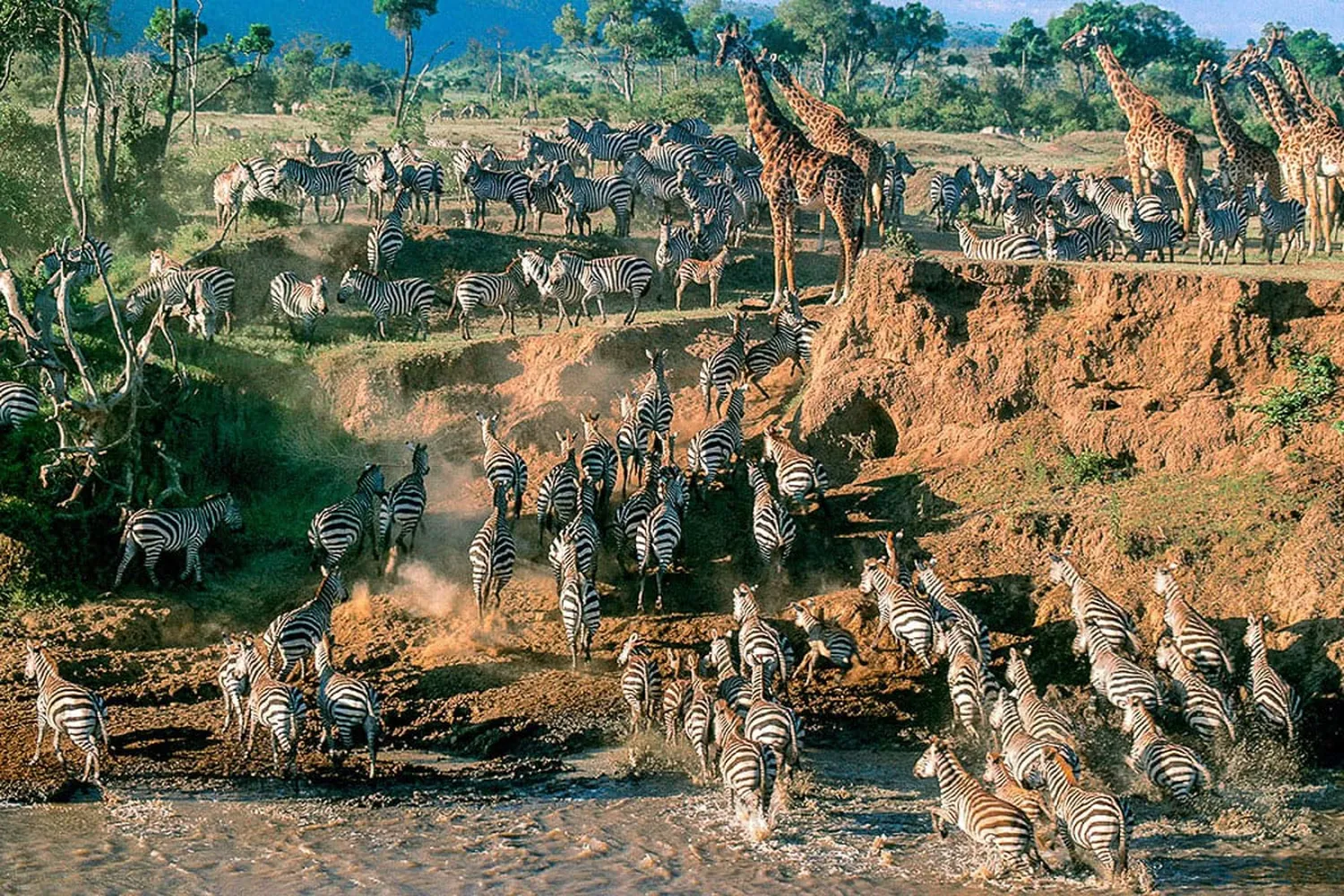
In June, large columns of wildebeest and zebra may stretch across central-western grasslands as they move toward the western corridor. UNESCO documentation describes mass movements in May and June that can form lines more than 10 kilometres long. The Grumeti system can become important, but one six-day itinerary should not be built around the promise of a single river crossing. A better goal is to spend enough time in the western movement zone to follow the herds wherever they settle that week.
July: Western and Central Herds Push North
By July, the safari focus increasingly shifts north. Kogatende and the wider Mara River area can become strategically important, especially from mid to late July, but movement varies from year to year. Some groups may arrive early while others remain farther south. A responsible July itinerary therefore uses recent field reports and accommodation with access to the active herd zone rather than assuming every guest will watch a river crossing.
Verified Migration and Wildlife Data
| Data point | Verified figure / finding | Planning meaning |
|---|---|---|
| Serengeti National Park area | 14,763 km² | TANAPA's brochure shows why choosing the correct sub-region matters on a six-day trip. |
| Serengeti ecosystem | About 30,000–35,000 km² depending on the operational/ecological definition used | The migration moves across a much larger ecosystem than the national park alone. |
| Migration scale | About 2 million wildebeest plus hundreds of thousands of zebra and gazelle | UNESCO describes one of the world's largest remaining unaltered terrestrial migrations. |
| Annual circuit | About 1,000 km | Monthly herd location is seasonal and rainfall-driven rather than fixed. |
| May–June movement | Mass westward movement; UNESCO documentation describes columns over 10 km long | June itineraries should not automatically target northern Serengeti. |
| TANAPA seasonal map | April–June west; June–November north | June is a transition month and July increasingly favours northern positioning. |
| Ngorongoro large animals | About 25,000 | UNESCO notes high year-round wildlife density, making the crater a reliable complement to migration-focused Serengeti days. |
Important: historical migration patterns are useful for positioning, but they are not a guarantee. Rainfall can accelerate, delay or split herd movement. The exact camp should be confirmed against current conditions before travel.
Best 6-Day Tanzania Safari Itinerary for June and July Migration
The strongest six-day itinerary changes slightly between June and July. Both versions keep Tarangire and Ngorongoro because they add habitat variety and dependable wildlife, but the Serengeti nights are placed where the migration is most useful for that month.
| Day | June route | July route |
|---|---|---|
| 1 | Arusha → Tarangire game drive → Karatu | Arusha → Tarangire game drive → Karatu |
| 2 | Ngorongoro Crater → Karatu/NCA edge | Ngorongoro Crater → Karatu/NCA edge |
| 3 | Drive to central Serengeti; afternoon game drive | Drive to central Serengeti; afternoon game drive |
| 4 | Move toward western corridor / current migration zone | Move north toward Kogatende / current migration zone |
| 5 | Full day western Serengeti migration tracking | Full day northern Serengeti and Mara River zone |
| 6 | Morning game drive; return or fly depending camp position | Morning northern game drive; scheduled flight to Arusha is usually the efficient option |
If migration is your main reason for travelling, compare the dedicated 6-day Serengeti wildebeest migration safari. Travellers who want complete control of how long they wait at herd concentrations should also compare a 6-day private Tanzania safari, while price-focused travellers can review the 6-day Tanzania sharing safari.
What to Know About Grumeti and Mara River Crossings
River crossings are dramatic, but they are also the part of migration marketing most likely to be oversold. Herds may gather for hours and then walk away. They can cross outside your game-drive window, use a different point, or remain on one side for days. A six-day safari should therefore be designed around migration viewing, not a crossing guarantee.
- June: the western corridor and Grumeti system can be relevant as the herds move west and northwest.
- July: northern Serengeti and the Mara River become increasingly important, especially later in the month.
- Ethical viewing: TANAPA's Mara River crossing guideline requires vehicles to use designated crossing points and remain stationary when migrants congregate to cross.
- Photography: a longer lens and patience usually matter more than chasing animals from point to point.
- Plan B: the northern Serengeti is still excellent for lions, elephants, cheetahs, leopard habitat and general plains game even if no crossing occurs.
June and July Weather: Dry Season Does Not Mean Warm Mornings
June and July fall in Tanzania's cool dry-season period. Road conditions are generally more reliable than during the long rains, grass begins to shorten, and wildlife often becomes easier to locate around dependable water. However, early morning departures can feel cold, particularly on the Ngorongoro rim and in open northern plains.
The Tanzania Meteorological Authority's June–August 2026 seasonal outlook described the period as generally cool across many parts of the country and noted episodes of stronger winds during June and July. Its July 2026 review also recorded moderate to severe cold during some nights and mornings in parts of Tanzania. These are national forecasts, not a promise of exact Serengeti temperatures, but they reinforce the need for warm layers on dawn game drives.
| Condition | June | July | What to pack |
|---|---|---|---|
| Early mornings | Cool | Cool to cold | Fleece or insulated layer |
| Afternoons | Comfortable to warm in lower areas | Comfortable, often dry | Light breathable shirt |
| Dust | Increasing | Often more noticeable | Lens cloth, scarf/buff, closed shoes |
| Rain risk | Usually lower than green season | Generally low, but local showers remain possible | Light waterproof shell |
How Much Does a 6-Day June or July Migration Safari Cost?
There is no single responsible price for every June or July migration safari. High-season camp location, vehicle format, group size, room category, park fees and whether you fly out of northern Serengeti all affect the total. Jaynevy Tours currently publishes a general 6-day Serengeti joining safari range of about USD 1,400–1,800 per person, including tax fees, park fees, meals, guide fees and shared transport. Treat that as a published product reference, not a guaranteed quote for every June or July migration route.
A northern July itinerary can cost more because well-positioned seasonal camps are in high demand and a Kogatende-to-Arusha flight may be added to save a full day of road travel. Review the broader Tanzania safari cost guide and request an itemised quotation before comparing operators.
| Price factor | Why it changes the total | Best question to ask |
|---|---|---|
| Private vs shared vehicle | Vehicle, fuel and guide costs are split among fewer or more guests | Is the safari private or joining? |
| Migration camp location | Northern and seasonal camps can carry high-season premiums | Which exact camp is included? |
| Fly-out from north | Adds airfare but saves long road hours | Is the Kogatende flight included? |
| Park / conservation fees | Mandatory statutory charges form a significant part of the safari cost | Are all park and Ngorongoro charges included? |
| Room type | Single rooms, family rooms and premium tents price differently | Is there a single supplement? |
| Travel date | July is a high-demand migration month | Is the quoted rate valid for my exact dates? |
Packing List for June and July Safari
- Warm fleece or light insulated jacket for dawn game drives and Ngorongoro.
- Neutral-coloured lightweight shirts and trousers for warmer daytime conditions.
- Light waterproof/windproof shell.
- Closed walking shoes plus comfortable camp shoes.
- Wide-brim hat, sunglasses and high-SPF sunscreen.
- Binoculars; 8×42 or 10×42 are practical safari choices.
- Camera with spare batteries, memory cards, beanbag and dust-cleaning kit.
- Soft-sided luggage if a light aircraft sector is included.
- Personal medicines and copies of travel-insurance documents.
Five Mistakes to Avoid on a 6-Day June–July Migration Safari
- Booking central Serengeti for every night. Central Serengeti is excellent, but migration-first travellers need seasonal positioning.
- Expecting a guaranteed river crossing. Wildlife does not perform to a timetable.
- Driving north and back by road in too few days. In July, a fly-out can protect valuable game-drive time.
- Choosing the cheapest camp regardless of location. A cheap room several hours from the herds can cost you the experience you travelled for.
- Ignoring early-morning cold. June and July can be surprisingly chilly before sunrise.
Who Is This June–July 6-Day Safari Best For?
| Traveller | Best choice | Why |
|---|---|---|
| First-time safari traveller | Tarangire + Ngorongoro + seasonally positioned Serengeti | Balances migration with reliable Northern Circuit wildlife. |
| Migration-focused photographer | Private safari with two full days in current herd zone | More flexibility for light, positioning and waiting. |
| Budget-conscious traveller | Joining safari, but verify exact Serengeti region | Lower shared cost without sacrificing seasonal logic. |
| July river-crossing hopeful | Northern Serengeti + fly-out | Maximises time near the Mara while avoiding a long final transfer. |
| Traveller who dislikes crowds | June or early July, with flexible western/transition routing | Can be less intense than peak northern crossing periods, though no date is crowd-free. |
Related Tanzania Safari Planning
Before confirming dates, use the Tanzania safaris by month guide to compare the wider year, and review the Tanzania Northern Circuit safari guide for route context. If a Grumeti fly sector is part of the plan, the Grumeti Airstrip in Serengeti guide can help with logistics.
Frequently Asked Questions
Is June a good month for a 6-day Tanzania safari?
Yes. June is one of the strongest transition months for the Great Migration. Large herds often move from central Serengeti toward the western corridor and permanent water, while drier conditions improve road access. Exact herd position still depends on rainfall and grazing.
Is July better than June for the Great Migration?
July is usually better if your priority is northern Serengeti and the possibility of Mara River crossings. June can be better for western Serengeti and Grumeti-area movement. Neither month guarantees a river crossing, so camp location and flexible guiding matter more than a fixed date.
Can I see a Mara River crossing in early July?
It is possible, but it cannot be guaranteed. Some herds may reach northern Serengeti in July while others remain farther south or west. River crossings depend on herd position, rainfall, grass and animal behaviour on the day.
Where should I stay in June for the migration?
A June migration safari often benefits from central-western or western Serengeti positioning, depending on current herd reports. The western corridor and Grumeti area can be especially relevant as the herds move toward permanent water.
Where should I stay in July for the migration?
For a migration-first July safari, northern Serengeti around the Kogatende and Mara River zone is often the strongest target, although early-July itineraries should retain flexibility because herds may still be moving north.
Is six days enough for the June or July migration?
Six days can work well if the route is seasonally focused and avoids too many parks. In July, a fly-out from northern Serengeti can save a long road transfer and protect game-drive time.
What is the weather like in Tanzania in June and July?
June and July fall in Tanzania’s cool dry-season period. Days in the safari lowlands are often comfortable, but early mornings, Ngorongoro highlands and open safari vehicles can feel cold. Tanzania Meteorological Authority guidance for June–August 2026 also highlighted cooler conditions and some windy periods.
How much does a 6-day June or July safari cost?
The final price depends on group size, whether the safari is private or shared, migration-camp location, park and conservation fees, room category and whether a domestic flight is used. Jaynevy Tours currently publishes a general 6-day Serengeti joining safari range of about USD 1,400–1,800 per person, but a June or July migration-focused quote can differ.
Should I choose a private or joining safari for migration season?
A joining safari can reduce cost, while a private safari gives more control over departure times, photography stops and how long you wait for herd movement. For travellers focused heavily on migration behaviour, private flexibility can be valuable.
How far in advance should I book July migration camps?
Book as early as practical, especially for northern Serengeti camps. July is high season and well-positioned camps have limited inventory. Six to twelve months ahead is a useful planning window for popular dates, though availability varies.
Sources and Data Notes
This article uses official conservation and weather sources for the numerical and seasonal claims. Migration timing remains an ecological pattern rather than a fixed schedule, so recent field reports should always be checked close to travel.
- TANAPA: Serengeti National Park general brochure
- TANAPA: Serengeti migration route map and seasonal guidance
- TANAPA: Mara River Migration Crossings Guideline, revised June 2024
- UNESCO World Heritage Centre: Serengeti National Park
- UNESCO: Serengeti migration documentation
- UNESCO World Heritage Centre: Ngorongoro Conservation Area
- Tanzania Meteorological Authority: June–August 2026 seasonal outlook