
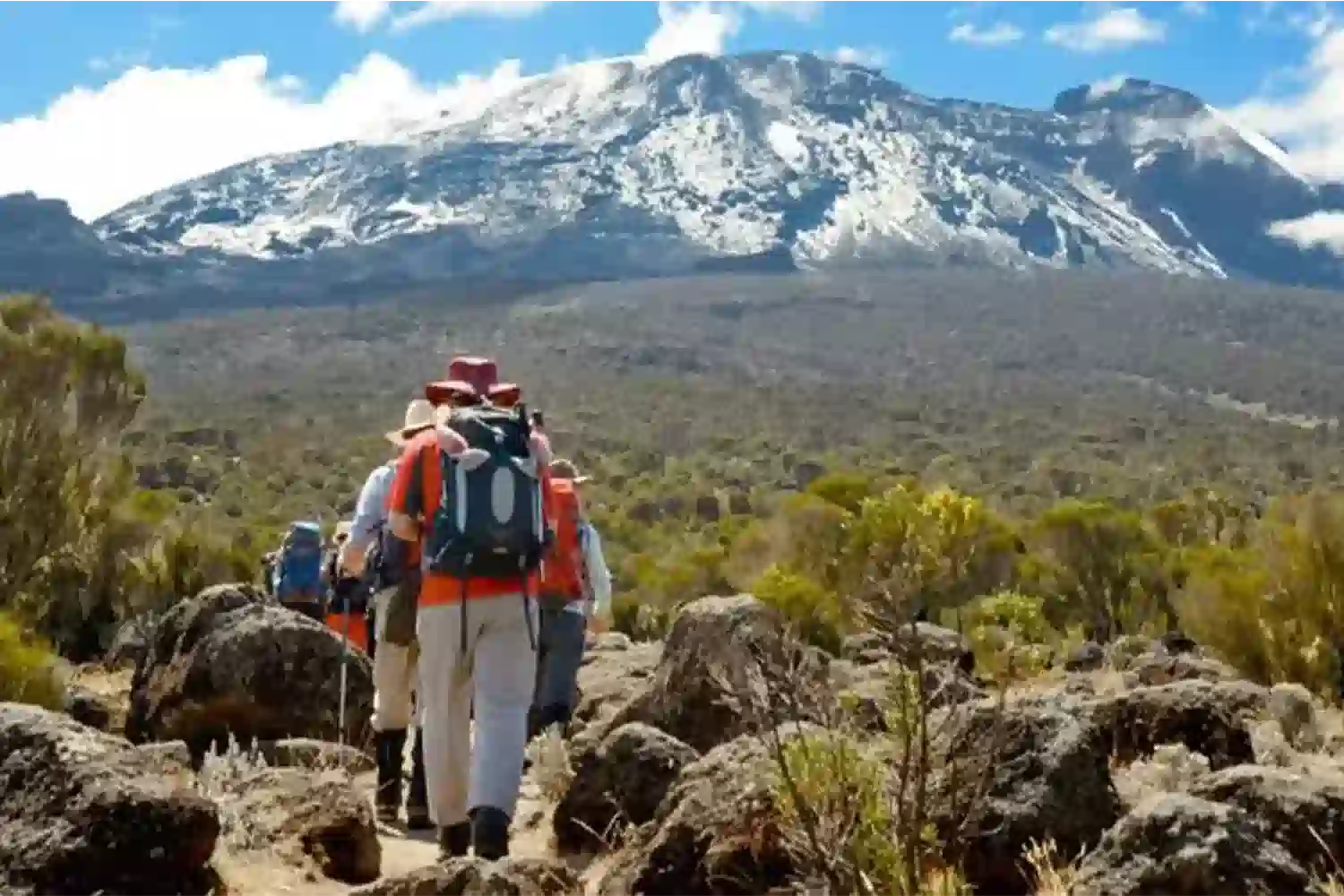
7-Day Kilimanjaro All-Inclusive Package at a Glance
Our 7-day Machame package is a camping climb designed for travelers who want a complete mountain operation rather than arranging guides, porters, meals, park logistics and transfers separately. The route is scenic and non-technical, but it remains a demanding high-altitude trek to Uhuru Peak at 5,895 m. A pre-climb hotel night is recommended and is not counted as one of the seven trekking days.
| Quick Fact | What to Expect |
|---|---|
| Route | Machame Route, descending via Mweka |
| Mountain duration | 7 trekking days |
| Highest point | Uhuru Peak, 5,895 m |
| Accommodation on the mountain | Camping in designated campsites |
| Key acclimatization feature | Shira to Barranco via Lava Tower, plus an overnight at Karanga before Barafu |
| Starting price | From USD 2,200 per person; final quote varies by confirmed services |
If you are deciding between six and seven mountain days, our 6-day vs 7-day Machame Route comparison explains why the Karanga overnight changes the pace before summit night.
How Much Does the 7-Day Kilimanjaro All-Inclusive Package Cost?
The price of this 7-Day Kilimanjaro All-Inclusive Package starts from USD 2,200 per person. Your final price can change with group size, travel date, private or shared arrangements, hotel category before and after the climb, airport-transfer requirements, personal equipment rental and any safari or Zanzibar extension. We confirm the exact amount and inclusions in writing before you pay a deposit.
| Price Variable | Why It Can Change the Quote |
|---|---|
| Group size | Some transport and mountain-operation costs are shared across the group. |
| Travel date | Hotel and supplier availability can differ by season and departure date. |
| Pre/post-climb hotel | Room category, number of nights and single-room requests affect the land package. |
| Personal rental equipment | Boots, sleeping bags, trekking poles or clothing are confirmed separately when needed. |
| Extra services | Private transfers, safari extensions, Zanzibar stays or additional nights are added only when requested. |
We do not rely on a generic price table for every traveler. Send us your date, number of climbers, pickup point and equipment needs so we can issue a written quotation that matches your actual trip.
7-Day Kilimanjaro Machame Route Itinerary
The seven-day itinerary below counts mountain days from Machame Gate to Mweka Gate. Arrive in Moshi at least the day before the climb for your briefing, equipment check and final preparation. Hiking times and distances are approximate because pace, weather, trail conditions and guide decisions vary.
Before Day 1: Arrival, Briefing and Equipment Check in Moshi
We recommend a pre-climb night in Moshi. When airport transfer and accommodation are included in your quotation, we coordinate your arrival from Kilimanjaro International Airport, hotel check-in, route briefing and gear check. This night is outside the seven trekking days.
Day 1: Machame Gate to Machame Camp
After registration at Machame Gate, you enter the montane rainforest and climb steadily to Machame Camp. The stage is commonly around 10-11 km and takes roughly 5-7 hours, depending on the group and trail conditions.
Day 2: Machame Camp to Shira Camp
The trail leaves the forest for heath and moorland, with a shorter but steeper climb toward the Shira Plateau. Expect roughly 5 km of trekking over about 4-6 hours, followed by rest and preparation for the higher acclimatization day.
Day 3: Shira Camp to Barranco Camp via Lava Tower
You climb toward Lava Tower at around 4,600 m before descending to sleep lower at Barranco Camp near 3,950 m. This is an important acclimatization stage and is usually one of the longer days, commonly around 10 km and 6-8 hours.
Day 4: Barranco Camp to Karanga Camp
The day begins with the Barranco Wall, a steep hands-on scramble that does not normally require technical climbing equipment. You then cross undulating alpine terrain to Karanga Camp. The walk is commonly about 5-6 km and 4-6 hours.
Day 5: Karanga Camp to Barafu Camp
This is a shorter approach to high Barafu Camp, typically around 4 km. After arrival, the focus is on eating, hydrating, checking summit clothing and resting before the overnight summit departure.
Day 6: Barafu Camp to Uhuru Peak and Down to Mweka Camp
The summit attempt normally begins around midnight. You climb toward Stella Point and continue to Uhuru Peak at 5,895 m if conditions, health and guide decisions allow. After a short summit stop, you descend past Barafu and continue to Mweka Camp. This is the longest and most demanding day of the itinerary.
Day 7: Mweka Camp to Mweka Gate and Transfer to Moshi
The final descent returns through forest to Mweka Gate, commonly around 10 km and 3-4 hours. After park exit procedures, we arrange the road transfer back to Moshi according to your confirmed package. A post-climb hotel night is recommended before an early onward flight.
For a dedicated route overview, see our Machame Route guide and our 7-day Machame climbing package.
What's Included in the 7-Day Kilimanjaro All-Inclusive Package?
Our core package is built around the services needed to operate the climb safely and practically. Because “all-inclusive” can mean different things to different travelers, your written quotation is the final authority on airport transfers, hotel nights, personal rental equipment and any upgrades.
Core Mountain Services We Arrange
- Mount Kilimanjaro park and camping arrangements for the confirmed itinerary
- Professional mountain guide team, porters and cook
- Standard group camping equipment and sleeping mats
- Meals and drinking water on the mountain
- Transport between Moshi and the mountain gates
- Pre-climb route briefing and equipment check
- Basic first-aid and emergency-support equipment carried by the mountain team according to the operating plan
Usually Excluded or Confirmed Separately
- International and domestic flights unless specifically listed
- Tanzania visa and entry-related costs
- Travel insurance with adequate high-altitude trekking and evacuation cover
- Tips for the mountain crew
- Personal clothing, boots and other individual trekking equipment unless rental is confirmed
- Personal purchases, alcoholic drinks and unlisted hotel meals
- Extra hotel nights, private-room upgrades, safari extensions and Zanzibar arrangements
Before booking, we recommend checking every item in the written quotation rather than assuming that the word “all-inclusive” covers every personal travel expense.
Acclimatization, Altitude and Safety on Kilimanjaro
Kilimanjaro is a high-altitude trek, and reaching 5,895 m carries a genuine risk of altitude illness. The seven-day Machame schedule gives more time than a compressed itinerary, including an overnight at Karanga before Barafu, but extra time does not guarantee a summit. You should report symptoms honestly and follow your guide's decision if the safest option is to stop, descend or change the plan.
- Walk slowly and avoid racing to camp, even when you feel strong.
- Drink and eat regularly as advised by your guide.
- Tell the guide early about headache, nausea, unusual fatigue, dizziness, breathing difficulty or changes in coordination.
- Do not treat fitness as protection against altitude illness; acclimatization varies between individuals.
- Confirm that your travel insurance covers trekking to the summit altitude and emergency evacuation.
The CDC Yellow Book guidance for Kilimanjaro notes that additional ascent time helps acclimatization. Medical advice and medication decisions should be discussed with a qualified clinician before travel.
Best Time for a 7-Day Kilimanjaro Climb
January to early March and June to October are commonly chosen for Kilimanjaro because conditions are often drier. April and May usually bring heavier rainfall, while November and December can be more variable. There is no month with guaranteed clear weather: conditions can change quickly from warm lower slopes to freezing summit temperatures.
| Period | General Pattern | Planning Guidance |
|---|---|---|
| January to early March | Often drier with mixed cloud and clear periods | A popular window; pack for rain and cold despite generally favorable conditions. |
| April to May | Typically wetter | Expect muddier lower trails, more rain protection and potentially lower visibility. |
| June to October | Often drier and cooler | Popular climbing months; summit nights can be very cold. |
| November to December | More variable with short-rain periods | Conditions can still be climbable, but flexibility and waterproof gear matter. |
If your dates are fixed, ask us what operational conditions we are seeing for that period rather than choosing only by a generic “best month” label.
Who This 7-Day Machame Package Suits
This package is a good fit for active travelers who want more acclimatization time than a compressed Machame schedule and are comfortable camping for a week. It can work for first-time high-altitude trekkers when they train properly, but it is not an easy hike and it should not be chosen only because no technical climbing skills are required.
- Good fit for: active beginners, experienced hikers, couples, friends, solo travelers joining an arranged departure and travelers combining Kilimanjaro with a safari.
- Discuss with us first if: you have limited trekking experience, mobility limitations, a tight flight connection after the climb, significant medical concerns or uncertainty about altitude insurance.
- Choose a longer or different route when: your priority is an even more gradual itinerary or a different scenery/traffic profile; compare our Kilimanjaro climbing packages before deciding.
Kilimanjaro Packing and Preparation Essentials
Prepare for several climate zones rather than one “African” temperature. The most important principle is layering: moisture-managing base layers, insulating mid-layers, a warm outer layer and waterproof protection. Your footwear should be broken in before arrival, and your summit-night system should be tested as a complete set.
- Waterproof hiking boots with suitable socks
- Base layers, trekking layers and insulated jacket
- Waterproof jacket and trousers
- Warm hat, sun hat, gloves and spare dry layers
- Headlamp with spare batteries for summit night
- Daypack, water capacity and personal snacks as advised
- Sunglasses, sunscreen and personal toiletries
- Personal medication and any clinician-recommended items
- Travel documents and proof of suitable insurance
Tell us which items you plan to rent before arrival. Personal equipment availability and rental charges should be confirmed in writing rather than assumed.
Arrival, Accommodation and Transfer Planning
Plan to be in Moshi at least one day before the climb. This gives time for a proper briefing, equipment check, missing-gear solution and rest before Machame Gate. Where airport transfers and hotel nights are included, we coordinate them according to your arrival details; otherwise we can quote them separately.
After the climb, avoid scheduling an unnecessarily tight international connection from the gate. A post-climb night gives you time to shower, recover, reorganize luggage and handle any timing changes caused by the mountain. If you are continuing to wildlife safari, we can connect the trip with our Tanzania safari packages.
Why Book Your Kilimanjaro Climb with Jaynevy Tours?
We coordinate the moving parts that matter before and during the climb: route planning, mountain crew, park logistics, camping, meals, gate transport, briefing and any hotel or airport services included in your quotation. Our role is also to make the package boundaries clear so you know what is confirmed, what is optional and what you must arrange personally.
Use the booking form on this page to send your preferred dates, number of climbers, arrival airport, accommodation preference and rental-equipment needs. We will respond with the written itinerary, confirmed inclusions and final quotation for your trip.
Related Kilimanjaro and Tanzania Trip Options
If you are still comparing routes or planning a longer Tanzania trip, these pages can help you make the next decision:
- Compare our Kilimanjaro climbing packages
- Read the Machame Route overview
- See the 7-day Machame climbing package
- Compare the 6-day and 7-day Machame itineraries
- Consider Mount Meru for trekking and altitude preparation
- Add a Tanzania wildlife safari after Kilimanjaro
- Add a Zanzibar beach holiday
Frequently Asked Questions about the 7-Day Kilimanjaro All-Inclusive Package
How much does the 7-Day Kilimanjaro All-Inclusive Package cost?
The price of our 7-Day Kilimanjaro All-Inclusive Package starts from USD 2,200 per person. Your final price depends on travel date, group size, accommodation before and after the climb, private or shared arrangements, equipment needs and any additional services confirmed in your written quotation.
Does the 7-day package mean seven days on the mountain?
Yes. In this itinerary, the seven-day duration refers to seven trekking days from Machame Gate to Mweka Gate. Plan at least one pre-climb night in Moshi for briefing and equipment checks, and ideally a post-climb night before an onward flight or safari.
What is included in the all-inclusive Kilimanjaro package?
Our core package is designed to cover the main mountain logistics: park and camping arrangements, professional mountain crew, camping equipment, meals and drinking water on the mountain, gate transfers and the pre-climb briefing. Airport transfers, hotel nights, personal rental gear and other services are included only when they are listed in your written quotation.
Is the 7-day Machame Route suitable for beginners?
It can suit fit first-time high-altitude trekkers who train properly and understand that Kilimanjaro is a demanding altitude trek. The route does not require technical mountaineering skills, but long walking days, cold conditions and altitude make preparation and honest communication with your guide essential.
When is the best time to climb Kilimanjaro via Machame?
January to early March and June to October are commonly chosen because conditions are often drier. April and May usually bring heavier rainfall, while November and December can be more variable. Mountain weather can change quickly in any month, so waterproof and cold-weather layers are needed year-round.
Do you guarantee that I will reach Uhuru Peak?
No. No responsible Kilimanjaro operator can guarantee a summit. Your outcome depends on acclimatization, health, weather, pace and guide safety decisions. Our priority is to manage the climb responsibly, monitor how you are feeling and descend when safety requires it.
Is personal trekking gear included?
Group camping equipment is part of the mountain operation, but personal items such as boots, base layers, insulated clothing and other individual gear should not be assumed to be included. Tell us what you already own and we will confirm any available rental items and costs in your quotation.
Can I combine this Kilimanjaro climb with a safari or Zanzibar?
Yes. We can coordinate an onward Tanzania safari or Zanzibar holiday after your climb. We recommend allowing enough recovery time after the mountain before tightly timed flights or physically demanding activities.