Written by Julius Nyange | Reviewed for safari planning accuracy | Last updated: July 29, 2026
Quick Answer: Where Is the Great Migration Each Month?
January to March: book Ndutu, Kusini or the southern Serengeti for calving and predator activity. April: herds remain in the south but begin spreading toward central Serengeti. May and June: target Moru, Seronera and the western corridor as long columns move north and west. July to October: stay near Kogatende, Lamai or northern Serengeti for the best chance of Mara River crossings. November and December: the herds commonly move through the northeast, east and central Serengeti before returning to the southern short-grass plains. These are probability zones, not fixed appointments; rainfall controls the exact route.
| Month | Most Likely Area | Main Migration Phase | Useful Airstrip | Planning Confidence |
|---|---|---|---|---|
| January | Ndutu, Kusini, southern plains | Herds gathering; early calving | Ndutu or Kusini | High for southern region |
| February | Ndutu and Ngorongoro short-grass plains | Peak calving and predator action | Ndutu | High for calving zone |
| March | Ndutu, Kusini, southern Serengeti | Late calving; herds begin spreading | Ndutu or Kusini | Medium-high |
| April | South-central Serengeti, Naabi, Moru | Northbound transition during long rains | Seronera or Ndutu | Medium |
| May | Moru, central Serengeti, western corridor | Long columns and mating activity | Seronera or Grumeti | Medium |
| June | Western corridor, Grumeti, Kirawira | Grumeti crossings and northward movement | Grumeti or Kirawira | Medium-high |
| July | Northwest and northern Serengeti | Arrival toward the Mara River | Kogatende | Medium-high |
| August | Kogatende, Lamai, Mara River | Strong river-crossing window | Kogatende | High for northern region |
| September | Northern Serengeti and Maasai Mara | River crossings and divided herds | Kogatende | High for northern region |
| October | Northern Serengeti, Lobo, Loliondo side | Late crossings; southward return begins | Kogatende or Lobo | Medium-high |
| November | Northeast, eastern and central Serengeti | Return south after short rains | Lobo or Seronera | Medium |
| December | Central, eastern and southern plains | Herds rebuild in the south | Seronera or Ndutu | Medium-high |
What the Serengeti Great Migration Really Is
The Great Migration is a continuous circular search for fresh grass and water across the wider Serengeti-Mara ecosystem. UNESCO describes the Serengeti as the site of the world's largest remaining unaltered animal migration, involving more than one million wildebeest plus hundreds of thousands of zebras and gazelles on an annual circuit of roughly 1,000 kilometres. The protected Serengeti property itself covers about 1.48 million hectares, while the wider ecosystem is approximately 25,000 square kilometres.
Published population figures differ by survey method and year. UNESCO uses broad totals of more than one million wildebeest and millions of migrating herbivores, while a recent ecological study describes a seasonal migration of about 1.3 million wildebeest. The useful planning lesson is not the exact headline number; it is that the herds can spread across many kilometres, split into separate groups and change direction after local rain.
For a wider overview of the animals involved, read the animals of the Great Wildebeest Migration and see the Great Migration map.
Why the 2026/2027 Calendar Is a Guide, Not a Guarantee
The migration follows rain and grass rather than human calendars. Scientific research shows a strong rainfall gradient across the ecosystem, from drier southeastern plains to wetter northwestern areas. During most wet seasons, the herds concentrate in the south; as the dry season begins, they move through central and western areas, then reach the north later in the year. If the short rains start early, the return south can begin sooner. If rain is delayed, animals may remain in northern or central areas longer.
- Reliable: the broad seasonal loop from south to west and north, then back south.
- Less predictable: the exact week a large herd reaches one river or camp.
- Never guaranteed: a specific Mara River crossing on a specific day.
- Best strategy: book the right region, allow several nights and use recent field reports.
Serengeti Great Migration Month by Month
January: Southern Plains and the Start of Calving
January normally finds large herds across Ndutu, Kusini and the short-grass plains that straddle southern Serengeti and the Ngorongoro Conservation Area. The grass is fresh after the short rains, the landscape is green and females prepare to give birth. Early calves may already be visible, particularly during the second half of the month.
Best base: Ndutu or Kusini. Best for: broad herd scenes, newborns, cheetahs and lions. Watch for: local rain can spread animals widely, so a camp positioned inside the seasonal zone saves hours of driving. Explore the dedicated Ndutu and southern Serengeti guide.
February: Peak Calving Season in Ndutu
February is the clearest month for travellers whose priority is calving rather than river crossings. The main herds are normally on the fertile short-grass plains around Ndutu and the southern boundary. The concentration of vulnerable young attracts lions, cheetahs, hyenas and other predators, creating intense wildlife viewing without the uncertainty of waiting beside a river.
Best base: a seasonal camp in Ndutu or the southern plains. Recommended stay: at least three nights in the calving zone. Important: Ndutu lies across a seasonal landscape that includes both Serengeti and Ngorongoro-managed areas, so itineraries and fees must be planned correctly.
March: Late Calving and the First Signs of Movement
In March, many calves are stronger and the herds remain in the south, but distribution can become less compact as grazing conditions change. Expect good predator activity, large nursery groups and dramatic green-season skies. Toward the end of the month, some groups may edge northwest or toward Moru and Naabi Hill.
Best base: Ndutu early in the month; a flexible south-central location later. Best for: photography, young animals and fewer peak-February visitors. Trade-off: heavier showers may affect road conditions.
April: Green Season and the Northbound Transition
April is usually part of the long-rain season. Herds may remain around the southern plains, Naabi, Gol or move toward Moru and central Serengeti depending on where fresh grass is available. This is one of the least predictable months for exact positioning, but it can be rewarding for travellers who value green landscapes, lower visitor density and movement rather than a single spectacle.
Best base: south-central Serengeti or Seronera with a flexible guide. Best for: value, photography and quieter game drives. Risk: muddy tracks and longer transfer times. Compare seasonal conditions in the Tanzania safaris by month guide.
May: Long Columns Through Central and Western Serengeti
May often brings one of the migration's most visually impressive phases: long columns moving from the south-central plains toward the western corridor. Mating activity can increase, and herds may pass through Moru Kopjes, Seronera, Simba Kopjes and westward toward Grumeti. Their exact line depends on rainfall.
Best base: central Serengeti for flexibility, or the western corridor later in the month. Best for: moving columns and fewer vehicles. Planning note: do not place every night in one far-western camp too early; a split stay protects against delayed movement.
June: Western Corridor and Grumeti River Activity
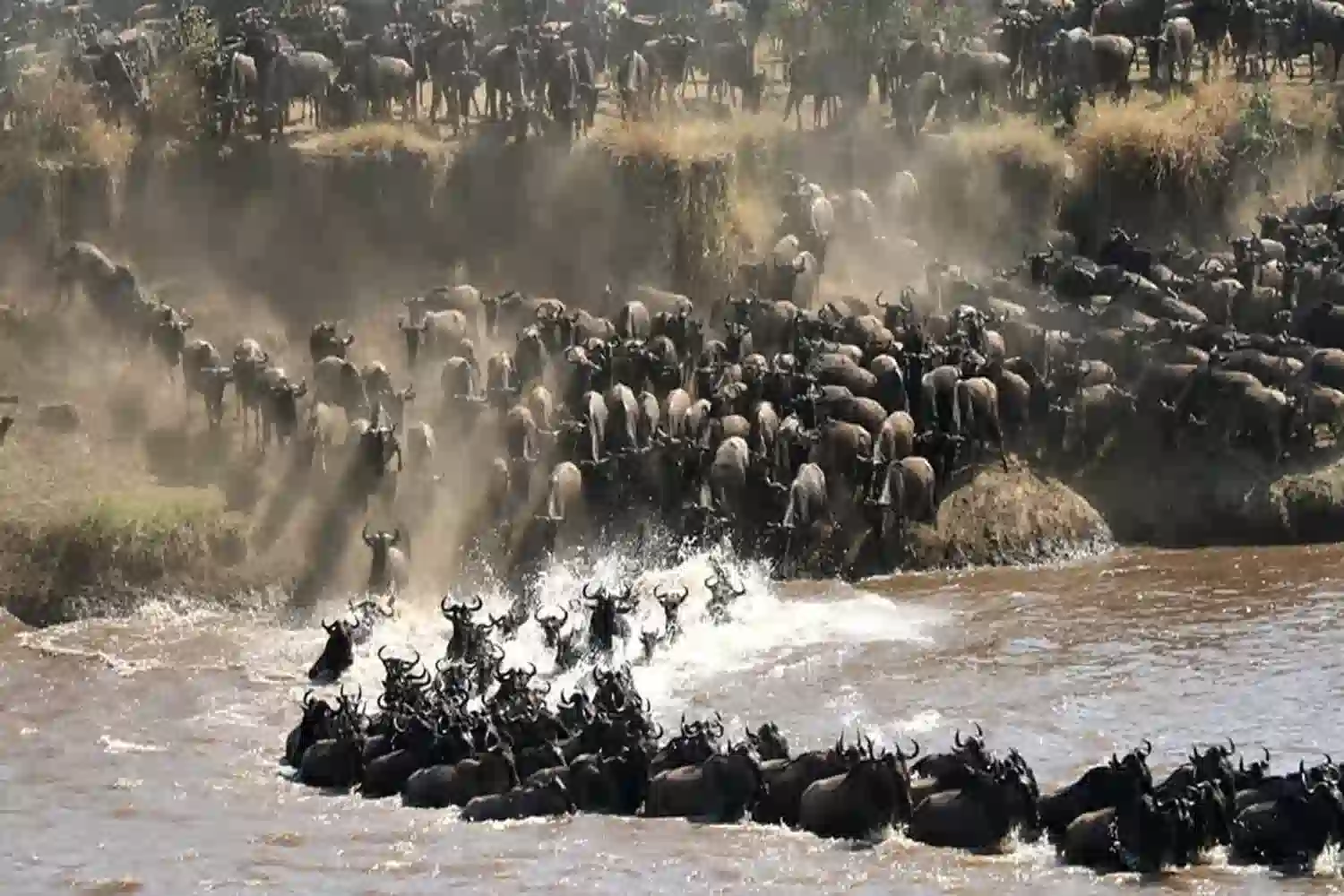
June is associated with the western corridor, Grumeti River and the push toward northern Serengeti. Some herds cross channels of the Grumeti system, although these crossings are generally smaller and less predictable than the famous Mara crossings. Other groups may already be travelling north through different routes.
Best base: Grumeti, Kirawira or a central-west split. Best for: moving herds, rutting behaviour and the transition into the dry season. Useful link: review the Serengeti western corridor route.
July: The Herds Reach Northern Serengeti
By July, major groups commonly reach the northwest and northern Serengeti. Early Mara River crossings may occur, but some animals can remain south of the river while others move across different channels or into Kenya. July is therefore best described as a strong northern-migration month rather than a guaranteed crossing month.
Best base: Kogatende or northern Serengeti. Recommended stay: three or four nights near the river plus time in central Serengeti. Why: the river is long, crossing points change, and herds may wait. See the dedicated guide to the best time for a Serengeti migration river crossing.
August: Prime Northern Serengeti River-Crossing Window
August is one of the strongest months for northern Serengeti migration safaris. Large groups may gather around Kogatende, Lamai and the Mara River, with repeated movement between Tanzania and Kenya. Satellite-based research has found particularly high dry-season wildebeest densities in August, although the exact hotspot varies between years.
Best base: Kogatende, Lamai or a mobile camp close to the Mara River. Best for: river-crossing opportunities and dense herd concentrations. Trade-off: peak demand, higher rates and more safari vehicles at popular crossing points.
September: River Crossings and Split Herds
September remains a high-probability month for northern Serengeti and Maasai Mara movement. The migration is rarely one single mass; herds may be divided across Tanzania, Kenya and multiple riverbanks. Crossings can happen in either direction as animals respond to grazing and water.
Best base: northern Serengeti if your Tanzania itinerary also includes Ngorongoro or central Serengeti. Best for: dry-weather game viewing and river activity. For a country comparison, read Serengeti vs Masai Mara for the Great Migration.
October: Late Crossings and the Return South
October can still produce Mara River crossings, especially early in the month, but the herds increasingly begin turning south through northern and northeastern Serengeti. Short showers may trigger faster movement toward Lobo, Loliondo-side grazing areas and central Serengeti.
Best base: northern Serengeti early; consider combining Kogatende with Lobo or Seronera later. Best for: travellers seeking a crossing chance with a broader northern-circuit safari. Risk: booking only the river area late in October may leave you behind the main movement.
November: Short Rains and the Southbound Return
November is a transition month. Once short rains refresh the eastern and southern plains, the herds may move rapidly from the north through Lobo, eastern Serengeti and central areas. This makes fixed long stays in a single corner less reliable, but a mobile or split-region itinerary can be excellent.
Best base: Lobo, eastern Serengeti or Seronera depending on current field reports. Best for: dramatic skies, young grass, returning herds and lower crowds than August or September.
December: Central and Southern Serengeti Rebuild
By December, many herds are commonly back across central, eastern and southern Serengeti, gradually concentrating around Ndutu as the calving cycle approaches again. Early December can remain scattered; late December is generally stronger for the south if the short rains have arrived normally.
Best base: Seronera plus Ndutu, or a flexible mobile camp. Best for: a festive-season safari combining migration movement, central Serengeti predators and the beginning of the southern season.
Best Month for Each Great Migration Experience
| Your Priority | Best Planning Window | Best Region | Reality Check |
|---|---|---|---|
| Calving and newborns | Late January to February | Ndutu and southern plains | More predictable by region than river crossings |
| Predator action | February to March | Southern Serengeti and Ndutu | Predators are present year-round; calving increases opportunities |
| Long moving columns | May to June | Central and western Serengeti | Routes split according to rainfall |
| Grumeti River activity | June to early July | Western corridor | Smaller and less famous than Mara crossings |
| Mara River crossings | July to October | Northern Serengeti | No crossing date can be guaranteed |
| Lower crowds and green scenery | March to May, November | Flexible by rainfall | Road conditions can be more challenging |
| Photography | February, March, August, November | South, north or transition areas | Choose based on desired behaviour and landscape |
Which Serengeti Region Should You Book?
| Region | Typical Migration Months | Best Airstrip | Why Stay There |
|---|---|---|---|
| Ndutu and southern plains | December to March | Ndutu or Kusini | Calving, open plains and predators |
| Central Serengeti / Seronera | April to May; November to December | Seronera | Flexible access and strong year-round resident wildlife |
| Western corridor | May to July | Grumeti or Kirawira | Northbound columns and Grumeti system |
| Northern Serengeti | July to October | Kogatende | Mara River and dry-season herds |
| Northeast / Lobo | October to November | Lobo | Southbound return and quieter landscapes |
Accommodation location matters more than luxury level when migration viewing is the priority. A beautiful lodge far from the active herds can mean several extra hours in the vehicle each day. Compare the best camps for the Serengeti migration and the broader Serengeti accommodation areas by season.
How Many Days Do You Need for a Migration Safari?
Four to five days: suitable for a focused fly-in safari to one seasonal region, especially Ndutu or northern Serengeti. It is efficient but leaves little protection against weather changes or delayed herd movement.
Seven days: the best balance for many first-time visitors. It allows three nights in the migration region plus central Serengeti and Ngorongoro. A route such as the 7-day Serengeti, Ngorongoro and Tarangire itinerary can be adjusted to match the season.
Eight to ten days: best for serious migration viewing, photography or uncertain transition months. The added time supports two Serengeti regions and reduces pressure to chase one event. See the 10-day Great Migration itinerary and 10-day Serengeti wildebeest migration safari.
Sample 2026/2027 Migration Itineraries
5-Day Calving Safari: January to March
- Arusha to Ngorongoro highlands or Ndutu.
- Full-day game drive across Ndutu and the southern plains.
- Second full day following the calving herds and predators.
- Ngorongoro Crater or transfer toward Karatu.
- Return to Arusha.
7-Day Western Corridor Safari: May to June
- Arusha to Tarangire.
- Ngorongoro or central Serengeti.
- Central Serengeti game drive.
- Transfer west following migration reports.
- Full day in the western corridor.
- Second western or central Serengeti day.
- Fly or drive back according to the itinerary.
8-Day Mara River Safari: July to October
- Arusha to Tarangire or fly directly to Serengeti.
- Central Serengeti.
- Drive or fly to northern Serengeti.
- Full day near the Mara River.
- Second full day near different crossing points.
- Third northern Serengeti day for flexibility.
- Ngorongoro highlands or central Serengeti.
- Ngorongoro Crater and return to Arusha.
Road Safari or Fly-In Safari?
| Option | Best For | Advantages | Limitations |
|---|---|---|---|
| Road safari | 7-10 day northern-circuit trips | See landscape changes; combine Tarangire and Ngorongoro; one guide throughout | Long transfers to northern or western Serengeti |
| Fly-in safari | 4-6 day focused migration trips | Saves time; lands close to seasonal region | Higher cost; strict baggage limits; weather and schedule changes possible |
| Fly one way, drive one way | First-time visitors wanting efficiency and variety | Reduces backtracking while keeping overland experience | Needs careful coordination with vehicle and camp logistics |
How to Increase Your Chance of Seeing the Migration
- Choose the region before choosing the lodge. Location is the first filter.
- Stay at least three nights in the target zone. This is especially important in northern Serengeti.
- Use a mobile or seasonal camp. These properties reposition around the classic migration cycle.
- Keep the itinerary flexible. A guide may need to change the next day's game-drive direction after new reports.
- Do not chase only river crossings. Herd movement, predator interactions and open-plain scenes can be equally memorable.
- Book peak months early. Small northern and Ndutu camps can fill well ahead of travel.
- Ask for the exact camp coordinates or region. “Serengeti” alone is not specific enough for a park of this scale.
Common Great Migration Planning Mistakes
- Booking central Serengeti in August and assuming it is close to the Mara River.
- Planning one night in Kogatende and expecting a guaranteed crossing.
- Using last year's crossing date as a fixed forecast for 2026 or 2027.
- Choosing a cheap lodge without checking daily driving distance to the herds.
- Confusing the Grumeti River phase with the Mara River crossing season.
- Ignoring airstrip transfers, park sectors and conservation-area fees.
- Driving from Arusha to northern Serengeti on an unrealistically short itinerary.
Review the full list of mistakes to avoid when planning a migration safari.
Responsible River-Crossing Viewing
River crossings are natural wildlife events, not staged performances. A responsible guide keeps a safe distance, avoids blocking an approach route, follows park instructions and does not pressure animals toward the water. Visitors should expect waiting periods and accept that the herds may turn away. Ethical viewing protects the animals and usually produces a calmer, more authentic experience.
Data Sources and Method Used for This Guide
This calendar combines the established seasonal route with official conservation descriptions and published ecological research. UNESCO documents the scale of the Serengeti ecosystem, the broad herd numbers and the roughly 1,000-kilometre circular movement. Tanzania's official tourism information describes the northward route from southern breeding grounds through the western corridor. Peer-reviewed studies support the wet-season concentration in the south, early dry-season movement through western areas and dry-season use of the north.
- UNESCO World Heritage Centre: Serengeti National Park
- UNESCO World Heritage Centre: Ngorongoro Conservation Area
- Official Tanzania Tourism: Serengeti National Park
- Scientific Reports: seasonal movement context in the western Serengeti ecosystem
- Nature Communications: satellite monitoring of wildebeest distribution
Plan a 2026/2027 Serengeti Migration Safari
The best itinerary begins with your travel month and desired wildlife behaviour. Tell Jaynevy Tours whether your priority is calving, moving herds, Grumeti activity or Mara River crossings. The route can then be built around the correct Serengeti region, realistic travel time and suitable accommodation rather than a generic park itinerary. Explore the Serengeti migration safari options or compare the Great Migration packages and prices.
Frequently Asked Questions
What is the best month to see the Serengeti Great Migration?
There is no single best month. February is strongest for calving in the Ndutu and southern plains, June often brings western-corridor movement, and July to October offers the best chance of Mara River crossings in northern Serengeti.
Where is the Great Migration in January and February?
The main herds are usually spread across the short-grass plains of Ndutu, southern Serengeti and the adjoining Ngorongoro Conservation Area, where calving activity peaks around late January and February.
When do the Mara River crossings happen?
Mara River crossings are most likely from July through October, but rainfall, grass and river conditions can move the first or last crossings by several weeks.
Can a river crossing be guaranteed?
No. Wildebeest may wait near the river, cross at another point or turn away. Spending at least three nights in northern Serengeti improves the opportunity but does not guarantee a crossing.
Is the Great Migration only in Kenya?
No. Most of the annual cycle takes place in Tanzania's Serengeti ecosystem. The herds may enter Kenya's Maasai Mara during part of the dry season before returning south.
How many days are recommended for a migration safari?
Seven to nine days is a practical first choice because it allows time in the migration zone plus central Serengeti or Ngorongoro. A focused fly-in trip can work in four to five days.
Which airstrip is best for the Great Migration?
Use Ndutu for the southern calving season, Seronera for central Serengeti, Grumeti or Kirawira for the western corridor, and Kogatende for northern Serengeti and the Mara River season.
Is April or May a bad time for the migration?
No. April and May can show long moving columns, green scenery and fewer vehicles. The trade-off is heavier rain, muddy tracks and possible seasonal camp closures.
Will the 2027 migration follow exactly the same dates as 2026?
No. The broad seasonal circuit is reliable, but exact timing changes with rainfall and fresh grass. Plan by region and a date window rather than one predicted crossing day.
Where should first-time visitors stay for the migration?
Choose a camp in the seasonal migration zone and combine it with central Serengeti. Mobile or seasonal camps reduce daily driving, while Seronera adds dependable year-round big-cat viewing.