
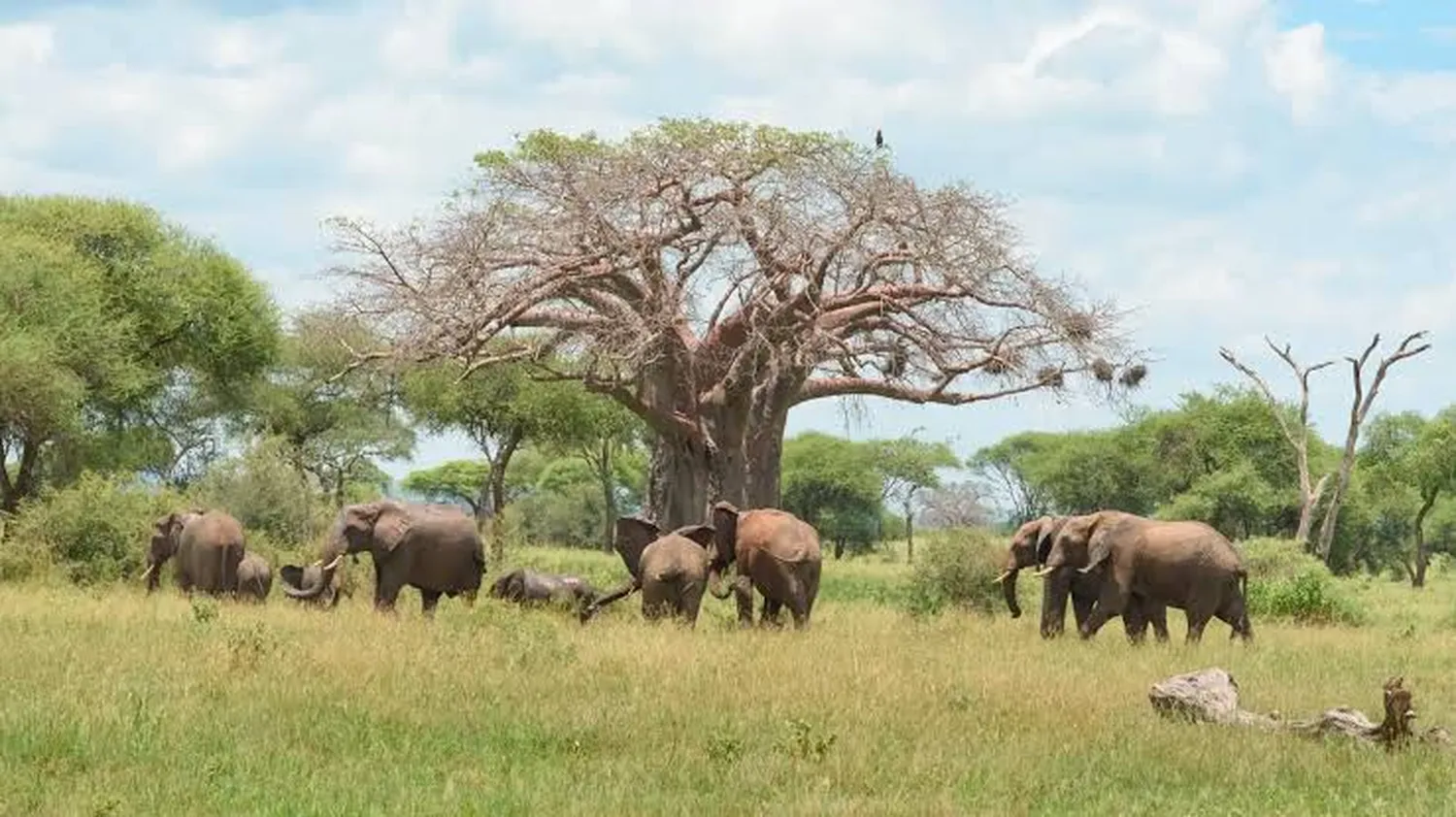
Quick Answer: Is Tarangire Worth Two Days on a 6-Day Elephant Safari?
Yes—if elephants are the reason for your safari, give Tarangire at least two substantial game-drive periods and preferably two nights. During the dry season, the park becomes an important refuge for elephants and other water-dependent wildlife. A practical six-day route is Tarangire for Days 1–2, Lake Manyara on Day 3, Serengeti on Days 4–5, and Ngorongoro Crater on Day 6.
This structure is stronger than rushing through Tarangire in one afternoon because elephant behavior changes across the day. One family may be feeding in woodland in the morning, another may arrive at water later, and bulls may move independently of family groups.
- Park area: 2,850 km².
- Wider ecosystem: roughly 30,000 km² in TANAPA's general brochure.
- Access: about 121 km from Arusha in TANAPA's Northern Zone reference guide.
- Dry-season focus: Tarangire River and Silale Swamp.
- Elephant reference: TANAPA currently uses both 3,000+ and 2,500+ figures on its Tarangire page.
- Large herds: TANAPA has reported dry-season herds of up to about 300.
- Birdlife: about 550 species recorded in TANAPA investment material.
- Landscape: baobabs, acacia savanna, riverine habitat, seasonal swamps and open plains.
Why Is Tarangire One of Tanzania’s Best Elephant Safari Parks?
Tarangire combines a large protected area with dry-season water that draws elephants from a much wider ecosystem. The national park covers 2,850 km², but TANAPA describes it as only a small part of a roughly 30,000 km² Maasai Steppe ecosystem. Elephants do not treat the park boundary as an ecological wall; rainfall, forage and water determine where they spend time.
This is why Tarangire becomes especially dramatic in the dry season. TANAPA's general brochure says that at the height of the dry season in October, the density of large animals around permanent or persistent water is exceptionally high, with wildlife gathering around the Tarangire River and Silale Swamp. Peer-reviewed ecological research likewise notes that elephants primarily reside inside Tarangire National Park during the dry season and may disperse into surrounding areas during wetter months.
Elephant Numbers: Why You May See 2,500+ and 3,000+ on TANAPA Material
TANAPA's current Tarangire webpage contains two different reference figures: its wildlife section says 3,000+ elephants, while a conservation statistics panel displays 2,500+. Rather than pretending one is an exact live census, this article treats them as official reference figures. Elephant abundance changes with seasonal movement, survey timing and counting method. The important planning fact is that Tarangire consistently supports one of Tanzania's most important elephant concentrations.
Where Are the Best Places to See Elephants in Tarangire?
The best elephant areas are linked to water, shade and feeding habitat—not a single fixed GPS point. In the dry season, start with the Tarangire River corridor and Silale Swamp, then use current guide information to decide which woodland, river bend or water point is active.
| Area | Why elephants use it | What you may observe | Best planning note |
|---|---|---|---|
| Tarangire River corridor | Critical dry-season water and riverine vegetation. | Drinking, digging, dusting, family groups moving between water and feeding areas. | Prioritize in the dry season, but exact pools and surface water vary year to year. |
| Silale Swamp | Important wetland/refuge habitat within the park. | Elephants, buffalo, birds and predators using the broader swamp ecosystem. | Excellent for wider wildlife context, not only close elephant portraits. |
| Riverine woodland | Shade, browse and movement corridors. | Feeding, resting and smaller family units in vegetation. | Drive slowly; elephants can be partly hidden by trees. |
| Baobab/acacia savanna | Seasonal forage and open travel routes. | Classic elephant-and-baobab photography and long-distance herd movement. | Best light often comes early and late in the day. |
Best Time for a 6-Day Tarangire Elephant Safari
June to October is the best general window when your main goal is concentrated elephant viewing. As the landscape dries, elephants and other herbivores depend more heavily on the park's water network. The green season is still valuable, but animals can spread farther across the ecosystem because water and forage become more widely available.
| Period | Elephant viewing | Landscape | Main advantage | Main drawback |
|---|---|---|---|---|
| Jun–Jul | Concentrations begin strengthening as water becomes limited. | Drying grass, clearer sight lines. | Strong balance of wildlife density and comfortable conditions. | Peak-season visitor numbers start rising. |
| Aug–Oct | Often the most concentrated dry-season elephant period. | Dry, dusty and highly seasonal. | Excellent river-focused viewing and potential for large aggregations. | Busier, dustier and hotter later in the period. |
| Nov–Dec | Elephants can begin dispersing as short rains create water elsewhere. | Fresh green growth and dramatic skies. | Good photography and fewer vehicles than peak dry season. | Less predictable concentration around the river. |
| Jan–Feb | Still productive, but distribution is more spread out than peak dry season. | Green to mixed conditions. | Good general wildlife and birding. | Not the strongest period for maximum river concentration. |
| Mar–May | More dispersed across the ecosystem. | Lushest period; long rains. | Quiet safari, green scenery, bird activity. | Muddy tracks and lower elephant concentration in some areas. |
How Large Can Tarangire Elephant Herds Be?
Large aggregations can be spectacular, but they are seasonal events rather than a daily guarantee. A TANAPA newsletter has described herds of up to about 300 elephants digging in the Tarangire riverbed during dry periods. That number is useful for understanding the scale Tarangire can reach, but it should not be advertised as the normal size of every herd.
Most elephant social encounters are more nuanced. Family groups contain related females and dependent young, while adult bulls may be alone or associate in looser male groups. When several family units use the same water source, a visitor may perceive one huge herd even though multiple social units are temporarily sharing the same area.
What Elephant Behaviors Can You Watch in Tarangire?
An elephant safari is more rewarding when you watch behavior instead of counting animals. Six days gives you enough time to observe the same species in different situations.
- Drinking and digging: elephants may use trunks, feet and tusks around riverbeds and water points.
- Dust bathing: soil and dust are thrown over the body and can help with skin care and insect protection.
- Calf care: mothers and other females may protect calves in the center of a family group.
- Greeting: trunk touches, vocalizations and body contact can reveal social relationships.
- Feeding: elephants browse leaves, bark, branches and grasses depending on season and habitat.
- Bull behavior: mature males often move differently from family groups and may spend time alone.
- Movement to water: watching a herd approach or leave the river can be more informative than simply photographing a stationary group.
Wildlife Safety: Never Ask a Driver to Crowd an Elephant Herd
Elephants are powerful wild animals. A responsible guide keeps escape space, avoids blocking a herd's route to water, gives mothers with calves room, and watches signs such as head position, ear movement, trunk posture and changes in walking direction. A close photograph is never worth causing an animal to change course or feel trapped.
Recommended 6-Day Elephant Safari Tarangire National Park Itinerary
The strongest six-day route gives Tarangire the first two days, then uses three other Northern Circuit ecosystems for contrast. This is deliberately different from a standard checklist itinerary that leaves Tarangire after one short drive.
Day 1: Arusha to Tarangire — Afternoon Elephant Drive
Drive roughly 120 km from Arusha toward Tarangire. After entry, begin with the river corridor and nearby baobab savanna. The first afternoon lets your guide establish where family groups, bulls and water-dependent herbivores are concentrating. Overnight inside or near Tarangire so the next morning begins close to the park rather than in Arusha.
Day 2: Full-Day Tarangire — River, Silale Swamp and Baobab Country
Start early and make this the main elephant day. Work the Tarangire River system, productive woodland and Silale Swamp according to current conditions. Instead of chasing every radio call, spend time with behavior: calves playing, matriarch-led movement, bulls feeding, dust bathing and interactions at water.
Day 3: Tarangire Sunrise Drive, Then Lake Manyara
Use a final early Tarangire drive before continuing to Lake Manyara. This gives you a third elephant-viewing window and then adds groundwater forest, primates, wetland birds and the possibility of tree-climbing lions. Overnight around Karatu or Mto wa Mbu.
Day 4: Karatu to Serengeti — Afternoon Plains Game Drive
Travel through the Ngorongoro highlands toward Serengeti and use the afternoon for central plains wildlife. This shifts the focus from elephant concentrations to predator-prey ecology, open grasslands and resident big cats.
Day 5: Serengeti Morning Game Drive to Ngorongoro Highlands
Spend the morning in Serengeti, then drive toward Ngorongoro. Elephant sightings are possible in Serengeti, but this day is designed to broaden the safari rather than duplicate Tarangire's elephant emphasis.
Day 6: Ngorongoro Crater Game Drive and Return to Arusha
Descend early into Ngorongoro Crater for concentrated wildlife viewing before returning to Arusha. The crater can add buffalo, lions, hippos and—when conditions and luck align—black rhino, completing a more diverse six-day Northern Circuit experience.
Alternative: Keep All Six Days Elephant-Focused
Serious elephant photographers can use three or four days in Tarangire and reduce the number of other parks. That gives more variation in light, herd composition, behavior and habitat. For most first-time Tanzania visitors, however, two Tarangire nights plus Lake Manyara, Serengeti and Ngorongoro offers a better balance.
Elephant-Focused Route vs Standard 6-Day Northern Circuit
| Factor | Elephant-focused route | Standard Northern Circuit |
|---|---|---|
| Tarangire nights | 2 nights | Often 1 night or day visit |
| Elephant observation time | High | Moderate |
| Serengeti time | About 1.5 days | Often 2 days or more |
| Best for | Elephant behavior, photography, families who love elephants | Travelers wanting equal emphasis across parks |
| Main trade-off | Less Serengeti time | Less Tarangire depth |
Tarangire vs Serengeti vs Ngorongoro for Elephant Viewing
Tarangire is the strongest elephant-specific choice on the classic Northern Circuit. Serengeti and Ngorongoro add elephants, but they serve different trip goals.
| Destination | Elephant strength | Best additional value |
|---|---|---|
| Tarangire | Best for dry-season concentrations, herds, river ecology and elephant-baobab landscapes. | Baobabs, birding, quieter safari feel. |
| Serengeti | Elephants occur, but they are not the park's defining wildlife spectacle. | Big cats, Great Migration, open plains. |
| Ngorongoro | Notable for large bulls and compact multi-species viewing. | Black rhino possibility, crater scenery, dense wildlife mix. |
| Lake Manyara | Can be very good for elephants in forest and woodland settings. | Primates, birds, Rift Valley scenery, tree-climbing lion reputation. |
Best Photography Strategy for Tarangire Elephants
- Use both wide and telephoto lenses. A herd under baobabs needs a wider composition; facial detail and calves benefit from telephoto reach.
- Photograph behavior, not just size. Trunk contact, nursing, dust bathing and family movement create stronger images.
- Give the herd space. Distance often lets elephants behave naturally and can improve storytelling.
- Use early and late light. Low-angle sunlight adds texture to dust, skin and baobab landscapes.
- Watch the whole group. A calf or interacting pair behind the obvious adult may create the best moment.
- Keep gear protected from dust. Dry-season Tarangire can be extremely dusty.
What Else Can You See During a Tarangire Elephant Safari?
Tarangire is not an elephant-only ecosystem. TANAPA lists lion, leopard, cheetah, African wild dog, buffalo, zebra, wildebeest, giraffe, eland, lesser and greater kudu, Beisa oryx and gerenuk among the park's wildlife. TANAPA's investment prospectus records about 550 bird species, making Tarangire especially useful for travelers who want mammals and birding in the same park.
For destination context, see Jaynevy's Tarangire National Park guide. For a shorter version, compare the 2-Day Tarangire & Lake Manyara Safari.
Private vs Group Safari for Elephant Viewing
A private vehicle is the better fit when elephant behavior is the primary objective. Shared safaris can be excellent value, but another traveler may prefer big cats, a picnic stop or moving quickly to the next park. Elephant observation often improves when you can wait.
| Factor | Private 4x4 | Shared safari |
|---|---|---|
| Time with one herd | You decide | Depends on group preference |
| Route flexibility | High | Moderate |
| Photography positioning | More control within park rules | Shared roof/window space |
| Cost | Higher for small groups | Lower per person |
| Best for this keyword | Recommended | Good for budget-first travelers |
Common Mistakes When Planning an Elephant Safari in Tarangire
- Giving Tarangire only a two-hour stop. That misses the reason for choosing an elephant-focused itinerary.
- Assuming a 300-elephant herd is guaranteed. It is an example of what can occur during dry-season concentration.
- Using one elephant population figure as a precise live count. Seasonal movement and survey methods matter.
- Ignoring the green season. It is less concentrated but can be beautiful, quiet and excellent for birds.
- Crowding elephants at water. Animals must always have an open path.
- Chasing every radio report. Patient observation often produces better behavior and photographs.
- Adding too many parks. More destinations can mean less meaningful wildlife time.
Useful Jaynevy Tours Internal Links for This Safari
- Tarangire National Park
- Tanzania Northern Safari 2026/2027
- 2-Day Tarangire & Lake Manyara Safari
- Serengeti National Park
- Ngorongoro Conservation Area
- Tanzania Safari Destinations
Frequently Asked Questions About a 6-Day Tarangire Elephant Safari
Is Tarangire the best national park in Tanzania for elephants?
Tarangire is one of Tanzania's strongest elephant destinations. Tanzania National Parks describes it as the 'Paradise of Elephants' and highlights very high elephant concentrations, especially as wildlife gathers around dry-season water sources. No park can guarantee a specific herd size or close encounter on a particular drive.
How many elephants are in Tarangire National Park?
TANAPA's current Tarangire webpage uses more than one reference figure: it describes 3,000+ elephants in the wildlife section and also displays a 2,500+ elephant conservation statistic. Because elephants move through the wider ecosystem and counts vary by season and method, these figures are best treated as park reference numbers rather than a fixed live 2026 census.
When is the best time for an elephant safari in Tarangire?
June to October is generally the strongest period for concentrated elephant viewing because the landscape becomes drier and permanent or persistent water sources such as the Tarangire River system and Silale Swamp attract wildlife. The green season remains rewarding for scenery, calves, birds and quieter roads, but elephants can disperse more widely.
Where should I look for elephants in Tarangire?
Focus on the Tarangire River corridor, Silale Swamp, riverine woodland and nearby waterholes, especially during the dry season. Elephant distribution changes with rainfall, water and forage, so a guide should adapt each day's route rather than drive a fixed circuit.
Can I see herds of 100 or more elephants in Tarangire?
Large aggregations are possible in the dry season. A TANAPA newsletter has described herds of up to about 300 elephants digging in the Tarangire riverbed during dry periods. That is an example of what can occur, not a guaranteed herd size for every visitor.
Is six days too long if elephants are my main interest?
No. Six days gives enough time to spend two substantial days in Tarangire while also adding Lake Manyara, Serengeti and Ngorongoro for a broader Northern Circuit safari. If elephants are the main goal, do not rush Tarangire into a single short drive.
Should I spend one or two nights in Tarangire?
Two nights are better for an elephant-focused safari. They allow an afternoon drive, a full day and an early morning follow-up, which gives more opportunities to see different family groups, feeding behavior and movement around water.
What other wildlife can I see in Tarangire?
TANAPA lists lion, leopard, cheetah, African wild dog, buffalo, zebra, wildebeest, giraffe, eland, kudu, oryx and gerenuk among the park's wildlife. TANAPA investment material also records about 550 bird species.
Is Tarangire good in the wet season?
Yes. The wet season brings greener landscapes, birding and more dispersed wildlife. It is often quieter, but elephant concentrations around the river are usually less dramatic because water and forage are more widely available across the ecosystem.
Do I need a private safari vehicle for an elephant-focused trip?
A private 4x4 is the strongest choice when elephant behavior is your priority because your group can wait longer with a herd, revisit a river section and spend more time photographing family interactions without following a fixed shared-group schedule.
Research Notes and Trusted Sources
This article separates official reference figures from ecological interpretation. TANAPA provides the park size, access, wildlife and elephant reference numbers. Peer-reviewed research supports the broader seasonal pattern in which elephants concentrate more inside Tarangire during the dry season and disperse more widely when rains increase water and forage outside the park.
- TANAPA: Tarangire National Park — elephant identity, 2,850 km² park size and current reference figures.
- TANAPA Northern Zone Quick Reference Guide — 2,850 km² and about 121 km access from Arusha.
- TANAPA General Brochure — approximately 30,000 km² wider ecosystem and dry-season gathering around river pools and Silale Swamp.
- TANAPA Investment Prospectus — elephant concentration context and about 550 recorded bird species.
- Oecologia / PMC: Savanna trees and large herbivores in Tarangire — elephants primarily resident in the park during the dry season and dispersing more widely during wetter periods.
- Peer-reviewed Tarangire Ecosystem conservation study — seasonal elephant density trends across Tarangire and surrounding management areas.
Editorial note: Wildlife counts, herd size, water levels and road access change. Jaynevy Tours should describe Tarangire as a high-value elephant destination without promising a fixed number of elephants or a specific close encounter.