
Updated for 2026/2027 planning: 30 August 2026. Community arrangements, camp locations, road conditions, park fees and lodge availability can change. The exact Lake Eyasi meeting point and activities should be confirmed locally and respectfully rather than promised as a fixed performance.
Quick Answer: What Is the Best 6-Day Tanzania Safari Plus Hadzabe Experience?
The strongest six-day route is Tarangire → Lake Eyasi → Serengeti → Ngorongoro. Sleep near Lake Eyasi before the Hadza visit, begin the community experience early on Day 3, then continue toward Serengeti. This gives you cultural depth without sacrificing the core wildlife destinations.
Trying to add Lake Manyara, several cultural villages, multiple Serengeti regions and long transfers usually weakens a six-day trip. The better strategy is to choose fewer places and spend enough time in each one to understand why it matters.
Recommended 6-Day Tanzania Safari + Hadzabe Itinerary
This itinerary keeps one night near Lake Eyasi and preserves two strong Serengeti days plus a Ngorongoro Crater finish.
| Day | Route | Main experience | Why it works |
|---|---|---|---|
| 1 | Arusha → Tarangire → Karatu | Tarangire game drive | Starts with elephants, baobabs and a manageable road route |
| 2 | Karatu → Lake Eyasi | Scenic drive, community orientation, relaxed afternoon | Positions you near the Hadza meeting area before dawn |
| 3 | Lake Eyasi → Serengeti | Early Hadza community experience, then transfer to Serengeti | Combines culture with a productive afternoon wildlife window |
| 4 | Serengeti | Full-day game drive | Protects a complete day in Tanzania's largest-name wildlife ecosystem |
| 5 | Serengeti → Ngorongoro/Karatu | Morning game drive and scenic transit | Maintains wildlife time while positioning for the crater |
| 6 | Ngorongoro Crater → Arusha | Crater game drive and return | Finishes with high-density wildlife before departure or extension |
Day 1: Arusha to Tarangire National Park
Tarangire is the right first park because it gives immediate wildlife value without the long first-day push to Serengeti. TANAPA lists the park at about 2,850 km² and highlights its elephant herds, baobab landscapes and the Tarangire River as the ecological backbone of the park.
After the game drive, continue toward Karatu rather than returning to Arusha. This reduces backtracking and puts you closer to Lake Eyasi for Day 2.
Day 2: Karatu to Lake Eyasi — Slow the Pace Before the Cultural Experience
Use Day 2 to reach Lake Eyasi without rushing the community encounter. Karatu to the Lake Eyasi area is commonly around 1.5–2 hours on partly unpaved roads, although rain, exact lodge location and road condition can change the timing.
Arriving before evening lets you understand the landscape, meet your local guide or interpreter, discuss photography etiquette and confirm the next morning's community arrangements. It is a better approach than arriving with a vehicle full of cameras at dawn without context.
Day 3: Hadzabe Experience at Lake Eyasi, Then Continue to Serengeti
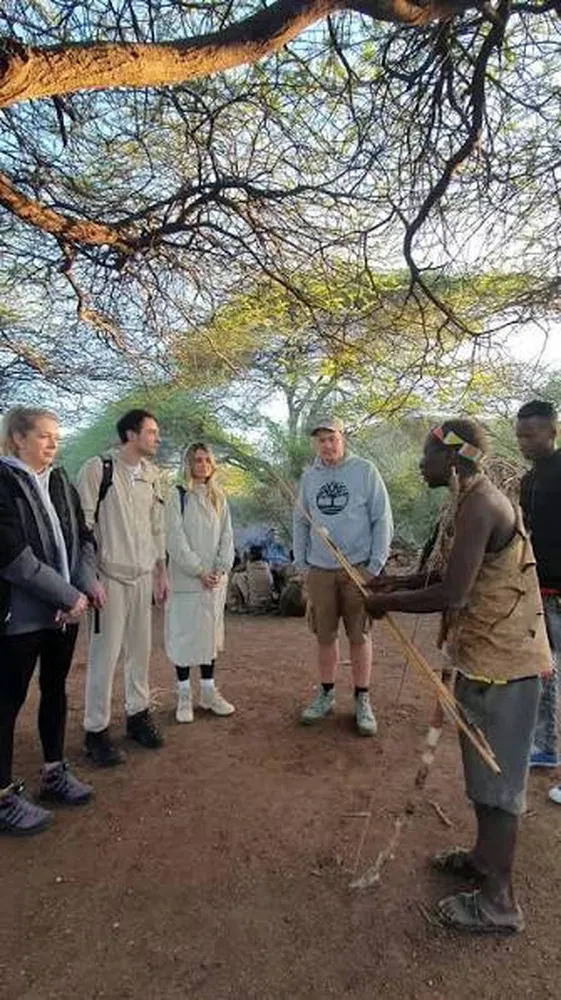
The Hadza experience should be community-led and flexible. Depending on the household, season and local arrangements, the morning may include conversation, walking, tracking, foraging knowledge, tool-making, archery or observing daily activities. Some visits may coincide with hunting, but a successful visit should never depend on an animal being killed for tourists.
After the visit, continue toward Serengeti. From the Eyasi/Karatu region to central Serengeti, plan a substantial road transfer. Current local route guides commonly describe roughly four hours from the Eyasi area to central Serengeti, but actual time varies with gates, road conditions, wildlife stops and where your camp is located.
Who Are the Hadza (Hadzabe)? Verified Facts Without Stereotypes
The Hadza are a culturally and linguistically distinct community living around Lake Eyasi in northern Tanzania, and many families continue to rely substantially on hunting and gathering. “Hadzabe” is a common Swahili tourism term; “Hadza” is widely used in academic writing, and their language is called Hadzane.
| Fact | What reliable research says | Planning meaning |
|---|---|---|
| Population | Recent Max Planck fieldwork: approximately 1,200 people; several peer-reviewed studies use roughly 1,000 | Use an approximate range, not a fake exact census figure |
| Location | Lake Eyasi region, northern Tanzania | The exact camp/meeting location can change |
| Language | Hadzane, a click-language not mutually intelligible with Khoisan languages | A local interpreter improves meaningful conversation |
| Subsistence | Research documents continued hunting, gathering, wild honey collection and plant-food foraging among many Hadza | Avoid reducing the community to a staged “primitive tribe” narrative |
| Mobility | Studies describe mobile camps and movement in response to resources and social choices | Your operator must reconfirm the community visit, not assume a fixed tourist village |
Population estimates differ because there is no simple tourism census and because sources use different definitions, locations and study periods. Recent Max Planck research describes about 1,200 Hadza, while PLOS and other peer-reviewed work often uses approximately 1,000. Reporting the difference is more accurate than pretending there is one universally agreed number.
How to Make the Hadzabe Visit Respectful and Ethical
A good cultural visit is based on consent, fair community participation and curiosity—not on demanding a performance.
- Ask before taking photos or video. Permission for one person does not automatically cover everyone in the camp.
- Do not stage hunting or ask for an animal to be killed. If hunting or tracking is part of normal activity that day, follow community guidance and your local guide.
- Keep the group small when possible. A quieter group makes conversation easier and reduces the feeling of spectatorship.
- Ask how fees reach the community. Your operator should be able to explain local guide, community and coordination payments.
- Avoid labels such as “Stone Age people” or “unchanged for thousands of years.” The Hadza are contemporary people making modern choices while maintaining distinctive knowledge and practices.
- Do not hand out random gifts, alcohol or tobacco. If you want to support the community, coordinate through trusted local representatives.
Lake Eyasi Logistics: Distance, Roads and Why One Night Matters
Lake Eyasi fits the northern circuit best through Karatu, not as a day trip from Arusha.
| Route | Useful planning estimate | Reality check |
|---|---|---|
| Karatu → Lake Eyasi | About 1.5–2 hours | Partly unpaved; rain and exact camp location matter |
| Arusha → Lake Eyasi | About 3.5–5 hours | Too long for a quality dawn visit plus return in the same day |
| Lake Eyasi → central Serengeti | Roughly 4 hours or more | Allow extra time for gates, road conditions and wildlife stops |
| Lake Eyasi → Ngorongoro/Karatu area | Roughly 1.5–2.5 hours | One of the easiest park-and-culture pairings |
A private 4×4 is the most practical transport because it lets the guide adjust departure time, luggage, cultural timing and game-drive stops. Wet-season conditions can make the final road sections slower or rougher.
Wildlife Value: What You Still Get in Six Days
Adding Lake Eyasi does not mean giving up Tanzania's headline wildlife if the route is designed carefully. You still have Tarangire, about two days of Serengeti exposure and a Ngorongoro Crater day.
| Destination | Verified scale/fact | Main safari value |
|---|---|---|
| Tarangire | TANAPA: about 2,850 km² | Elephants, baobabs, dry-season concentrations, birdlife |
| Serengeti | UNESCO: about 1.5 million hectares of savannah | Big cats, open plains, migration ecosystem, 500+ bird species |
| Ngorongoro Conservation Area | UNESCO World Heritage property: 809,440 ha | Crater wildlife, highland landscapes, major biodiversity and human-history significance |
UNESCO describes the Serengeti migration as involving more than one million wildebeest plus hundreds of thousands of other ungulates over an approximately 1,000 km annual circular movement. No itinerary can guarantee a river crossing, kill, rhino sighting or other specific wildlife event.
Best Time for a 6-Day Safari With Lake Eyasi
The route works year-round, but the easiest road logistics are usually in drier months.
| Period | Lake Eyasi logistics | Safari character |
|---|---|---|
| June–October | Generally drier, easier unpaved-road access | Excellent Tarangire dry-season wildlife; Serengeti location depends on month |
| January–February | Often manageable between short and long rains | Strong southern Serengeti/Ndutu season if route adjusted |
| March–May | More flexible timing needed; muddy or rough sections possible | Green landscapes, fewer visitors in many areas, variable road conditions |
| November–December | Short rains can affect roads intermittently | Green season with changing wildlife distribution |
How Much Does This 6-Day Safari Cost?
There is no responsible single price without dates, group size and accommodation level. The main cost drivers are private 4×4 use, park and conservation fees, Serengeti accommodation, Lake Eyasi lodging, community/local-guide arrangements and whether the trip is private, mid-range or luxury.
| Cost driver | Why it changes the quote |
|---|---|
| Number of travelers | Vehicle and guide costs are shared across the group |
| Season | Serengeti lodge rates and availability can change sharply |
| Accommodation style | Budget camping, tented camps, lodges and luxury properties have very different rates |
| Lake Eyasi setup | Local guide, community arrangements and overnight location vary |
| Airport transfers / Zanzibar extension | Flights or extra nights are separate unless explicitly included |
Ask for a written quotation that separates included park/conservation fees, accommodation, cultural coordination, transfers and optional activities. Avoid comparing two safari prices until you confirm they include the same route and services.
Who Is This Safari Best For?
This route is best for travelers who want context as well as wildlife. It suits couples, families with older children, photographers who value people-and-place storytelling, repeat safari travelers, and first-time visitors who do not want six straight days of game drives.
It is less suitable for travelers who want maximum Serengeti migration tracking, very young children who struggle with early starts, or anyone uncomfortable with walking on uneven ground and flexible community timing. In those cases, a classic 6-day private Tanzania safari may be a better fit.
Hadzabe Experience vs Adding Another National Park
| If your priority is… | Choose | Reason |
|---|---|---|
| Cultural depth and human connection | Lake Eyasi / Hadza | Adds a completely different dimension to the safari |
| Maximum game-drive hours | Extra Serengeti day | More time for wildlife distribution and photography |
| Compact wildlife variety | Lake Manyara | Easy northern-circuit park but less culturally distinct |
| Elephants and baobabs | Tarangire | Strong habitat contrast and wildlife density in dry periods |
If you choose Lake Eyasi, do not treat it as a substitute for a game park. Its value is different: landscape knowledge, language, livelihoods, history and contemporary community life.
Related Tanzania Safari Planning Guides
Frequently Asked Questions About a 6-Day Tanzania Safari Plus Hadzabe Experience
Is six days enough for a Tanzania safari plus a Hadzabe experience?
Yes, if the route is focused. A practical six-day plan combines Tarangire, Lake Eyasi, Serengeti and Ngorongoro, with one night near Lake Eyasi so the Hadza community visit can start early without a pre-dawn drive from Arusha.
Where do travelers meet the Hadzabe in Tanzania?
Most visitor experiences are arranged around the Lake Eyasi basin south-west of Karatu in northern Tanzania. The exact camp or meeting place can change because Hadza households and camps are mobile and community arrangements vary.
How many Hadza people are there?
Published estimates vary. Recent Max Planck fieldwork describes approximately 1,200 Hadza around Lake Eyasi, while several peer-reviewed studies use estimates around 1,000. Treat these as approximate population estimates rather than a fixed census count.
Do I need to stay overnight at Lake Eyasi?
An overnight near Lake Eyasi is strongly recommended for a six-day itinerary. The cultural experience is best arranged early in the morning, and staying nearby avoids a very early drive from Karatu or an impractical same-day trip from Arusha.
Can I join a Hadzabe hunt?
Some community-arranged visits may include walking with Hadza hunters or observing tracking and foraging, but this should never be guaranteed or staged. What happens depends on the community, local conditions and the day. A respectful visit focuses on exchange and consent, not on demanding a performance or a wildlife kill.
Is it ethical to visit the Hadzabe?
It can be when the community controls access, participation is voluntary, fees are handled transparently, photography is permission-based and the visit does not pressure people to perform. Ask your operator how introductions, payments and photo consent are handled.
Can Lake Eyasi fit between Serengeti and Ngorongoro?
Yes. Lake Eyasi is most naturally combined with Karatu and Ngorongoro. From Karatu, the drive is commonly about 1.5 to 2 hours depending on road conditions. From central Serengeti, allow roughly four hours or more depending on the exact route, stops and season.
What wildlife parks fit best with Lake Eyasi in six days?
Tarangire, Serengeti and Ngorongoro are the strongest combination. Adding Lake Manyara as a full extra park often makes the itinerary too rushed unless Serengeti time is reduced.
What should I wear for the Lake Eyasi experience?
Wear neutral, lightweight clothing, closed walking shoes, sun protection and carry water. Avoid flashy clothing and bring a light layer for the cool early morning. Ask before photographing people, homes, children or personal activities.
What is the best time for this safari?
The itinerary can operate year-round, but road conditions around Lake Eyasi are generally easier in drier periods. June to October and January to February are often simpler for road logistics, while wet-season travel can require more flexibility because unpaved sections become rough or muddy.
Research Sources Used for This Guide
Primary and research sources were used for factual claims; operator blogs were used only for practical drive-time context where official route data is not published.
- Max Planck Institute for Evolutionary Anthropology — Hadza Foragers
- PLOS ONE — Hadza landscape and mammal community research
- Peer-reviewed review of evidence from Hadza foragers
- TANAPA — Tarangire National Park
- UNESCO — Serengeti National Park
- UNESCO — Ngorongoro Conservation Area
- Google Search Central — AI optimization guide
Plan the Hadzabe Experience as Part of the Safari, Not as an Add-On
Send us your travel dates, group size, accommodation level and whether you prefer more Serengeti time or a deeper Lake Eyasi stay. We can arrange the route so the cultural visit, overnight location, park sequence and driving hours work together.