
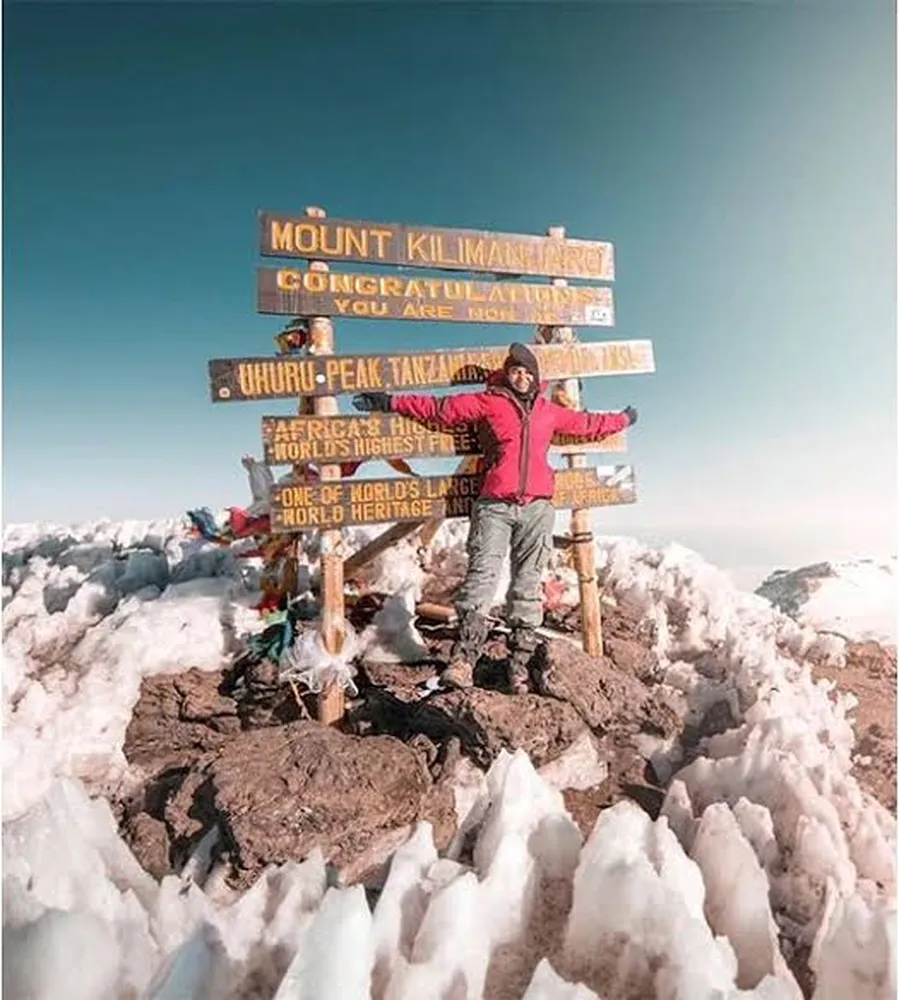
Quick Answer: How Do You Combine a 6-Day Tanzania Safari with a Kilimanjaro Day Hike?
Allow seven calendar days. Use six days for the safari and one separate day for Kilimanjaro. For most travelers, the easiest mountain option is the Marangu day hike from about 1,860–1,870 m at Marangu Gate toward Mandara Hut at about 2,700 m. Jaynevy's current route pages describe the ascent as roughly 8–9 km and around 3–5 hours, depending on pace and conditions. Maundi Crater can be added only when time and trail conditions allow.
- Total trip: 7 calendar days if the hike is additional to the six safari days.
- Safari focus: Tarangire, Serengeti and Ngorongoro are a strong default combination.
- Day-hike route: lower Marangu Route.
- Usual target: Mandara Hut, around 2,700 m.
- Summit? No. Uhuru Peak is 5,895 m and requires a multi-day climb.
- Best base: Moshi is more efficient than Arusha for the mountain day.
- Current Jaynevy day-hike starting price: from US$180 per person.
First Clarify the Day Count: 6 Safari Days + 1 Hike Day Means 7 Days
This sounds obvious, but it is one of the most common itinerary problems. Some six-day safari packages count an arrival or briefing day as Safari Day 1. Others start game driving immediately. If you want six actual safari calendar days plus a Kilimanjaro day hike, the mountain day must be outside those six days. Otherwise you are buying five safari days plus one hike day.
| Trip wording | What it really contains | Best description |
|---|---|---|
| 6-day safari + 1-day Kilimanjaro hike | Seven calendar days | Correct for this keyword intent |
| 6 total days including Kilimanjaro hike | Five safari days + one mountain day | Do not market as six safari days |
| Arrival Day + 5 safari days + hike | Seven calendar days, but only five active safari days | State the day-by-day schedule clearly |
Should You Hike Kilimanjaro Before or After the Safari?
For most travelers, hiking first is the stronger default. You arrive with fresher legs, do the more physically demanding activity first, then spend the following days mainly in a 4x4. Safari first can still be better when the route finishes near Arusha or Moshi and your international departure is from Kilimanjaro International Airport.
| Sequence | Main advantage | Main drawback | Best for |
|---|---|---|---|
| Day hike → 6-day safari | Fresh legs; safari becomes recovery-friendly | You need an early start soon after arrival | Active travelers and first-time hikers |
| 6-day safari → day hike | Natural finish near Moshi/JRO when logistics align | Long safari drives may leave you tired | Travelers ending the safari near Arusha/Moshi |
Recommended 7-Day Safari + Kilimanjaro Day-Hike Itinerary
The schedule below uses the mountain first. It protects two full Serengeti days and avoids turning the seven-day trip into a race through too many parks.
| Day | Plan | Main purpose | Sleep |
|---|---|---|---|
| 1 | Moshi → Marangu Gate → Mandara area → Moshi | Kilimanjaro lower-mountain day hike | Moshi |
| 2 | Moshi/Arusha → Tarangire | Elephants, baobabs and first game drive | Tarangire / Manyara / Karatu area |
| 3 | Tarangire area → Serengeti | Transfer plus afternoon wildlife | Serengeti |
| 4 | Serengeti | Full-day game drive | Serengeti |
| 5 | Serengeti | Second full game-drive day | Serengeti |
| 6 | Serengeti → Ngorongoro highlands | Final Serengeti viewing and repositioning | Ngorongoro / Karatu |
| 7 | Ngorongoro Crater → Arusha/Moshi/JRO | Crater game drive and trip finish | — or post-tour hotel |
Which 6-Day Safari Route Works Best with the Kilimanjaro Hike?
The simplest answer is a Northern Circuit route that begins or ends around Arusha/Moshi. The current 6-day Tarangire, Manyara, Serengeti and Ngorongoro safari from Arusha starts from US$1,850 per person sharing, while the 6-day Tanzania private safari provides another route reference.
If your priority is Serengeti rather than collecting four parks, the 6-day Serengeti Tanzania safari gives you more time in the park. Whichever route you choose, do not remove a full Serengeti day simply to fit the Kilimanjaro hike inside the six-day safari label.
What Exactly Is the Kilimanjaro Day Hike?
Jaynevy Tours' current 1-day Mount Kilimanjaro hike from Moshi follows the lower Marangu Route. You transfer to Marangu Gate, complete park formalities and walk through montane forest toward Mandara Hut. If time, weather, trail conditions and your pace allow, the guide may continue to Maundi Crater before returning to Marangu Gate.
The alternative Marangu Route day climb page describes the uphill section as about 8 km and three to four hours. Other current Jaynevy route pages use about 8–9 km and three to five hours, so the honest planning range is more useful than pretending every traveler walks at the same speed.
Marangu Day Hike: Numbers That Matter
| Reference | Current figure | Why it matters |
|---|---|---|
| Marangu Gate elevation | About 1,860–1,870 m | Your hike already begins well above sea level. |
| Mandara Hut elevation | About 2,700 m | Roughly 800+ m of elevation gain on the usual day-hike target. |
| Gate → Mandara distance | About 8–9 km uphill | This is a real hiking day, not a short viewpoint walk. |
| Typical uphill walking time | About 3–5 hours | Pace, mud, breaks and group fitness affect the day. |
| Maundi Crater | About 15 minutes past Mandara according to TANAPA | Add it only if the turnaround time remains safe. |
| Uhuru Peak | 5,895 m | The day hike does not reach the summit. |
Why a Day Hike Is Not a One-Day Kilimanjaro Summit
Tanzania National Parks states that climbing to Kibo peak takes five to nine days depending on the route. UNESCO lists Kilimanjaro's highest point at 5,895 metres. A one-day Marangu hike remains on the lower mountain around the forest-to-lower-moorland transition and does not enter the summit program.
That distinction is important for both safety and search quality. A page targeting “Kilimanjaro day hike” should not use summit language that creates the impression you can reach Uhuru Peak in a day. If your real goal is the summit, compare the multi-day Kilimanjaro climbing options instead.
What Does TANAPA Say About the Lower Kilimanjaro Environment?
Tanzania National Parks describes the montane forest belt as extending from roughly 1,800 to 2,800 metres. That means the normal Marangu day hike spends most of its time inside the mountain forest rather than the alpine desert or summit zones. The same official brochure records more than 179 bird species and 140 mammal species across Kilimanjaro's vegetation zones.
Possible lower-mountain wildlife includes black-and-white colobus monkeys, blue monkeys and forest duikers, but this is not a safari game drive and no animal should be promised. The experience is mainly about walking through the ecosystem, changing elevation, forest scenery and understanding how the mountain differs from the plains you see on safari.
How Far Is Marangu Gate from Moshi?
Tanzania National Parks states that Marangu Gate is about 41 km from Moshi. This is why Moshi is the most efficient base for the hike. Starting from Arusha is possible, but it adds road time before and after an already active day.
If the safari itself starts in Moshi, the Tanzania safari from Moshi page is useful for comparing routes. Travelers with an extra day can also check things to do in Moshi for coffee, waterfalls and other lower-intensity alternatives.
How Difficult Is the Kilimanjaro Day Hike?
The Marangu day hike is moderate to challenging for an ordinary traveler because the trail climbs continuously for several hours and then descends the same day. It is not technically difficult, but the combination of elevation gain, forest humidity, mud and long walking time makes fitness matter.
- Good fit: travelers comfortable walking uphill for several hours.
- Possible challenge: people who have spent six safari days mostly seated in a vehicle.
- Wet-season issue: mud and slippery trail sections can slow the pace.
- Turnaround rule: Mandara or Maundi is never more important than returning safely within daylight and park guidance.
What Should You Pack for the Kilimanjaro Day Hike?
Do not pack summit expedition gear. Pack for a long, changeable rainforest hike.
| Item | Why you need it |
|---|---|
| Hiking shoes with good grip | Wet roots, mud and downhill sections can be slippery. |
| Light waterproof jacket | Forest weather can change even in drier months. |
| Warm layer | Mandara is much higher and cooler than Moshi. |
| Breathable hiking clothes | The lower forest can feel humid during the climb. |
| Daypack | For water, lunch, rain layer and personal items. |
| Sun protection | UV exposure increases when cloud breaks or forest cover opens. |
| Personal medicine | Keep essential medicine with you rather than in stored safari luggage. |
Best Time for a 6-Day Safari Plus Kilimanjaro Day Hike
Tanzania National Parks describes Kilimanjaro's drier periods as late June to September and December to early March. The main wet season is March to May, while shorter rains are commonly associated with October to November. For safari, June to October is also the easiest general dry-season window for many Northern Circuit routes.
| Period | Safari side | Kilimanjaro day-hike side | Overall fit |
|---|---|---|---|
| January–February | Strong southern Serengeti / calving-season planning | Relatively dry mountain window | Excellent combination |
| March–May | Lush and lower demand; roads can be slower | Main wet season; trail can be muddy | Best for flexible travelers |
| Late June–September | Classic dry-season safari conditions | Officially identified drier mountain period | Easiest all-round overlap |
| October–November | Shoulder / short-rain pattern | Short rains can affect forest trail | Good with rain flexibility |
| December | Green season / festive demand | Dry period begins again | Good, but peak holiday pricing may matter |
Compare this with the current best time for a Tanzania safari before fixing your Serengeti zone and lodge dates.
How Much Does the Combined Safari + Day Hike Cost?
There is no single reliable package price because a six-day safari can range from shared camping to private luxury lodges. The current Tanzania safari cost guide uses about US$250–350 per person/day for shared budget travel, US$350–550 for mid-range, US$600–1,200 for luxury and US$1,200–2,500+ for ultra-luxury or fly-in safaris.
The current Jaynevy Kilimanjaro day hike starts from US$180 per person. A current private four-park six-day safari from Arusha starts from US$1,850 per person sharing. Using those two specific published products as a simple reference gives about US$2,030 per person before any extra hotel night, changed transfer, seasonal supplement or service not included in those individual pages. Your written combined quotation is the figure to rely on.
What Should Be Included in a Combined Quote?
- All six safari calendar days with exact parks and overnight locations.
- Private or group-joining vehicle status.
- Professional safari driver-guide and 4x4 transport.
- Safari accommodation and meals stated by day.
- Park and conservation charges included in the safari quotation.
- Moshi or Arusha hotel night needed before/after the hike, if applicable.
- Transfer to and from Marangu Gate.
- Kilimanjaro park-entry coordination for the day hike.
- Professional mountain guide.
- Lunch/refreshments and drinking-water arrangement stated in the hike package.
- Final airport transfer if included.
What Is Usually Excluded?
- International flights.
- Tanzania visa and personal entry-document costs.
- Travel, medical and evacuation insurance unless explicitly included.
- Tips and gratuities for safari and mountain guides.
- Personal hiking clothing and footwear.
- Extra hotel nights not listed in the itinerary.
- Optional balloon safari or unrelated activities.
- Personal purchases, laundry and premium drinks.
When Should You Skip the Kilimanjaro Day Hike?
Skip it if your seven-day holiday is already too compressed, if you are recovering from an injury, if several hours of continuous uphill walking is not realistic for you, or if your international flight timing leaves no safe margin. In those cases, Moshi still has lower-intensity options such as coffee experiences, waterfalls and other local day trips.
Tanzania National Parks' own rules tell visitors not to push on when exhausted or seriously unwell. A successful day hike is the one that fits your body and schedule, not the one that reaches a particular turnaround point at all costs.
Common Planning Mistakes
1. Calling the Whole Trip “6 Days”
Six safari days plus one mountain day is seven days. Cutting a safari day to protect the marketing label reduces the value of the wildlife itinerary.
2. Describing the Day Hike as a Summit Climb
Mandara is around 2,700 m; Uhuru Peak is 5,895 m. These are completely different experiences and should be sold honestly.
3. Starting from Arusha Without Accounting for Extra Road Time
Moshi is the more efficient mountain base because Marangu Gate is about 41 km away. If you start from Arusha, leave earlier and expect a longer overall day.
4. Wearing Safari Shoes with Poor Grip
Comfortable game-drive footwear is not automatically good hiking footwear. The forest trail can be muddy, wet and slippery.
5. Scheduling a Late International Flight Immediately After the Hike
Hiking time can change with rain, pace and trail conditions. Keep a realistic transfer buffer rather than turning the final descent into a race.
Frequently Asked Questions
Is a 6-day Tanzania safari plus Kilimanjaro day hike a 7-day trip?
Yes, if the safari itself uses six calendar days and the Kilimanjaro hike is an additional full day, the combination needs seven calendar days. If Day 1 of the safari is only an arrival or briefing day, the trip may contain fewer than six full game-drive days, so check the exact itinerary rather than the package label.
Can you hike Kilimanjaro in one day?
You can hike the lower mountain in one day, but you cannot responsibly climb to Uhuru Peak and return in a day. Jaynevy Tours' current day hike uses the lower Marangu Route from Marangu Gate toward Mandara Hut, with Maundi Crater added only when timing and conditions allow.
Does the Kilimanjaro day hike reach the summit?
No. Uhuru Peak is 5,895 metres. Tanzania National Parks states that summit climbs take about five to nine days depending on the route. A day hike stays on the lower mountain and is not a shortened summit climb.
How high does the Marangu Kilimanjaro day hike go?
The usual target is Mandara Hut at about 2,700 metres, starting from Marangu Gate at about 1,860–1,870 metres. The exact turnaround point can change with weather, pace and park instructions.
How far is the Marangu Gate to Mandara Hut hike?
Jaynevy Tours' current Marangu route pages describe the ascent as roughly 8–9 kilometres, usually taking about three to five hours depending on the page, pace and trail conditions. The return follows the same lower route, with extra distance if Maundi Crater is included.
How difficult is a Kilimanjaro day hike after safari?
It is a real mountain walk rather than a casual sightseeing stop. The trail gains roughly 800 metres from Marangu Gate to Mandara Hut and can be muddy or slippery in wet weather. Travelers who can walk uphill for several hours at a steady pace generally find it manageable, but fitness and conditions matter.
Should I do the Kilimanjaro day hike before or after the safari?
For many travelers, hiking first is better because you start with fresher legs and then recover during the more vehicle-based safari. Hiking after the safari also works well when the safari finishes near Arusha or Moshi and your onward flight is from Kilimanjaro International Airport.
Can I do the day hike from Arusha?
Yes, but Moshi is the more efficient base. Tanzania National Parks states that Marangu Gate is about 41 km from Moshi. Starting from Arusha adds road time before and after a physically active day.
How much does a Kilimanjaro day hike cost?
Jaynevy Tours' current 1-day Mount Kilimanjaro hike page starts from US$180 per person. The final price depends on pickup point, group size, park charges and confirmed inclusions.
How much does a 6-day Tanzania safari cost before the hike?
Jaynevy Tours' 2026/2027 safari cost guide uses planning ranges of about US$250–350 per person per day for shared budget travel, US$350–550 for mid-range, US$600–1,200 for luxury, and US$1,200–2,500+ for ultra-luxury or fly-in safaris.
What should I wear for the Kilimanjaro day hike?
Use comfortable hiking shoes, breathable layers, a warm layer, waterproof shell, hat and sun protection. Keep rain protection accessible because the Marangu forest can be wet even when the plains are dry.
What wildlife can I see on the lower Kilimanjaro hike?
Wildlife is not guaranteed, but Tanzania National Parks lists black-and-white colobus monkeys, blue monkeys, forest duikers and other small mammals among animals hikers may encounter. The park brochure also records more than 179 bird species and 140 mammal species across the mountain's vegetation zones.
What is the best time for a safari plus Kilimanjaro day hike?
June to September is the easiest overall overlap for many travelers because Northern Tanzania is generally drier and Kilimanjaro's lower trails are less affected by the main wet season. December to early March is another relatively dry mountain window. Wildlife priorities may still make January–February or other months attractive.
Do I need altitude acclimatization for a one-day Marangu hike?
The usual Mandara target is much lower than Kilimanjaro's summit and below the high camps used on summit routes, but you still gain substantial elevation in one day. Walk at a steady pace, hydrate normally, follow your guide and turn around if you become unwell or exhausted.
Research and Accuracy Notes
This page was reviewed on 19 August 2026. Kilimanjaro altitude, climate, forest-zone, wildlife and access figures were checked against Tanzania National Parks and UNESCO. Jaynevy price and route examples were checked against current live Jaynevy pages. Safari rates, park charges, lodge prices, weather, road conditions and trail conditions can change, so the final quotation and day-hike turnaround are reconfirmed for the traveler's exact dates.
- Tanzania National Parks — Kilimanjaro National Park brochure
- UNESCO World Heritage Centre — Kilimanjaro National Park
- Google Search Central — helpful, reliable, people-first content
- Google Search Central — generative AI search optimization
Final Recommendation: Give the Mountain Its Own Day
The cleanest version of this trip is seven days: one dedicated Kilimanjaro day hike and six properly paced safari days. If physical energy is the priority, hike first from Moshi and begin safari the next morning. If flight logistics favor the opposite order, finish the safari near Arusha/Moshi, rest overnight and hike the following day. In either case, keep the day hike honest: Marangu Gate to Mandara is a rewarding lower-mountain experience, not a one-day summit shortcut.
Start by comparing the Kilimanjaro day hike, the 6-day Tanzania private safari and the Tanzania safari cost guide, then request one written itinerary that joins the two without losing a safari day.
For a tailored plan, use the booking form on this page or contact Jaynevy Tours.