
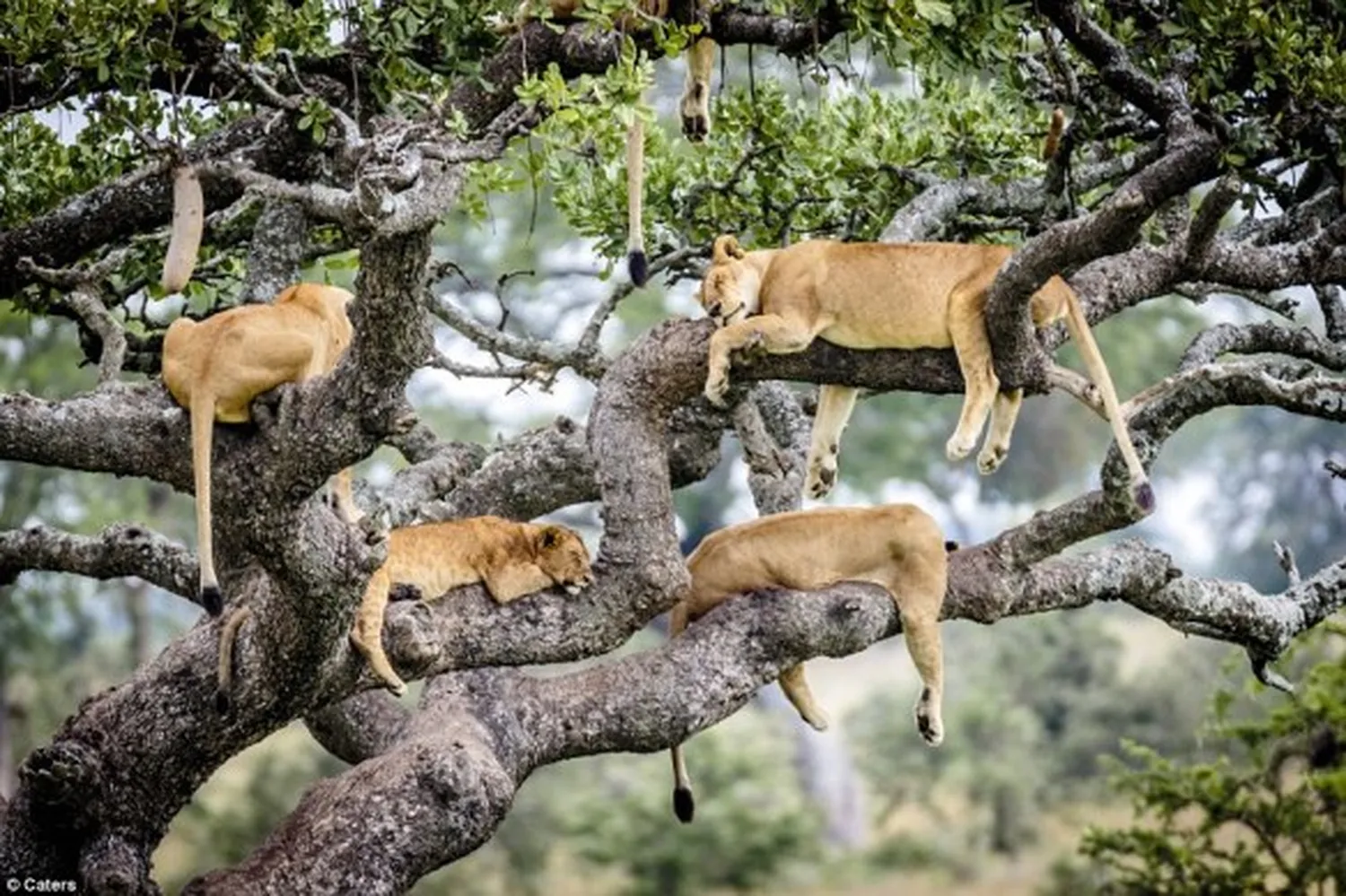
Quick Answer: Can You See Tree-Climbing Lions on a 6-Day Lake Manyara Safari?
Yes, Lake Manyara is one of Tanzania’s best-known places for tree-climbing lions, but a lion in a tree is never guaranteed. Tanzania National Parks promotes the species behavior as a signature attraction of the park. For a six-day itinerary, the best practical strategy is to dedicate a full game-drive day to Lake Manyara and, when timing allows, return for a second early-morning search before continuing to Serengeti.
Do not treat historical research numbers as modern sighting probabilities. A classic Lake Manyara lion study found lions in trees on roughly two-thirds of occasions when lions were encountered during that study period, but the research was conducted decades ago and does not mean today’s visitor has a 66% chance.
- Protected park area: 648.7 km² in current TANAPA material.
- Signature behavior: lions resting or lounging in trees.
- Bird diversity: more than 400 species recorded by TANAPA.
- Road access: about 125 km / 2–2.5 hours from Arusha according to TANAPA’s visitor guide.
- Core habitats: groundwater forest, acacia woodland, floodplain, wetlands and alkaline lake.
- Other wildlife: elephant, buffalo, giraffe, zebra, wildebeest, hippo, baboon and blue monkey.
- Canopy walkway: TANAPA describes it as about 370 m long and reaching around 18 m high.
- Key rule: remain on designated roads and follow ranger/guide instructions.
Why Is Lake Manyara Famous for Tree-Climbing Lions?
Lake Manyara became internationally associated with tree-climbing lions because the behavior was repeatedly documented there and became unusually visible to visitors. The park’s mix of acacia woodland, floodplain and broad-limbed trees provides suitable resting structures, while its compact road network makes a tree-resting lion easier to notice than in some larger ecosystems.
The important correction is that tree-climbing is not exclusive to Lake Manyara lions. Lions in other parts of East Africa can also climb and rest in trees. TANAPA’s older general visitor brochure explicitly notes that the behavior occurs elsewhere and cautions against treating Manyara lions as biologically different. Lake Manyara’s value is that the behavior is a long-established part of the park’s natural history and tourism identity.
What Does Research Say About Lake Manyara’s Tree-Climbing Lions?
The best-known quantitative evidence comes from a classic field study by Stephen Makacha and George B. Schaller. The researchers observed Lake Manyara lions for about 1¼ years. They reported an estimated density of roughly 0.4 lions per km² during that historical study period and noted that lions were seen in trees on about two-thirds of occasions when lions were encountered.
The same study reported that buffalo accounted for about 62% of recorded lion kills, zebra about 18% and impala about 12%. These numbers are valuable for understanding the historical ecology of the population, but they must not be presented as current 2026 population density, diet composition or tourism success rates. Habitat, prey, lion numbers, hydrology and tourism conditions have changed over time.
How to Interpret the Famous “Two-Thirds” Figure Correctly
The historical study did not say that two-thirds of tourists will see a tree-climbing lion. It said lions were in trees on roughly two-thirds of the occasions on which the researchers encountered lions during their study. Tourist outcomes also depend on where the animals are, road access, vegetation, time spent searching, guide decisions and simple chance.
Why Do Lions Climb Trees in Lake Manyara?
No single explanation has been proven as the universal reason. Several hypotheses are plausible, and more than one may operate at the same time:
- Relief from biting insects: getting above ground level may reduce irritation from some flies.
- Cooler or breezier rest: elevated branches may offer air movement during warm periods.
- Better visibility: trees can provide a vantage point over floodplain or woodland edges.
- Dry resting space: during wetter periods, branches may offer an alternative to damp ground.
- Learned behavior: young lions may copy pride members where climbing is common.
- Comfort and shade: broad branches can function as daytime resting places.
A helpful guide should explain these as hypotheses rather than telling guests that science has settled on one reason.
Where Should You Look for Tree-Climbing Lions in Lake Manyara?
Search broad-limbed acacia woodland, floodplain edges and tree lines rather than expecting lions in the dense entrance forest. TANAPA’s current attractions material specifically highlights acacia woodland as a place where the park’s famous tree-climbing lions may be seen. A 2025 TANAPA monitoring update also reported seasonal shifts in lion use of acacia zones near the floodplain.
| Habitat | Why it matters | What to scan | Practical note |
|---|---|---|---|
| Acacia woodland | Broad branches and shade provide potential resting places. | Large horizontal limbs, forked trunks, shaded ground below trees. | One of the most logical areas to search for the signature behavior. |
| Floodplain edge | Prey movement, open visibility and adjacent trees create useful lion habitat. | Tree lines, shade patches and nearby grazing animals. | Seasonal water levels can change access and wildlife distribution. |
| Groundwater forest edge | Dense forest transitions into more open habitat used by mammals. | Openings and margins rather than only dense canopy. | Excellent for primates even when lions are absent. |
| Lakeshore/wetlands | Supports hippos, waterbirds and grazing wildlife. | Wildlife congregation and nearby cover. | Lion presence varies; use this zone for the wider ecosystem, not only cats. |
Best Time of Day to Search for Tree-Climbing Lions
Use both early morning and the warmer daytime period instead of relying on one short drive. Lions may be active near dawn and then settle into shade or elevated resting sites later. Midday tree resting is part of the park’s long-standing reputation, but there is no current public dataset that proves a specific hour gives a fixed probability.
| Time | What to focus on | Why |
|---|---|---|
| Gate opening–09:00 | Locate active lions, fresh tracks, prey reactions and open-area movement. | Cooler conditions can support more movement before daytime resting. |
| 09:00–13:00 | Scan broad branches and shaded woodland. | Lions may settle as temperatures rise. |
| 13:00–15:30 | Keep expectations patient; combine lion search with elephants, primates and birds. | Long resting periods are normal lion behavior. |
| 15:30–late afternoon | Revisit promising areas and watch for lions becoming active. | Cooling conditions may increase movement again. |
Best Season for a 6-Day Tree-Climbing Lions Lake Manyara Safari
Lake Manyara is open year-round, and there is no scientifically verified “best month” specifically for seeing a lion in a tree. TANAPA’s general visitor literature identifies June–October and January–February as popular periods for the park. The better choice depends on whether you value drier roads, green scenery, birding, lower visitor numbers or wider Northern Circuit wildlife.
| Period | Lake Manyara advantage | Possible drawback | Best wider route use |
|---|---|---|---|
| Jan–Feb | Warm conditions, generally popular safari period, green areas still possible. | Tree-climbing behavior is not guaranteed despite warm daytime conditions. | Combine Manyara with southern Serengeti calving-season travel. |
| Mar–May | Lush landscapes, migrant/resident birding and fewer vehicles in some periods. | Long rains can make some tracks wet or temporarily difficult. | Good for flexible green-season travelers. |
| Jun–Oct | Drier conditions and easier general wildlife viewing across the Northern Circuit. | Peak months can be busier. | Strong Tarangire + Manyara + Serengeti + Ngorongoro combination. |
| Nov–Dec | Fresh vegetation, birding and changing wildlife distribution after short rains. | Rain timing varies and lake/road conditions can shift quickly. | Flexible route with Manyara before or after Serengeti. |
Recommended 6-Day Tree-Climbing Lions Lake Manyara Safari Itinerary
The best balanced route gives Lake Manyara one full day plus a second early search, while still preserving two Serengeti game-drive periods and an Ngorongoro Crater descent. This is more useful for the keyword intent than a standard itinerary that rushes through Manyara in two or three hours.
Day 1: Arusha to Tarangire National Park
Leave Arusha after breakfast and drive to Tarangire. Use the afternoon for elephants, baobabs, giraffes and riverine wildlife before overnighting around Tarangire or the Mto wa Mbu/Karatu corridor. This keeps Day 2 available for an early Lake Manyara entry instead of losing the morning to a long transfer.
Day 2: Full-Day Lake Manyara Tree-Climbing Lion Search
Enter Lake Manyara early and work the habitat systematically: groundwater forest, acacia woodland, floodplain edge and lake/wetland viewpoints. Spend time scanning broad branches instead of racing through the park. Even without a tree-climbing lion, the day can deliver elephants, buffalo, giraffe, hippos, baboons, blue monkeys and strong birding. Overnight near Mto wa Mbu or Karatu.
Day 3: Early Lake Manyara Revisit, Then Continue to Serengeti
Use the morning for a second targeted lion search before driving through the Ngorongoro highlands toward Serengeti. This repeat visit is the main upgrade over a generic six-day circuit. Arrive in central Serengeti for an afternoon game drive and overnight in the park.
Day 4: Full-Day Serengeti Predator and Plains Wildlife Drive
Spend the day in Serengeti searching for lions, leopards, cheetahs and plains game. If your dates correspond with a seasonal migration sector, the route can be adjusted, but do not sacrifice the entire day to long relocation unless the ecology supports it.
Day 5: Serengeti Morning Drive to Ngorongoro Highlands
Use the morning for another Serengeti game drive before heading toward Ngorongoro. Overnight near the crater rim or in Karatu so Day 6 can start early.
Day 6: Ngorongoro Crater Game Drive and Return to Arusha
Descend early into the crater for concentrated wildlife viewing, picnic inside the conservation area, then return to Arusha in the afternoon or early evening.
Why This Route Is Better Than a Standard “Four Parks in Six Days” Schedule
Jaynevy already publishes a 6-Day Tarangire, Manyara, Serengeti & Ngorongoro Safari from Arusha. For a traveler specifically searching for tree-climbing lions, this article’s version changes the emphasis by protecting more Lake Manyara search time instead of treating the park as a brief checklist stop.
Lake Manyara-Focused vs Standard Northern Circuit: Which Is Better?
| Factor | Manyara-focused route | Standard balanced route |
|---|---|---|
| Lake Manyara time | Full day + second morning search | Usually one game-drive block |
| Tree-climbing lion objective | Better fit | Possible, but less search time |
| Serengeti time | One full day plus arrival/departure viewing | Often similar or slightly more |
| Tarangire time | One main game-drive day | Often one day |
| Best for | Lion behavior, photography, repeat Manyara search | First-time travelers wanting equal park coverage |
What Else Makes Lake Manyara Worth Including?
The park is much more than a lion-search stop. TANAPA describes a 648.7 km² protected landscape with unusually varied habitats packed between the Rift Valley escarpment and the alkaline lake. That habitat compression is why a single game drive can move quickly from dense forest primates to open floodplain mammals and wetland birds.
- 400+ bird species: TANAPA lists more than 400 recorded species, including fish eagles, storks, herons, spoonbills and migrants.
- Flamingos: both lesser and greater flamingos may occur, but numbers are seasonal and should never be guaranteed.
- Elephants: one of the park’s best-known large-mammal attractions.
- Primates: blue monkeys and large baboon troops are often associated with the groundwater forest.
- Hippos: wetland and pool areas provide additional large-mammal viewing.
- Rift Valley scenery: the escarpment creates a strong landscape contrast with lake and forest.
- Canopy walkway: TANAPA’s 2026 tourism material describes a walkway roughly 370 m long and up to about 18 m high.
Read Jaynevy’s Lake Manyara National Park guide for the destination overview, or compare a shorter Lake Manyara day trip from Arusha.
How to Improve Your Chances Without Disturbing the Lions
- Use a private vehicle when possible. It lets your group spend longer scanning productive woodland.
- Enter early. Morning tracks and active animal behavior help guides understand where lions may later settle.
- Revisit good habitat. A lion hidden at 08:00 may be visible on a branch at 11:00.
- Use binoculars. Branch shadows can hide a resting lion surprisingly well.
- Ask the guide to explain signs. Tracks, prey alarm behavior and recent ranger/guide information are more useful than chasing rumors blindly.
- Respect road rules. Never request illegal off-road driving to get closer to a tree.
- Keep noise low. Natural resting behavior is more valuable than forcing a lion to react.
Private vs Group Safari for Tree-Climbing Lion Viewing
A private safari is usually the stronger option for this niche objective. Shared safaris can offer better value, but the group may not want to wait beside a quiet woodland zone or repeat the same route later in the day.
| Factor | Private 4x4 | Shared safari |
|---|---|---|
| Search time | Controlled by your group | Shared with other priorities |
| Ability to revisit a zone | High | Depends on group plan |
| Photography patience | Better | More limited |
| Cost per person | Usually higher for small groups | Usually lower |
| Best fit for this keyword | Recommended | Good for budget-first travelers |
Common Mistakes When Booking a Tree-Climbing Lions Safari
- Booking a route that gives Lake Manyara only two hours. That is too little time for a behavior-focused objective.
- Believing “tree-climbing lion” means guaranteed sighting. It does not.
- Treating a decades-old study as a current success rate. Historical ecology and modern tourism probability are different things.
- Ignoring other wildlife. Manyara remains valuable even when every lion stays on the ground.
- Adding too many parks. More destinations can reduce observation time.
- Expecting fixed flamingo numbers. Water chemistry, depth and food conditions change.
- Pressuring the guide to break park rules. Wildlife welfare and legal access come first.
Useful Jaynevy Tours Internal Guides for Planning This Safari
- 6-Day Tarangire, Lake Manyara, Serengeti & Ngorongoro Safari from Arusha
- Tanzania Safari from Arusha
- Lake Manyara National Park
- Lake Manyara Day Trip from Arusha
- 3-Day Tarangire, Ngorongoro & Lake Manyara Safari
- Best Safari Parks in Tanzania
- 8-Day Tanzania Wildlife Safari: Northern Circuit
Frequently Asked Questions About a 6-Day Lake Manyara Tree-Climbing Lions Safari
Can you really see tree-climbing lions in Lake Manyara?
Yes. Tanzania National Parks identifies tree-climbing lions as one of Lake Manyara National Park's signature attractions. However, lions are free-ranging and a tree sighting cannot be guaranteed on a particular game drive.
Why do Lake Manyara lions climb trees?
There is no single proven explanation. Researchers and field observers have proposed several possible advantages, including escaping biting insects, finding cooler or breezier resting places, gaining a better view and using broad branches for daytime rest. The behavior should be presented as an ecological habit with multiple possible explanations rather than one settled cause.
How common is tree-climbing behavior in Lake Manyara?
A classic historical study by Stephen Makacha and George Schaller reported lions in trees on about two-thirds of the occasions when lions were encountered during their observation period. That is valuable historical evidence, not a current tourist sighting rate or a 2026 population estimate.
What is the best time of day to search for tree-climbing lions?
Late morning through the warmer part of the day can be worth checking broad-limbed trees because lions may rest during daytime heat, but early morning remains valuable for locating active lions before they settle. A full-day game drive gives more flexibility than a short rushed visit.
What is the best season for a Lake Manyara safari?
Lake Manyara can be visited year-round. TANAPA visitor literature highlights June to October and January to February as popular periods. Wet-season months bring greener scenery and strong birding, while road and lake conditions can change with rainfall.
Is one day in Lake Manyara enough on a six-day safari?
One full day can work, but travelers whose main objective is tree-climbing lions benefit from adding a second early-morning search before continuing to Serengeti. Repeated game-drive time improves opportunity without creating a guarantee.
What other wildlife can I see in Lake Manyara?
TANAPA lists elephants, buffalo, zebra, wildebeest, giraffe, hippos, baboons, blue monkeys and more than 400 recorded bird species, while flamingo numbers vary seasonally with lake and feeding conditions.
Is Lake Manyara only worth visiting for the lions?
No. The park combines groundwater forest, acacia woodland, floodplain, wetlands, the alkaline lake and Rift Valley scenery in a compact area. Birding, primates, elephants, hippos and landscape variety can make the visit worthwhile even when no lion is seen in a tree.
Should I choose a private safari for a tree-climbing lion focus?
A private vehicle is usually the better choice for this specific objective because you control how long the guide searches acacia woodland, whether you revisit promising areas and how much time you spend in Lake Manyara before moving to the next park.
Can a 6-day Lake Manyara safari also include Serengeti and Ngorongoro?
Yes. A practical Northern Circuit route can combine Tarangire, Lake Manyara, Serengeti and Ngorongoro in six days. If tree-climbing lions are the priority, protect a full Lake Manyara day and, if possible, a second morning search instead of treating the park as a quick transit stop.
Research Notes and Trusted Sources
This guide separates current park facts from historical lion research. Current park area, wildlife and visitor information come from Tanzania National Parks. The quantitative tree-climbing and diet figures come from the classic Makacha–Schaller Lake Manyara lion study and are deliberately labeled historical rather than presented as modern tourist probabilities.
- TANAPA: Lake Manyara National Park — 648.7 km² protected area and tree-climbing lion identity.
- TANAPA: Lake Manyara Wildlife & Habitats — elephants, lions, floodplain wildlife and 400+ recorded bird species.
- TANAPA: Lake Manyara Visitor Guide — roughly 125 km / 2–2.5 hours by road from Arusha, regulations and safety.
- Makacha & Schaller: Observations on lions in Lake Manyara National Park — historical lion density, diet and tree-climbing observations.
- TANAPA Tourism publication — canopy walkway details of about 370 m length and 18 m height.
Editorial note: Wildlife locations, lake conditions and road access change. A 6-day itinerary improves observation time but cannot guarantee that a lion will be resting in a tree on your travel date.