
Quick Answer: What Is the Best 6-Day Wildebeest Migration Tracking Plan?
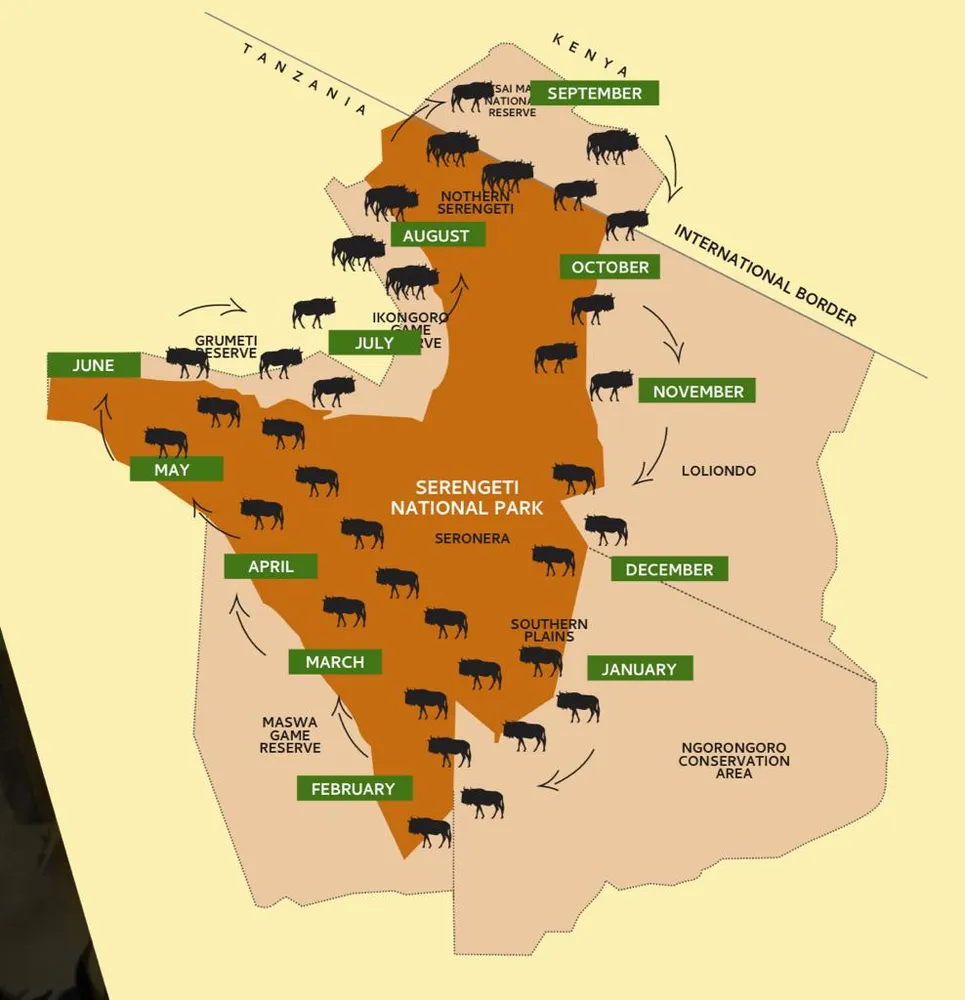
The strongest six-day plan is to spend four to five safari days inside the expected migration zone and avoid trying to combine too many unrelated parks. From January to March, focus on Ndutu and the southern plains; in May and June, follow the movement through central and western Serengeti; from July to October, base the trip in northern Serengeti; and in November to December, track the herds as they move back through eastern and central Serengeti toward the south. Treat month-by-month locations as a planning pattern, not a guaranteed timetable.
Quick navigation: What migration tracking means | Month-by-month locations | 6-day itinerary | Seasonal route versions | Migration data | River crossings | Calving season | How guides track herds | Photography | Planning advice | FAQs
What Wildebeest Migration Tracking Actually Means
Migration tracking is different from booking a standard Serengeti safari and hoping the herds happen to be nearby. A migration-focused itinerary is built around the expected seasonal position of the herds, then adjusted around current rainfall, grazing, access and the direction in which the animals are moving.
The Serengeti-Mara migration is a circular ecological movement rather than a single event. UNESCO describes more than one million wildebeest, together with hundreds of thousands of other ungulates, making an annual trek of about 1,000 km across Tanzania and Kenya. TANAPA describes Serengeti as the core of a wider Serengeti-Mara ecosystem of roughly 30,000 km². That scale is the reason a camp in the wrong sector can leave you many hours from the main concentrations.
For travelers comparing broader options, our wildebeest migration safari page explains the overall experience, while the Serengeti migration map and routes guide helps visualize how the annual circuit moves through different parts of the ecosystem.
Wildebeest Migration Locations by Month
The migration follows a broad seasonal pattern, but rainfall can move the leading and trailing herds earlier or later. UNESCO's current Serengeti ecosystem material describes calving around Lake Ndutu in February, northwest movement beginning in May or June, dry-season movement toward the Maasai Mara from August to November, and the return south with the rains in December.
| Period | Broad tracking zone | Main safari interest | Best 6-day planning approach |
|---|---|---|---|
| January–March | Ndutu, southern Serengeti and short-grass plains | Large herds, calving in February, predator activity, green plains | Road or fly to Ndutu; keep 3–4 nights in the southern migration zone |
| April | Southern to central Serengeti | Green season, dispersing herds, dramatic skies, fewer dry-season crowds | Use flexible central/southern camps and avoid overcommitting to one small area |
| May–June | Central Serengeti toward western corridor | Northwest movement, long columns, rut period, river and woodland habitats | Split nights between central and western Serengeti if current movement supports it |
| July | Western/northwestern Serengeti toward the north | Transition toward northern ranges; herds can be widely spread | Use recent field information before locking all nights into one sector |
| August–October | Northern Serengeti and Mara River zone | Major herd concentrations and possible Mara River crossings | Fly into northern Serengeti when possible and spend several full days there |
| November–December | Eastern/central Serengeti moving south | Return migration, fresh grass after rains, moving columns | Track the return route with flexible central, eastern and southern placement |
If your travel month is already fixed, compare it with our Tanzania safaris by month guide before selecting camps. For river-crossing travel specifically, see the best time for Serengeti migration river crossings.
6-Day Wildebeest Migration Tracking Itinerary
This is the most useful six-day framework because it protects tracking time and leaves room to react to the herds. The exact named camps and daily sectors should change with the season rather than being hardcoded for the whole year.
Day 1: Arusha to the Current Migration Zone
Travel from Arusha to the part of the Serengeti ecosystem where the migration is expected to be concentrated. For the southern season, a road journey through the Ngorongoro highlands to Ndutu can work well because it places you directly into the calving ecosystem. For northern Serengeti in the July-to-October period, a scheduled bush flight can save most of a road-transfer day and preserve valuable afternoon tracking time.
Once in the migration zone, the first objective is not to chase a dramatic scene immediately. Your driver-guide uses the afternoon to establish where the densest herds are feeding, resting or moving and which sectors are practical for the next morning.
Day 2: Full-Day Herd Tracking and Movement Reading
Start early and spend the day inside the main migration sector. Large herds rarely behave as one solid mass. There may be a leading front, dense central concentrations and smaller trailing groups spread across many kilometres. The guide therefore reads movement rather than treating one sighting as the entire migration.
In the south, this may mean working the Ndutu and short-grass plains. In the north, it may mean checking several Mara River access sectors without assuming that waiting at one crossing point all day is the best strategy.
Day 3: Follow the Herd Front, Calving Grounds or River Sector
Day 3 is deliberately kept in the same broad region. This matters because migration viewing improves when you have time to revisit a promising area under different light and animal conditions. A herd that is resting in the morning may begin moving later; animals near a river can approach, retreat and reorganize without crossing.
For February calving travel, this day is used to work the short-grass plains around Ndutu and the Serengeti-Ngorongoro boundary. For northern migration travel, it becomes another full day in the Kogatende/Lamai and Mara River environment.
Day 4: Second Tracking Sector and Predator Ecology
Use Day 4 to expand the search rather than repeating the exact same loop. Herd movement creates a moving food web: lions, cheetahs, hyenas and scavengers respond to concentrations of wildebeest and other grazers. The best day is often not the one with the biggest herd count, but the one that shows how predators, calves, grass, water and migration routes interact.
When current conditions justify it, this is also the day to shift camp within Serengeti—for example from central to western Serengeti in the northwest-moving season, or from eastern/central areas toward southern plains during the return migration.
Day 5: Buffer Day for Weather, Herd Movement and Missed Opportunities
A buffer day is one of the biggest advantages of a six-day itinerary. Wildlife does not follow a booking calendar. Heavy rain can change road access, a herd can move overnight, and a river crossing can fail to happen despite hours of waiting. Keeping Day 5 in the migration region lets the guide adapt without sacrificing the entire trip.
For northern Serengeti, this means another chance to work different Mara River sectors. For Ndutu, it can mean following fresh concentrations toward the boundary plains. For the western corridor, it can mean choosing between riverine habitat and broader migration columns depending on current conditions.
Day 6: Dawn Tracking and Return to Arusha or Onward Flight
Use the last morning for one final tracking session before leaving the ecosystem. A dawn drive can provide cleaner light, cooler temperatures and active predators. Then return by road or fly from the nearest suitable airstrip, depending on the region and onward travel plan.
If you want a package built around this structure, compare the existing 6-day Serengeti wildebeest migration safari and broader Tanzania Great Serengeti Migration safari options.
How the 6-Day Itinerary Changes by Migration Season
A single fixed route is not credible for every month. The table below shows how the same six-day duration should be repositioned according to the seasonal migration pattern.
| Migration season | Suggested six-day structure | Why it works |
|---|---|---|
| Calving: Jan–Mar | Day 1 Arusha–Ndutu; Days 2–4 Ndutu/southern plains; Day 5 south/central Serengeti; Day 6 exit via Ngorongoro or fly out | Concentrates time on short-grass calving habitat and allows one second Serengeti sector |
| Northwest movement: May–Jun | Day 1 central Serengeti; Day 2 central; Days 3–5 central/western corridor based on movement; Day 6 exit | Protects flexibility while the herds stretch across a broad moving front |
| Northern migration: Jul–Oct | Day 1 fly to northern Serengeti; Days 2–5 northern tracking and Mara sectors; Day 6 dawn drive and fly out | Reduces transfer time and gives multiple chances for river-area activity |
| Return south: Nov–Dec | Day 1 central/eastern Serengeti; Days 2–3 east/central; Days 4–5 move with herds toward southern plains; Day 6 exit | Matches the return migration instead of assuming the herds remain in the north |
Great Migration Numbers That Matter for Planning
Useful numbers should explain the scale of the ecosystem, not create false precision about what you will see on one game drive. The strongest official figures are these:
- About 1,000 km: UNESCO's stated length of the annual circular migration trek.
- More than 1 million wildebeest: UNESCO's criterion statement for the migrating wildebeest population, accompanied by hundreds of thousands of other ungulates.
- 1,476,300 hectares: the UNESCO World Heritage property area for Serengeti National Park, equal to 14,763 km².
- About 30,000 km²: TANAPA's description of the wider Serengeti-Mara ecosystem associated with the annual migration.
- 1,100–2,000 metres: TANAPA's published altitude range for Serengeti National Park.
- Roughly 900–1,000 mm annual rainfall: TANAPA's broad Serengeti climate reference, one reason rainfall patterns matter so much to grass growth and movement.
- 809,440 hectares: the Ngorongoro Conservation Area World Heritage property, whose northern plains are part of the migration and calving system.
These figures explain why “the migration is in Serengeti” is not specific enough for a six-day plan. Serengeti alone is vast, and the wider migration system is larger still.
Mara River Crossings: What a 6-Day Itinerary Can and Cannot Promise
A six-day northern Serengeti itinerary can give you several opportunities to look for river-crossing behavior, but it cannot guarantee that wildebeest will cross the Mara River while your vehicle is present. Herds can gather at the bank, wait for hours, move away, or choose a different crossing point.
TANAPA's revised 2024 Mara River crossing guideline maps 14 designated crossing points. Depending on the site, the published maximum number of vehicles ranges from 30 to 70, while allowable viewing distances from the river bank range from 30 to 140 metres. The guideline instructs vehicles to remain at designated positions and gives animals space to move without obstruction.
This is why responsible tracking is not “race to the river.” The better approach is patience, correct positioning and enough days in the north. A crossing lasting minutes should never be sold as if it were a scheduled activity.
Calving Season in Ndutu: Why February Is Different
Calving season is not simply another migration location. It is a biological phase of the annual cycle. UNESCO states that wildebeest calve in February on the short-grass plains around Lake Ndutu, straddling Serengeti National Park and the Ngorongoro Conservation Area.
These plains are valuable because the open habitat supports grazing and visibility, while the concentration of newborns attracts predators and scavengers. A February itinerary should therefore spend more time in the southern ecosystem rather than driving north in search of a river-crossing style experience that belongs to a different season.
The Ngorongoro Conservation Area is directly relevant here, not just as an optional crater add-on. UNESCO describes more than one million wildebeest passing through the property as part of the annual migration and identifies the boundary short-grass plains as calving grounds.
How Driver-Guides Track the Migration on the Ground
Tracking is a combination of seasonal knowledge and real-time observation. No single signal tells you where every herd is. A good guide builds a picture from several clues and keeps the day's plan flexible.
- Rainfall and fresh grass: recent rain can change grazing quality and encourage movement toward new pasture.
- Herd direction: the direction and speed of moving columns helps distinguish local feeding from broader migration movement.
- Fresh tracks and dust columns: large moving herds leave obvious landscape-scale signs, especially in drier conditions.
- Water access: rivers and dependable water become increasingly important in the dry season.
- Predator and scavenger activity: concentrations of lions, hyenas and vultures can indicate a productive herd area, especially during calving.
- Road and weather conditions: the closest point on a map is not always the most practical or responsible route after heavy rain.
- Current field information: guides use recent observations from the operating area to decide whether to stay, reposition or change the next day's plan.
That flexibility is one reason private migration safaris can be valuable. A private vehicle can normally adjust departure time, stop duration and daily focus more easily than a fixed joining schedule. For a wider comparison of safari styles, see our Tanzania safari packages.
Photography Strategy for a Wildebeest Migration Safari
Migration photography is about scale, movement and behavior. A tight portrait of one wildebeest tells a different story from a wide frame containing thousands of animals, dust, horizon and storm light. Carry equipment that lets you do both.
- Telephoto zoom: a 100–400 mm class lens is versatile for predators, calves, compressed herd patterns and river-bank action.
- Wide or standard zoom: useful for the scale of the plains, long migration columns and environmental portraits.
- Fast shutter speed: useful when animals run, cross water or interact quickly.
- Dust protection: keep lens changes controlled during dry months and carry a blower or basic cleaning kit.
- Memory and batteries: action sequences consume storage and battery power faster than normal landscape photography.
- Vehicle positioning: ask for space and communicate your preferred side before a long sighting develops.
If photography is a major priority, our wildlife photography safari page covers vehicle and shooting considerations in more detail.
How to Plan a 6-Day Migration Safari Without Wasting Time
The best migration itinerary is usually simpler than a classic multi-park safari. Concentrate nights where the herds are expected rather than adding Tarangire, Lake Manyara and Ngorongoro Crater simply because they are famous. Those parks are excellent, but every extra transfer takes time away from the specific reason you booked this trip.
- Start with your month. Your travel dates determine the first-choice migration sector.
- Then choose camp location. A beautiful lodge several hours from the herds is the wrong lodge for a tracking-focused trip.
- Protect at least three full tracking days. Four is better when river crossings are the priority.
- Use flights strategically. Northern Serengeti is where one-direction flying can save the most time on a six-day trip.
- Keep one buffer day. This protects the itinerary against weather, shifting herds or a missed opportunity.
- Do not demand a crossing guarantee. Ask instead how many full days you will have in the relevant river zone.
- Confirm whether your vehicle is private. This materially changes how freely the guide can follow your migration priorities.
- Ask where each night is located. “Serengeti accommodation” is not enough; northern, central, western and southern locations can be many hours apart.
Before booking, it is also worth reading the common Serengeti migration planning mistakes and our broader Tanzania safari planning page.
Who This 6-Day Migration Tracking Itinerary Suits
This itinerary suits travelers whose first priority is the Great Migration rather than collecting as many national parks as possible. It is especially strong for photographers, repeat safari visitors, wildlife-focused couples, families comfortable with longer game-drive days, and travelers who understand that the best wildlife experiences depend on patience and flexibility.
It is less suitable for someone who wants Tarangire elephants, Lake Manyara, Ngorongoro Crater and the migration all in six days with equal time in each place. That is a different safari goal. If broad Northern Circuit variety matters more than herd tracking, choose a conventional multi-park itinerary instead of forcing both objectives into the same six-day schedule.
Research Sources and Methodology
This guide uses official and primary conservation references for migration scale, seasonal route patterns, calving areas and Mara River operating rules. The month-by-month table is a planning interpretation of those broad patterns, not a live herd-location guarantee. Rainfall, pasture, water, road access and animal decisions can alter the exact position of the migration in any year.
- UNESCO World Heritage Centre: Serengeti National Park
- UNESCO World Heritage Centre: Ngorongoro Conservation Area
- UNESCO Serengeti-Mara ecosystem migration and seasonal movement material
- TANAPA Serengeti National Park brochure
- TANAPA Mara River Migration Crossing Guideline, revised June 2024
- Ngorongoro Conservation Area Authority: Ndutu Airstrip and migration-route information
Frequently Asked Questions About a 6-Day Wildebeest Migration Tracking Itinerary
Is six days enough for a wildebeest migration safari?
Yes. Six days is enough for a focused migration safari when most nights are placed in the expected herd zone instead of being split across too many parks. Northern Serengeti trips are usually more efficient with a fly-in or fly-out sector.
Where is the wildebeest migration from January to March?
The broad seasonal pattern places major herds on the southern Serengeti and Ndutu short-grass plains. February is the key calving period, although exact herd position varies with rainfall and grazing conditions.
Where is the migration in June and July?
The herds generally move northwest through the western Serengeti and then toward the north. June is often associated with the western corridor, while July is a transition month when herd position can be spread over a large area.
Where is the migration from August to October?
The broad pattern places major herds in northern Serengeti and the wider Mara ecosystem. This is the main season for attempting Mara River crossing viewing, but no operator can guarantee a crossing on a particular day.
Can a guide guarantee a Mara River crossing?
No. A crossing is a spontaneous wildlife event. Herds can gather near the river and then wait, turn away or cross at a different point. A good itinerary gives several days in northern Serengeti rather than building the trip around one fixed crossing time.
How long is the Great Migration route?
UNESCO describes the migration as an annual circular trek of about 1,000 kilometres involving over one million wildebeest plus hundreds of thousands of other ungulates across Tanzania and Kenya.
What is special about Ndutu during calving season?
The short-grass plains around Lake Ndutu and the Serengeti-Ngorongoro boundary are major calving grounds. UNESCO states that wildebeest calve there in February, making the area especially important for newborns, predators and large herd concentrations.
Should I fly or drive to northern Serengeti on a 6-day itinerary?
For a six-day migration-focused trip in the July-to-October northern season, flying at least one direction usually protects more time for tracking. A full road transfer from Arusha is possible, but it consumes a significant part of the itinerary.
What is the best camera setup for migration photography?
A telephoto zoom in roughly the 100–400 mm class is highly useful for herd details and predators, while a second wider lens helps capture the scale of the plains and river scenes. Carry spare batteries, memory cards and a dust-protection plan.
Does the migration follow an exact calendar?
No. The monthly pattern is a planning guide, not a fixed timetable. Rainfall, fresh grass, water availability and herd decisions can shift movement earlier, later or across several sectors at once.