
Quick Answer: What Is the Best Time for a 6 Day Tanzania Great Migration Safari?
Choose January–March for calving and predator action in the southern Serengeti/Ndutu area; choose July–October if your priority is northern Serengeti and the possibility of Mara River crossings. For a six-day road safari, the southern calving season is usually easier to combine with Ngorongoro because the migration zone is closer to the conservation-area highlands. A six-day northern-crossing safari can still work very well, but it benefits from a more focused route, a fly-in or fly-out sector, or fewer additional parks so you do not spend too much of the trip transferring.
- Best for calving: late January through March, with February often a prime planning month.
- Best for possible Mara River crossings: broadly July through October, but crossings are unpredictable and never guaranteed.
- Best for lower crowds and greener scenery: parts of November–December and the wetter April–May period, accepting more weather uncertainty.
- Best rule: choose the Serengeti zone first, then build the six-day route around it.
Great Migration Timing at a Glance for a 6-Day Safari
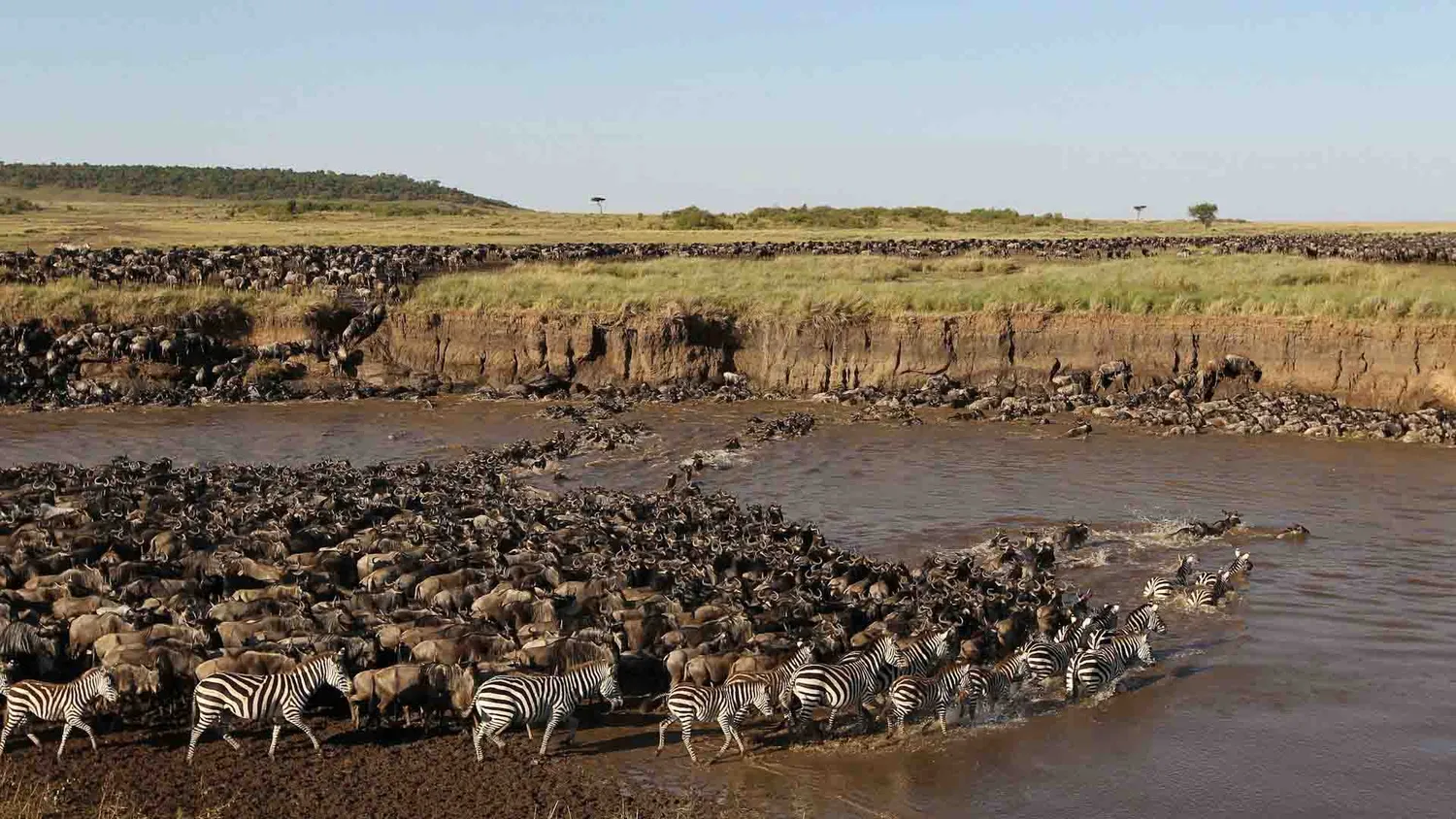
The migration is a year-round movement, not a single event. Wildebeest and associated grazers move through the Serengeti ecosystem in response to rainfall, water and fresh grass. A month-by-month calendar is therefore a planning tool, not a timetable. The most useful question is: which migration phase do you want, and which Serengeti region gives a six-day itinerary enough time on the ground?
| Period | Likely migration focus | Best 6-day strategy | Main trade-off |
|---|---|---|---|
| January–March | Southern Serengeti / Ndutu, calving | Road safari with Ngorongoro + southern plains | Rain showers possible; herd location still varies |
| April–May | Southern/central to western movement | Flexible central/western routing | Long rains, muddy roads, some seasonal camp closures |
| June | Western Corridor / transition north | Focus Serengeti + Ngorongoro; stay flexible | Herds may be spread over a broad area |
| July–October | Northern Serengeti; possible Mara crossings | Trim extra parks or use a flight to protect northern game-drive time | Peak demand, higher rates, crossings never guaranteed |
| November–December | Southward movement through central/eastern zones | Flexible Serengeti + Ngorongoro route | Short rains can shift herd timing quickly |
Why the “Best Time” Depends on Which Migration Experience You Want
Calving, mass herd movement and river crossings are different safari experiences. A traveller who wants newborn wildebeest and predator-prey interaction should not automatically choose August just because it is famous for migration. Likewise, a traveller dreaming of a river crossing should not book February and expect the Mara River.
- Calving focus: southern short-grass plains, newborns, large nursery herds and active predators.
- Movement focus: huge herds traveling through central or western Serengeti, often spread over a broad landscape.
- River-crossing focus: northern Serengeti, where herds may approach and cross the Mara River multiple times—or remain on one side for days.
- General wildlife focus: Serengeti remains a major wildlife destination even when the largest migration concentrations are elsewhere.
January: Is It a Good Month for a 6-Day Migration Safari?
January can be very good, particularly as herds gather around the southern Serengeti and Ndutu ecosystem after the short rains. Grass can be green, plains can hold large concentrations, and the first part of the calving period begins to build. Exact timing depends on rain. For six days, the southern location is practical because it combines naturally with Ngorongoro and avoids the long push to northern Serengeti.
A strong January route can use Tarangire or Lake Manyara on Day 1, then move into Ndutu/southern Serengeti for several game-drive sessions before Ngorongoro. If migration is the main priority, adding both Tarangire and Manyara may dilute Serengeti time; one supporting park is usually enough.
February: Is This the Best Month for Calving?
February is one of the strongest planning months for travellers whose Great Migration priority is calving. TANAPA's 2026 tourism material describes the southern plains calving spectacle between January and March, and UNESCO notes that vast numbers of wildebeest calve on the short-grass plains straddling the Ngorongoro Conservation Area and Serengeti boundary. The abundance of vulnerable calves can also create intense predator activity.
For a six-day road safari, February is especially efficient because the wildlife objective is in the south rather than far north. You can spend meaningful time in Ndutu/southern Serengeti and still include Ngorongoro without making the route feel like a transfer race.
March: Is the Calving Season Still Worth It?
March can still be excellent for southern-plains migration viewing, although conditions become more variable as the season progresses. Calves are growing, herds can remain spread across the short-grass ecosystem, and storms can produce dramatic skies and green photography. The trade-off is increasing rain risk, especially later in the month.
If your dates are fixed in March, ask the operator to confirm where its guide network is currently finding the larger herds rather than relying on a generic “Ndutu in March” promise.
April and May: Are the Long Rains a Bad Time for the Migration?
April and May are not “bad” wildlife months, but they require a traveller who values green landscapes, fewer vehicles and flexibility more than dry roads. Current Jaynevy season guidance describes April–May as lower-demand months with lush scenery, while warning that rain can make some roads difficult and some remote camps may close.
The migration generally works north and west as rain patterns change, but herd distribution can be broad. A six-day safari in these months should avoid overcommitting to one narrow migration zone months in advance. Central Serengeti can be useful because it gives a guide several directions to work from.
June: Is It Too Early for River Crossings?
June is better viewed as a transition month than a guaranteed Mara River month. Herds can be moving through the western corridor and toward northern areas, and the exact pace changes with rainfall. Some dramatic river activity can occur in western Serengeti, but a traveller booking specifically for the Mara River should generally think later in the dry season.
June is attractive for travellers who want drier conditions and strong general game viewing without necessarily requiring the busiest northern-crossing period. A six-day itinerary can remain more road-efficient if the herds have not yet moved deep into the far north.
July: When Does Northern Serengeti Become the Main Focus?
July is when northern Serengeti becomes increasingly important for migration-focused itineraries, but the exact arrival date is not fixed. If herds are already around Kogatende and the Mara River system, the route must protect enough time in the north. A six-day itinerary that spends too many early days in Tarangire, Manyara and central Serengeti can leave only a short window for the primary objective.
For July travellers, consider a fly-in sector, or design the road route around Serengeti + Ngorongoro rather than trying to include every Northern Circuit park.
August and September: Best Months for Mara River Crossing Possibilities?
August and September are among the most popular months for northern Serengeti because large herds may be around the Mara River system. However, “crossing season” does not mean a crossing will occur at a scheduled hour or even on the day you visit a particular river point. Herds may approach, retreat, split, cross elsewhere or remain on one bank.
The practical value of six days comes from repeated opportunities. Spend several game-drive sessions in the northern sector rather than one rushed afternoon. This is also peak-demand territory, so accommodation location matters: a camp near the northern action can save hours of daily driving.
October: Is It Too Late for Northern Serengeti?
October can still be productive in northern Serengeti, but the migration may begin responding to changing rainfall and fresh grazing farther south. The exact transition varies each year. If your six-day safari is in October, use a flexible operator who can choose the Serengeti sector based on current herd reports rather than selling a rigid “crossing itinerary” regardless of conditions.
October also retains many dry-season advantages such as thinner vegetation and easier roads in many areas, while peak-season crowd patterns can begin to soften later in the month.
November and December: Can You Still See the Great Migration?
Yes. The migration does not stop after the river-crossing months. Short rains can pull the herds through central and eastern Serengeti toward southern grazing. This period can offer greener scenery, fresh grass, birdlife and more flexible availability than the heart of peak season.
The challenge is predictability. A rain event can change herd direction quickly. For a six-day safari, central Serengeti is often strategically useful because it gives the guide options to adjust north, east or south depending on current movement.
Which Month Is Best for a 6-Day Great Migration Safari?
There is no single best month; there is a best month for a specific goal. Use the table below rather than choosing only from social-media images.
| Your priority | Strong planning window | Recommended focus | 6-day suitability |
|---|---|---|---|
| Calving + predators | Jan–Mar | Ndutu / southern Serengeti | Excellent for road safari |
| Green scenery + fewer vehicles | Apr–May | Flexible southern/central/western route | Good if rain is acceptable |
| Moving herds + drier weather | June | Western/central transition | Very good with flexible routing |
| Mara River crossing possibility | Jul–Oct | Northern Serengeti | Excellent if route is focused or includes flight |
| Shoulder season + southward migration | Nov–Dec | Central/eastern/southern transition | Very good with current herd intelligence |
Why River Crossings Can Never Be Guaranteed
No ethical safari operator can guarantee a Mara River crossing on a specific date. Crossings depend on herd pressure, water levels, rainfall, grazing conditions and animal behavior. Even when thousands of wildebeest are near the river, they may wait for hours or days, move to another crossing point or turn away completely.
A better promise is operational: the operator should place you in the correct seasonal region, use current guide reports, protect enough game-drive time and adjust the day when conditions change. Jaynevy's current 6-day luxury Great Migration safari explicitly states that herd locations and crossings cannot be guaranteed and that routing should follow dates and current wildlife information.
Is a 6-Day Safari Long Enough for the Great Migration?
Yes, six days can be enough when the itinerary is built around the migration phase. The mistake is trying to combine four parks, long road transfers and a far-northern crossing objective without sacrificing time somewhere.
- Southern calving safari: six road days can work very efficiently.
- Central/western migration safari: six days is usually workable with disciplined routing.
- Northern Mara safari: six days works best when you reduce side trips or use a domestic flight.
- Photography-first safari: consider using more of the six days in one Serengeti sector rather than changing camps every night.
Best 6-Day Route for January–March Calving Season
A southern-focused road route gives strong migration value because Ngorongoro and Ndutu fit naturally together. One practical structure is:
- Day 1: Arusha → Tarangire or Lake Manyara.
- Day 2: Drive through the Ngorongoro highlands toward Ndutu/southern Serengeti, with game viewing en route.
- Day 3: Full day in the southern migration zone.
- Day 4: Second full or near-full southern Serengeti/Ndutu game-drive day.
- Day 5: Move toward Ngorongoro rim/highlands.
- Day 6: Ngorongoro Crater → Arusha.
This structure protects multiple migration sessions instead of giving the southern plains only one afternoon. The exact first park can be dropped if your priority is maximum migration time.
Best 6-Day Route for July–October Northern Serengeti
A northern crossing safari should protect at least two meaningful northern Serengeti game-drive periods. Because the northern sector is much farther from Arusha than Ndutu, six days requires more discipline.
| Approach | Example structure | Best for | Trade-off |
|---|---|---|---|
| Road-focused | Arusha → central Serengeti → north Serengeti → Ngorongoro → Arusha | Travellers who enjoy overland scenery | Longer drive time; fewer side parks |
| Fly-in + road out | Fly to northern Serengeti → 2–3 north days → central → Ngorongoro → Arusha | Protecting migration time | Higher airfare and baggage restrictions |
| Road in + fly out | Ngorongoro/central → north Serengeti → fly to Arusha | Seeing landscape progression but avoiding the long return | Flight schedule must match itinerary |
Should You Include Tarangire on a 6-Day Migration Safari?
Tarangire is worthwhile, but it should not weaken the core migration objective. It adds elephants, baobabs and a different dry-country ecosystem. For January–March, Tarangire can fit comfortably as the opening day. For July–October northern Serengeti, adding Tarangire may force an extra long transfer or reduce northern game-drive time.
If this is your only Tanzania safari and you value ecosystem variety, keep Tarangire. If a Mara crossing is the dominant objective, use the six days more narrowly.
Should You Include Ngorongoro on a Migration-Focused 6-Day Safari?
For most first-time visitors, yes. Ngorongoro adds a very different wildlife and landscape experience and fits naturally on many road routes between Serengeti and Arusha. UNESCO describes the conservation area as a major natural and cultural landscape, and large numbers of migratory wildebeest use its wider ecosystem during the annual cycle.
The main exception is a highly focused northern Serengeti trip where every additional road day reduces time around the Mara River. In that case, a fly-in Serengeti-only itinerary may suit the traveller better.
Arusha or Moshi: Which Is Better for a 6-Day Migration Safari?
Arusha is generally the more direct road-safari staging city for the Northern Circuit, while Moshi can still work well when it matches your flights, hotel or Kilimanjaro plans. The difference matters most when the itinerary is already time-sensitive. You can compare safaris from Arusha with safaris from Moshi before finalizing transfers.
For a six-day northern Serengeti route, do not waste a productive morning with avoidable positioning. Ask where the safari clock starts, whether the pre-night is included and whether airport/hotel transfers are part of the written quote.
How Does Weather Affect the Great Migration?
Rainfall is one of the main forces behind grazing and herd movement. The migration follows access to water and nutritious grass, which is why annual movement does not happen on identical dates. This also explains why a fixed “migration map” is useful for planning but cannot predict the exact herd position months in advance.
Dry-season roads are generally easier, while green-season storms can create mud and slower travel. Rain can also improve photography with dramatic skies, lower dust and greener backgrounds. The best season depends on whether you prioritize predictability of road access, calving, crossings, landscape or crowd levels.
How Do Crowds Change the Experience?
The most famous migration moments can also attract the most safari vehicles. Northern river areas in peak season and popular southern calving zones can become busy around major sightings. A skilled guide reduces the impact by choosing timing, route and positioning intelligently rather than following every vehicle.
Travellers sensitive to crowds should consider shoulder dates, staying in a well-positioned camp, starting early, or choosing a less famous but still active migration phase. Seeing herds moving through open plains without a crossing can be a more satisfying wildlife experience than sitting in a large vehicle queue near one river point.
When Should You Book a 6-Day Great Migration Safari?
Book earlier when your dates, room type and migration zone are inflexible. July–September and popular calving camps can sell well ahead because the best-located properties have limited beds. Current Jaynevy planning guidance recommends much earlier booking for peak dry-season and migration travel than for flexible shoulder-season trips.
- Peak July–September: early planning gives the strongest camp/location choice.
- February calving: book early if you want a specific Ndutu property.
- April–May: more availability may exist, but confirm which seasonal camps are operating.
- Last minute: possible, but the “deal” may be a different camp, different route or remaining room—not necessarily a lower price.
How Much Does a 6-Day Great Migration Safari Cost?
The final price depends heavily on season, Serengeti sector, group size and accommodation. Migration-focused trips can cost more in peak months because well-located northern or mobile camps are in strong demand. Jaynevy's current premium 6-day luxury Great Migration safari starts from USD 3,950 per person, while non-luxury migration packages are quoted from exact dates because camp and supplier costs change.
Do not use one luxury example as a market-wide average. For lower-cost formats, compare the 6-day Serengeti wildebeest migration package, 6-day Serengeti safari and group-joining safari options. Ask for named accommodation and written inclusions before deciding which price is genuinely better.
Does Peak Migration Season Always Give the Best Value?
No. Peak season can give the right wildlife phase but weaker price value if your actual goal does not require it. A February calving safari may deliver more meaningful wildlife behavior for a family or photographer than an August crossing-focused trip. A November safari may offer fewer vehicles and lower accommodation pressure while still intersecting migrating herds.
Value should be measured against your objective, not against the most famous month. Paying a peak premium for August makes sense if the northern river phase is the experience you want; it makes less sense if you simply want large wildlife concentrations and excellent photography.
What Should Be Included in a Great Migration Quote?
A useful quote should define the seasonal strategy, not just say “Great Migration.” Ask for:
- Exact travel dates and the Serengeti sector planned for those dates.
- Named camps/lodges and whether they are inside or outside the park.
- Private or shared 4x4 and maximum passengers.
- Number of meaningful Serengeti game-drive sessions.
- Park/conservation charges included in the quoted total.
- Meals, drinking water and airport/hotel transfers.
- Any domestic flight and baggage limit.
- Single-room or child pricing where relevant.
- Payment schedule and cancellation terms.
- A written statement that wildlife and river crossings cannot be guaranteed.
How to Compare Two 6-Day Migration Itineraries
Compare productive migration time before comparing lodge photos. Two six-day packages can have the same duration but radically different value if one spends two full days around the target herds and the other spends those hours driving between distant parks.
| Comparison point | Better-value signal | Warning sign |
|---|---|---|
| Serengeti sector | Matches travel month | Same fixed zone sold all year |
| Game-drive time | 2+ strong sessions in target area | Only one afternoon near migration area |
| Camp location | Near seasonal wildlife focus | Cheap camp requiring long daily commute |
| Crossing language | “Possible / seasonal / not guaranteed” | Guaranteed crossing claim |
| Route | Few unnecessary backtracks | Too many parks for six days |
| Price | Mandatory inclusions stated | Low headline price with unclear fees |
Common Great Migration Planning Mistakes
Most disappointing migration trips are planning problems, not a lack of wildlife.
- Choosing a month before choosing the migration phase: “August is best” is incomplete advice.
- Guaranteeing river crossings: wildlife does not follow an appointment schedule.
- Using one camp all year: mobile or seasonal positioning can matter greatly.
- Trying to see every Northern Circuit park in six days: distance can erase game-drive time.
- Ignoring camp location: cheap accommodation far from the action can cost hours every day.
- Booking the north by road without counting transfer time: northern Serengeti requires realistic logistics.
- Assuming migration equals only wildebeest: the ecosystem includes zebras, gazelles and major predator interactions.
Great Migration Facts That Help You Plan Better
The scale of the ecosystem explains why exact prediction is impossible. UNESCO describes Serengeti National Park as about 1.5 million hectares of savannah. UNESCO documentation also describes migration involving roughly two million wildebeest, with very large numbers of gazelles and zebras moving through the wider ecosystem. The animals are not one compact herd traveling in a straight line; they can spread into multiple groups over vast distances.
This is why a knowledgeable guide, current reports and enough time in the correct region matter more than a marketing map with a single arrow.
Best Time for First-Time Visitors
For first-time visitors who want the classic “big wildlife + migration” combination, February or August–September are strong but very different choices. February gives a road-efficient southern route, calving and predator activity. August–September gives the northern dry-season atmosphere and possible river crossings but usually needs tighter logistics and earlier accommodation planning.
If your dates are flexible and you dislike crowds, June, October or parts of November can be excellent compromises. The Tanzania safari guide for first-time visitors can help you balance migration goals with the rest of the Northern Circuit.
Best Time for Photographers
Photographers should choose the behavior and light conditions they want, not simply the driest month. Calving season can offer newborns, predator interactions, green plains and dramatic clouds. Dry-season northern Serengeti can offer dust, golden grass and river action. Green-season travel can bring cleaner backgrounds and fewer vehicles.
For six days, private transport often adds real photographic value because you control stops, positioning and how long you wait at a scene. If photography is central, reduce park count before reducing time at sightings.
Best Time for Families
Families often get excellent value from the southern calving season because the route can be less transfer-heavy than a road trip deep into northern Serengeti. February can combine large herds, young animals and Ngorongoro with a logical six-day flow. However, school calendars may push families toward July or August, in which case a flight can reduce long road hours.
Ask for family room configuration, child rates, meal flexibility and maximum daily driving before confirming.
Best Time for Honeymoon and Luxury Travellers
Luxury travellers have more tools to make a six-day migration itinerary efficient. Fly-in sectors, premium seasonal camps and private 4x4s can position you closer to the seasonal herd location. Peak July–September can be spectacular but expensive; February also has premium mobile camps around the southern plains.
Review the 6-day luxury Tanzania safari packages alongside the dedicated migration option. The best luxury choice is the one whose location solves a seasonal logistics problem, not simply the property with the highest room category.
Is a Group-Joining Safari Good for the Great Migration?
It can be, but confirm the route and dates carefully. A group departure saves money by sharing the vehicle and guide, but it also reduces flexibility. If the itinerary is designed for central Serengeti while the migration is far north, the lower price may not serve your objective.
Before joining, ask which Serengeti sector is included, whether the departure is guaranteed, how many people share the vehicle, luggage limits and whether the group can adjust game-drive timing. See current Tanzania group-joining safari guidance for price and format context.
Do You Need a Migration Map?
A migration map is useful for understanding the annual cycle, but it should not be treated as live tracking. Use Jaynevy's Great Wildebeest Migration map to understand the broad seasonal movement, then ask for current guide intelligence near your departure date.
A responsible final itinerary should be based on the season plus real operating conditions, not on a map created months earlier.
2026/2027 Booking Checklist for a 6-Day Great Migration Safari
- Define your priority: calving, crossings, large herds, predators, photography or lower crowds.
- Match your month to the likely Serengeti sector.
- Protect at least two meaningful game-drive periods in that sector.
- For July–October northern trips, calculate road hours honestly or consider a flight.
- Ask for named accommodation, not only “mid-range” or “luxury.”
- Confirm private vs shared vehicle and maximum passenger count.
- Verify park/conservation fees and meals in writing.
- Confirm airport/hotel transfers and pre-/post-safari nights.
- Check payment and cancellation terms before deposit.
- Reject any “guaranteed river crossing” promise.
Frequently Asked Questions About the Best Time for a 6-Day Great Migration Safari
What is the best month for a 6-day Tanzania Great Migration safari?
February is excellent for calving; August and September are strong for northern Serengeti and possible Mara River crossings. The better month depends on which migration phase you want.
Can I see the Great Migration in six days?
Yes. Six days is enough when the itinerary is focused on the correct Serengeti region and does not waste too much time adding distant parks.
Are Mara River crossings guaranteed in August?
No. August can be a strong northern Serengeti month, but river crossings depend on wildlife behavior, water, rainfall and grazing conditions.
Is February better than August?
Neither is universally better. February is better for calving and a road-efficient southern route; August is better for northern dry-season conditions and possible river crossings.
Where is the migration in February?
The main planning focus is the southern Serengeti/Ndutu short-grass plains. Exact concentrations still depend on rainfall and grazing.
Where is the migration in August?
Northern Serengeti is usually the key planning area, including the wider Mara River system. Herds can spread across Tanzania and Kenya, so exact locations vary.
What is the cheapest season for a migration safari?
Lower-demand wet or shoulder periods can offer better accommodation availability and sometimes lower rates, but they do not provide the same migration phase as February calving or peak northern crossings. Compare value, not discount percentage alone.
Should I fly to northern Serengeti on a six-day safari?
A flight can be worth it when northern migration is the main objective. It reduces long overland transfers and protects game-drive time, but adds airfare and baggage constraints.
How far ahead should I book?
Book earlier for July–September and popular February calving camps, especially if you need a specific room type or property. Flexible shoulder-season travel can often be arranged closer to departure.
Is November still a migration month?
Yes. The migration is year-round; November often involves southward movement as short rains create fresh grazing, although timing varies.
Research Notes and Sources
This guide separates predictable seasonal patterns from claims that cannot be guaranteed. Key factual references include UNESCO's Serengeti and Ngorongoro World Heritage descriptions, TANAPA's current tourism material on southern-plains calving, Google Search Central's current generative-AI Search guidance and current Jaynevy Tours migration/season pages. Current Google Search Status history lists the June 2026 spam update and May 2026 core update as the latest public ranking updates as of 18 August 2026. Google also states that foundational SEO, unique value and people-first content remain the basis for AI Overviews and AI Mode.
- UNESCO World Heritage Centre — Serengeti National Park
- UNESCO World Heritage Centre — Ngorongoro Conservation Area
- Tanzania National Parks (TANAPA)
- Google Search Central — Optimizing for generative AI features
- Google Search Status Dashboard — Ranking update history
- Jaynevy Tours — 6 Days Serengeti Wildebeest Migration Safari
- Jaynevy Tours — 6-Day Luxury Great Migration Safari
- Jaynevy Tours — Great Wildebeest Migration Map
Get a 6-Day Great Migration Route for Your Exact Dates
Send your travel dates, number of travellers, preferred comfort level and whether calving, river crossings, photography or general wildlife is your main goal. Jaynevy Tours can then build the six-day route around the seasonal Serengeti sector instead of forcing one itinerary across the whole year. You can also compare the 6-day migration safari, 6-day Serengeti safari, luxury migration safari and safaris from Arusha.