
Quick answer: how much does a luxury Serengeti safari cost in 2026/2027?
For two adults sharing, a well-designed luxury Serengeti safari commonly requires a planning budget of about USD 1,200–2,500 per person per day. Ultra-luxury camps, exclusive-use vehicles, premium suites, private villas, charter flights and peak migration dates can push the cost above USD 3,000 per person per day.
A practical 2026/2027 planning range is approximately:
| Trip length | High-end luxury | Ultra-luxury | Typical use |
|---|---|---|---|
| 4 days / 3 nights | USD 3,800–6,500 pp | USD 7,000–12,000+ pp | Short fly-in safari focused on one Serengeti region |
| 5 days / 4 nights | USD 5,000–8,500 pp | USD 9,000–16,000+ pp | Strong first Serengeti trip with three full game-drive windows |
| 7 days / 6 nights | USD 7,500–13,000 pp | USD 14,000–24,000+ pp | Two regions, migration focus or slower photography pace |
| Private villa safari | Often priced per villa, not per person; published examples can exceed USD 20,000 per night | Families, multigenerational groups and maximum privacy | |
These are planning ranges, not quotations. The same number of nights can produce very different totals because one lodge rate may include game drives, drinks, laundry and airstrip transfers while another excludes park fees, concession fees, levies and private vehicle use.
What does “luxury” mean in the Serengeti?
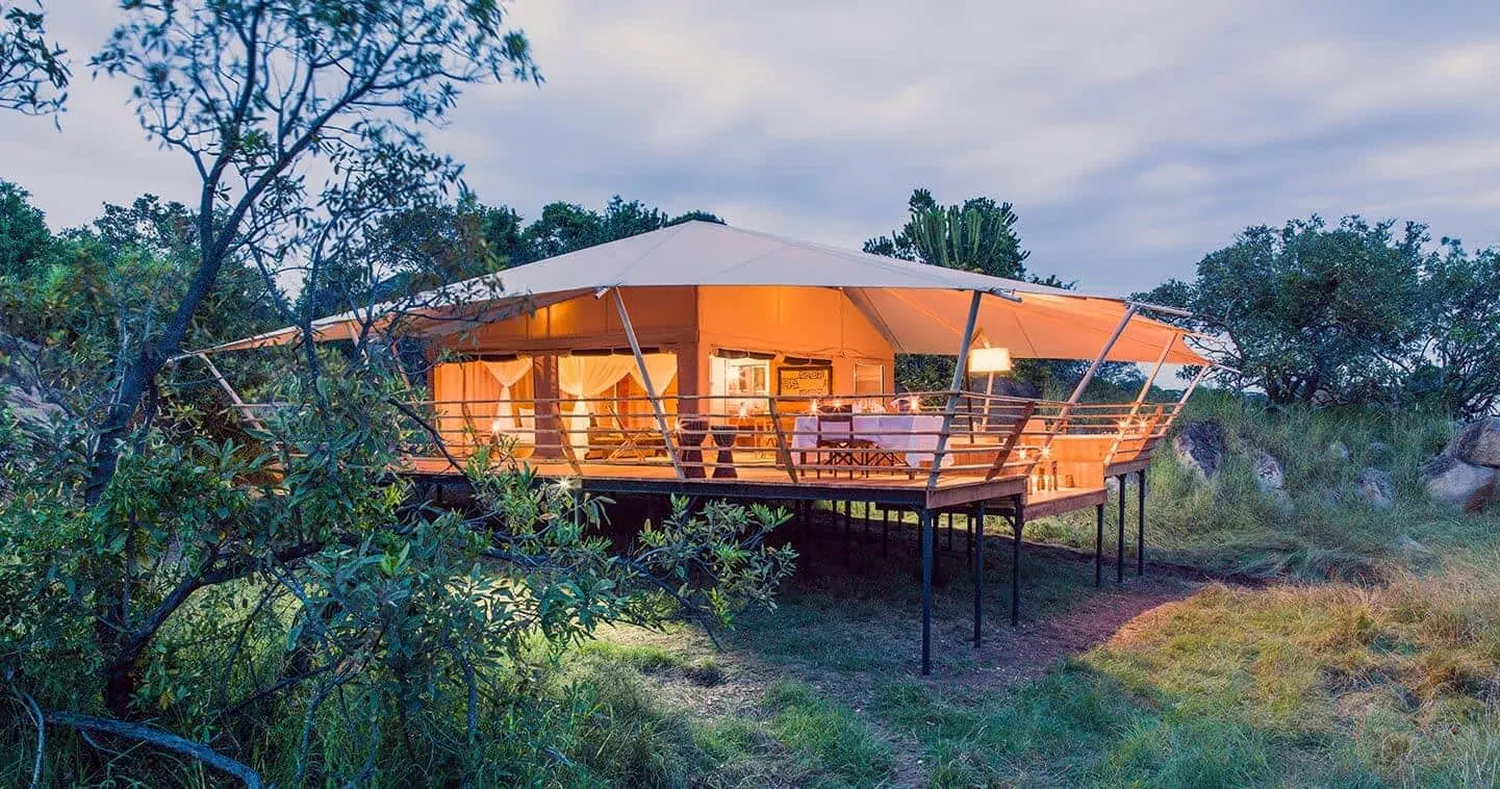
Luxury is not simply a permanent building, a swimming pool or an expensive tent. In the Serengeti, the most valuable luxury is often location, time and access. A camp positioned near the wildlife you want to see can save hours of driving every day. A skilled private guide can change plans immediately when conditions shift. A small camp can provide quieter meals, faster departures and more personal service than a large lodge.
- High-end luxury: spacious ensuite tent or suite, excellent food, reliable service, scheduled game drives, quality guiding and a strong park location.
- Premium luxury: larger suites, refined design, wider beverage selection, spa or pool, stronger privacy and more flexible service.
- Ultra-luxury: highly personalised guiding, premium food and wine, very low guest density, private plunge pools, exclusive-use options and exceptional staff-to-guest ratios.
- Private villa: dedicated guide, chef, host or butler, private vehicle, private dining and exclusive living space for one family or group.
Compare the styles in the Serengeti tented camps versus lodges guide and review the best safari lodges in Serengeti.
What are you actually paying for?
A luxury safari price is a stack of separate costs. Accommodation is usually the largest line, but it is not the whole bill.
| Cost component | What it pays for | Why it changes |
|---|---|---|
| Accommodation | Suite or tent, meals, staff, housekeeping, power, water, logistics and camp infrastructure | Season, location, room category, brand and exclusivity |
| Park and overnight fees | Protected-area access and overnight concession or camping charges | Nationality, age, season, number of 24-hour periods and where you sleep |
| Safari vehicle | 4x4, fuel, maintenance, tyres, recovery equipment and cleaning | Private versus shared use, route distance and number of days |
| Professional guide | Wildlife tracking, interpretation, route decisions, safety and logistics | Experience, language, private service and specialist skills |
| Bush flights | Seat on a light aircraft, airport handling and remote-airstrip operations | Origin, destination, routing, fuel surcharges and season |
| Food and drinks | Full board, house drinks or premium beverages depending on rate | Inclusion level, imported products and private dining |
| Camp logistics | Transporting food, fuel, staff and supplies into remote areas | Distance from towns, road conditions and mobile-camp movements |
| Taxes and levies | VAT, tourism levies and other statutory charges | Government policy and whether shown inside or outside the rack rate |
Published Serengeti lodge rates: real 2026/2027 examples
The examples below are published rack rates from lodge companies, shown to demonstrate how widely “luxury” varies. They should not be treated as a complete market survey. Special offers, trade rates, minimum stays, child policies and authority fees can change the final price.
| Property example | Published 2026 rate | Published 2027 rate | What the number shows |
|---|---|---|---|
| Asilia Dunia Camp | USD 560 green season; USD 920 secret season; USD 1,200 high season, pppn | USD 590; USD 1,000; USD 1,250, pppn for corresponding seasons | A strong luxury tented-camp range with major seasonal movement |
| &Beyond Serengeti Under Canvas | About USD 1,080–1,640 pppn | Published separately by the lodge | Mobile luxury near seasonal wildlife, with a high premium in demand periods |
| &Beyond Grumeti Serengeti River Lodge | About USD 1,310–2,930 pppn | Published separately by the lodge | Premium lodge pricing can more than double between low and peak periods |
| Singita Sabora Tented Camp | USD 2,210 low period; USD 2,795 in October; USD 3,220 peak, pppn | Published by Singita | Ultra-luxury pricing includes a deeper service and beverage package |
pppn means per person per night, normally based on two guests sharing.
Asilia's published Dunia rate includes full-board accommodation, house drinks, limited laundry, scheduled open-vehicle game drives, airstrip transfers and a tourism levy. Singita's published Sabora package includes accommodation, meals, premium beverages, twice-daily game drives, laundry and airstrip transfers, but lists wildlife, park, concession and other levies as exclusions. That difference is why comparing only the nightly rate can be misleading.
How much of the price is accommodation?
For most fly-in luxury trips, accommodation represents roughly half to three-quarters of the final trip price. The percentage rises at ultra-luxury properties and falls when a road itinerary has long vehicle days, multiple park entries or expensive private transfers.
For a couple staying four nights at a camp charging USD 1,200 per person per night, the room-and-board line alone is USD 9,600. A camp charging USD 2,790 per person per night produces an accommodation line of USD 22,320 for the same couple and the same four nights—before checking whether authority fees, flights or private game drives are included.
Serengeti park fees and concession charges
Government fees are mandatory and are normally paid by the operator through the official reservation system. The public TANAPA tariff page currently displays a non-resident Serengeti entry benchmark of USD 70.80 and states that displayed fees include VAT where applicable and are valid for 24 hours. However, that page also carries an older financial-year label, while operator documents show seasonal 2025/2026 fee bands. For 2026/2027 travel, the safe approach is to treat online fee figures as a planning benchmark and reconfirm the authority invoice at booking.
A guest sleeping inside Serengeti may encounter:
- park conservation or entry fee per adult per 24-hour period;
- overnight concession or camping fee per adult per night;
- vehicle entry or service charges;
- VAT or statutory charges where applicable;
- additional fees for special activities or protected concession areas.
Using commonly published 2026 non-resident benchmarks, entry plus overnight charges can add roughly USD 130–155 per adult for each full park day and night. Four nights for two adults can therefore create a government-fee line around USD 1,000–1,400, depending on the exact dates, rate category, timing and what the lodge already includes. This is one of the first items to verify in a quote.
Bush flights: what flying into Serengeti adds
Flying saves holiday time and is often the right luxury choice. Arusha to Seronera may take roughly one to two hours depending on stops, compared with a full road transfer from Arusha or a long transfer from Karatu. Northern airstrips such as Kogatende, Lamai and Lobo position guests closer to migration areas during the relevant months.
Official airline booking pages sometimes advertise promotional fares, including a Flightlink Arusha–Seronera fare from USD 75. That is a “from” price, not a dependable all-season budget. Real tickets may include higher fare classes, taxes, fuel changes, baggage restrictions, intermediate stops or different airstrips.
| Flight decision | Lower-cost approach | Luxury approach |
|---|---|---|
| Getting into Serengeti | Drive in from Arusha/Karatu | Scheduled bush flight to the closest airstrip |
| Changing regions | Long game-drive transfer | Airstrip-to-airstrip flight where schedules work |
| Aircraft type | Scheduled shared light aircraft | Private charter |
| Baggage | Soft bag within airline weight limit | Charter or paid extra seat when more luggage is essential |
| Privacy | Shared cabin and possible stops | Dedicated aircraft and custom timing, subject to aviation rules |
Read the Tanzania fly-in safari guide and the Serengeti airstrips guide before choosing a camp.
Private vehicle and private guide costs
Some luxury camps include scheduled game drives shared with other guests. A shared vehicle is not automatically a poor experience: the vehicles are often excellent, the guides know the local area and the small number of guests may share similar interests.
A private vehicle becomes valuable when you:
- want to stay with one sighting for photography;
- travel with young children or older relatives;
- prefer flexible breakfast and departure times;
- have a specialist interest such as birds, big cats or migration behaviour;
- do not want to negotiate the day's plan with other guests.
Private game packages are priced differently by each lodge. Published partner documents show supplements in the hundreds of dollars per vehicle per day, while a full private road safari includes a dedicated vehicle and guide throughout the route. Ask whether the private-vehicle charge applies per day, per game drive or for the entire stay.
Why peak migration dates cost more
Luxury pricing follows demand and camp location more than a simple dry-season versus wet-season rule. Northern Serengeti camps are most valuable when herds are likely to be in the north. Southern mobile camps are most valuable during calving. Central Serengeti remains productive year-round, so well-positioned camps can hold strong rates in several seasons.
| Travel period | Typical pricing pressure | Why |
|---|---|---|
| January–February | High in Ndutu/southern migration areas | Calving demand, predator activity and limited premium inventory |
| March–May | Lowest rates at many open camps | Long rains, softer demand and some seasonal closures |
| June | Rates rise | Dry season begins and western/northern demand builds |
| July–September | Highest in northern and central areas | Peak international holidays and river-crossing interest |
| October | High to shoulder | Strong wildlife, variable herd location and continuing demand |
| November–mid-December | Good value at many camps | Short rains and lower demand before festive dates |
| Christmas–New Year | Peak pricing and minimum stays | Festive travel demand across the circuit |
Migration timing follows rainfall and grass, not a fixed calendar. Use the best time for the Serengeti migration and where to stay in Serengeti by season.
How location changes the value of an expensive camp
A cheaper camp in the wrong region can cost more in wasted time. If you spend three hours driving to a river area and three hours returning, you have used fuel, guide time and most of the best wildlife-viewing hours. A more expensive camp close to the target area may give you two extra game-drive windows and a quieter midday break.
Location should be judged against your month and objective:
- Central Serengeti: dependable resident wildlife and the easiest choice for a short first visit.
- Northern Serengeti: best positioned for Mara River interest in the broad July–October period.
- Western Corridor: useful around the Grumeti movement period and for quieter luxury properties.
- Southern Serengeti/Ndutu: best for the broad calving period, usually January–March.
- Eastern Serengeti: attractive for big-cat country, open landscapes and lower vehicle density in selected areas.
Luxury camp versus luxury lodge: which gives better value?
| Feature | Luxury tented camp | Luxury lodge |
|---|---|---|
| Wildlife atmosphere | Closer to sounds, scents and the feeling of the bush | More separation from the landscape |
| Mobility | Some camps move seasonally | Permanent location |
| Facilities | May have fewer large shared facilities | More likely to have spa, gym, larger pool and multiple dining spaces |
| Privacy | Often small guest count | Varies from boutique to large property |
| Power and connectivity | Solar systems and limited high-power use at some camps | Usually more robust, but still remote |
| Best for | Immersion, migration positioning and intimate service | Facilities, families wanting space and travellers who prefer solid walls |
Neither is automatically more luxurious. The better choice is the property that places you near the right wildlife while meeting your comfort priorities.
Worked example: 5-day luxury fly-in safari for two adults
The following example shows how a quote may be built. It is not a live offer.
Option A: luxury camp with scheduled game drives
| Line item | Example calculation for two |
|---|---|
| Four nights at USD 1,200 pppn | USD 9,600 |
| Park and overnight fee allowance | About USD 1,000–1,400 |
| Return scheduled bush flights | About USD 600–1,400 depending on route and fare |
| Transfers and small logistics | USD 200–500 if not included |
| Planning total for two | About USD 11,400–12,900 |
| Planning total per person | About USD 5,700–6,450 |
Option B: add private game-viewing vehicle
A private vehicle supplement can add roughly USD 1,500–3,500 to the couple's total across the stay, depending on the lodge, number of game-drive days and what is already included. The revised planning total becomes roughly USD 12,900–16,400 for two.
The lesson is simple: a USD 1,200 nightly rate does not mean a five-day safari costs USD 4,800 per person. Flights, government charges and vehicle arrangements must be reconciled first.
Worked example: ultra-luxury Serengeti for two
At a published ultra-luxury rate of USD 3,220 per person per night, four nights cost USD 25,760 for two adults. Depending on the property, that may already include premium drinks, game drives, laundry and airstrip transfers. Government and other listed exclusions can still add more than USD 1,000 for the couple, followed by flights and any private-use upgrades.
The final five-day trip can therefore exceed USD 28,000–32,000 for two without being incorrectly priced. The cost is driven by the lodge's service model, location, exclusivity and operating infrastructure—not only by the bed.
What is normally included in a luxury Serengeti safari?
- ensuite accommodation;
- breakfast, lunch and dinner;
- drinking water and usually house beverages;
- scheduled or private game drives as stated;
- professional English-speaking safari guide;
- airstrip transfers when staying on a fly-in game package;
- laundry at many camps, sometimes limited;
- park and concession fees when the operator marks them as included;
- emergency support and trip coordination from the safari operator.
What may be excluded?
- international flights;
- Tanzania visa and travel insurance;
- park, concession or wildlife fees when quoted separately;
- premium champagne, cellar wines and selected spirits;
- private vehicle supplement;
- hot-air balloon safari;
- spa treatments and boutique purchases;
- tips for guide and camp staff;
- medical evacuation membership or specialist insurance;
- single-room supplement;
- extra baggage or charter-flight costs.
A detailed quote should place every major exclusion in one visible section. “All-inclusive” is not enough; ask what the term means at that specific property.
Hot-air balloon safari: an optional USD 599 upgrade
Serengeti Balloon Safaris and Miracle Experience currently publish a shared Serengeti balloon price of USD 599 per person. The package includes lodge pickup in the operating area, a flight of roughly one hour, landing celebration and bush breakfast. Park entry is generally separate, while the balloon company's own concession and VAT treatment is described in its inclusion list.
For a couple, the activity adds USD 1,198. It is valuable for aerial perspective and a memorable morning, but it is not a replacement for ground game drives. Read the Serengeti balloon price guide.
Does a private safari cost more per person?
Yes—especially for one or two travellers—because the vehicle, guide and operating costs are divided among fewer people. A family of four or group of six can often secure a private vehicle with a smaller per-person premium than a couple.
| Group size | Cost effect | Practical note |
|---|---|---|
| Solo traveller | Highest per-person cost | Single supplement plus vehicle or game-package minimums |
| Couple | Standard lodge sharing rate, high private-vehicle share | Good choice for scheduled game drives or romantic private upgrade |
| Family of four | Better vehicle cost sharing | Family suite may price per unit and improve value |
| Four to six adults | Often strongest private-road-safari value | One vehicle can be shared, subject to comfort and luggage |
| Large multigenerational group | Villa may become competitive | Compare total villa rate with multiple suites and vehicles |
Explore the private Serengeti safari guide for vehicle and flexibility considerations.
Best months for luxury value
March to May and November to mid-December often provide the best published luxury rates. The trade-off is a greater chance of rain, seasonal camp closures and more variable road conditions. Green-season travel can still deliver dramatic skies, fewer vehicles, excellent predator sightings and rich photography.
Value does not mean choosing the lowest rate. A lower-priced camp that is open, accessible and correctly located is good value. A discounted camp far from your priority wildlife may not be.
How to reduce the cost without making the safari feel cheap
- Stay longer in one region. Fewer relocations reduce flights, transfers and lost game-drive time.
- Travel in shoulder season. October, November, early December and parts of March can offer strong rates.
- Use one ultra-luxury stay and one high-end luxury stay. This controls the average nightly cost while preserving a standout experience.
- Share scheduled game drives for part of the trip. Add a private vehicle only on photography-heavy days.
- Drive one way and fly one way. This can balance scenery, cost and time.
- Match the camp to the month. Correct positioning is more valuable than a famous brand in the wrong region.
- Ask for long-stay offers. Some lodges publish preferential pricing for four or more nights.
- Compare total landed cost. Include fees, flights, drinks and transfers before choosing the lower quote.
When is ultra-luxury worth paying for?
Ultra-luxury is worth the premium when the service model matches your priorities. It can be a strong purchase for a honeymoon, milestone celebration, private family trip, specialist photography, restricted mobility or travellers who value food, wine, privacy and highly flexible days as much as wildlife.
It may not be worth it when you spend nearly every daylight hour away from camp, do not drink premium beverages, are happy sharing game drives and care mainly about wildlife location. In that case, a smaller high-end tented camp with excellent guiding may deliver better safari value.
How to compare two luxury Serengeti quotes
| Question | Why it matters |
|---|---|
| Are park and concession fees included? | They can add more than USD 100 per adult per day/night. |
| Are game drives shared or private? | The experience and cost are materially different. |
| Which airstrip serves each camp? | A distant airstrip creates long transfers and lost safari time. |
| Are drinks included, and at what level? | House drinks and premium cellar wines are not the same inclusion. |
| Is laundry included? | Useful with light-aircraft baggage limits. |
| Are all domestic flights included? | Some quotes include only one sector or exclude airport taxes. |
| Does the price include VAT and levies? | A low rack rate can grow after statutory charges. |
| What happens if authority fees rise? | Most contracts allow government increases to be passed through. |
| Which room category is confirmed? | Standard tent, suite, family tent and villa prices differ greatly. |
| What are the cancellation terms? | Luxury camps often require substantial deposits and early final payment. |
Common luxury safari pricing mistakes
- Comparing a room-only lodge rate with a fully packaged safari.
- Assuming “all-inclusive” automatically includes government fees and premium drinks.
- Booking northern Serengeti during a month when the main objective is in the south.
- Choosing several famous camps and spending too much time relocating.
- Ignoring single supplements, festive supplements and minimum stays.
- Using promotional “from” flight fares as the guaranteed ticket price.
- Paying for a private vehicle without confirming whether it is private for every drive.
- Choosing a large suite while compromising on guide quality or camp location.
Suggested luxury Serengeti trip lengths
| Time in Serengeti | Best structure | Who it suits |
|---|---|---|
| 3 nights | One central or seasonally correct region | Short fly-in visit or Zanzibar extension |
| 4 nights | One region deeply, or two nearby camps | Most first-time luxury travellers |
| 5–6 nights | Two distinct regions with three nights in the priority area | Migration, photography and slower pace |
| 7+ nights | Two or three camps with rest time | Repeat visitors, families and comprehensive wildlife trips |
Package examples include a 5-day luxury Serengeti fly-in safari, a 7-day luxury Great Migration safari and the broader luxury Serengeti safari guide.
Is a luxury Serengeti safari worth the cost?
It is worth it when the extra money buys a better location, more time with wildlife, a strong guide, reliable logistics, privacy and comfort that matters to you. It is poor value when the price is driven mainly by oversized rooms, branding or facilities you will not use.
The best luxury safari is not the most expensive itinerary. It is the itinerary where every major cost has a purpose: the camp is in the right place, the transfer saves time, the vehicle arrangement suits your group and the guide can use the flexibility you paid for.
Frequently asked questions
What is the average luxury Serengeti safari cost per day?
A useful 2026/2027 planning range is USD 1,200–2,500 per person per day for two adults sharing. Ultra-luxury stays can exceed USD 3,000 per person per day.
Can a Serengeti safari cost USD 1,000 per person per day?
Yes, especially in low or shoulder season at a high-end camp. Confirm whether flights, park fees, concession fees and private game drives are included before treating it as the total cost.
Why are Serengeti lodges so expensive?
They operate far from normal supply chains and must transport food, fuel, staff and equipment into protected wilderness while meeting conservation, safety and service requirements.
Are park fees included in luxury lodge rates?
Sometimes. Some camps include selected levies, while others list park, concession and wildlife fees separately. Check the written inclusions for each property.
Is a fly-in safari more expensive than driving?
Usually, but it can save one or two long transfer days. For a short luxury holiday, the time saved may justify the additional ticket cost.
What is the cheapest month for a luxury Serengeti safari?
April and May frequently have the lowest published lodge rates, although some camps close and rain can affect access. November to mid-December can also offer good value.
What is the most expensive time to visit Serengeti?
Peak migration periods, Christmas and New Year are commonly the most expensive. Northern Serengeti is especially competitive from July to September.
How much is a Serengeti balloon safari?
Major operators currently publish a shared-balloon rate of USD 599 per person, with pickup in the operating area, approximately one hour of flight and bush breakfast.
Do luxury safaris include alcohol?
Many include house wines, beer and standard spirits. Premium champagne, reserve wines and rare spirits may be charged separately.
Is a private vehicle worth the extra cost?
It is especially valuable for photographers, families and travellers who want full control over timing. Couples with general wildlife interests may be satisfied with a well-managed shared vehicle.
How many nights should I spend in Serengeti?
Four nights is a strong luxury starting point. Five or six nights is better when combining two regions or following seasonal migration movement.
Should I book a luxury lodge or tented camp?
Choose a tented camp for immersion and seasonal positioning. Choose a lodge for larger facilities and permanent infrastructure. Location and guide quality matter more than the building type.
Research notes and data sources
This guide was reviewed on 29 July 2026. Published prices can change without notice, and safari quotations depend on exact dates, room availability, nationality, age, air routes and authority invoices.
- Google Search guidance for generative AI features: people-first, unique, non-commodity content and clear organisation.
- TANAPA tariff page: published entry benchmark, VAT note and 24-hour fee validity; the displayed financial-year label should be checked before quoting future trips.
- UNESCO Serengeti National Park: 1.5 million hectares, migration scale and biodiversity context.
- Asilia Dunia Camp: published 2026/2027 rates and inclusions.
- &Beyond Serengeti Under Canvas: published 2026 rate ranges.
- &Beyond Grumeti Serengeti River Lodge: published seasonal rates.
- Singita Sabora Tented Camp: published rates, inclusions and exclusions.
- Flightlink Serengeti booking page: published promotional fare example and daily route information.
- Auric Air Serengeti guide: airstrip-to-lodge transfer examples.
- Serengeti Balloon Safaris: published USD 599 shared-balloon price and inclusions.
Plan a transparent luxury Serengeti safari
Ask for a quotation that separates accommodation, authority fees, flights, vehicle arrangements, activities and exclusions. Jaynevy Tours can then match the camp region to your travel month and build the trip around the experience you value—not around the highest nightly rate.