
What You Need to Know: For most climbers Kilimanjaro is safe; the main risk is altitude sickness. On every climb we carry emergency oxygen, a pulse oximeter, a first-aid kit and a stretcher, your guide checks your blood-oxygen and pulse at every camp, and each climber has their own guide, so a descent never ends the climb for the rest of the group. Serious cases are evacuated by helicopter through companies such as Pro Flight. You need travel insurance covering trekking to 19,700 ft (6,000 m) and helicopter evacuation.
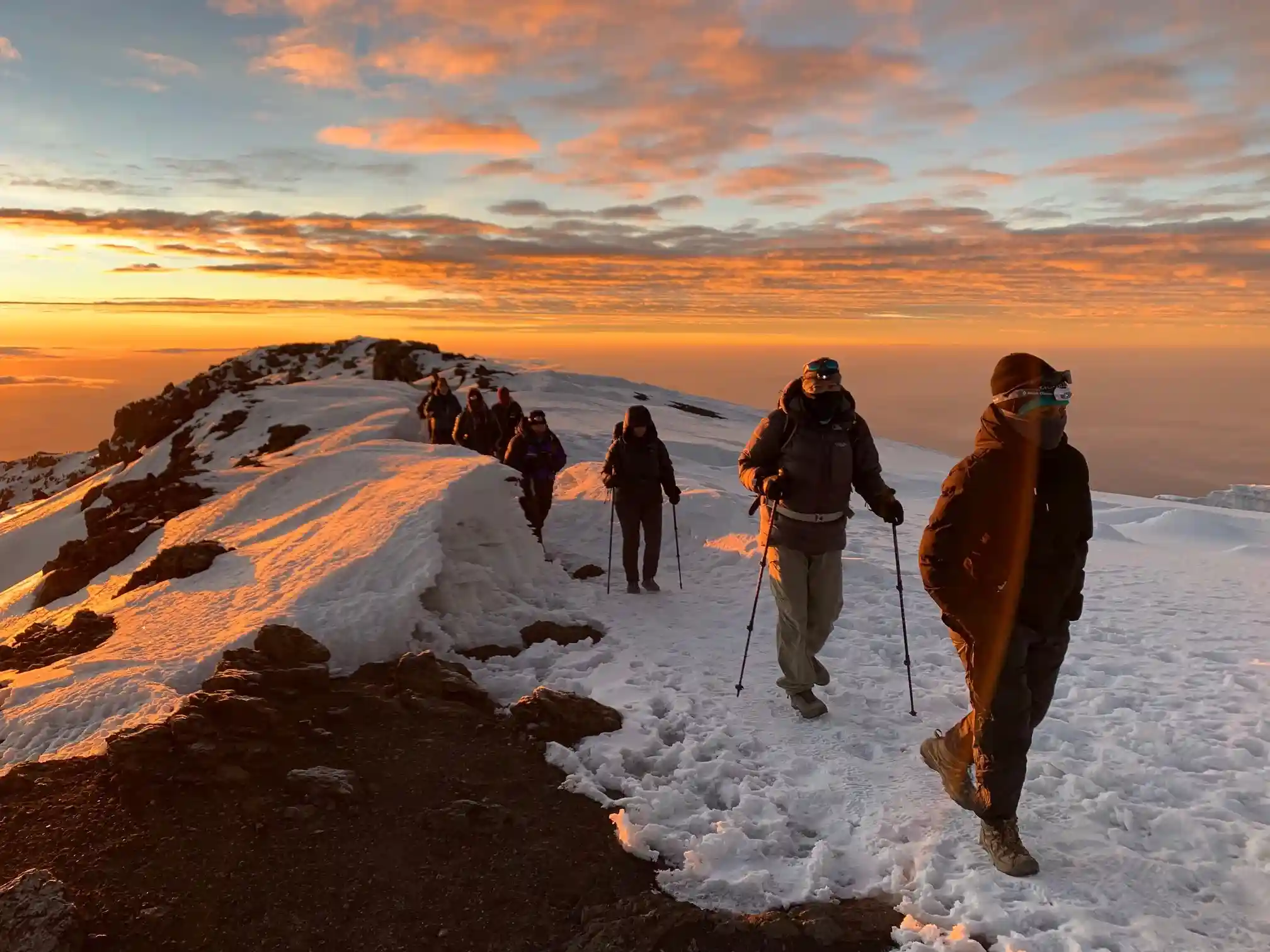
What Safety Equipment Do We Carry on Every Kilimanjaro Climb?
Every climb carries emergency oxygen, a pulse oximeter, a first-aid kit and a stretcher, whatever the route or price level.
| Equipment | What it is for |
|---|---|
| Pulse oximeter | Daily blood-oxygen and pulse checks at every camp |
| Emergency oxygen | Support during an emergency descent |
| First-aid kit | Blisters, minor injuries and illness |
| Stretcher | Carrying a climber who cannot walk down |
The oxygen is for emergencies during a descent, not to help you climb. If you want your own supplemental oxygen system, an Altox personal oxygen system can be rented in Moshi for US$300 for the climb.
Daily Health Checks at Every Kilimanjaro Camp
At every camp your guide measures your blood-oxygen and pulse and asks about headache, nausea, appetite and sleep. The guide compares your readings day by day; a steady fall, or worsening symptoms, is the signal to slow down, rest or descend.
- Blood-oxygen and pulse with a pulse oximeter
- Symptoms: headache, nausea, appetite, sleep
- Readings tracked over the climb, not just once
Low readings are normal at altitude, so the readings never decide anything alone. A climber at 15,100 ft (4,600 m) with a reading in the low 80s who is eating, sleeping and walking well is usually fine; the same reading with a worsening headache and no appetite is a reason to stop. Be honest with your guide. The checks only work if you tell them how you feel.
Your Kilimanjaro Guide and Crew: One Guide per Climber
Each climber has a crew of seven: one mountain guide, one cook and five porters. One guide per climber matters for safety: if one person has to go down, a guide goes with them and the others continue with their own guides.
Our mountain guides are certified through Tanzanian universities, have three years of guiding experience and are licensed by Kilimanjaro National Park. Our porters carry no more than 18 kg (40 lb) each, and we have been a KPAP partner since 2023, so the people who look after you are properly paid and equipped too. Our tents and mountain gear come from major international outdoor brands such as Patagonia and The North Face.
Every morning and evening the guide briefs you on the day ahead, the trail and the weather, and on summit night the guides walk with the group, at the front and the back, so nobody is left alone.
Who Decides If You Turn Back?
Your guide. If your readings or symptoms show it is unsafe to go higher, the guide stops the ascent and arranges your descent, and that decision is final.
Going down is the treatment for serious altitude sickness, and climbers almost always improve as they lose height. Turning back is disappointing, but it is the right call.
| What the guide sees | What happens |
|---|---|
| Mild symptoms | Rest, water, a slower pace |
| Worsening symptoms | Stop and reassess; stay at the same altitude or go down |
| Serious symptoms | Immediate descent with a guide, with oxygen if needed |
| Can't walk | Stretcher, park rescue team or helicopter evacuation |
See the symptoms to watch for in our acclimatization guide.
What Happens in an Emergency on Kilimanjaro?
Most problems are solved by walking down a few hundred meters with a guide. When a climber can't walk, the crew carries them on the stretcher to the park's rescue team. For serious cases, we arrange a helicopter evacuation through companies such as Pro Flight, which fly climbers from the mountain to hospital.
Kilimanjaro National Park's rescue fee, included in every climb, covers the park's rescue service on foot. It does not pay for a helicopter, which is why your insurance must cover helicopter evacuation.
In practice, the sequence is simple: the guide decides, the climber goes down with a guide straight away, oxygen is used if needed, and our office in Moshi coordinates the rest, from the park rescue team or helicopter to the hospital, your insurer and your onward plans. The rest of your group continues with their own guides.
Travel Insurance for Kilimanjaro
You need travel insurance that covers trekking up to 19,700 ft (6,000 m), including helicopter evacuation and medical treatment. Many standard policies stop at a lower altitude, so check the small print.
- Covers trekking to at least 19,700 ft (6,000 m)
- Includes emergency helicopter evacuation
- Includes medical treatment abroad
- Includes cancellation, if you want it
Send us your policy details before the climb so your guide has them. Insurance is not included in our climb prices. Expect to pay roughly US$100–300 for a policy that includes trekking to 19,700 ft (6,000 m); the cheapest standard policies often stop at 3,000 or 14,800 ft (4,500 m).
Other Risks on Kilimanjaro, and How to Avoid Them
| Risk | How to reduce it |
|---|---|
| Cold on summit night | Every layer on from the start; good gloves and hat; insulated water bottles |
| Slips on the descent | Trekking poles; walk slowly on scree and wet forest trails |
| Sunburn and snow glare | Sunglasses, sunscreen and a hat above the forest |
| Dehydration | 3–4 liters of water a day; soups and hot drinks count |
| Stomach upsets | Hand sanitizer before meals; drinking water is provided by the crew |
| Blisters | Broken-in boots and good socks; blister plasters in your daypack |
Health Checks Before You Travel to Tanzania
See your doctor before the climb, especially about altitude medication, malaria tablets and any existing conditions. Moshi is in a malaria area at lower altitudes, and your doctor can also advise on vaccinations for Tanzania. Tell us about any medical conditions when you book, so your guide knows before the climb.
Train for 8–12 weeks with long hill walks, break in your boots, and arrive rested: a long flight followed by the climb the next day is hard on the body. If you can, spend a day in Moshi before you start; our difficulty and training guide has a plan.
More on vaccinations and malaria: travel health in Tanzania.
Common Questions About Safety on Kilimanjaro
Is Kilimanjaro dangerous?
For most climbers, no. The main risk is altitude sickness, which is managed by a slow pace, daily health checks and descending when needed.
Do you carry oxygen on Kilimanjaro?
Yes. Every climb carries emergency oxygen, along with a pulse oximeter, a first-aid kit and a stretcher.
Is there helicopter rescue on Kilimanjaro?
Yes. For serious cases we arrange a helicopter evacuation through companies such as Pro Flight. Your travel insurance must cover it.
Do I need special insurance?
Yes. It must cover trekking up to 19,700 ft (6,000 m), plus emergency helicopter evacuation and medical treatment.
What if one person in our group gets sick?
A guide takes them down, and the rest of the group continues with their own guides.
How do I know if a Kilimanjaro operator is safe?
Ask how often health checks are done, what safety equipment is carried, how many guides come per climber, and how evacuations are handled.
The Bottom Line
Choose enough days, walk slowly, be honest with your guide and carry the right insurance. On our climbs you have a guide of your own, daily health checks, oxygen and a stretcher, and a clear plan for getting you down if you need it.
Send us your dates, the number of climbers and your hotel level through the form, on WhatsApp +255 678 992 599 or by email to jaynevytours@gmail.com, and our sales team in Moshi will reply with a written quotation.