
What You Need to Know: Climbing Kilimanjaro is hard but achievable for most reasonably fit people. Most days are steady 4–7 hour walks; the difficulty is the altitude, which slows every step above 13,100 ft (4,000 m), and summit night, 10–14 hours of effort in the dark and cold. You need no climbing skills. Choosing at least seven days, such as the 7-day Machame or 8-day Lemosho, and walking slowly matter more than how fit you are.
What Makes Kilimanjaro Difficult?
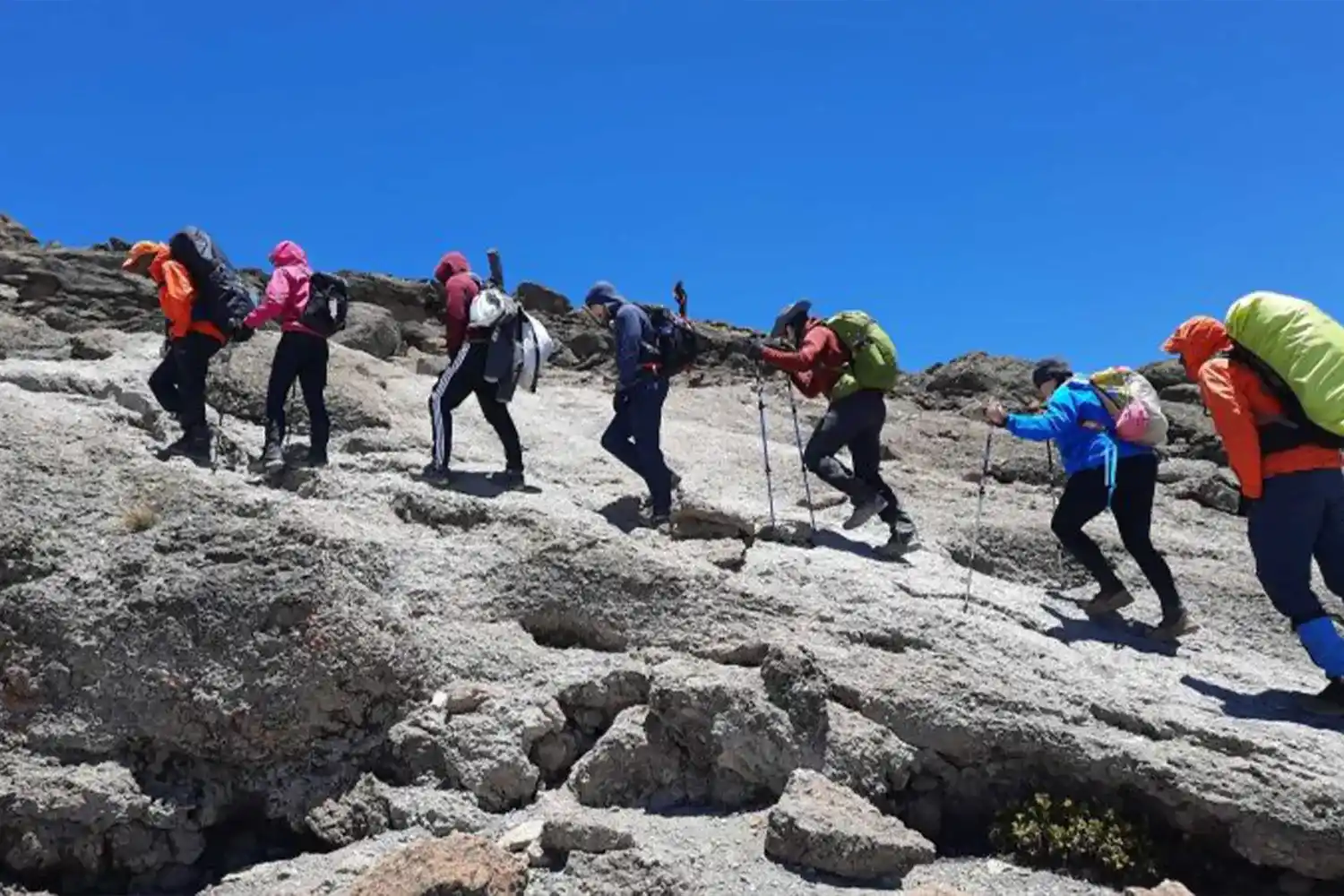
The altitude and the summit night. Most of the climb is moderate walking on good trails; summit night is 10–14 hours of effort in the cold and dark at altitudes where each breath holds about half the oxygen it does at sea level.
Above about 13,100 ft (4,000 m) every step takes more effort, sleep is lighter and appetite drops. Summit night starts around midnight, reaches the crater rim around sunrise and continues after the summit with a long descent to a lower camp. Fitness helps you enjoy the days before; it does not protect you from altitude sickness.
| Part of the climb | How hard it is |
|---|---|
| Forest and moorland days | Moderate: 4–7 hours of steady walking |
| Barranco Wall (Machame, Lemosho, Umbwe) | An 820 ft (250 m) scramble, using your hands in places; not technical |
| Alpine-desert days above 13,100 ft (4,000 m) | Harder: thin air, cold nights, poor sleep |
| Summit night | The hardest: 10–14 hours, below freezing, steep scree |
| The descent | Long downhill days; hard on the knees |
Prepare for summit night and the rest of the climb will feel manageable.
What Is Summit Night on Kilimanjaro Really Like?
You wake around 11 pm after a few hours of broken sleep, put on every layer you have, and start walking at midnight by headlamp. For the next 6–8 hours you climb slowly up loose volcanic scree in zigzags, with short rests only, to the crater rim at Stella Point or Gilman's Point. Most climbers reach the rim around sunrise.
From the rim it is about another hour to Uhuru Peak, 19,341 ft (5,895 m). After photos you descend the same scree, rest at the high camp, and continue down to a lower camp for the night. The second half is easier on the lungs but hard on the legs; trekking poles help a lot.
The hardest part is mental: it is dark, cold and slow, and you can't see how far you have to go. Your guide sets a steady pace and watches every climber. The camps and timings for each route are on the climb pages, for example the 7-day Machame summit night.
How Fit Do You Need to Be to Climb Kilimanjaro?
Fit enough to walk 5–7 hours a day, several days in a row, with a daypack, on uneven ground and steep slopes. You do not need to be an athlete.
A useful test: if you can do two back-to-back days of 5–6 hours of hill walking with a loaded daypack and feel fine the next morning, you have the fitness for Kilimanjaro. Very fit climbers who rush often suffer more from altitude than steady walkers who pace themselves.
- Comfortable on long hill walks of 5–7 hours
- Able to walk several days in a row
- Happy on steep, uneven ground and scree
- No technical climbing skills needed
If you are unsure, choose a longer climb. More days make every day easier.
A 12-Week Training Plan for Kilimanjaro
Start about three months before the climb. Hiking in the boots you will wear matters most, because it builds stamina, breaks in your boots and gets you used to carrying a daypack.
| Weeks | Focus | What to do |
|---|---|---|
| 1–4 | Base | 3 sessions a week of brisk walking, cycling or swimming (30–45 min); one 2–3 hour hike at the weekend |
| 5–8 | Build | Add leg strength twice a week (squats, lunges, step-ups); weekend hikes of 4–5 hours with a loaded daypack |
| 9–11 | Peak | Back-to-back weekend hikes of 5–6 hours, with hills or stairs; one longer weekday session |
| 12 | Taper | Short, easy walks; rest, sleep and pack |
Train on hills if you can: the descents are as tiring as the climbs. If you live somewhere flat, stairs and an incline treadmill with a loaded pack are a good substitute.
Which Climbs Are Best for Beginners?
The longer ones. "Easy" on Kilimanjaro means a gradual height gain, so the 7-day Machame, 8-day Lemosho, 6-day Marangu and 9-day Northern Circuit give first-timers the best chance.
| Climb | Why it suits a first climb |
|---|---|
| 7-day Machame | Our usual first-timer recommendation: Lava Tower day plus a night at Karanga |
| 8-day Lemosho | The most gradual ascent we offer on the south side, with a quiet start |
| 6-day Marangu | Huts, a gentle trail and an acclimatization day at Horombo |
| 9-day Northern Circuit | The most time of any route, and the quietest |
| Umbwe | Not for a first climb: the steepest route with the fastest early height gain |
See every route compared in choosing the right Kilimanjaro route.
Is There an Age Limit for Climbing Kilimanjaro?
Kilimanjaro National Park sets a minimum age of 10 for summit climbs. There is no upper age limit, and older climbers reach the summit every season, but everyone should see a doctor before the trip.
Tell us about any medical conditions when you book, so your guide knows before the climb. Heart and lung conditions in particular should be discussed with your doctor, along with altitude medication such as acetazolamide (Diamox). Your travel insurance must cover trekking up to 19,700 ft (6,000 m) and helicopter evacuation.
Children from 10 can climb with an adult; for families we usually suggest a longer itinerary and a slower pace. Climbers in their 60s and 70s do well on Kilimanjaro, especially on 7- or 8-day climbs, because steady walking matters more than speed. If you are unsure whether the climb is right for you, a Kilimanjaro day hike from Moshi is a good way to try the trail first.
- Minimum age for the summit: 10 years
- No upper age limit
- Medical check recommended before you travel
- Travel insurance covering trekking to 19,700 ft (6,000 m) and helicopter evacuation
How Our Crew Makes the Climb Easier
A lot of the difficulty is taken off your shoulders. A crew of seven per climber, a guide, a cook and five porters, carries the tents, food, water and equipment, so you walk with only a daypack of water, snacks, layers and a camera. The porters overtake you on the trail and have camp set up before you arrive.
Your cook serves three hot meals a day and never repeats a meal during the climb, with soup before every lunch and dinner to help you drink and eat when the altitude dulls your appetite. Your guide checks your blood-oxygen and pulse at every camp and sets the pace, which on Kilimanjaro is always slower than you expect. On camping routes you also have a private toilet tent, which makes a real difference on cold nights.
What you can do: walk slower than feels necessary, drink 3–4 liters of water a day, eat even when you are not hungry, and tell your guide honestly how you feel. Our acclimatization guide explains why these matter.
Common Mistakes That Make Kilimanjaro Harder
Most climbers who struggle on Kilimanjaro do so for avoidable reasons. These are the ones our guides see most often, and how to avoid them.
| Mistake | What to do instead |
|---|---|
| Choosing too few days to save money or time | Take 7 or 8 days; the extra day costs about US$245 |
| Walking too fast on the first two days | Follow your guide's pace, even when you feel strong |
| New boots that haven't been worn in | Wear your boots on every training hike |
| Not drinking enough in the cold | 3–4 liters a day; soups and hot drinks count |
| Hiding symptoms to keep going | Tell your guide at every health check |
| Too few warm layers for summit night | Pack or rent a down jacket, warm gloves and a hat |
None of these needs special fitness; they need patience and honesty. Climbers who follow them give themselves the best chance of reaching the top.
Common Questions About Kilimanjaro's Difficulty
Can a beginner climb Kilimanjaro?
Yes. Many first-time climbers reach the summit. Choose 7 days or more to give yourself the best chance.
What is the hardest part of Kilimanjaro?
Summit night: a midnight start, cold and thin air, and a long descent afterwards.
Do I need climbing experience?
No. All the main routes are trekking routes. The Barranco Wall is a scramble where you use your hands in places, not a technical climb.
How long should I train for Kilimanjaro?
About 12 weeks, building up to back-to-back days of 5–6 hours of hill walking with a loaded daypack.
Is Kilimanjaro harder than Everest Base Camp?
Kilimanjaro is higher, 19,341 ft (5,895 m) against about 17,600 ft (5,364 m), and climbed in fewer days, so the altitude is the bigger challenge. The daily walking is similar.
What is the easiest route up Kilimanjaro?
The route with the most days. The 6-day Marangu has the gentlest trail and huts; the 8-day Lemosho has the most gradual ascent on the south side.
The Bottom Line
Kilimanjaro is hard because of the altitude, not the walking. Train for 12 weeks with long hill walks, choose seven days or more, walk slowly and be honest with your guide, and you give yourself the best possible chance of standing on Uhuru Peak.
Send us your dates, the number of climbers and your hotel level through the form, on WhatsApp +255 678 992 599 or by email to jaynevytours@gmail.com, and our sales team in Moshi will reply with a written quotation.