
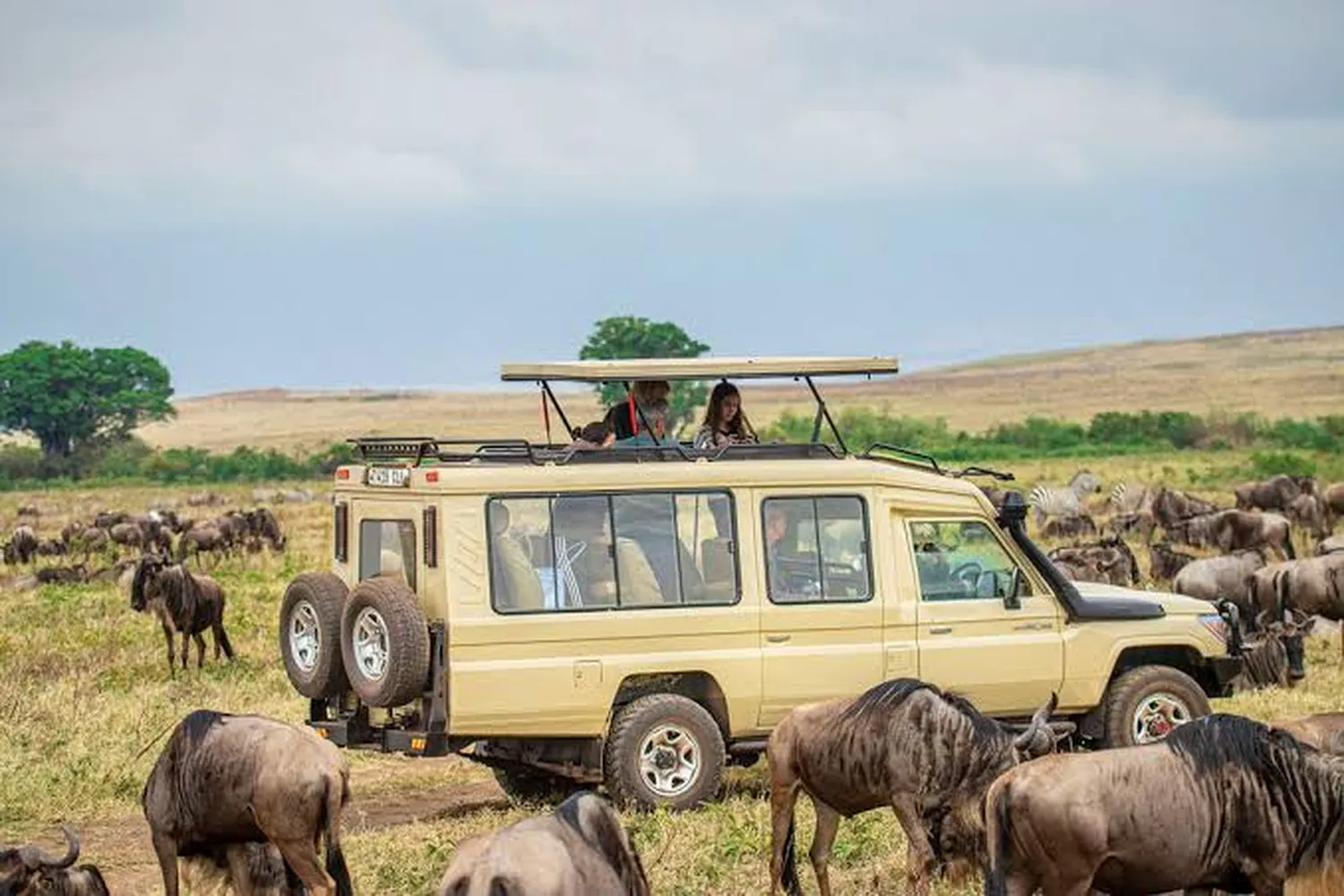
Quick Answer: How Much Should You Budget for a 6 Day Tanzania Safari?
For 2026/2027 planning, allow roughly USD 900–1,300 per person for a published six-day budget group-joining format, USD 1,400–1,900 for a published mid-range group format, and about USD 1,850 or more for a current private mid-range four-park example when 4–6 people share the vehicle. A broader Tanzania safari cost guide on Jaynevy currently uses approximately USD 250–350 per person per day for shared budget travel, USD 350–550 for mid-range and USD 600–1,200 for luxury. Those two sets of figures use different product assumptions, so the written quotation must state the exact route, room type, vehicle arrangement, fees and services included.
- Best budget lever: share the vehicle and avoid unnecessary backtracking.
- Best value lever: spend money on park time, guiding and route logic before cosmetic upgrades.
- Biggest quote mistake: comparing two totals without checking whether park fees, crater fees, transfers, meals and taxes are included.
- Useful contingency: keep 5–10% of your land-safari budget separate for personal extras and small changes.
- Tipping reference: Jaynevy's current guide suggests about USD 10–25 per person per day for safari driver-guides, depending on service and group arrangement.
6 Day Tanzania Safari Budget at a Glance
Start with the safari format before choosing a lodge. Vehicle costs, park charges and guiding are major fixed components, which is why a solo private safari can be much more expensive per person than the same route shared by four travellers.
| Safari format | Current planning reference | What usually drives the rate | Best for |
|---|---|---|---|
| Budget group joining | USD 900–1,300 pp / 6 days | Shared vehicle, simpler camps/lodges, fixed departure structure | Solo travellers and price-focused couples |
| Mid-range group joining | USD 1,400–1,900 pp / 6 days | Shared 4x4 plus more comfortable lodge/tented-camp nights | Travellers balancing comfort and cost |
| Private mid-range | From about USD 1,850 pp on one current 4–6 traveller example | Private vehicle, route flexibility, accommodation, group size | Families, friends, photographers |
| Luxury | Broad guide: USD 600–1,200 pp/day | Premium camps, location, private services, flights and season | Comfort-focused travellers |
What Should Be Included in a Good 6-Day Safari Quote?
A good quote should make it possible to understand what you are paying for without calling the operator to decode the total. At minimum, it should identify the parks, accommodation standard, meal plan, vehicle format, guide, government charges and start/end logistics.
| Cost item | Should the quote state it? | Why it matters |
|---|---|---|
| 4x4 safari vehicle | Yes — private or shared | A major fixed cost; per-person cost falls as more travellers share. |
| Driver-guide | Yes | Guiding quality directly affects wildlife interpretation, timing and route decisions. |
| Park / conservation fees | Yes | These are material statutory costs and can change when authorities revise tariffs. |
| Ngorongoro crater service / vehicle charges | Yes if crater descent is included | Crater logistics can materially change the package cost. |
| Accommodation | Yes — name or standard plus room basis | Location and room category can change both price and driving time. |
| Meals and drinking water | Yes | Full board is common on safari, but drinks and special meals vary by property. |
| Airport / hotel transfers | Specify included or excluded | Pre- and post-safari logistics are frequently priced separately. |
| Taxes / VAT | Specify whether included | A low headline quote can look cheaper if compulsory charges are not yet included. |
Budget Tip 1: Choose the Right Route Before You Choose the Hotel
The cheapest hotel is not automatically the cheapest safari. A lodge far from the next day's game-drive area can add fuel, driving hours and lost wildlife time. For a first six-day Northern Circuit trip, a logical sequence such as Arusha → Tarangire → Lake Manyara or Karatu → Serengeti → Ngorongoro → Arusha keeps the route coherent. If Serengeti is your main priority, it can be better to remove one park and protect an extra Serengeti night rather than rush through four destinations.
Compare the standard four-park structure on our 6-day Tarangire, Manyara, Serengeti and Ngorongoro safari from Arusha with the more flexible 6-day private Tanzania safari.
Budget Tip 2: Share the Fixed Costs When Flexibility Is Not Your Priority
Group joining is usually the strongest money-saving option for one or two travellers because the vehicle and guide costs are shared. The trade-off is that departure times, photography stops and daily decisions must work for the whole group. A private safari becomes better value as the party grows because the same vehicle cost is divided across more people.
| Decision | Group joining | Private safari |
|---|---|---|
| Lowest price for solo traveller | Usually strongest | Usually expensive per person |
| Control of start times | Shared decision | More flexible within park rules |
| Long photography stops | Must balance other guests | Easier to customize |
| Family / friends of 4–6 | Can still work | Often much more competitive per person |
| Luggage space | More restricted | More predictable for your party |
Read the full trade-offs in our private vs group safari Tanzania guide.
Budget Tip 3: Travel in a Value Season, Not Simply the “Cheapest Month”
April and May are often the lowest-demand months, but lower rates come with real trade-offs such as heavier rain, muddy tracks and seasonal camp closures. November and early December can offer a more balanced shoulder-season compromise with greener landscapes and generally better availability than peak dry-season months. If your goal is classic dry-weather game viewing and easier road conditions, June to October is the safest all-round window, but demand and room rates are often higher.
For a month-by-month decision, use our best time for a Tanzania safari 2026/2027 guide.
Budget Tip 4: Do Not Pay Luxury Rates for Features You Will Barely Use
On a game-drive-heavy six-day safari, location and sleep quality usually matter more than an oversized room, large spa or elaborate resort facilities. If you leave before sunrise and return near dinner, paying a large premium for facilities you will use for one hour can be poor value. A well-located mid-range tented camp with an ensuite bathroom, good meals and a comfortable bed can produce a better overall safari than a remote luxury lodge that adds two extra hours of driving.
Budget Tip 5: Understand the Park-Fee Component
Protected-area charges are not a small optional line item. TANAPA's current park pages list international adult entry at USD 70 for Serengeti, Tarangire and Lake Manyara, with different child and resident rates. TANAPA also notes that park fees are generally valid for 24 hours and that tariffs can be revised. Ngorongoro is administered separately by NCAA and includes its own conservation-area and crater-related tariff structure.
These official figures explain why a safari quote should not be judged only by accommodation price. A route covering several protected areas accumulates multiple statutory charges alongside the vehicle, fuel and guide costs.
Budget Tip 6: Keep Optional Activities Separate Until the Core Safari Works
Build the best wildlife itinerary first; add optional activities only after the core route fits your budget. Balloon safaris, cultural visits, walking activities, premium drinks, domestic flights, private bush meals and room upgrades can be excellent, but they should not force you to reduce essential park time. Ask for each extra as a separate line item so you can see its real effect on the total.
Budget Tip 7: Plan for Tips Without Treating Them as a Hidden Fee
Tipping is discretionary, but it is sensible to include a gratuity allowance in your personal budget before travelling. Jaynevy's current tipping guide suggests roughly USD 10–25 per person per day for safari driver-guides; groups may instead use a per-vehicle approach. For a six-day safari, a traveller using the per-person guideline would therefore plan roughly USD 60–150 for the driver-guide, adjusted for service quality and the operator's recommendation.
See the dedicated Tanzania safari guide tipping guide before finalizing your cash budget.
Budget Tip 8: Pack Light Enough to Avoid Expensive Logistics Problems
For a road safari, soft luggage is easier to load into a safari vehicle; for itineraries using bush flights, luggage limits can be stricter. Jaynevy's current packing guidance notes that many internal bush flights use total allowances around 15–20 kg per person and prefer soft-sided bags. Even without a flight, carrying only what you need improves vehicle space and makes hotel or camp changes easier.
Use the detailed Tanzania safari packing checklist instead of buying unnecessary “safari gear.” Neutral lightweight clothing, a warm early-morning layer, sun protection, binoculars, medication and a small day bag matter more than an expensive safari wardrobe.
Budget Tip 9: Start From Arusha or Moshi Based on Your Actual Travel Plan
Do not choose a starting city simply because one web page shows a lower safari price. Arusha is the conventional Northern Circuit gateway and may reduce initial driving for many routes. Moshi can be more practical when your trip also includes Kilimanjaro, when your hotel is already in Moshi, or when airport and pre-safari logistics make a Moshi start simpler. Compare the total door-to-door cost, not just the safari line.
See our Tanzania safari from Arusha and Tanzania safari from Moshi pages for current routing examples.
How Much Cash Should You Carry on a 6-Day Safari?
If your package is prepaid, you normally need cash mainly for tips, small purchases, drinks or services not included in your booking. There is no universal amount because spending habits differ, but the table below gives a practical way to build a personal cash reserve rather than carrying an arbitrary large amount.
| Personal item | Planning approach | 6-day example |
|---|---|---|
| Driver-guide tip | USD 10–25 pp/day reference | About USD 60–150 pp |
| Camp/lodge staff tips | Property tip box or operator guidance | Set a small separate envelope |
| Drinks / laundry | Check each property's inclusion policy | Variable |
| Souvenirs | Personal choice | Set your own cap before departure |
| Emergency buffer | 5–10% of personal spending budget | Keep separately from main cash |
6-Day Tanzania Safari Daily Itinerary: Where the Money and Time Go
The most efficient six-day itinerary uses each transfer day to move toward the next wildlife area rather than returning to the same city every evening. Below is a practical Northern Circuit example showing both experience and budget logic.
Day 1: Arusha to Tarangire National Park
Use the first day for a full game-drive destination rather than paying for a transfer-only day. Tarangire is especially strong in the drier months, when wildlife gathers around dependable water. TANAPA lists the park at more than 2,850 km² and highlights its large elephant population. Overnight near Tarangire or Karatu depending on the next day's route.
Day 2: Lake Manyara or Direct Route Toward Serengeti
Choose Lake Manyara only if it fits your interests and route. TANAPA lists Lake Manyara at 648.7 km² and more than 390 bird species. For birding, forest scenery and the Rift Valley landscape, it adds real variety; for travellers whose only priority is Serengeti, skipping it may protect more time and budget for the plains.
Day 3: Enter Serengeti National Park
Accept that this is a long movement day and avoid overloading it with extra paid activities. TANAPA's current Serengeti page describes more than 15,000 km² of protected area, over 500 bird species and a migration involving more than 1.5 million wildebeest, zebras and associated wildlife. Your camp location matters because the ecosystem is enormous.
Day 4: Full-Day Serengeti Game Drive
This is the day you are really paying to protect. A full Serengeti day gives the guide time to respond to wildlife conditions rather than racing toward the next lodge. If you are choosing between a room upgrade and keeping this full game-drive day, the wildlife time is usually the better investment.
Day 5: Serengeti to Ngorongoro Area
Game drive while leaving Serengeti, then position near Ngorongoro for an early final day. An overnight closer to the crater access can cost more than a distant lodge, but it may buy valuable morning time. Compare location and departure time, not room price alone.
Day 6: Ngorongoro Crater and Return
Start early, descend for the planned crater game drive, then return to Arusha or connect to your next arrangement. NCAA manages Ngorongoro separately from TANAPA and publishes its own entry, vehicle, camping, concession and crater-service tariff structure. Confirm the exact charges in your quote because the authority states tariffs can change without prior notice.
What Can You Cut From the Budget Without Hurting the Safari?
Cut upgrades before cutting wildlife time. The most painless savings usually come from sharing transport, choosing comfortable but non-premium accommodation, avoiding internal flights on a road-friendly route, limiting paid extras and travelling outside the highest-demand dates.
- Choose group joining if you are one or two travellers and can accept fixed schedules.
- Use one well-located mid-range camp instead of upgrading every night.
- Skip a balloon flight if it forces you to shorten the safari.
- Avoid changing camps every night unless the route genuinely requires it.
- Ask whether airport transfers and pre/post safari hotels are already included before paying twice.
- Use road travel for the classic Northern Circuit unless time savings justify a bush flight.
What Should You Never Cut Just to Save Money?
Do not reduce safety, legal park access, vehicle reliability, guide quality or adequate rest simply to reach a headline price. A six-day safari involves long distances, rough roads and early starts. The operator must have a workable vehicle plan, licensed access, realistic driving times and clear emergency procedures. A suspiciously cheap quote deserves questions, not automatic approval.
Common Budget Mistakes on a 6-Day Tanzania Safari
- Comparing different room bases: one price may assume two people sharing; another may include a single supplement.
- Ignoring group size: a private two-person price cannot be compared directly with a six-person shared vehicle rate.
- Assuming every “all-inclusive” safari is identical: alcohol, laundry, airport hotels and optional activities may still be excluded.
- Choosing too many parks: more destinations can mean more gate fees and more driving, not necessarily more wildlife quality.
- Booking peak season too late: the best-value rooms sell first, leaving expensive alternatives.
- Forgetting tips and personal extras: these can turn a carefully planned budget into daily stress.
- Paying for a migration guarantee: the Great Migration is a natural event; exact crossings and herd locations cannot be guaranteed.
Sample 6-Day Safari Budget for Two Travellers
Use a budget worksheet rather than one total number. The example below is not a quotation; it shows how to think about the components for two adults sharing.
| Budget line | Value approach | Comfort approach | Question to ask |
|---|---|---|---|
| Safari package | Group joining / budget camp | Private or mid-range lodge | Is the vehicle private or shared? |
| Accommodation | Basic camp / simple lodge | Ensuite lodge / tented camp | Inside or outside the park? |
| Meals | Full board where included | Full board plus selected drinks | Which drinks are excluded? |
| Park charges | Included in package | Included in package | Are current statutory fees covered? |
| Tips | Pre-planned cash allowance | Pre-planned cash allowance | What does the operator recommend? |
| Optional activities | None or one priority extra | One or two selected extras | Can each be quoted separately? |
| Contingency | 5% personal buffer | 5–10% personal buffer | Can unused balance stay on card? |
How to Compare Two Safari Quotations in 10 Minutes
Normalize the quotes before comparing totals. Put both offers into the same checklist and mark anything that is missing or vague.
- Confirm number of safari days and hotel nights.
- Confirm start and finish city.
- Confirm every park and whether Ngorongoro crater descent is included.
- Confirm private versus shared vehicle and expected maximum passengers.
- Confirm exact accommodation names or at least the agreed standard and location.
- Confirm meal plan and drinking water.
- Confirm park, conservation, concession and crater-related charges.
- Confirm taxes / VAT.
- Confirm airport transfers, pre-night and post-night accommodation.
- List all exclusions, especially tips, drinks, flights, visas, insurance and optional activities.
6-Day Tanzania Safari Tips for First-Time Visitors
- Ask for the route in writing: “Serengeti safari” is not enough; identify the sector and nights.
- Expect early mornings: wildlife activity and long distances make 06:00–07:00 starts common on some days.
- Use layers: mornings around Ngorongoro can feel cool while midday plains can be hot.
- Keep binoculars accessible: not every animal will be beside the road.
- Carry personal medication in your day bag: do not bury it in luggage.
- Protect electronics from dust: use zip pouches or simple dust covers.
- Do not chase a checklist: good guiding focuses on behaviour, ecology and quality sightings, not only the Big Five.
- Keep plans realistic: a six-day trip should feel like safari, not a race between lodge check-ins.
When Is It Worth Spending More?
Spend more when the upgrade buys time, location, privacy or a clearly better wildlife experience. Examples include a well-positioned Serengeti camp that reduces daily transfer time, a private vehicle for photographers, a family vehicle that solves seating and luggage problems, or a flight that saves an entire road day on a short itinerary. Spend less when the upgrade is mostly decorative and does not improve how you use your six days.
Frequently Asked Questions About 6 Day Tanzania Safari Tips and Budget Advice
Is six days enough for a Tanzania safari?
Yes. Six days is enough for a strong Northern Circuit safari if the route is logical. A typical itinerary can include Tarangire, Serengeti and Ngorongoro, with Lake Manyara added when it supports the traveller's interests rather than simply increasing the park count.
What is the cheapest practical way to do a six-day safari?
A group-joining safari with simple camping or budget accommodation is usually the lowest-cost practical format. Jaynevy's current group guide lists six-day budget references around USD 900–1,300 per person, subject to route, dates and availability.
How much does a mid-range six-day Tanzania safari cost?
Current Jaynevy references vary by format. The group-joining guide lists about USD 1,400–1,900 per person for six days, while one private four-park itinerary starts from USD 1,850 per person sharing for 4–6 travellers. Ask for a written quote because room and vehicle assumptions are different.
How much should I tip my safari guide for six days?
A current Jaynevy guideline is about USD 10–25 per person per day. Across six days that works out to roughly USD 60–150 per traveller, but gratuities remain discretionary and should reflect service quality and group arrangement.
Is a private safari always much more expensive?
No. It is usually expensive for one traveller or a couple because they carry most of the vehicle cost, but a family or group of friends can divide that fixed cost across four to six passengers and make private travel much more competitive.
Which months are best for a lower safari budget?
April and May often have the lowest accommodation demand, while November and early December can offer a useful shoulder-season balance. Rain, road conditions and camp closures must be considered, so the cheapest month is not automatically the best value for every route.
Should I book a safari from Arusha or Moshi?
Choose the city that fits your wider trip. Arusha is generally closer to the classic Northern Circuit routing; Moshi can be practical when combining Kilimanjaro or staying there before safari. Compare the total transfer and hotel costs rather than the safari price alone.
Are international flights included in six-day safari prices?
Usually not unless the quotation explicitly says so. International airfare, visas, travel insurance, personal purchases and optional activities are commonly separate from the land-safari package.
What is the best place to save money without reducing wildlife quality?
Share the vehicle, choose well-located mid-range accommodation and avoid unnecessary paid extras. Keep the full Serengeti game-drive day, reliable guide and legally required park access intact.
Research Notes and Sources
Prices on this page are planning references, not a promise that every departure can be sold at the same amount. Government tariffs, accommodation contracts, fuel, room availability and group size can change the final quotation. Wildlife numbers and park-size facts are included only where they help explain route or cost decisions.
- TANAPA — Serengeti National Park: park size, wildlife, current visitor fee display and seasonal guidance.
- TANAPA — Tarangire National Park: park size, elephant information and visitor guidance.
- TANAPA — Lake Manyara National Park: 648.7 km² area, birdlife and current visitor fee display.
- TANAPA — Park tariffs: statutory fee framework and VAT/payment notes.
- Ngorongoro Conservation Area Authority — Tariffs: entry, vehicle, camping, concession and crater-service categories; tariffs may change.
- Jaynevy Tours — Tanzania Safari Cost 2026/2027: broad per-day planning ranges.
- Jaynevy Tours — Group Joining Safaris: current six-day group price ranges.
- Jaynevy Tours — 6-Day Northern Circuit from Arusha: current private mid-range starting-price example.
- Jaynevy Tours — Safari Guide Tipping: current gratuity planning reference.
Get a Clear 6-Day Tanzania Safari Quote
Send your travel dates, number of adults and children, start city, preferred accommodation level and whether you want private or group travel. We can then price the route with current availability and show the inclusions in writing. If you are still comparing formats, browse our Tanzania safari guide, camping safari options and luxury safari packages before deciding.