
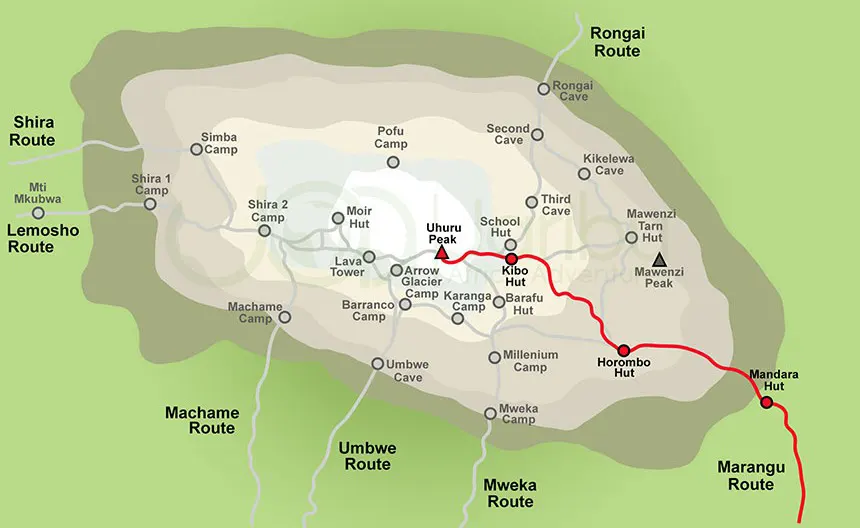
Day 1: Moshi to Marangu Gate, then Mandara Hut
We collect you from the agreed Moshi-area accommodation and drive to Marangu Gate for registration and park formalities. The trek then begins through humid montane forest toward Mandara Hut. The current itinerary estimates around 3–4 hours of walking over approximately 8 km.
The forest can be wet and slippery, so waterproof layers and well-broken-in boots should be easy to reach in your daypack. Depending on conditions and timing, your guide may discuss the nearby Maundi Crater viewpoint.
- Approximate elevation: 1,860 m to 2,700 m
- Approximate distance: 8 km
- Approximate walking time: 3–4 hours
- Overnight: Mandara Hut
Day 2: Mandara Hut to Horombo Hut
After breakfast, you leave the forest and continue through heath and moorland toward Horombo Hut. The landscape opens up as you gain altitude, with views toward Mawenzi and Kibo possible when cloud conditions allow. The current itinerary estimates roughly 5–6 hours of walking.
- Approximate elevation: 2,700 m to 3,700 m
- Approximate distance: about 12 km
- Approximate walking time: 5–6 hours
- Overnight: Horombo Hut
Day 3: Horombo Hut Acclimatization Day
The sixth day in this Marangu schedule is created by adding an acclimatization day at Horombo. A common plan is to walk higher toward Zebra Rocks and then return to Horombo to sleep at the lower altitude. The purpose is controlled altitude exposure rather than simply resting all day.
Your guide decides the exact acclimatization walk according to weather and the condition of the group. The existing itinerary lists Zebra Rocks at roughly 4,020 m and a return to Horombo Hut at about 3,700 m.
- Approximate acclimatization walk: about 5 km
- Approximate high point: around 4,020 m
- Sleep altitude: around 3,700 m at Horombo Hut
- Overnight: Horombo Hut
Day 4: Horombo Hut to Kibo Hut
You continue across the broad saddle between Mawenzi and Kibo toward Kibo Hut, the base for the summit attempt. Vegetation becomes sparse and the air noticeably thinner as you move into high-alpine terrain. The current itinerary estimates about 5–7 hours of walking over approximately 9.5 km.
After arriving, the priority is food, hydration, final equipment preparation and early rest because the summit attempt normally begins late at night.
- Approximate elevation: 3,700 m to 4,700 m
- Approximate distance: 9.5 km
- Approximate walking time: 5–7 hours
- Overnight: Kibo Hut
Day 5: Kibo Hut to Uhuru Peak, then Descend to Horombo Hut
The summit attempt normally starts around midnight. You climb slowly over steep scree toward Gilman's Point on the crater rim and, if your health, weather and guide's safety assessment allow, continue toward Uhuru Peak at 5,895 m. Reaching the summit is an objective, not a guarantee.
After the summit attempt, you descend to Kibo Hut for a short rest and then continue down to Horombo Hut. This is the longest and most physically demanding day, so steady pacing, warm clothing, hydration and immediate reporting of altitude symptoms are especially important.
- Summit altitude: 5,895 m
- Approximate ascent distance: about 6 km
- Approximate descent to Horombo: about 15 km
- Overnight: Horombo Hut
Day 6: Horombo Hut to Marangu Gate, then Return to Moshi
After breakfast, you descend past Mandara and through the forest to Marangu Gate. Park exit procedures are completed at the gate, and eligible summit certificates are issued according to the point reached. Our vehicle then transfers you to the agreed Moshi-area drop-off point.
- Approximate elevation: 3,700 m to about 1,700–1,860 m
- Approximate distance: about 20 km
- Approximate walking time: around 4–7 hours depending on pace and conditions
- Transfer: Marangu Gate to agreed Moshi-area drop-off