
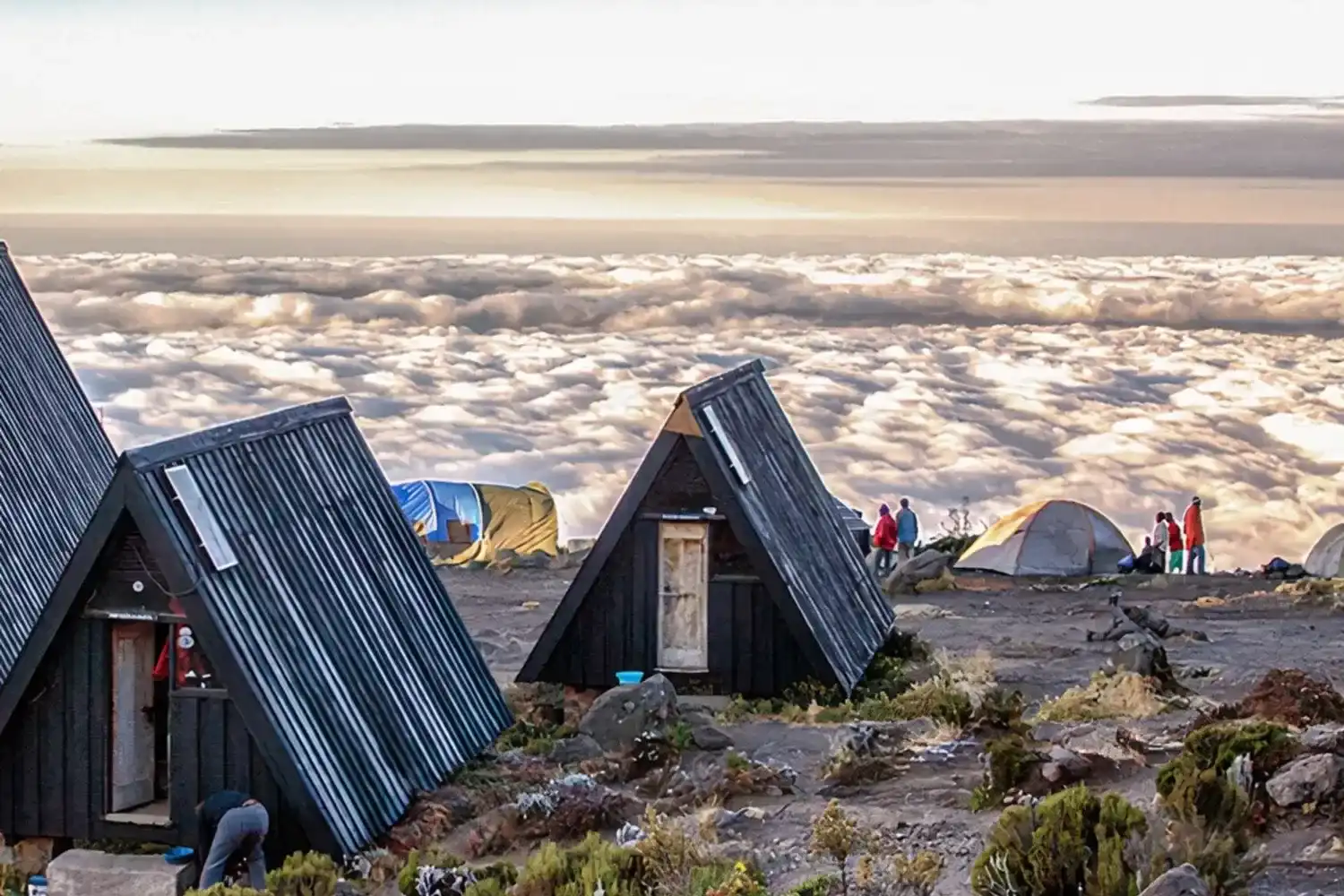
Quick Answer: Marangu or Machame?
For most first-time climbers who are comfortable camping, the 7-day Machame Route is the stronger all-round choice. It normally provides more mountain time, more varied scenery and a better-designed acclimatization pattern. Choose the 6-day Marangu Route when hut accommodation, a more direct trail and avoiding camping matter more to you.
Do not choose Marangu simply because it is often called the “easy” route. Its path is less rugged, but altitude remains the main challenge. Likewise, Machame is not technical mountaineering; its difficulty comes from steeper trail sections, camping, long days and the same extreme summit altitude.
Marangu vs Machame Route Comparison Table
| Factor | Marangu Route | Machame Route | Which has the edge? |
|---|---|---|---|
| Typical duration | 5–6 days | 6–7 days | Machame for more time |
| Recommended version for this comparison | 6 days | 7 days | Machame for pacing |
| Accommodation | Dormitory-style huts | Designated tented camps | Preference |
| Approximate route length | ~72 km round trip | ~62 km | Machame is shorter in distance |
| Trail shape | Same route up and down | Ascends southwest; descends via Mweka | Machame for variety |
| Physical terrain | More gradual, fewer steep scrambles | Steeper sections and Barranco Wall | Marangu physically simpler |
| Acclimatization | Fair on 6 days; rushed on 5 | Good on 7 days with Lava Tower profile | Machame |
| Scenery | Rainforest, moorland, Saddle, Mawenzi views | Rainforest, Shira Plateau, Lava Tower, Barranco, glaciers | Machame |
| Crowds | Can be moderate; ascent and descent share trail | Often busy on popular dates | Marangu may feel quieter |
| Wet-weather sleeping comfort | Roofed huts | Tents | Marangu |
| Best for | Climbers who dislike camping or have limited time | Climbers prioritizing scenery and acclimatization time | Depends on priorities |
Huts vs Camping: The Biggest Everyday Difference
Accommodation changes how the climb feels every evening. The Marangu Route is Kilimanjaro’s only standard trekking route with permanent hut accommodation. Kilimanjaro National Park visitor information lists three main hut stations: Mandara at about 2,700 m, Horombo at about 3,720 m and Kibo at about 4,703 m. Climbers sleep in shared dormitory-style spaces and still need a warm sleeping bag.
The Machame Route uses designated campsites. A standard seven-day itinerary commonly uses Machame Camp, Shira Camp, Barranco Camp, Karanga Camp, Barafu Camp and Mweka Camp. Porters carry the tents and camp equipment, while climbers carry a daypack.
What Marangu huts actually improve
- Weather protection: a solid roof is useful when rain is persistent.
- No tent setup for the guest: you arrive at an established hut station rather than a tented sleeping area.
- More stable sleeping surface: bunks can be easier for people who dislike sleeping on the ground.
- Shared social environment: dining and sleeping spaces are communal rather than private hotel-style rooms.
Huts should not be confused with lodges. They are basic mountain shelters with communal facilities. Privacy is limited, and Kibo Hut is still a cold, high-altitude base before a difficult summit night. Read the dedicated Marangu hut accommodation guide before assuming the route offers hotel comfort.
What Machame camping changes
Camping gives a more immersive mountain experience and lets the route use the scenic southern circuit. The trade-off is less insulation from weather and more dependence on good camp equipment. A quality operator should provide weather-resistant tents, suitable sleeping mats and an organized dining setup. See the Machame camping accommodation guide for the main camps.
Which Is Harder: Marangu or Machame?
Machame is usually harder on the legs; Marangu can be harder on acclimatization. That distinction is more useful than calling either route simply easy or hard.
Why Machame feels more physically demanding
Machame contains steeper ascents and descents, rougher trail, the Shira Plateau, the Lava Tower excursion and the Barranco Wall. Barranco Wall is a hands-on scramble rather than technical rock climbing, but it adds exposure and requires balance. The seven-day route also contains repeated 4–8 hour trekking days before summit night.
Why Marangu can still be difficult
Marangu’s trail is more direct and generally less rugged, but the altitude schedule is compressed. On a standard six-day mountain itinerary, climbers progress from Mandara to Horombo, use an acclimatization day around Horombo, then sleep at Kibo before the summit. The five-day version removes that extra adjustment day. The route’s reputation for being easy can lead climbers to underestimate altitude, cold and the long summit push.
“Easier trail” does not mean “easy summit”
Uhuru Peak is 5,895 m above sea level on both routes. CDC guidance notes that at around 3,050 m the inspired oxygen pressure is only about 69% of sea-level value, and physical fitness does not determine who is susceptible to altitude illness. A strong runner can still become unwell.
6-Day Marangu vs 7-Day Machame: Day-by-Day Route Profile
Operators count days differently, so always confirm whether arrival and hotel nights are included. The table below compares the common six mountain days on Marangu with seven mountain days on Machame.
| Stage | 6-Day Marangu | 7-Day Machame | Why it matters |
|---|---|---|---|
| Day 1 | Marangu Gate → Mandara Hut ~2,700 m | Machame Gate → Machame Camp ~2,850 m | Both enter high sleeping altitude quickly. |
| Day 2 | Mandara → Horombo ~3,720 m | Machame → Shira ~3,800 m | Both make a large sleeping-altitude gain. |
| Day 3 | Acclimatization walk from Horombo; sleep again ~3,720 m | Shira → Lava Tower ~4,600 m → Barranco ~3,950 m | Both can create an acclimatization stimulus, but in different ways. |
| Day 4 | Horombo → Kibo ~4,703 m | Barranco → Karanga ~3,995 m | Marangu makes a major sleeping-altitude jump; Machame stays near 4,000 m. |
| Day 5 | Kibo → Gilman’s Point → Uhuru 5,895 m → Horombo | Karanga → Barafu ~4,673 m | Marangu summits one day earlier. |
| Day 6 | Horombo → Marangu Gate | Barafu → Stella Point → Uhuru 5,895 m → Mweka | Machame uses the extra day before the summit. |
| Day 7 | — | Mweka → Mweka Gate | Final descent. |
Acclimatization: Why One Extra Day Matters More Than Route Nicknames
Altitude adaptation is the most important difference for many climbers. The CDC states that the crucial acute acclimatization process occurs over the first 3–5 days after ascent. It also cites a general recommendation that, once above 3,000 m, sleeping altitude should increase by no more than about 500 m per night, with an additional acclimatization night for each 1,000 m of sleeping-altitude gain. Kilimanjaro’s fixed camps make those textbook targets difficult to follow perfectly, which is one reason longer itineraries are valuable.
Marangu acclimatization profile
The best reason to choose six days instead of five on Marangu is the extra Horombo acclimatization day. A common excursion heads toward Zebra Rocks or the Mawenzi area before returning to sleep at Horombo. That follows the useful principle of spending part of the day higher and sleeping lower. The next move from Horombo at roughly 3,720 m to Kibo around 4,703 m is still close to a 1,000 m sleeping-altitude gain, so the route remains aggressive by high-altitude trekking standards.
Machame acclimatization profile
The seven-day Machame schedule spreads the ascent across more nights and includes the classic Shira–Lava Tower–Barranco day. Climbers may reach around 4,600 m at Lava Tower before descending to sleep near 3,950 m at Barranco. The following night at Karanga remains near 4,000 m before moving to Barafu. This does not guarantee successful acclimatization, but it gives the body more time than a shorter schedule.
What published Kilimanjaro research actually shows
- A prospective cohort study included 1,237 recreational Kilimanjaro hikers. In that cohort, 87.9% reached Uhuru Peak, 8.6% developed severe altitude-illness symptoms and 1.1% were hospitalized.
- In the same study, climbing in more days predicted summit success. The study did not publish a universal audited Marangu-versus-Machame success percentage.
- The CDC reports AMS prevalence of 75–77% in studies of rapid four- and five-day Kilimanjaro ascents.
- The CDC states that training and physical fitness do not determine susceptibility to altitude illness.
Correct interpretation: these statistics support slower ascent, careful symptom monitoring and conservative decision-making. They do not justify promising that one route has an automatic 90%, 95% or 98% summit success rate. Operator percentages are only meaningful when the sample size, dates, route duration, definition of success and denominator are disclosed.
Scenery: Machame Has More Variety, Marangu Has a Cleaner Mountain Profile
Machame generally wins for visual variety. It rises through southwest rainforest, reaches the open Shira Plateau, traverses beneath the Western Breach area, passes Lava Tower and descends into Barranco Valley before crossing Karanga and Barafu. The route then descends through Mweka, so the return landscape differs from the ascent.
Marangu follows an eastern line with rainforest around Mandara, broad heath and moorland around Horombo, then the open Saddle between Mawenzi and Kibo before Kibo Hut. Because the descent repeats the same trail, it offers less variety overall, but the Mawenzi views and long Saddle crossing are distinctive. Neither route is visually poor; they simply emphasize different sides of the mountain.
Crowds: Which Route Feels Busier?
Machame is widely regarded as one of Kilimanjaro’s busiest routes, especially in the main dry seasons. Its popularity means some camps can feel large and active. Marangu can be quieter on some departure dates, but its ascent and descent use the same trail, so you may meet descending groups while climbing upward.
Crowd levels are seasonal rather than fixed. A midweek or shoulder-season departure can feel very different from a peak-season weekend. If solitude is your highest priority, compare all Kilimanjaro routes rather than assuming Marangu or Machame will be quiet.
Which Route Is Better in Rainy Weather?
Marangu has a practical comfort advantage when rain is persistent because you sleep under a solid roof instead of in a tent. That does not make the route weather-proof. Lower trails can still become wet and muddy, clothing must still stay dry, and summit conditions can be cold and windy. On Machame, good waterproof tents and careful packing are especially important.
Whichever route you choose, use the Kilimanjaro packing checklist and prioritize waterproof layers, insulated clothing, gloves, head protection and a suitable sleeping bag.
Cost: Is Marangu Cheaper Than Machame?
Marangu is often cheaper because standard itineraries use fewer mountain days and the route does not require a full camping setup. However, final cost depends on group size, hotel standard, park and hut/camping fees, staff ratios, private toilet arrangements, equipment, transport and whether the itinerary counts hotel nights as tour days.
| Published page | Displayed range | Important note |
|---|---|---|
| 6-Day Marangu guide | USD 1,600–2,800 pp | Range varies by category and group size. |
| 7-Day Machame guide | USD 1,800–3,000 pp | Range varies by category and group size. |
These are published guide figures, not a promise for every departure. Use the Kilimanjaro cost guide to understand the components, then rely on your written quotation for the final price and inclusions.
Comfort: Which Route Helps You Recover Better?
Comfort is personal. Some climbers sleep better in a hut because the floor is stable and there is more shelter from wind and rain. Others dislike shared dormitories, noise and close sleeping quarters and prefer the privacy of a two-person tent. At altitude, sleep quality often worsens on either route; CDC notes that periodic breathing becomes common above roughly 2,700 m.
The best comfort choice is therefore not simply “hut equals luxury.” Marangu provides shelter. Machame can provide privacy. Neither route provides normal hotel comfort on the mountain.
Safety and Altitude Decision-Making
Route choice is only one part of safety. A strong itinerary should include trained guides, daily symptom checks, conservative pacing, hydration and a clear descent plan. Mild altitude symptoms should never be treated as a test of toughness. The prospective Kilimanjaro study found that the majority of climbers continued upward despite symptoms, while not climbing higher when mild symptoms were present was associated with a lower incidence of severe symptoms.
Review the Kilimanjaro safety guide, acclimatization tips and common Kilimanjaro challenges before booking.
Health note: this article provides travel-planning information, not personal medical advice. Travelers with medical conditions, previous severe altitude illness or medication questions should speak with a qualified clinician before high-altitude travel.
Which Route Should You Choose?
| Your priority | Better fit | Reason |
|---|---|---|
| You do not want to sleep in tents | Marangu | Only standard route with huts. |
| You have seven mountain days | Machame | Uses the extra day to spread the ascent. |
| You have only five mountain days | Marangu, but reconsider the schedule | Five days is possible but leaves limited acclimatization time. |
| You want the widest scenery | Machame | Shira, Lava Tower, Barranco and a different descent trail. |
| You prefer gentler trail gradients | Marangu | More direct trail and no Barranco Wall. |
| You dislike shared sleeping spaces | Machame | Tents usually offer more personal sleeping privacy. |
| You are climbing during wetter weather | Marangu | Huts improve overnight shelter. |
| You want stronger standard acclimatization | 7-day Machame | More mountain time and climb-high, sleep-lower profile. |
Choose 6-day Marangu if:
- Sleeping in a tent is a major negative for you.
- You prefer a more direct route with gentler trail sections.
- You understand the extra Horombo acclimatization day is important.
- You accept that hut accommodation does not make summit day easy.
Choose 7-day Machame if:
- You are comfortable camping for a week.
- You want more varied scenery and a different descent route.
- You value an extra mountain day and a stronger acclimatization profile.
- You are comfortable with steeper trail and a busy route.
Final Verdict: Marangu or Machame?
For most climbers with seven mountain days, Machame is the better-balanced route. It is physically more rugged, but the itinerary usually gives more time to adapt to altitude and delivers more landscape variety. Marangu is the better specialist choice when huts are a genuine priority, camping is undesirable, or you want a more direct route.
The most important booking decision is not the nickname “Coca-Cola” versus “Whiskey.” Compare the exact number of mountain days, sleeping elevations, acclimatization plan, guide procedures and inclusions. A sensible six-day Marangu plan is better than rushing the route in five days, and a seven-day Machame itinerary is generally preferable to compressing Machame into six days.
Frequently Asked Questions
Which is better, Marangu or Machame?
Machame is usually the stronger choice for climbers who can camp and want a seven-day itinerary with more varied scenery and a better acclimatization profile. Marangu is better for travelers who strongly prefer hut accommodation, a more direct trail and a shorter standard itinerary.
Is Marangu easier than Machame?
Marangu has gentler trail gradients and no Barranco Wall, so it can feel physically simpler. However, its shorter five- or six-day schedule can make altitude adaptation harder. Machame has steeper sections but the seven-day version generally gives the body more time to acclimatize.
Does the Marangu Route have huts?
Yes. Marangu is Kilimanjaro’s only standard trekking route with dormitory-style mountain huts. Main overnight stations include Mandara Hut, Horombo Hut and Kibo Hut.
Do you camp on the Machame Route?
Yes. Machame uses designated campsites such as Machame Camp, Shira, Barranco, Karanga, Barafu and Mweka. The operator supplies and carries the camping equipment.
Which route is better for acclimatization?
A seven-day Machame itinerary normally has the stronger acclimatization profile because it provides more mountain days and includes a climb-high, sleep-lower pattern around Lava Tower and Barranco. A six-day Marangu itinerary improves on the five-day version by adding an acclimatization day around Horombo.
How long are the Marangu and Machame routes?
Kilimanjaro National Park planning information commonly lists Marangu at about 72 km round trip and Machame at about 62 km. GPS totals can vary slightly by camp position, side walks and measurement method.
Which route has better scenery?
Machame generally offers more varied scenery because it climbs from the southwest, crosses the Shira Plateau, passes Lava Tower and Barranco Wall, and descends by Mweka. Marangu still passes rainforest, moorland and alpine desert and gives strong views of Mawenzi and Kibo.
Which route is better in rainy weather?
Marangu’s huts give more shelter from rain at night, which can make it more appealing in wetter periods. The trail can still be muddy and summit weather can still be severe, so hut accommodation does not remove weather risk.
Is Machame more crowded than Marangu?
Machame is often busier because it is one of Kilimanjaro’s most popular routes. Crowd levels vary by month and departure date. Marangu can feel quieter, although climbers ascend and descend on the same trail.
Does Machame have a higher summit success rate than Marangu?
There is no independent, audited universal success percentage that applies to every operator and departure. Published Kilimanjaro research shows that climbing in more days predicts summit success, so itinerary length and altitude profile matter more than repeating an unsupported route percentage.
Which route should a first-time Kilimanjaro climber choose?
For a healthy first-time high-altitude trekker who is comfortable camping, seven-day Machame is usually the more balanced option. Six-day Marangu can suit a first-time climber who prioritizes huts and understands that the summit remains a demanding high-altitude objective.
Research and Planning Sources
This guide was reviewed on 7 August 2026. Route distances and camp altitudes are approximate because measurement methods and camp positions can vary. Prices and inclusions can change; the written quotation is the final authority.
- Kilimanjaro National Park: gates, huts and campsites
- Kilimanjaro National Park: route lengths and route characteristics
- TANAPA: Kilimanjaro facilities and route map
- CDC Yellow Book: high-altitude travel and acclimatization
- CDC Yellow Book: Kilimanjaro altitude illness
- Journal of Travel Medicine: prospective cohort of Kilimanjaro hikers
- Google Search Central: helpful, reliable, people-first content
- Google Search Central: generative AI Search guidance