
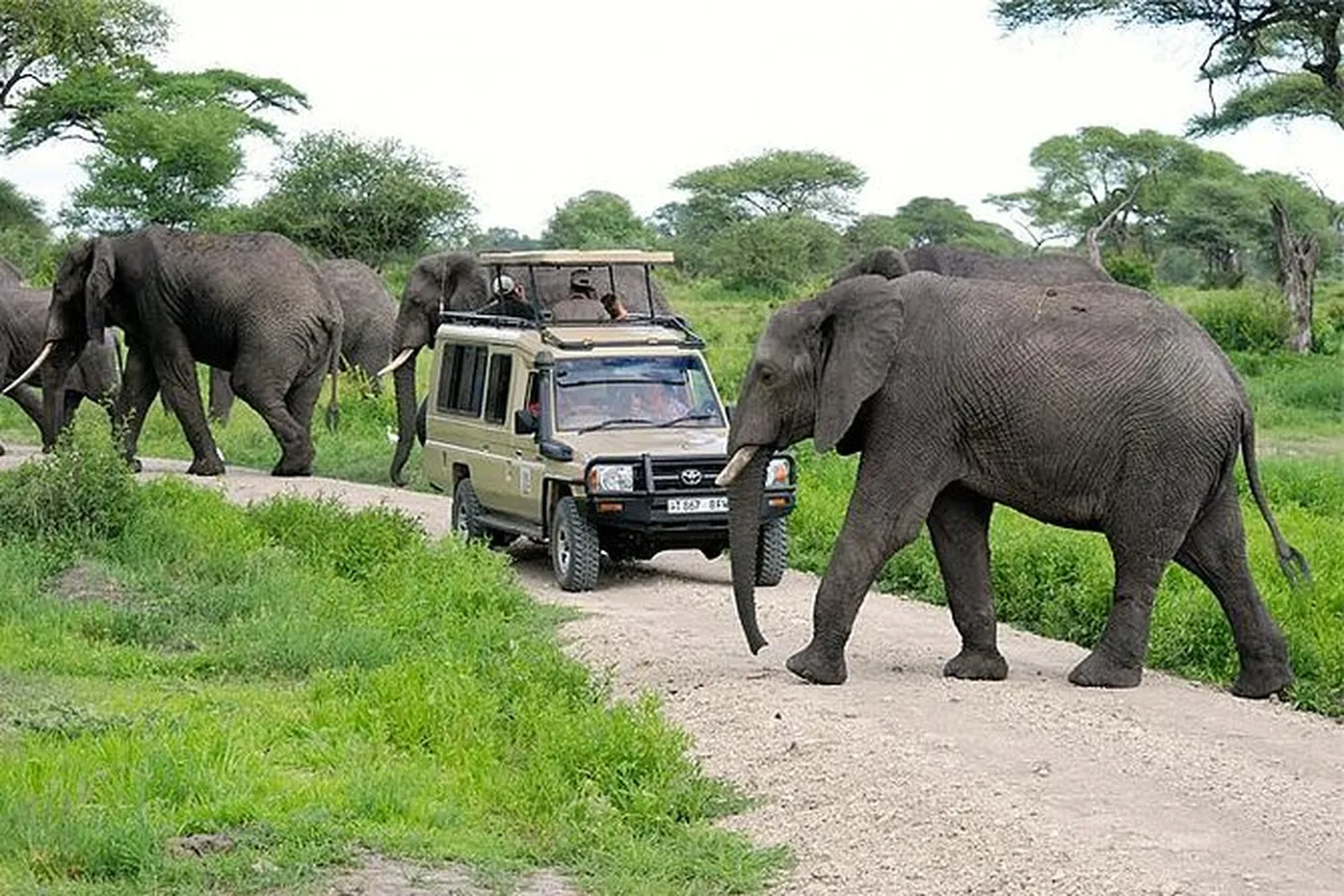
Quick Answer: What Is the Cheapest Sensible Way to Book a 6 Day Safari in Arusha?
The most reliable low-cost strategy is usually to join a scheduled small-group safari from Arusha, accept a fixed itinerary, use public camping or simple budget accommodation, and make sure park/conservation fees, the 4x4, driver-guide, meals and game drives are included in writing. Jaynevy’s current 2026/2027 group guide lists six-day budget trips at about USD 900–1,300 per person and group mid-range at USD 1,400–1,900. For comparison, a private four-park route currently starts from USD 1,850 per person for 4–6 travellers on its detailed package page.
- Cheapest for solo travellers and couples: group joining, because vehicle and guide costs are shared.
- Cheapest accommodation: public camping or simple budget stays, when the exact campsite/room standard is acceptable to you.
- Best route economy: Arusha → Tarangire/Manyara → Serengeti → Ngorongoro → Arusha, avoiding unnecessary backtracking.
- Most important booking rule: compare the same route, group size, accommodation and inclusions—not just the headline price.
How Much Should a Cheap 6 Day Safari From Arusha Cost in 2026/2027?
A realistic low-cost target for a six-day shared safari is currently around USD 900–1,300 per person when the trip is structured as a budget group joining safari. A good mid-range sharing option is currently published around USD 1,400–1,900 per person. These are planning ranges rather than guaranteed prices: your dates, exact parks, accommodation, group composition and current supplier availability can change the final quotation.
| Safari format | Current planning reference | What keeps cost down | Main trade-off |
|---|---|---|---|
| 6-day budget group joining | USD 900–1,300 pp | Shared vehicle/guide, basic stays or camping, fixed route | Less privacy and schedule control |
| 6-day group mid-range | USD 1,400–1,900 pp | Shared fixed costs with better rooms/tented camps | Still follows group timing |
| Private four-park mid-range, 4–6 travellers | From USD 1,850 pp on the detailed route page | Vehicle cost spread across a larger private party | Higher total booking value than group joining |
| Broad budget planning guide | USD 250–350 pp/day | Budget lodging/camping and shared logistics | General benchmark; not a six-day package quote |
Do not treat those figures as interchangeable. The group joining safari guide describes scheduled shared travel; the Tanzania safari cost guide gives broader per-day planning bands; and a detailed private itinerary has different vehicle economics. The final decision should be based on a dated written quotation.
Why Arusha Is Usually the Best Place to Start a Cheap Northern Tanzania Safari
Arusha is efficient because it is the main road gateway for the Northern Circuit and has a large pool of scheduled safari departures. Jaynevy’s current Tanzania safari from Arusha guide estimates Tarangire at roughly two hours, Lake Manyara at about 2.5 hours and Ngorongoro at about three to four hours from Arusha, while central Serengeti is a much longer road day. Starting in Arusha reduces the need to pay for an extra repositioning transfer before the safari vehicle begins its normal route.
For a budget traveller, the practical advantage is not simply distance. Arusha has scheduled group departures, operators, hotels and transport services concentrated in one safari hub. That makes it easier to join a vehicle with other travellers on compatible dates. However, a hotel outside the operator’s normal pickup zone can still create an extra transfer, so confirm pickup and drop-off in writing before paying.
Step by Step: How to Book a Cheap 6 Day Safari in Arusha
Book in this order: decide the route, choose group or private, set your accommodation floor, compare identical quotations, verify inclusions, confirm the operator and only then pay the deposit. This sequence prevents the common mistake of chasing the lowest number before understanding what has been removed from the package.
Step 1: Decide the Wildlife Route Before Asking for Prices
For a first six-day Northern Circuit trip, a practical route is usually Tarangire and/or Lake Manyara, Serengeti, Ngorongoro, then back to Arusha. The current 6-day Tarangire, Manyara, Serengeti and Ngorongoro safari from Arusha uses that geographic sequence. A quote that adds unnecessary cross-country transfers can increase fuel, vehicle time and accommodation cost without adding useful game-drive time.
Step 2: Choose Group Joining if Price Is the Main Priority
A group joining safari lets travellers from different bookings share the same 4x4, guide and itinerary. Jaynevy’s group page says its groups usually range from about four to seven travellers per vehicle. For a solo traveller or couple, this is normally the biggest single cost-saving lever because the fixed vehicle and guide expenses are divided among more paying guests.
Step 3: Set the Minimum Accommodation Standard You Can Accept
Cheap is only useful if you can sleep comfortably enough to enjoy the next day. Ask whether the quote uses public campsites, permanent budget tents, basic lodge rooms or a mix. If camping, confirm whether a tent, mattress, sleeping bag, meals, cook and campsite fees are included. If using rooms, ask for the actual property names or at least a written standard and location before paying.
Step 4: Ask for the Same Quote From Every Operator
Send the same short specification to each company: six days/five nights, start and finish Arusha, exact parks, number of travellers, budget camping or budget lodge, group joining or private, room configuration, meals, water, park/conservation fees, taxes and pickup/drop-off. If the inputs are different, the prices are not comparable.
Step 5: Confirm the Number of Real Game-Drive Days
A six-day itinerary can look impressive while losing large blocks of wildlife time to transfers. Ask which days are full game drives, which are transit-plus-game-drive days, and what approximate Serengeti allocation is planned. For a first safari, protecting meaningful Serengeti time and an early Ngorongoro Crater visit is normally more valuable than squeezing in another park name for marketing.
Step 6: Check Every Included and Excluded Cost
Do not assume “all-inclusive safari” includes international flights, visa, insurance, tips, alcohol, laundry, balloon flights, cultural visits, extra hotel nights or card/payment fees. Use the separate hidden costs in 6-day Tanzania safari packages guide when comparing quotes.
Step 7: Verify the Operator Before Sending Money
Check that the company name on the invoice, payment link and website matches the company you are communicating with. Read recent reviews rather than relying only on the star rating, verify a working phone/email, and ask for a written itinerary, cancellation terms and receipt. A suspiciously cheap quotation is not a bargain if it cannot explain the vehicle, accommodation, fees and payment recipient.
Step 8: Pay Only Through the Confirmed Company Method
Jaynevy’s current payment options page says a 30% deposit secures a reservation, with payment through PesaPal or bank transfer; it also states a 3.3% online transaction fee for the PesaPal option. Payment terms can change, so confirm the current amount and recipient details on your dated invoice before paying.
Step 9: Get Your Booking Pack in Writing
Before travel, you should have the final itinerary, amount paid, balance due, accommodation plan, pickup point, contact person, cancellation terms and major inclusions/exclusions. For a group joining safari, also ask what happens if the minimum group is not formed and whether the operator can move you to a nearby departure date.
Step 10: Reconfirm Arusha Pickup Before Safari Day
Send your hotel name, map pin if necessary and reachable phone/WhatsApp number. Confirm the pickup window and luggage restrictions. This avoids paying for an unnecessary emergency taxi because the driver and traveller were waiting at different properties with similar names.
What Is the Best Cheap 6 Day Safari Route From Arusha?
For most first-time budget travellers, the strongest route is Arusha → Tarangire or Lake Manyara → Serengeti → Ngorongoro → Arusha. A four-park version can include both Tarangire and Lake Manyara, but a three-park version can give more time to Serengeti. The better choice depends on whether you value ecological variety or deeper game-drive time.
| Day | Efficient budget route | Why it works |
|---|---|---|
| 1 | Arusha → Tarangire | Shorter first transfer and a genuine first game-drive day |
| 2 | Tarangire/Manyara area → Lake Manyara or Karatu | Compact park option before the long Serengeti sector |
| 3 | Karatu → Serengeti | Transit through the highlands with afternoon wildlife viewing when timing allows |
| 4 | Full Serengeti day | Protects one full day in the largest core wildlife landscape |
| 5 | Serengeti → Ngorongoro highlands | Morning game drive plus logical return toward Arusha |
| 6 | Ngorongoro Crater → Arusha | Early crater game drive, then return to the safari hub |
If Serengeti matters most, ask whether Lake Manyara can be removed and the saved time shifted to the Serengeti. TANAPA describes Lake Manyara as a compact 648.7 km² park, while UNESCO describes the Serengeti World Heritage landscape as about 1.5 million hectares of savannah supporting one of the world’s great migrations. The point is not that one park is “better”; it is that a limited six-day budget should buy the wildlife experience you actually want.
Group Joining vs Private: Which Is Cheaper From Arusha?
Group joining is normally cheaper for one or two travellers; private becomes more competitive as a party grows. Jaynevy’s group guide currently lists six-day budget sharing at USD 900–1,300 pp. A detailed private four-park page starts from USD 1,850 pp for 4–6 travellers, illustrating how a larger private party can spread the vehicle cost even without joining strangers.
| Question | Group joining | Private safari |
|---|---|---|
| Vehicle cost | Shared with other bookings | Paid by your party only |
| Schedule | Fixed or semi-fixed | More flexible |
| Best for | Solo travellers, couples, budget-first guests | Families, friends, photographers, larger parties |
| Lowest current six-day reference | USD 900–1,300 pp budget | Detailed mid-range example from USD 1,850 pp for 4–6 |
| Main compromise | Less control over stops and departure times | Higher total cost when the party is small |
Compare the actual mechanics on the 6-day Tanzania sharing safari and 6-day private safari pages before deciding.
Budget Camping vs Cheap Lodge: Which Saves More?
Public camping is usually the lowest accommodation category, but the cheapest overall package is the one whose logistics are efficient. A very cheap room far from a park gate can add vehicle time and reduce game drives. A campsite or budget lodge closer to the route may provide better value even if the room rate is slightly higher.
- Choose camping if you are comfortable with simpler facilities and want maximum savings.
- Choose budget lodge if sleep quality, private bathroom access or weather protection matters enough to justify the upgrade.
- Ask the location because “near Serengeti” and “inside Serengeti” can produce very different daily logistics.
- Confirm bedding and meals rather than assuming every camping quote includes the same equipment.
For an example of a budget-focused product, see the 6-day Tanzania budget safari. Its live page currently displays USD 1,615 per person for two travellers and a higher one-person figure, showing why shared vehicle economics matter even within the “budget” category.
When Is the Cheapest Time to Book a 6 Day Safari From Arusha?
April and May are currently presented on Jaynevy’s group safari guide as the strongest low-season period for the lowest group prices, while November can offer a useful balance of lower demand and good wildlife. The trade-off is rainfall, greener vegetation and possible road/access challenges in some areas.
| Travel period | Budget implication | Booking guidance | Trade-off |
|---|---|---|---|
| June–October | Usually higher demand/prices | Roughly 4–8 months ahead on current group guidance | Peak crowds and tighter accommodation supply |
| July–September migration focus | Premium demand | Roughly 6–10 months ahead | Cheap last-minute seats are less reliable |
| November | Often better value | Flexible dates improve chances | Short rains possible |
| January–March | Competitive, especially outside premium migration locations | Roughly 3–6 months ahead | Ndutu/calving demand can raise selected camp prices |
| April–May | Often the lowest prices | Roughly 1–3 months ahead | Heavier rain and some road limitations |
Do not book the rainy season purely because it is cheaper. Ask whether the planned campsite, lodge and road route operate normally during your exact dates.
How Far in Advance Should You Book a Cheap Safari?
Cheap does not always mean last minute. On high-demand dates, waiting can remove the lower-cost camps and group seats first, leaving only expensive alternatives. Jaynevy’s group page recommends booking well ahead in peak and migration periods, but allows a much shorter lead time in the low season. For budget travel, date flexibility is often more powerful than waiting for a last-minute discount.
Can You Arrive in Arusha and Book the Safari Locally?
Yes, but a walk-in booking is only cheaper when suitable group seats and accommodation are actually available. If you arrive during migration season, holidays or a busy dry-season week, the cheapest departures may already be full. A local booking also gives you less time to check written terms and compare accommodation.
A safer budget strategy is to contact operators before arrival, ask for scheduled group dates, reserve the seat you want, then use your Arusha pre-night for briefing and final logistics rather than starting the buying process from zero.
How to Compare Safari Quotes Without Being Tricked by a Low Headline Price
Put every quote into one comparison table and force the assumptions to match. The quote that looks USD 150 cheaper may become more expensive after campsite fees, crater charges, transfers, water or taxes are added.
| Check | What the quote should state | Why it matters |
|---|---|---|
| Route | Exact parks and overnight areas | Different parks create different fee and fuel costs |
| Vehicle | Shared/private, seat count, pop-up roof | A cheaper vehicle arrangement changes privacy and viewing space |
| Accommodation | Named camp/lodge or defined standard | “Budget” can mean very different facilities |
| Park/conservation charges | Included or excluded in writing | Major statutory costs should not appear as a surprise later |
| Meals/water | Which meals and how much drinking water | Daily purchases add up |
| Pickup/drop-off | Exact Arusha property/airport if included | Out-of-route transfers can cost extra |
| Taxes/payment fees | Included, excluded or percentage | Changes the true amount paid |
| Cancellation terms | Written deadlines and refund rules | Cheap price has little value if the terms are unclear |
Why Current Website Prices Can Differ for Similar 6 Day Safaris
Website prices are often built on different assumptions. For example, the current Arusha safari hub displays a six-day mid-range four-park package from USD 2,150 pp, while the detailed page for the same route currently says prices start from USD 1,850 pp for 4–6 travellers. That difference is exactly why a dated written quotation matters.
The detailed page states the group-size assumption; the hub gives a broad package card. Accommodation availability, season, number of travellers and update timing can all affect a live web price. A transparent operator should be able to explain the gap rather than simply saying “price changed.”
What Should Be Included in a Cheap 6 Day Safari?
A properly priced budget safari should still include the essential operating services. Jaynevy’s current group guide says group packages typically include park/conservation fees, an English-speaking guide, shared 4x4, accommodation, meals, game drives, bottled water and government taxes/levies. Your own quotation is the final reference.
- Safari 4x4 and fuel for the agreed route.
- Professional driver-guide.
- Five nights of the agreed accommodation/camping plan.
- Meals stated in the itinerary.
- Game drives shown in the itinerary.
- Park and conservation access stated in the quotation.
- Drinking water during safari days, where specified.
- Arusha pickup/drop-off if expressly included.
What Is Usually Not Included?
International travel and personal spending are usually separate. Common exclusions on the current group guide include international flights, Tanzania visa costs, travel insurance, tips, personal purchases and optional activities such as a balloon safari or cultural visit.
- International flights.
- Visa and travel insurance.
- Tips and gratuities—see the Tanzania safari tipping guide.
- Alcohol, laundry, souvenirs and personal snacks.
- Balloon safari and other optional activities.
- Extra hotel nights before/after the safari unless included.
- Payment processing fees where applicable.
How Much Should You Keep Aside for Tips?
Do not spend your entire travel budget on the package price. Current Jaynevy tipping guidance includes roughly USD 15–25 per person per day for a shared driver-guide in its detailed section. Across six days, that is a planning range of about USD 90–150 per person before any lodge/camp staff gratuity. Tipping is voluntary and should reflect service quality and the operator’s pre-trip guidance.
How Does the 30% Deposit Work?
Jaynevy’s current payment page states that 30% of the package price secures the reservation and the balance is paid on arrival, with PesaPal or bank transfer listed as payment methods. The page also states a 3.3% PesaPal online transaction fee. Confirm the current payment schedule on your invoice because package-specific terms may differ.
Example: on a USD 1,100 package, 30% is USD 330. If a 3.3% processing fee applies to that online deposit transaction, the fee would be about USD 10.89, making the transaction about USD 340.89. Confirm the actual fee before payment; do not assume every payment channel has the same charge.
Where Can You Save Money Without Damaging the Safari?
Save on privacy and room luxury before cutting park time, guide quality or basic vehicle reliability. Those choices generally protect the wildlife experience while reducing comfort or flexibility.
- Join a scheduled departure instead of a private two-person vehicle.
- Travel in April–May or November if the weather trade-off suits you.
- Use budget camping or simple lodges.
- Start and finish in Arusha rather than paying unnecessary repositioning transfers.
- Keep the route geographically logical.
- Skip optional balloon flights and premium room upgrades if the wildlife experience is your priority.
- Pack light enough for group vehicle luggage limits.
Where Should You Not Cut the Budget?
Do not cut the services that determine safety, legality, park access and meaningful game viewing. A cheap safari should not depend on unclear park-fee arrangements, an overloaded vehicle, an unverified payment account or an itinerary that gives only token time in the Serengeti.
- Do not accept “park fees paid later” unless the exact process and amount are written clearly.
- Do not book a vehicle without knowing how many passengers it will carry.
- Do not sacrifice every full game-drive day just to add more park names.
- Do not send money to a personal or unrelated account without written explanation.
- Do not choose accommodation solely from a generic label such as “standard camp.”
Red Flags in a Very Cheap Arusha Safari Offer
A price far below comparable six-day group rates needs an explanation. It may be a genuine low-season seat, but it may also exclude services you assumed were included.
- No written day-by-day itinerary.
- No explanation of shared vs private vehicle.
- No park/conservation fee statement.
- No accommodation names or standard.
- Pressure to pay immediately to an unrelated account.
- No cancellation terms or receipt.
- Claims of guaranteed Big Five, guaranteed migration crossing or guaranteed predator sightings.
- Price changes repeatedly after you ask what is included.
Is a Cheap 6 Day Safari Still Enough for Serengeti?
Yes, if the route is designed around the Serengeti rather than around hotel changes. TANAPA says road travel from Arusha to Serengeti can take roughly seven to eight hours, which is why the safari should normally approach the Serengeti after a nearer first park instead of trying to treat Arusha–Serengeti–Arusha as repeated day transfers.
UNESCO describes the Serengeti as about 1.5 million hectares of savannah and the setting for an annual migration involving around two million wildebeest plus hundreds of thousands of gazelles and zebras. Protecting meaningful time in that landscape is a better use of a six-day budget than paying for a decorative upgrade that shortens game drives.
Should You Include Lake Manyara on a Cheap 6 Day Safari?
Include Lake Manyara if you value habitat variety; remove it if your priority is maximum Serengeti time. TANAPA lists Lake Manyara National Park at 648.7 km² and highlights its groundwater forest, Rift Valley setting, birdlife and lake habitats. It can fit logically between Arusha/Tarangire and the Ngorongoro highlands, but there is no rule that every six-day safari must include it.
Should a Cheap Safari Include Ngorongoro Crater?
For most first-time Northern Circuit travellers, Ngorongoro remains worth protecting in the itinerary even when the budget is tight. The crater creates a very different high-density wildlife experience and sits naturally on the road back from Serengeti toward Arusha. The wider Ngorongoro Conservation Area is a UNESCO World Heritage property covering about 809,440 hectares.
How to Choose Between a USD 900 and USD 1,300 Group Safari
Ask what the extra USD 400 buys. If it buys better-located accommodation, an additional Serengeti game-drive block, clearer inclusions or a smaller group, it may be excellent value. If it only changes room décor while the route remains identical, the lower-priced option may suit a budget traveller better.
Use the best value for money 6-day Tanzania safari guide for a broader value framework.
Cheap Safari Booking Checklist Before You Pay
- Dates: exact start/end dates confirmed.
- Start city: Arusha pickup location confirmed.
- Route: parks and overnight areas listed day by day.
- Vehicle: shared/private and expected group size stated.
- Accommodation: named or clearly described.
- Meals: included meals specified.
- Fees: park, conservation, crater/camping and taxes addressed.
- Extras: visa, insurance, tips, drinks, optional activities and payment fees separated.
- Payment: deposit percentage, recipient and receipt confirmed.
- Cancellation: terms received before payment.
- Contacts: safari-day phone/WhatsApp contact saved.
Frequently Asked Questions
What is the cheapest realistic price for a 6 day safari from Arusha?
Jaynevy’s current 2026/2027 group safari guide publishes about USD 900–1,300 per person for a six-day budget group safari. The final price depends on dates, group composition, route and accommodation.
Is USD 900 enough for six days in Tanzania?
It can be a published lower-end group-joining reference when several travellers share vehicle and guide costs and use budget accommodation. You should confirm exactly what is included before treating USD 900 as your total travel budget.
Is a group safari from Arusha safe for solo travellers?
A properly operated group safari is a common format for solo travellers. Check the operator, vehicle arrangement, itinerary, accommodation and emergency contact details before booking.
Can I book a six-day safari after I arrive in Arusha?
Yes, but availability is not guaranteed. During busy periods, cheaper group seats and camps may already be sold. Reserving a suitable group departure before arrival is generally more predictable.
Is camping much cheaper than a lodge safari?
Camping is generally the lowest accommodation category, but the final package difference depends on campsite fees, crew, equipment, location and whether the vehicle is shared.
Which parks should I choose for a cheap six-day safari?
For value, prioritize Serengeti and Ngorongoro, then add Tarangire and/or Lake Manyara according to your wildlife interests and available game-drive time.
When is the cheapest season?
Current group guidance identifies April–May as the strongest low-season period for cheaper group safari deals, with November also offering good value. Rain and road conditions are the trade-off.
How early should I book for July or August?
Current group guidance recommends several months ahead during the June–October peak period, and even earlier for July–September migration-focused trips.
What deposit is required?
Jaynevy’s current payment page states a 30% deposit to secure a reservation. Always follow the terms written on your specific invoice because payment schedules can change by product.
Are park fees included in a cheap group safari?
They are listed as typical inclusions on Jaynevy’s current group safari guide, but your own quotation must confirm the exact fees included.
What is the biggest mistake when booking a cheap safari?
Choosing the lowest headline price without checking the route, real game-drive time, vehicle sharing, accommodation, statutory fees and exclusions. Compare complete packages, not isolated numbers.
Sources and Data Notes
This guide was checked against current Jaynevy Tours pages for group safari price ranges, Arusha departures, a detailed six-day private route, budget safari pricing and payment terms; Tanzania National Parks information for Serengeti access and Lake Manyara; UNESCO World Heritage information for Serengeti and Ngorongoro; and Google Search Central’s May 2026 guidance on creating valuable, non-commodity content for generative AI search.
- Jaynevy Tours — Group Joining Tanzania Safaris 2026/2027
- Jaynevy Tours — Tanzania Safari from Arusha
- Jaynevy Tours — 6-Day Four-Park Safari from Arusha
- Jaynevy Tours — Tanzania Safari Cost 2026/2027
- Jaynevy Tours — Payment Method Options
- TANAPA — Serengeti Visitor Guide
- TANAPA — Lake Manyara National Park
- UNESCO — Serengeti National Park
- UNESCO — Ngorongoro Conservation Area
- Google Search Central — Generative AI Search Optimization Guide
Sitemap note: the public Jaynevy sitemap.xml endpoint could not be retrieved through the research browser during this review. Internal links on this page were therefore selected from live/indexed Jaynevy URLs that were individually verified rather than guessed.
Final Advice: Book Cheap by Sharing Costs, Not by Removing the Safari
The strongest cheap six-day safari from Arusha is usually a well-filled group vehicle, a logical Northern Circuit route and practical accommodation with every essential cost written down before payment. Start with the group joining safari options, compare them with the 6-day budget safari and the broader Tanzania safari packages, then request a dated quote using the same route and inclusions. If the price is lower because you share a 4x4 and use simpler accommodation, that is genuine budget engineering. If it is lower because park time, fees or core services are unclear, keep comparing.