
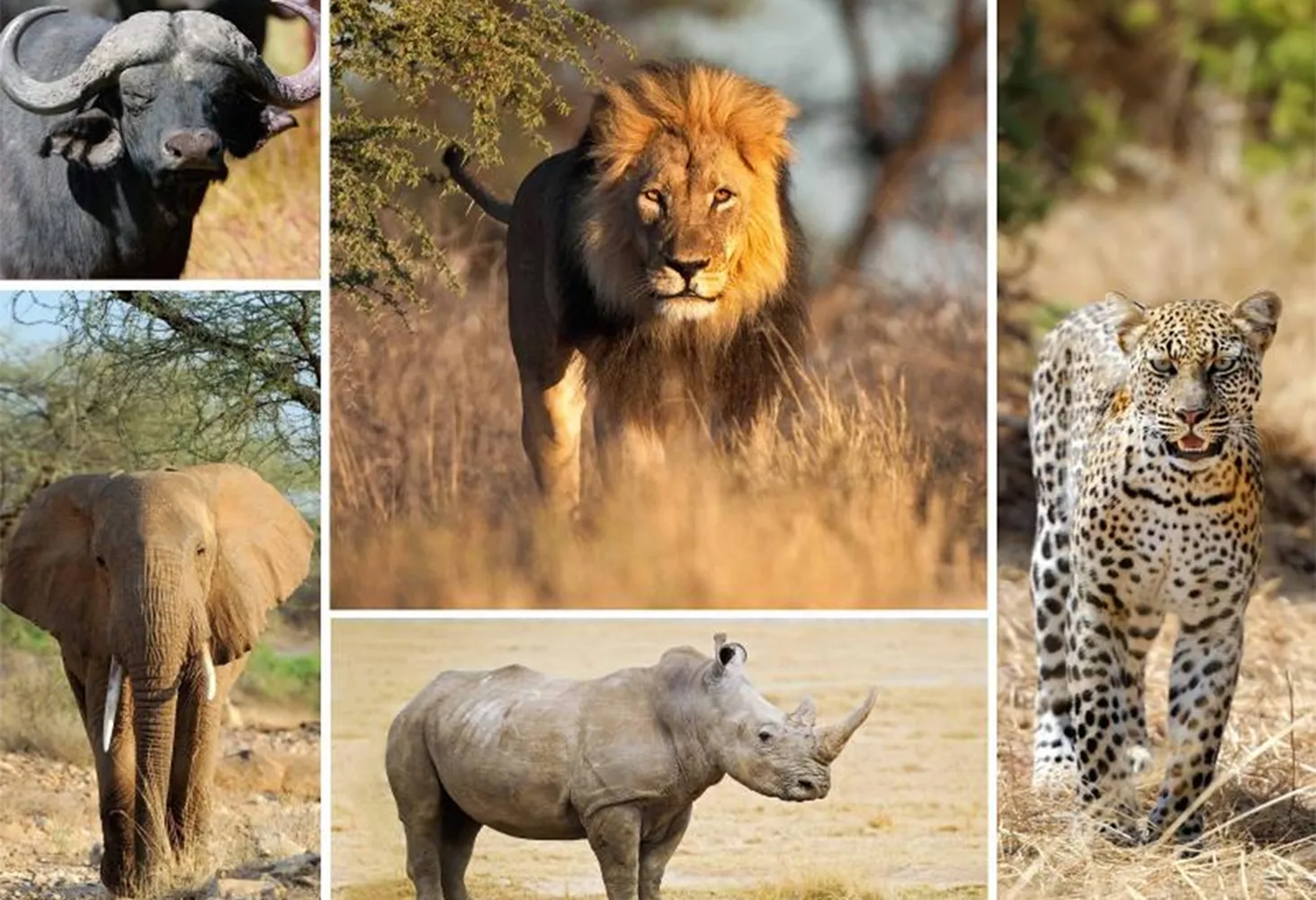
Quick Answer: Can You Spot the Big Five in Six Days?
Yes, you can potentially see lion, leopard, elephant, buffalo and black rhino during a six-day northern Tanzania safari, but seeing all five is never guaranteed. A strong route is Tarangire → Serengeti → Ngorongoro, with at least two substantial Serengeti game-drive days and the crater scheduled early on the final wildlife day. Lion, elephant and buffalo are generally easier targets; leopard is naturally elusive; black rhino is the species most likely to decide whether you complete the Big Five list.
If the Big Five is your primary goal, do not sacrifice Serengeti search time simply to add another park. See our broader Big Five safari Tanzania guide before comparing specific six-day routes.
What Are the Big Five Animals in Tanzania?
The Big Five are lion, leopard, African elephant, African buffalo and rhinoceros. The term came from the colonial hunting era and referred to animals considered difficult and dangerous to hunt on foot. On a modern photographic safari, the goal is observation and conservation. In northern Tanzania, the rhino you are seeking is the black rhinoceros; Tanzania does not have a wild white-rhino population in the standard northern-circuit parks.
- Lion: social, territorial and often easier to locate in open savannah.
- Leopard: solitary and exceptionally well camouflaged; often the most time-consuming cat to find.
- African elephant: especially associated with Tarangire's riverine and baobab landscapes.
- African buffalo: found in herds and mixed habitats across the Serengeti, Ngorongoro and Tarangire ecosystems.
- Black rhinoceros: rare, heavily protected and the hardest Big Five species to build an itinerary around.
Big Five Spotting Table: Best Parks, Difficulty and Search Strategy
The five species do not have the same visibility. A useful safari plan treats each animal differently instead of assuming one game drive can produce everything.
| Big Five animal | Best focus in a 6-day route | What your guide searches for | Realistic difficulty |
|---|---|---|---|
| Lion | Serengeti + Ngorongoro | Prides near prey, kopjes, shade, water and open plains | Often seen, never guaranteed |
| Leopard | Serengeti + Tarangire | Riverine trees, acacias, kopjes, drainage lines, impala-rich areas | Difficult and highly variable |
| Elephant | Tarangire + Serengeti | Family herds, river systems, woodland and water | Usually one of the easier targets |
| Buffalo | Ngorongoro + Serengeti + Tarangire | Large herds, grasslands, wetlands and woodland edges | Common in suitable habitat |
| Black rhino | Ngorongoro; Serengeti only as a rare bonus | Distant open areas, known habitat and current guide/ranger information | Hardest target; no responsible guarantee |
Why Serengeti and Ngorongoro Matter Most for the Big Five
Serengeti supplies search time and predator habitat; Ngorongoro adds dense wildlife and the most practical black-rhino focus for a short northern itinerary. UNESCO describes Serengeti National Park as 1.5 million hectares of savannah with one of the world's largest and most diverse predator-prey systems. Its Outstanding Universal Value page lists 2 million wildebeest, 900,000 Thomson's gazelles and 300,000 zebras among the ecosystem figures used to describe its biological significance. These numbers are ecological reference figures, not a live daily wildlife census.
UNESCO describes the Ngorongoro Conservation Area as 809,440 hectares and notes the presence of globally threatened black rhino plus unusually high wildlife density in and around the crater. A World Heritage decision records roughly 25,000 large animals in the property and describes it as having an exceptionally high density of mammalian predators. That is why an early crater game drive is strategically valuable on a short Big Five itinerary.
What the Rhino Numbers Actually Tell You
Black rhino is genuinely rare, so a six-day Big Five article should not invent a “90% rhino chance.” The IUCN's African rhino conservation 2025–2035 framework lists 228 black rhinos for Tanzania in its country table. The IUCN reported 6,788 black rhinos in Africa by the end of 2024 and retains the species as Critically Endangered.
Those national figures do not mean 228 rhinos are visible to tourists in Ngorongoro. Tanzania's rhinos are distributed among protected landscapes, locations are security-sensitive, and the animals can remain far from roads. For itinerary planning, the correct conclusion is simple: protect enough time for Ngorongoro, use a good guide and treat a rhino sighting as earned luck, not a contractual inclusion.
Best 6-Day Tanzania Safari Route for Spotting the Big Five
For a focused Big Five safari, prioritize three ecosystems rather than racing through every northern park. This route gives elephants and buffalo a strong Tarangire day, then places the largest block of search time in the Serengeti before finishing at Ngorongoro.
| Day | Route | Big Five priority | Why it matters |
|---|---|---|---|
| 1 | Arusha/Moshi → Tarangire | Elephant, buffalo, lion, possible leopard | Start with a habitat famous for elephants instead of using the day only for transit. |
| 2 | Tarangire → Serengeti | Lion, leopard, buffalo, elephant | Use arrival time for a game drive if road and gate timing allow. |
| 3 | Full-day Serengeti | Lion + leopard focus | A full day allows repeated searches across different habitats rather than one rushed drive. |
| 4 | Full-day Serengeti | Leopard + remaining Big Five | The second full day is valuable because elusive cats do not follow your schedule. |
| 5 | Serengeti game drive → Ngorongoro highlands | Final Serengeti targets | Use the morning productively, then position close to the crater for an early Day 6 descent. |
| 6 | Ngorongoro Crater → Arusha/Moshi | Black rhino, lion, buffalo, elephant | Crater day is the key chance to close gaps in the Big Five list before returning. |
This is close to the logic used in our 6-day luxury northern circuit safari. Travelers who specifically want more Serengeti time can also compare the 6-day Serengeti safari.
Should Lake Manyara Be Included in a Big Five-Focused Six-Day Safari?
Lake Manyara is a rewarding park, but it is not essential if completing the Big Five list is your primary objective. TANAPA currently lists the park at 648.7 km² and highlights tree-climbing lions, elephants, flamingos and varied forest-to-lake habitats. It adds landscape and birding diversity, but another half or full Serengeti day may be more valuable when leopard and rhino are your unresolved targets.
If you want the classic four-park experience, Manyara can still fit. Review the Lake Manyara National Park guide and compare the wildlife objective against available driving time.
Why Tarangire Is Valuable Even Though Rhino Is Not the Goal There
Tarangire is one of the most efficient ways to add high-quality elephant viewing to a six-day route. TANAPA's current park page lists Tarangire at 2,850 km² and shows an elephant population of 2,500+. TANAPA also describes the park as a major elephant sanctuary, while an official park brochure notes that lion and leopard are regularly encountered.
Use Tarangire to build the elephant, buffalo and big-cat side of the list; use Ngorongoro for your best short-itinerary rhino focus. For a dedicated park option, see our Tarangire safari guide.
How to Search for Each Big Five Animal
1. Lion: Search Open Plains, Kopjes and Prey Concentrations
Lions are often easiest to find around prey and resting cover. Early mornings can reveal activity before heat builds, while midday lions may be sleeping in shade or around rocky kopjes. In the Serengeti, a guide watches not only for lions but for stopped vehicles, alarm calls, hyena movement and clusters of prey looking in the same direction.
2. Leopard: Slow Down Around Trees and Drainage Lines
Leopard spotting rewards patience more than mileage. Search large horizontal branches, riverine woodland, drainage lines and rocky cover. A tail hanging below a branch or an impala carcass hoisted into a tree may be easier to notice than the cat itself. This is where binoculars and an experienced guide make a measurable difference.
3. Elephant: Give Tarangire and Water Sources Time
Elephants are mobile and social, so do not treat one distant bull as the whole experience. Family herds, calves, dust bathing and river crossings create better observation opportunities when you can wait quietly instead of driving immediately to the next checklist animal.
4. Buffalo: Look for Herds and Older Bulls
Buffalo occur in large herds but older bulls can also be found in smaller groups near water and cover. Ngorongoro, Serengeti and Tarangire can all contribute. Large herd sightings are particularly useful for photography because you can observe social behavior rather than simply confirm the species.
5. Black Rhino: Use Distance, Optics and Patience
Rhino often requires the most disciplined viewing. A black rhino may appear as a distant shape in open crater country. Good binoculars matter. Guides may use up-to-date field knowledge, but wildlife welfare and security come before a closer photograph. Do not pressure a guide to leave permitted tracks or approach animals unsafely.
Dry Season vs Green Season for a 6-Day Big Five Safari
Dry months can make general spotting easier, but there is no single season when every Big Five species becomes predictable. Wildlife remains present year-round. Your choice changes visibility, road conditions, visitor numbers, vegetation and where prey concentrations are strongest.
| Factor | Dry season, roughly Jun–Oct | Green/wetter months, roughly Nov–May |
|---|---|---|
| General visibility | Often easier where vegetation thins and water concentrates animals | Vegetation can be taller and animals more dispersed |
| Roads | Usually more predictable | Some tracks can be muddy after heavy rain |
| Predator context | Good year-round; prey may gather around permanent water | Excellent seasonal predator activity around southern Serengeti/Ndutu herds in the appropriate months |
| Visitor pressure | Higher in famous peak-season areas | Often lower outside holiday and calving hotspots |
| Big Five guarantee? | No | No |
Does the Great Migration Help You Spot the Big Five?
The migration helps most with predator context, not with completing a five-animal checklist. UNESCO describes the Serengeti migration as a circular movement involving more than a million wildebeest plus hundreds of thousands of other ungulates. Large prey concentrations can create exceptional lion, hyena and cheetah activity. Leopards, elephants, buffalo and black rhinos follow different ecological patterns, so a migration-focused camp is not automatically the best location for all five.
If migration is also a priority, compare the 6-day luxury Great Migration safari and keep the exact Serengeti sector flexible according to current herd movement.
Private vs Group Safari for Big Five Spotting
A private vehicle gives the strongest control over a Big Five search. You can leave earlier, stay longer with a leopard, change sectors when your guide receives useful wildlife information and decide whether to spend two hours on a rhino search instead of moving to the next scheduled stop. A group safari remains a good value option, but everyone shares the vehicle and daily priorities.
- Choose private: if photography, Big Five completion or flexible game-drive timing is your top priority.
- Choose group joining: if budget matters more than complete control of the wildlife search.
Compare our 6-day Tanzania group joining safari with private options before deciding.
Safari Vehicle and Guide Strategy Matter More Than a “Sighting Percentage”
Be cautious with websites that publish precise Big Five success percentages without an audited dataset. Wildlife observations depend on route, season, hours in the field, guide experience, weather, vegetation, park rules and pure chance. A number such as “99% chance” has little value unless the operator defines the sample size, time period, species definition and whether every traveler was independently recorded.
A practical advantage is a well-maintained 4x4 with a pop-up roof, good sight lines and an experienced driver-guide. Review our Tanzania safari vehicle guide for the setup used during game drives.
Photography Tips for the Big Five in Six Days
- Bring binoculars: especially important for distant rhino and cats in trees.
- Use a telephoto lens: a flexible zoom is easier inside a safari vehicle than changing lenses repeatedly.
- Photograph behavior, not only portraits: lion interactions, elephant families and buffalo herds tell a stronger story.
- Protect highlights: pale rhino skin and bright sky can fool exposure in harsh midday light.
- Do not crowd wildlife: a cleaner, ethical image is better than forcing an animal to move.
- Keep gear dust-ready: use a blower, lens cloth and a closed bag on long dry-season transfers.
Common Mistakes That Reduce Your Big Five Chances
- Trying to visit too many parks. More park names can mean fewer quality wildlife hours.
- Leaving the Serengeti after one rushed drive. Leopard searches need time.
- Scheduling Ngorongoro after a long same-day transfer. Sleep near the crater so you can descend early.
- Choosing accommodation only by luxury level. Camp location can matter more than thread count for game-drive efficiency.
- Assuming migration equals Big Five. Migration geography and rhino geography are not the same.
- Demanding guaranteed animals. Ethical operators manage expectations because wildlife is free-ranging.
- Skipping binoculars. Some of the most important sightings are distant.
Is a 6-Day Tanzania Safari Long Enough for the Big Five?
Six days is a strong minimum for a focused northern-circuit Big Five safari, provided the route is efficient. It gives enough time for one Tarangire game drive, two substantial Serengeti days plus arrival/departure viewing, and a Ngorongoro crater day. Seven or eight days gives more resilience when leopard or rhino refuses to cooperate, but six days is far better than compressing the same goal into a two- or three-day transfer-heavy trip.
Start with our Tanzania safari overview and compare current Tanzania safari packages by route rather than by duration alone.
Frequently Asked Questions About Spotting the Big Five in a 6-Day Tanzania Safari
Can you see all Big Five on a 6-day Tanzania safari?
You can see all five in six days, but no operator can responsibly guarantee it. Lion, elephant and buffalo are widely distributed on the northern circuit; leopard is naturally elusive; and black rhino is the hardest species to find. A route combining Tarangire, multiple Serengeti game drives and Ngorongoro gives a strong, realistic search strategy.
Which park is best for the Big Five in Tanzania?
For a six-day northern-circuit safari, Ngorongoro Crater is especially important because UNESCO notes its high wildlife density and the presence of black rhino. Serengeti is the core destination for lions, leopards and large predator-prey interactions, while Tarangire is particularly strong for elephants and buffalo.
Where is the best chance to see a black rhino in six days?
Ngorongoro is usually the most practical place to focus on black rhino during a short northern-circuit itinerary. Rhinos are rare and protected, exact locations are not predictable, and a sighting should never be promised.
Is leopard the hardest Big Five animal to see?
Leopard and black rhino are normally the two hardest Big Five species on a short safari. Leopards are solitary, camouflaged and often rest in trees or dense cover, so several Serengeti game drives improve your search time without creating a guarantee.
How many Serengeti days should a Big Five safari include?
If spotting the Big Five is the main goal, spend at least two full game-drive days in or around the Serengeti when possible. A six-day itinerary that rushes through four parks can reduce the time available to search for elusive cats.
Is Tarangire worth including for a Big Five safari?
Yes. TANAPA describes Tarangire as a major elephant sanctuary and lists more than 2,500 elephants on its current park page. It also supports buffalo, lion and leopard. Rhino, however, should not be the reason to include Tarangire.
Is the dry season better for seeing the Big Five?
The June-to-October dry season can simplify wildlife viewing in many areas because animals often concentrate around water and vegetation is thinner. However, the Serengeti and Ngorongoro are productive year-round, and seasonal movement matters more than a single universal best month.
Do Great Migration months guarantee more Big Five sightings?
No. Migration months can increase predator activity around large herbivore herds, but they do not guarantee the Big Five. The migration itself moves with rainfall and grazing, while rhino and leopard sightings depend on different habitats and chance.
What equipment helps with Big Five spotting?
Bring binoculars, a camera with a useful telephoto range, neutral clothing and sun protection. A well-maintained 4x4 with a pop-up roof and an experienced driver-guide is more important than chasing animals or breaking park rules for a closer photograph.
Should I choose a private or group safari for Big Five spotting?
A private safari gives more control over departure times, how long you stay at a sighting and which areas you search. A group safari can still produce excellent wildlife viewing, but route and stopping decisions are shared with the other passengers.
Research Notes and Trusted Sources
This article separates independently published conservation data from safari expectations. Population figures from UNESCO World Heritage documentation describe ecosystem significance and should not be read as a live game-drive census. Rhino numbers are national conservation estimates, not tourist sighting counts. Wildlife movement is continuous, and no figure in this guide is a sighting guarantee.
- UNESCO World Heritage Centre: Serengeti National Park — 1.5 million hectares, migration, predator-prey significance and ecosystem reference figures.
- UNESCO World Heritage Centre: Ngorongoro Conservation Area — 809,440 hectares, black rhino presence and high wildlife density.
- UNESCO Decision 34 COM 8B.13 — approximately 25,000 large animals and predator-density context for Ngorongoro.
- TANAPA: Tarangire National Park — current park page with 2,850 km² and 2,500+ elephant population indicators.
- TANAPA: Lake Manyara National Park — 648.7 km² and habitat/wildlife overview.
- IUCN: African rhino conservation 2025–2035 — Tanzania black-rhino country estimate.
- IUCN 2025 rhino status update — 6,788 black rhinos in Africa by end-2024 and Critically Endangered status.
Final Answer: Build the Safari Around the Hardest Animals
The best strategy for spotting the Big Five in six days is to design the route around leopard and black rhino, not around the animals that are easiest to see. Give Tarangire one quality day, protect at least two substantial Serengeti search days, sleep near Ngorongoro before the crater, and keep expectations honest. If lion, elephant and buffalo appear early, resist the urge to rush; wildlife behavior is the experience, while the checklist is only one way to organize it.
For a tailored route, tell Jaynevy Tours your travel month, number of travelers, accommodation level and whether your priority is Big Five completion, photography, Great Migration, or a balanced first safari. We can then recommend the most efficient six-day routing without claiming that free-ranging wildlife can be guaranteed.