
10-Day Serengeti Wildebeest Migration Safari
This 10-day Serengeti wildebeest migration safari is a private mid-range Tanzania safari designed around five nights in the Serengeti, with Tarangire, Lake Manyara and Ngorongoro completing the northern-circuit route. Jaynevy Tours arranges the vehicle, driver-guide, accommodation, park and conservation services, airport transfers and scheduled game drives. The planning price starts from USD 7,088 per person under the stated one-traveler mid-range assumptions. Migration locations, road conditions, camp availability and wildlife movements can change the operating plan, so the final itinerary and price are confirmed in a written quotation before booking.
10-Day Serengeti Migration Safari Overview
This route is deliberately Serengeti-heavy. Instead of moving through many parks quickly, it gives five nights to Serengeti National Park, allowing the stay to be divided between central Serengeti and the migration region that best matches the travel month. The opening days add Tarangire National Park and Lake Manyara National Park, while the final night positions the safari for a Ngorongoro Crater game drive.
The Great Migration is a moving ecosystem event rather than a fixed attraction. Jaynevy Tours uses the travel month and recent field information to decide whether the migration-focused Serengeti nights should emphasize the southern plains, central Serengeti, western corridor, northern Serengeti or the return route through the east and center. See the Serengeti Great Migration by month guide for the seasonal pattern.
| Day | Route focus | Typical overnight area |
|---|---|---|
| 1 | Kilimanjaro International Airport to Arusha | Arusha |
| 2 | Tarangire game drive | Outside Tarangire / Karatu corridor |
| 3 | Lake Manyara game drive | Karatu or Manyara area |
| 4–5 | Central Serengeti | Serengeti |
| 6–8 | Seasonal migration region | Serengeti seasonal area |
| 9 | Serengeti to Ngorongoro | Ngorongoro Conservation Area |
| 10 | Ngorongoro Crater to Arusha or JRO | Departure |
10-Day Serengeti Migration Safari Price and Inclusions
Planning price: from USD 7,088 per person. This figure follows the current page assumptions of one traveler, a private vehicle, mid-range accommodation, five Serengeti nights, one Ngorongoro Conservation Area night and three non-park nights. Group size, seasonal camp rates, the exact migration area and supplier availability can change the final amount.
Included in the planning package
- Airport transfer arrangements as confirmed in the final itinerary
- Private safari vehicle with professional driver-guide for the scheduled safari days
- Mid-range accommodation specified in the written quotation
- Park and conservation arrangements included in the confirmed route
- Ngorongoro Crater game-drive arrangements
- Meals and drinking water as listed in the final quotation
- Scheduled game drives and inter-park road transfers
Not included unless confirmed in writing
- International and domestic flights
- Tanzania visa and personal travel documents
- Personal travel, medical and evacuation insurance
- Tips, personal purchases and premium beverages
- Optional hot-air balloon safari or other activities not listed in the quotation
10-Day Serengeti Wildebeest Migration Safari Itinerary
Day 1: Kilimanjaro International Airport to Arusha
Meet the Jaynevy Tours representative after arrival and transfer to Arusha. The day is kept light so there is time to recover from the flight, review the route with the safari team and confirm any dietary, mobility or timing requirements before departure.
Day 2: Arusha to Tarangire National Park
Drive to Tarangire for the first full safari day. Game viewing focuses on the Tarangire River system, baobab woodland and open habitat where elephants, giraffes, zebras, antelopes and predators may be encountered. Continue to the booked lodge outside the park or in the Karatu/Manyara corridor after the game drive.
Day 3: Lake Manyara National Park
Explore Lake Manyara's compact mix of groundwater forest, woodland, floodplain and escarpment scenery. Wildlife varies with season and water levels, but elephants, baboons, giraffes, antelopes and extensive birdlife are possible. Overnight in the Manyara or Karatu area keeps the next day's route toward Serengeti practical.
Day 4: Karatu to Central Serengeti
Travel through the Ngorongoro highlands toward Serengeti National Park, entering the open plains and continuing to central Serengeti. An afternoon game drive introduces the Seronera area, which is useful for resident wildlife and as a flexible base before moving toward the seasonal migration zone.
Day 5: Full Day in Central Serengeti
Spend a full day on game drives in central Serengeti. The area supports year-round resident wildlife, and sightings may include lions, leopards, cheetahs, elephants, buffalo, giraffes and plains game. The guide also uses the day to assess current migration reports before the seasonal move.
Day 6: Central Serengeti to the Seasonal Migration Region
Shift toward the part of the Serengeti ecosystem most suitable for the travel month. January to March may favor the southern plains and adjoining Ndutu area; May and June often favor central-western or western areas; July to October normally favors northern Serengeti; November and December can favor the eastern, central and southern return route. If the best seasonal base lies outside the standard Serengeti fee pattern, the final quotation is adjusted before booking.
Day 7: Full Migration-Focused Game Drive
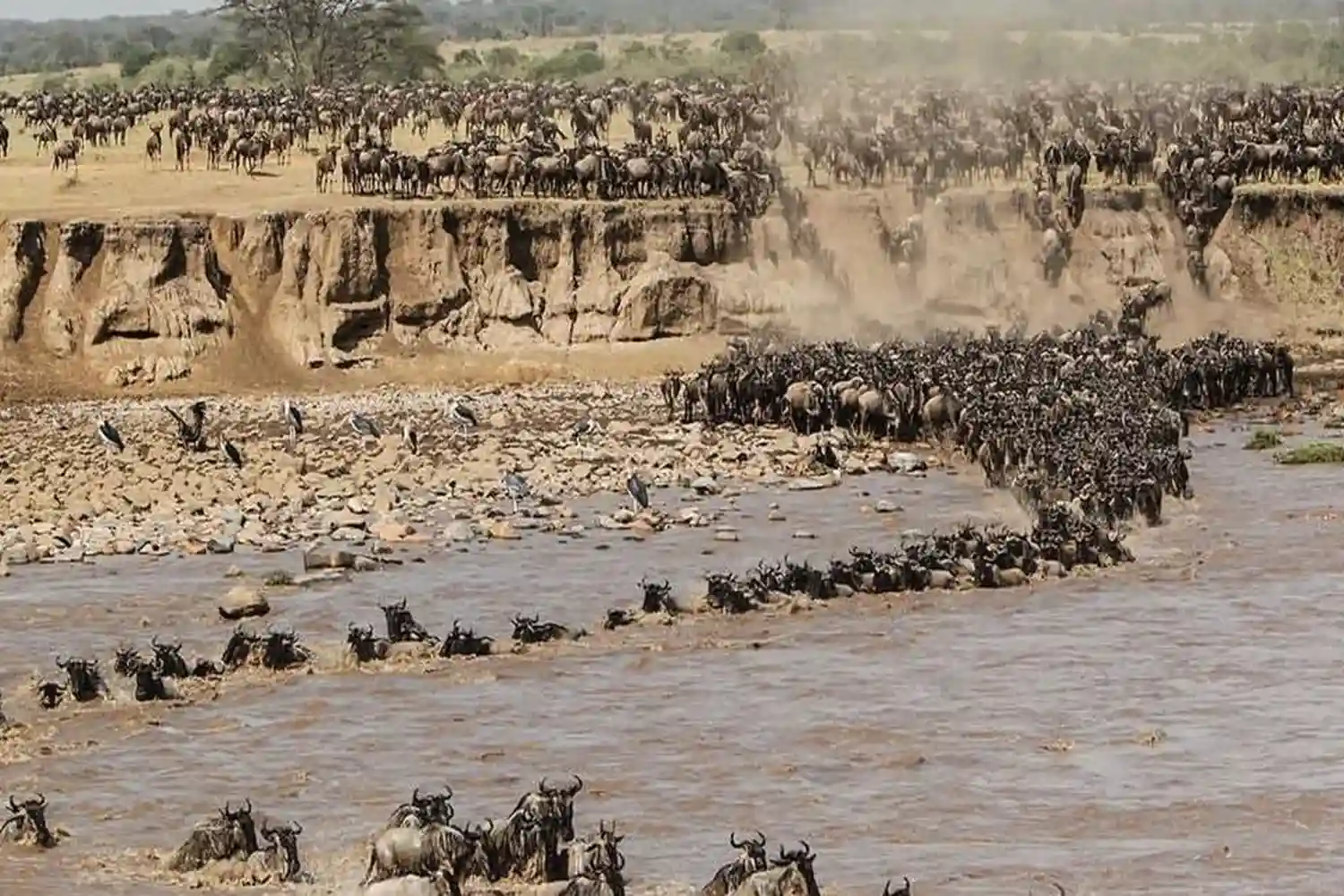
Use the full day to follow herd movement rather than a fixed checklist. Depending on season, the focus can be calving groups, long moving columns, western-corridor activity, northern herds near the Mara River or southbound groups after the short rains. Predator activity may be strong around concentrations of wildebeest and zebra.
Day 8: Second Full Day in the Seasonal Migration Region
A second full day in the seasonal region provides flexibility when animals are widely scattered, weather changes road access or the herds pause unexpectedly. During the northern season, the guide may work different sections of the Mara River, but a crossing cannot be promised on a particular day.
Day 9: Serengeti to Ngorongoro Conservation Area
Take a final morning game drive in Serengeti before beginning the transfer toward Ngorongoro. The overnight inside or near the conservation area positions the safari for an early crater descent the following morning and avoids attempting a rushed Serengeti-to-crater game-drive combination in one day.
Day 10: Ngorongoro Crater Game Drive and Return to Arusha or JRO
Descend into Ngorongoro Crater for the final major wildlife drive. The crater floor supports dense concentrations of grazing animals and predators, with black rhino among the rarer possible sightings. After the game drive, drive to Arusha or Kilimanjaro International Airport according to the confirmed flight schedule. A late departure flight or an additional post-safari night may be necessary depending on timing.
Best Time for a 10-Day Serengeti Migration Safari
The migration occurs throughout the year, but the useful base changes with rainfall and grass. The table below is a planning guide, not a guarantee of exact herd position.
| Travel period | Typical focus | Planning note |
|---|---|---|
| January–March | Southern Serengeti and Ndutu | Calving season and predator activity; some camps may be in the adjoining Ngorongoro short-grass plains. |
| April–May | South-central and central Serengeti | Transition period with green landscapes and less predictable herd distribution. |
| June | Central-west and western corridor | Northbound movement and possible Grumeti-system activity. |
| July–October | Northern Serengeti | Best broad window for Mara River activity, but crossings remain unpredictable. |
| November–December | East, central and southern return | Short rains can move herds rapidly; flexible camp positioning matters. |
Migration and Wildlife Experience
Serengeti's migration is built around very large herds of wildebeest accompanied by zebras and gazelles, with predators following the movement. On this itinerary, guests may also encounter lions, cheetahs, leopards, hyenas, elephants, buffalo, giraffes and many antelope species. Ngorongoro adds another concentrated wildlife environment, while Tarangire and Lake Manyara broaden the habitats seen during the trip.
Wildlife is free-ranging. No specific animal, predator interaction, calving event or river crossing can be guaranteed.
Safari Safety and Practical Requirements
- Remain inside the safari vehicle unless the guide confirms that it is safe and permitted to exit.
- Keep a safe distance from wildlife and follow the driver-guide's instructions at sightings and river areas.
- Share dietary needs, allergies, mobility limitations and relevant travel requirements before the itinerary is confirmed.
- Carry personal travel and medical insurance suitable for safari travel; evacuation cover is not assumed unless specifically written into the quotation.
- Allow realistic road-transfer time. Seasonal rain, wildlife on the road and park conditions can change driving times.
What to Pack
- Neutral, lightweight clothing plus a warm layer for early mornings and the Ngorongoro highlands
- Comfortable closed shoes and lodge footwear
- Sun hat, sunglasses and high-SPF sunscreen
- Insect repellent and personal medication
- Binoculars and camera equipment with spare batteries or charging options
- Light rain layer, especially for green-season travel
- Passport, visa documents, insurance details and copies of essential travel records
- Soft-sided luggage if the final itinerary includes light-aircraft sectors or stricter vehicle space limits
Serengeti-Heavy Route or Balanced Northern Circuit?
| Decision point | This 10-day Serengeti-heavy route | Balanced northern-circuit style |
|---|---|---|
| Serengeti time | Five nights | Usually fewer Serengeti nights |
| Main priority | Migration tracking and photography flexibility | Broader park variety |
| Seasonal camp changes | More important | Less central to the itinerary |
| Best for | Travelers who want the migration to drive the route | First-time visitors who value equal time across several parks |
Who This Safari Suits
This itinerary suits travelers who are comfortable with long safari days and want more time in Serengeti than in a standard multi-park circuit. It is especially useful for migration-focused travelers, wildlife photographers and visitors traveling in transition months when extra nights improve flexibility. Travelers who prefer short daily drives, frequent hotel changes or a beach-heavy holiday may be better served by a different route.
Frequently Asked Questions
How much does the 10-day Serengeti wildebeest migration safari cost?
The planning price starts from USD 7,088 per person using the stated mid-range, one-traveler assumptions. The final price changes with group size, travel dates, accommodation, seasonal migration region and confirmed services.
Why does this itinerary include five Serengeti nights?
Five Serengeti nights give more time to split the stay between central Serengeti and the seasonal migration region, reducing the pressure to chase the herds in a single day.
What is the best time for this 10-day migration safari?
The migration is year-round, but the best region changes by season. January to March usually favors the southern plains and Ndutu, May to June central and western areas, July to October northern Serengeti, and November to December the eastern, central and southern return.
Are Mara River crossings guaranteed on this safari?
No. River crossings are natural events controlled by herd movement, rainfall, grazing and river conditions. Northern Serengeti from roughly July to October can improve the opportunity, but no specific crossing can be guaranteed.
Which part of Serengeti will we stay in?
The itinerary uses central Serengeti plus a seasonal migration area selected for the travel month. The exact camps and region are confirmed in the written quotation before booking.
Is this safari private or shared?
This page is planned as a private safari with a dedicated vehicle and driver-guide. Shared departures may be available on selected dates, but they should be confirmed separately in writing.
Is a hot-air balloon safari included?
No. A balloon safari is optional unless it is specifically listed in the written quotation. Availability, location and price depend on the operating area and travel date.
How do I book this 10-day migration safari?
Send your travel dates, number of adults and children, preferred accommodation level and any special requirements. Jaynevy Tours will confirm the route, seasonal Serengeti area, availability and final written quotation before payment.