
Quick answer: spend three nights in Serengeti on most 7-day safaris
For most first-time visitors, three nights in Serengeti is the best balance on a seven-day Tanzania safari. It normally gives you one arrival game drive, one or two substantial full-day wildlife sessions, and a final morning drive before continuing to Ngorongoro. Two nights can work when you want to include Tarangire, Lake Manyara and Ngorongoro, but it leaves less flexibility for distant wildlife sightings. Four nights is better when the Great Migration is the main purpose of the trip or when you want a slower pace.
| Serengeti stay | Best for | Typical result | Main compromise |
|---|---|---|---|
| 2 nights | Travellers wanting four parks | About 1.5–2 useful safari days in Serengeti | More driving and less flexibility |
| 3 nights | Most first-time visitors | About 2.5–3 useful safari days | Usually one fewer night elsewhere |
| 4 nights | Migration, photography and relaxed travel | About 3.5–4 useful safari days | Tarangire or Manyara may be shortened |
Why Serengeti deserves the largest share of a seven-day safari
Serengeti is not a single viewing area. UNESCO describes the park as roughly 1.5 million hectares of savannah, and the wider ecosystem supports one of the world’s largest remaining terrestrial migrations. The annual circular movement covers roughly 1,000 kilometres across Tanzania and Kenya, involving more than one million wildebeest plus hundreds of thousands of zebra and gazelles. That scale explains why one quick overnight cannot show the park properly.
Central Serengeti alone can fill several game drives. Seronera’s river valleys, kopjes and open plains support year-round resident wildlife, including lions, leopards, cheetahs, elephants, buffalo and many antelope species. During migration seasons, the most active herds may be several hours away in Ndutu, the Western Corridor or Northern Serengeti. Your number of nights therefore determines whether your guide can react to current wildlife reports instead of following a rigid route.
How many Serengeti nights should you choose?
Choose two nights when park variety matters most
A two-night Serengeti stay works best for travellers who strongly want Tarangire, Lake Manyara and Ngorongoro in the same week. The route may still deliver excellent sightings, especially when both nights are in Central Serengeti. However, “two nights” does not equal two complete days. Arrival and departure transfers consume part of each outer day.
- Good for first-time travellers with a broad destination checklist.
- Usually includes an afternoon game drive, one long game-drive day and a departure-morning drive.
- Best when accommodation is placed inside or very close to the main wildlife zone.
- Less suitable for northern river crossings or remote migration areas.
Choose three nights for the strongest overall balance
Three nights is the recommended default because it protects your wildlife time without removing the other Northern Circuit highlights. It allows your guide to use a flexible mixture of early mornings, a full-day drive and quieter late-afternoon hours. It also provides a buffer if rain, road conditions or an exceptional sighting changes the plan.
- Enough time to explore more than one section of Central Serengeti.
- Better chance of locating less predictable species such as leopard and cheetah.
- More comfortable for families, older travellers and photographers.
- Still leaves time for Tarangire and Ngorongoro within seven days.
Choose four nights when Serengeti is the main event
Four nights makes sense for migration-focused travel, serious photography or guests who dislike changing lodges every night. It may allow a split stay, such as two nights in Central Serengeti and two nights near the seasonal herd location. This is especially useful from roughly January to March around Ndutu, from June to July toward the Western Corridor and northward movement, and from July to October in Northern Serengeti. Migration timing is driven by rainfall, so these are planning windows rather than guarantees. Review the detailed migration timing guide before choosing camps.
Best 7-day Tanzania safari itinerary with three Serengeti nights
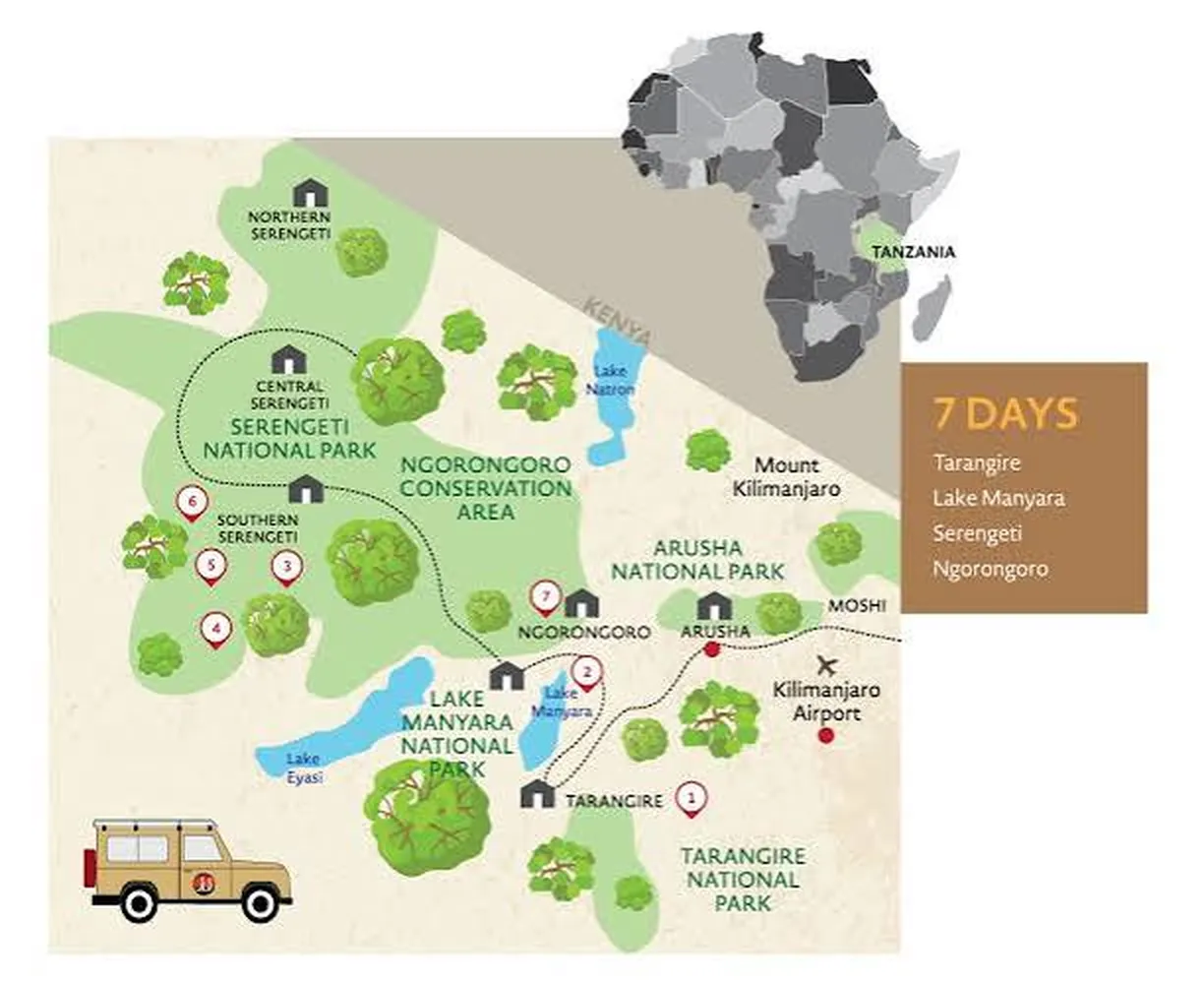
This route is designed for wildlife value rather than collecting the maximum number of park names. It works from Arusha or Moshi, although starting in Arusha saves some road time. Travellers starting in Moshi should leave early on Day 1.
| Day | Route | Approximate driving | Safari focus |
|---|---|---|---|
| 1 | Arusha/Moshi to Tarangire | Arusha: about 2–3 hours; Moshi: about 3.5–4.5 hours | Elephants, baobabs and river habitat |
| 2 | Karatu to Central Serengeti | About 4–6 hours including conservation-area transit and stops | Scenery, Olduvai option and afternoon game drive |
| 3 | Central Serengeti | Game-drive mileage varies | Full-day resident wildlife search |
| 4 | Central or seasonal Serengeti zone | Game-drive mileage varies | Second full safari day or migration focus |
| 5 | Serengeti to Ngorongoro highlands | About 3.5–5 hours plus game viewing | Morning Serengeti drive and crater-rim sunset |
| 6 | Ngorongoro Crater to Karatu | Short transfers plus crater drive | Dense mixed wildlife and black-rhino possibility |
| 7 | Lake Manyara or relaxed return | Karatu to Arusha about 2–3 hours; longer to Moshi | Optional Manyara drive, cultural stop or easy departure |
Day 1: Tarangire National Park
Leave early and enter Tarangire before the hottest part of the day. The park is especially strong in the dry months when animals gather near the Tarangire River, but its elephants, baobabs and varied birdlife remain valuable throughout the year. Overnight around Karatu, Mto wa Mbu or near the park depending on budget and Day 2 routing.
Day 2: Travel through Ngorongoro to Serengeti
This is a scenic transfer and game-drive day, not wasted transport. You cross the Ngorongoro highlands, descend toward the plains and enter Serengeti through Naabi Hill. A well-paced departure allows lunch en route and an afternoon wildlife drive before reaching camp. Avoid promising a fixed arrival hour because gate procedures, road conditions and sightings affect timing.
Days 3 and 4: two substantial Serengeti game-drive days
These are the core of the itinerary. Your guide can combine early-morning predator activity with river valleys, kopjes and open plains later in the day. One day may be a picnic-based full-day drive, while the other can be split into morning and afternoon sessions if your lodge is centrally located. The second full day is what makes three nights noticeably less rushed than two.
Day 5: final Serengeti drive and Ngorongoro highlands
Use the morning for one final wildlife search, then travel southeast toward Ngorongoro. An overnight near the crater rim gives the earliest access next morning but costs more. Karatu often offers better room value, gardens and a more relaxed atmosphere, with a longer pre-dawn transfer.
Day 6: Ngorongoro Crater
Descend early to reduce crowd pressure and benefit from cool morning conditions. The crater is compact compared with Serengeti, but the experience is intensive: open grassland, marshes, woodland and soda-lake habitat are concentrated within the caldera. The crater visit complements Serengeti rather than replacing it. Read the Ngorongoro guide for first-time travellers for realistic expectations.
Day 7: Lake Manyara, local experience or direct return
Your final day should match your flight time and energy. Lake Manyara adds forest, groundwater habitat and birdlife, while a cultural or coffee visit creates a slower ending. Travellers with an early international departure should return directly and keep a safe airport buffer.
Alternative seven-day routes by Serengeti-night count
| Plan | Night distribution | Who should choose it? |
|---|---|---|
| Maximum variety | Tarangire 1, Manyara/Karatu 1, Serengeti 2, Ngorongoro 1, arrival/departure 2 | Visitors who prioritise multiple landscapes |
| Recommended balance | Karatu/Tarangire 1, Serengeti 3, Ngorongoro/Karatu 1, arrival/departure 2 | Most first-time safari travellers |
| Serengeti priority | Serengeti 4, Ngorongoro 1, arrival/departure 2 | Migration, predators and photography |
| Slow luxury | Tarangire 2, Serengeti 3, Ngorongoro 1, final night 1 | Guests using fly-out logistics or extending beyond seven calendar days |
For a ready-made route, compare this plan with the site’s 7-day Tanzania safari itinerary and Tarangire, Serengeti and Ngorongoro itinerary.
When three Serengeti nights may not be enough
Three nights can still feel short when your target area is remote from Central Serengeti. Northern Serengeti, for example, is not a quick side trip from Seronera. A migration itinerary should place accommodation close to the expected herds instead of spending hours commuting from the wrong zone.
- January–March: consider Ndutu or the southern plains for calving-season activity.
- April–May: movement is rain-dependent; central and western positioning may offer value and fewer vehicles.
- June–July: western and northern movements become more important.
- July–October: Northern Serengeti is often selected for Mara River opportunities, but crossings are never scheduled performances.
- November–December: herds may move south as short rains refresh the plains.
For broader seasonal planning, use the best months for Tanzania wildlife viewing.
Realistic game-drive time: nights are not the same as safari days
| Booked nights | Likely useful Serengeti time | Flexibility score |
|---|---|---|
| 1 night | Two partial drives | Low |
| 2 nights | One full day plus two partial drives | Moderate |
| 3 nights | Two full days plus two partial drives | High |
| 4 nights | Three full days plus two partial drives | Very high |
Actual time varies with camp location, check-in, road conditions, park-entry administration and wildlife sightings. A cheaper camp far outside the target zone may reduce useful game-drive hours more than the saving is worth.
Expected cost of a seven-day Tanzania safari in 2026/2027
Safari prices are built from park and conservation fees, the private vehicle and guide, accommodation, meals, fuel, taxes and logistics. Published authority tariffs can change without notice, and NCAA states that permits are generally valid for one entry within 24 hours. Always request an itemised quotation showing what is included.
| Style | Planning range per person | Typical accommodation |
|---|---|---|
| Budget private, 4–6 guests | US$1,900–2,700 | Simple lodges or public camping |
| Mid-range private, 2–4 guests | US$2,700–4,200 | Comfortable lodges and tented camps |
| Luxury private | US$4,500–8,000+ | Premium camps, strong locations and upgraded service |
These are planning ranges, not fixed quotations. July–October, Christmas/New Year and migration-focused camps can cost more. April, May and parts of November may offer lower accommodation rates, but road conditions and rainfall need consideration. Review the Tanzania park-fees guide and current operator quote before paying.
How accommodation location changes the right number of nights
Three nights in well-positioned camps can outperform four nights with long daily commutes. Ask for the exact camp area, not only the marketing phrase “Serengeti.” Central Serengeti is the safest all-year base for first-time visitors. Seasonal mobile camps can be better for migration trips, while properties outside park boundaries may offer value but require extra gate and transfer time.
- Confirm whether the lodge is inside the national park, in a concession or outside the gate.
- Ask the expected drive to the main wildlife area for your travel month.
- Check whether changing camps will consume half a safari day.
- For premium choices, compare luxury safari lodges and Northern Tanzania camps and lodges.
Drive-in, fly-in or fly-out: which protects Serengeti time?
| Transport plan | Advantage | Trade-off |
|---|---|---|
| Drive in and drive out | Best landscape continuity and usually lowest cost | More road hours |
| Drive in, fly out | Combines overland scenery with a time-saving finish | Higher cost and luggage limits |
| Fly in and fly out | Maximum time in wildlife areas | Highest transport cost; misses overland parks unless separately planned |
A drive-in, fly-out arrangement is often the strongest upgrade when seven days includes arrival and departure logistics. Explore fly-in safari options when road fatigue is a concern.
Common mistakes that make a seven-day safari feel rushed
- Counting arrival and international departure days as full safari days.
- Booking only one Serengeti night. It creates a long transfer for very limited viewing.
- Adding too many parks. Four good destinations are usually better than six hurried stops.
- Choosing camps by price alone. Location directly affects wildlife time.
- Expecting guaranteed migration crossings. Rain and herd decisions cannot be scheduled.
- Changing accommodation every night. Packing, check-out and transfers quietly consume hours.
Who should spend more or fewer nights in Serengeti?
| Traveller | Recommended nights | Reason |
|---|---|---|
| First safari, general wildlife | 3 | Best balance of depth and park variety |
| Family with young children | 3, often in one camp | Reduces packing and long transfers |
| Migration-focused visitor | 4 | More weather and location flexibility |
| Wildlife photographer | 4 or more | More dawn, dusk and repeat opportunities |
| Traveller focused on many parks | 2 | Preserves time for Manyara and Tarangire |
| Beach-plus-safari traveller | 2–3 | Depends on flight logistics and total holiday length |
Booking checklist for the right seven-day route
- Confirm whether “seven days” includes arrival and departure days.
- Request the exact number of Serengeti nights and full game-drive days.
- Ask for each camp’s map location and seasonal suitability.
- Check private versus shared vehicle arrangements.
- Confirm park fees, crater service fee, concession fees and taxes.
- Review luggage limits for any bush flight.
- Keep at least one route element flexible for current wildlife reports.
- Read the first-time Tanzania safari guide before finalising.
Final recommendation
Book three Serengeti nights on a standard seven-day Northern Tanzania safari. That is the most reliable balance for a first visit: enough time to understand the park, respond to wildlife reports and enjoy two meaningful safari days without sacrificing Tarangire and Ngorongoro. Choose two nights only when destination variety is more important than depth. Choose four nights when migration, predators, photography or a slower pace is the main priority.
Compare current 7-day luxury safari options or browse broader Tanzania safari packages before requesting a date-specific quotation.
Frequently asked questions
Are two nights in Serengeti enough?
Two nights are enough for a useful introduction, normally one full day plus arrival and departure drives. Three nights provide noticeably more flexibility and are better for most first-time visitors.
Is three nights or four nights better in Serengeti?
Three nights is better for a balanced seven-day Northern Circuit safari. Four nights is better when Serengeti itself, the Great Migration or photography is the main purpose.
Can I visit Tarangire, Serengeti and Ngorongoro in seven days?
Yes. A well-paced route usually gives Tarangire one day, Serengeti three nights and Ngorongoro one substantial crater day, with remaining time for transfers and an optional Manyara or cultural stop.
How many full game-drive days do three Serengeti nights provide?
Usually two full game-drive days plus an arrival-afternoon drive and a departure-morning drive, depending on camp location and routing.
Should I stay in one Serengeti camp or split camps?
Stay in one central camp for a general first safari. Split camps when seasonal migration positioning clearly justifies the move and you have at least four Serengeti nights.
What is the best month for a seven-day Tanzania safari?
June through October generally offers dry conditions and strong wildlife visibility. January through March is valuable for southern Serengeti calving. Green-season months can provide lower rates, dramatic scenery and fewer vehicles.
Does Serengeti have wildlife all year?
Yes. Resident predators and herbivores remain in Serengeti throughout the year, although the large migratory herds shift between ecosystem zones according to rainfall and grazing.
Is a seven-day safari too rushed?
No, provided you limit the route to three or four core areas and avoid changing lodges every night. It becomes rushed when arrival days are counted as safari days or too many parks are added.
Is it worth flying out of Serengeti?
It can be worthwhile for travellers who value time and comfort. Flying out removes a long return drive, but costs more and usually comes with soft-bag luggage restrictions.
How much does a private seven-day Tanzania safari cost?
A realistic planning range is about US$1,900–2,700 per person for budget private travel with a larger group, US$2,700–4,200 for mid-range private travel, and US$4,500–8,000 or more for luxury. Dates, group size and camp choice materially change the price.
Should I include Lake Manyara in a seven-day itinerary?
Include it when forest scenery, birdlife and another ecosystem matter to you. Skip it when you prefer a slower itinerary with three or four Serengeti nights.
Research and planning sources
This guide uses current planning information from UNESCO’s Serengeti World Heritage listing, Tanzania National Parks, the Ngorongoro Conservation Area Authority and Google Search Central. Driving times and market prices are realistic planning ranges and vary with roads, season, accommodation and group size.