
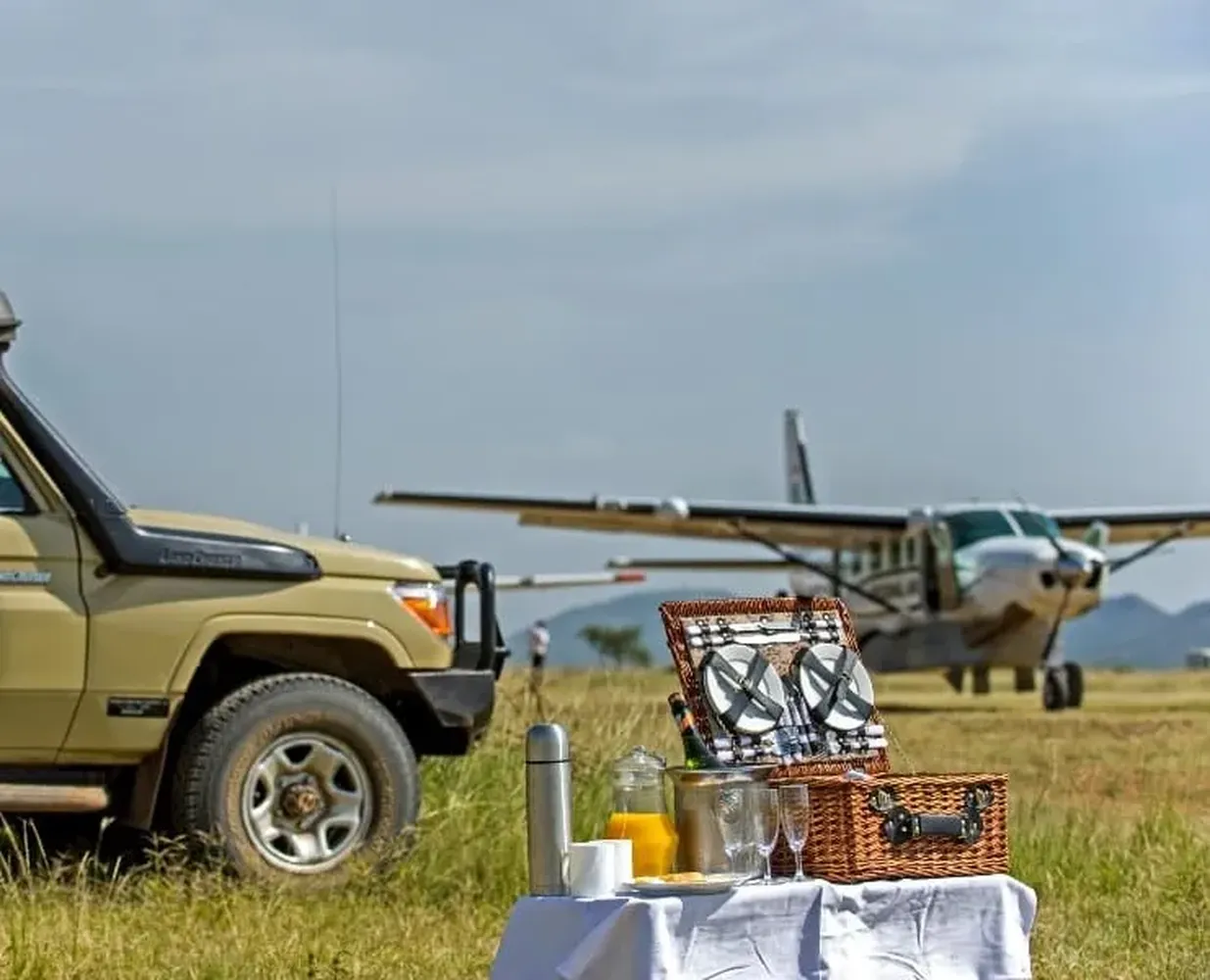
Quick answer: should you fly or drive on safari in Tanzania?
Choose a driving safari when you have at least six days, want Tarangire, Ngorongoro and Serengeti in one continuous route, and care about value. Choose a fly-in safari when you have two to five days, are travelling from Zanzibar, want to reach a remote camp, or would rather pay more to avoid a long transfer day.
For many travellers, the best answer is neither “all flying” nor “all driving”. A fly-in, drive-out or drive-in, fly-out itinerary often gives the best balance: one scenic overland journey through the northern circuit and one flight that removes the longest return transfer.
| Your priority | Usually better choice | Why |
|---|---|---|
| Lowest total cost | Driving | One vehicle and guide can serve the whole route without per-person air tickets |
| Maximum wildlife time on a short trip | Fly-in | A flight can replace a six-to-eight-hour road sector |
| First northern-circuit safari | Driving or hybrid | You see the Rift Valley, highlands and changing habitats rather than only the destination |
| Safari from Zanzibar | Fly-in | The island is separated from mainland parks; flying avoids a ferry, city transfer and long road connection |
| Family with a very young child | Fly-in or hybrid | Shorter transfers, though aircraft noise and baggage rules still need consideration |
| Serious photography | Depends | Flying saves time, but driving allows more camera gear and continuous access to one private vehicle |
| Remote western or southern parks | Fly-in | Road journeys can consume one or more full days |
| Eight-day relaxed safari | Driving | There is enough time to move gradually and avoid paying for several flight sectors |
What does “fly-in safari” actually mean?
A fly-in safari uses a scheduled light-aircraft service or private charter to reach an airstrip near a lodge or camp. It does not mean that wildlife viewing happens from the aircraft. After landing, a safari vehicle and guide collect you for road transfers and game drives.
Scheduled bush flights often operate like a shared air taxi. The aircraft may stop at several airstrips to drop off or collect passengers, so the published time is not always a nonstop flying time. The final routing depends on bookings, airstrip conditions, weather and the aircraft assigned that day.
- Common northern gateways include Arusha Airport and Kilimanjaro International Airport.
- Serengeti airstrips include Seronera, Kogatende, Lobo, Grumeti, Fort Ikoma, Ndutu and others.
- Southern and western circuits use airstrips serving Nyerere, Ruaha, Katavi, Mahale, Rubondo and nearby camps.
- The camp may include shared game drives, while some packages charge separately for a private vehicle.
See the broader fly-in safari guide for Tanzania and compare Tanzania safari packages with domestic flights.
What does “driving safari” mean?
A driving safari usually means travelling with a professional driver-guide in a purpose-built 4x4 safari vehicle. It is different from renting a car and navigating the parks independently. The same vehicle normally collects you from Arusha, Moshi or another gateway, carries your luggage, moves between lodges and becomes your game-drive vehicle.
The road day is not always dead time. Between Arusha and Serengeti, travellers pass farming areas, the Rift Valley escarpment, Ngorongoro highlands, Maasai country and wildlife corridors. However, the last sections can be corrugated, dusty in the dry season and muddy during heavy rain.
- You keep the same guide for most or all of the safari.
- Luggage allowance is more generous than on light aircraft.
- Stops can be adjusted for views, lunch, wildlife and comfort breaks.
- The cost of the vehicle is shared across your private party rather than charged as a separate air ticket for every person.
For a wider road-based route, review a 7-day private Tanzania safari or an 8-day private Tanzania safari.
Fly-in vs driving safari at a glance
| Comparison | Fly-in safari | Driving safari |
|---|---|---|
| Transport pricing | Mostly per person, per flight sector | Mostly per vehicle and operational day |
| Best trip length | Two to six days, or remote multi-camp trips | Five to ten days on a connected circuit |
| Travel speed | Fast between distant regions | Slower, especially to Serengeti and remote parks |
| Door-to-door reality | Includes check-in, transfers, stops and possible delays | Hotel-to-lodge without airport procedures |
| Luggage | Usually 15–20 kg total on scheduled services | More flexible, subject to vehicle space |
| Guide continuity | Guides may change by camp | Usually one guide throughout |
| Game-drive style | Often shared unless private vehicle is purchased | Often private when booked as a private safari |
| Scenic experience | Aerial views of plains, lakes and escarpments | Close view of villages, landscapes and habitat changes |
| Weather sensitivity | Higher; flights may be rerouted or delayed | Road conditions can deteriorate during heavy rain |
| Best value for four to six people | Only in selected cases or charter arrangements | Usually stronger because the vehicle cost is shared |
How much time does flying really save?
Compare door-to-door time, not only the minutes printed beside a flight number. A one-hour scheduled flight may require a hotel-to-airport transfer, check-in, waiting time, one or more airstrip stops, baggage handling and a lodge transfer after landing.
| Route | Typical road planning time | Published flight example | Practical conclusion |
|---|---|---|---|
| Arusha to Tarangire | About 2–2.5 hours to the main area, traffic dependent | Auric 2027: Arusha 10:00 to Kuro 10:30 | Flying saves limited time after airport and airstrip transfers; driving is normally better value |
| Arusha to Lake Manyara | About 2–2.5 hours and roughly 125 km | Coastal: Arusha 07:45 to Manyara 08:10 | Useful for luxury camp connections, but not essential for a normal circuit |
| Arusha to Ngorongoro Lodoare Gate | Officially about 160 km and around two hours | No scheduled aircraft lands inside the crater | Road travel remains necessary; flying to Manyara only shortens part of the journey |
| Arusha to Central Serengeti | Commonly 6–8 hours including gates, stops and road conditions | Coastal examples range from 07:45–08:55 to 10:15–12:15 | Flying can recover a large part of the day |
| Zanzibar to Serengeti | No practical direct road route; mainland transfer would be lengthy | Coastal example: 08:00–10:50 | Flying is the sensible option for a short Zanzibar add-on |
| Dar es Salaam to Nyerere | Long dry-season road transfer | Coastal example: 08:30–09:15 | A flight can turn a transfer day into an afternoon safari |
| Dar es Salaam to Ruaha | Usually a full-day road journey | Coastal example: 08:30–11:00 | Flying is normally worth the cost on a short itinerary |
Road times are planning estimates rather than guarantees. Gate procedures, wildlife on the road, rain, dust, stops and traffic around towns can change the day substantially. Published flight schedules are also estimates and may change with final routing.
Published 2026 and 2027 bush-flight price examples
The figures below come from Auric Air's published rack-rate sheets. They are one-way adult examples, not complete safari prices. The exact fare can differ by airstrip, direction, taxes, booking class, routing and date.
| Route example | 2026 published rack adult | 2027 published rack adult | What the example shows |
|---|---|---|---|
| Arusha to Serengeti/Seronera | USD 182 | USD 192 | A relatively affordable one-way sector can be valuable when it replaces the longest northern-circuit drive |
| Arusha to Tarangire/Kuro | USD 177 | USD 187 | The time saving is smaller, so road travel often remains the better-value choice |
| Serengeti/Seronera to Arusha | Confirm by selected service | USD 295 | Direction and service pattern can affect the fare; do not assume a symmetrical return price |
| Serengeti/Seronera to Zanzibar | USD 490 | USD 515 | A direct safari-to-beach connection costs more but removes multiple transfers |
| Tarangire/Kuro to Serengeti/Seronera | USD 440 | USD 460 | Flying between parks may cost more than expected because every traveller needs a ticket |
For two adults, a 2027 Arusha–Seronera outbound example totals USD 384. Adding a published Seronera–Arusha return example would bring the two-person air-ticket total to USD 974 before airport transfers, lodge transfers or private game-drive upgrades. This is why a round-trip fly-in package can be much more expensive than a road safari even when the flight itself looks affordable.
Rates and schedules can change without notice. Treat these numbers as transparent planning benchmarks and request a current written quotation before paying.
Why driving is usually cheaper
A scheduled flight is charged per passenger. A road safari vehicle is mostly a fixed booking cost. When four or six travellers share one private 4x4, the vehicle and guide cost per person falls sharply.
| Cost element | Fly-in effect | Driving effect |
|---|---|---|
| Aircraft seat | Added for every traveller and every sector | Not applicable |
| Safari vehicle | Still required after landing; may be shared or privately charged | Already included as the main transport and game-drive vehicle |
| Driver-guide | May be included by the camp or charged through a vehicle package | One guide commonly serves the full itinerary |
| Airport/airstrip transfers | May be separate at both ends | Usually integrated into the route |
| Park and conservation fees | Still payable | Still payable |
| Accommodation | Fly-in camps often sit in higher price categories, though not always | Wider choice of budget, mid-range and luxury lodges |
| Unused vehicle time | A private guide from Arusha may need to reposition separately if kept throughout | The vehicle travels with you and remains available |
A published 2026 market benchmark places a dedicated 4x4 with driver-guide at roughly USD 150–250 per vehicle per day before the full package's accommodation, park and operating costs. This is not a Jaynevy fixed tariff, but it demonstrates why a group of four can often drive for less per person than buying several air sectors.
Use the Tanzania safari cost guide to compare the other expenses that remain the same regardless of transport style.
When a fly-in safari can still be better value
Better value does not always mean lower price. A traveller who has only three available days may get more useful safari hours from a USD 500 flight than from spending an entire day driving. The value comes from buying time, comfort and access.
- Short trip: two or three nights in Serengeti would be weakened by two long transfer days.
- Zanzibar combination: the flight links beach and bush without returning through Dar es Salaam or Arusha by road.
- Remote park: Katavi, Mahale or Ruaha can justify flying because road access consumes too much itinerary time.
- High accommodation budget: when camp rates already exceed the flight price, saving one night or one road day may make financial sense.
- Limited mobility or road tolerance: reduced vibration and fewer hours seated may matter more than the fare difference.
- Migration positioning: flying to Kogatende, Ndutu or another seasonal airstrip can place you closer to the wildlife target.
For a practical short option, compare a 2-day Serengeti fly-in safari with a 3-day Serengeti fly-in safari.
When a driving safari offers the better experience
Driving reveals Tanzania as a connected landscape rather than a collection of airstrips and lodges. On the northern circuit, the gradual change from baobab country to highland forest and then open Serengeti plains helps travellers understand why different animals gather in different places.
- You see more of local life outside the protected areas.
- Your guide can explain agriculture, geology, villages and conservation corridors along the route.
- You can carry larger camera bags, extra clothing and family equipment.
- The vehicle is available for spontaneous stops and can follow wildlife without waiting for a camp's shared-drive schedule.
- You avoid repeated packing, check-in and aircraft boarding procedures.
A well-paced road itinerary should not force Arusha–Serengeti–Arusha into too few days. Four days can work but feels active; six to eight days provides a much more balanced northern circuit. The first-time Tanzania safari guide explains the normal rhythm of game drives and transfer days.
The hidden difference: private vehicle versus shared camp vehicle
Transport to the park and wildlife viewing inside the park are separate decisions. A fly-in camp may include shared game drives with other guests. That can reduce cost and create a social experience, but it also means departure times, seat positions and sighting priorities are shared.
A road-based private safari usually gives your party one dedicated vehicle. For photographers and families, this can be more valuable than the flight itself.
| Question to ask | Why it matters |
|---|---|
| Are game drives private or shared? | A low fly-in price may assume shared drives with several camp guests |
| How many guests per vehicle? | Six window seats is different from eight passengers rotating positions |
| Is a private vehicle supplement available? | It can add hundreds of dollars per day at some luxury camps |
| Are arrival and departure transfers counted as game drives? | An airstrip transfer may be short and should not be mistaken for a full safari session |
| Will the same guide stay with us? | Camp guides may change between properties; a road safari often provides continuity |
| Can the vehicle follow an early-morning plan? | Shared guests may prefer different start times or activities |
Baggage limits: one of the biggest practical differences
Light aircraft have strict weight and cargo-door limits. Coastal publishes a standard allowance of 15 kg per passenger including carry-on luggage and strongly recommends soft bags. Auric publishes 20 kg total, including hand luggage, cameras, filming equipment and personal items.
| Item | Fly-in safari | Driving safari |
|---|---|---|
| Main luggage | Soft-sided duffel usually preferred; hard cases may not fit | Hard or soft luggage may be accepted, though soft bags remain easier to load |
| Total allowance | Commonly 15–20 kg including hand luggage | More generous but still limited by passenger and vehicle space |
| Camera equipment | Often included within the total weight | Easier to carry multiple bodies, long lenses and support equipment |
| Extra luggage | Must be pre-arranged; excess carriage remains subject to aircraft load | Usually manageable with advance notice |
| Large family items | Prams and rigid cases require confirmation | More practical in a private vehicle |
Do not assume an international airline's 23 kg or 30 kg allowance will transfer to a bush flight. Arrange storage in Arusha, Kilimanjaro, Dar es Salaam or Zanzibar for items not needed on safari.
Comfort: aircraft versus safari vehicle
What a bush flight feels like
Light aircraft are efficient but not equivalent to a large commercial jet. Cabins may be compact, engine noise is noticeable, air-conditioning can be limited and boarding uses steps beside an open airstrip. The aerial views can be outstanding, but travellers sensitive to turbulence should discuss concerns before booking.
What a long safari drive feels like
A good safari vehicle has supportive seats, charging points, drinking water and a pop-up roof, but long transfers still involve vibration and dust. The Ngorongoro–Serengeti road can be rough. Travellers with back problems should request a newer vehicle, sensible daily distances and seats away from the rear axle where possible.
Neither option is automatically comfortable. The quality of the aircraft operation, vehicle, seat allocation, route and itinerary pacing matters more than the marketing label.
Reliability and weather risk
Scheduled bush flights can be delayed, rerouted or combined because of weather, airstrip conditions, passenger loads and operational requirements. Road travel also faces uncertainty from rain, mud, damaged tracks, gate queues and traffic.
- Do not book a bush flight that lands too close to an international departure.
- Build a buffer night before a long-haul flight whenever possible.
- Confirm the correct Serengeti airstrip for the camp; the wrong strip can create a long ground transfer.
- Ask whether the service is confirmed or operates on minimum-seat inducement.
- Carry essential medication and documents in a small accessible bag.
Which option is better from Zanzibar?
Flying is normally the clear winner from Zanzibar. Coastal publishes a Zanzibar–Serengeti example of 08:00–10:50 and a Serengeti–Zanzibar example of 11:00–12:50. Actual routing can include stops, but the connection still makes a short safari practical.
A road-based alternative would require an island-to-mainland flight or ferry, transfers through Dar es Salaam, and then many more hours by road. That only makes sense when the mainland road journey is itself part of a longer holiday.
Read the Serengeti safari from Zanzibar guide or compare a 4-day luxury fly-in safari from Zanzibar.
Which option is better for the northern circuit?
For Tarangire, Lake Manyara, Ngorongoro and Serengeti, road travel works naturally because the destinations form a connected route. The key is to avoid backtracking.
| Trip length | Recommended transport plan | Reason |
|---|---|---|
| 3 days | Fly to Serengeti, or drive only Tarangire/Manyara/Ngorongoro | Driving to Serengeti leaves too little relaxed game-drive time |
| 4 days | Drive one-way through the circuit, or fly one Serengeti sector | Possible but active; a hybrid removes the hardest transfer |
| 5 days | Drive-in/fly-out or all-drive with two Serengeti nights | Hybrid offers strong time value; road-only remains economical |
| 6–7 days | Mostly driving | Enough time for connected parks and three Serengeti nights |
| 8+ days | Driving, with an optional flight home | The overland journey fits comfortably and preserves guide continuity |
Which option is better for southern and western Tanzania?
Distance changes the answer. Nyerere can be reached by road from Dar es Salaam, but a short flight may save much of a day. Ruaha is farther, and Katavi or Mahale are usually much more practical by air.
- Nyerere: driving can work for a budget-conscious trip of four or more days; flying is better for a short safari.
- Ruaha: scheduled flights usually offer stronger time value than a full-day road transfer.
- Katavi: fly-in access is normally the sensible choice for international visitors.
- Mahale: air and boat logistics are part of the experience; a normal road safari is not a practical substitute.
The decision is explored further in the Tanzania road-trip guide.
Best choice for different travellers
| Traveller | Recommended approach | Planning detail |
|---|---|---|
| Solo traveller | Group fly-in or group road safari | Compare single supplements and confirmed departures |
| Couple on a mid-range budget | Road or hybrid | One flight can save time without converting every sector to air |
| Honeymoon couple | Fly-in or luxury hybrid | Privacy depends on the game-drive arrangement, not only the flight |
| Family with children | Private road safari or one-sector hybrid | Private timing is valuable; check aircraft child and baggage rules |
| Four to six friends | Private driving safari | Shared fixed vehicle cost usually delivers excellent per-person value |
| Photographer | Private road safari or fly-in with private vehicle | Confirm camera weight, seat access and charging |
| Traveller with limited mobility | Fly-in with carefully selected camp | Confirm aircraft steps, airstrip surfaces, vehicle access and room design |
| Repeat visitor | Fly to one remote region | Skip familiar transit areas and focus on a specific ecosystem |
Three itinerary models that make sense
Option 1: Seven-day all-driving northern circuit
- Arusha or Moshi to Tarangire.
- Tarangire or Karatu to Central Serengeti.
- Two full Serengeti days.
- Serengeti to Ngorongoro highlands.
- Ngorongoro Crater and return to Arusha.
Best for: first-time travellers, families and groups wanting value, one guide and a complete landscape experience.
Option 2: Five-day drive-in, fly-out safari
- Arusha to Tarangire and Karatu.
- Ngorongoro Crater or highlands.
- Drive into Serengeti with game viewing.
- Full day in Serengeti.
- Morning game drive and flight from Seronera to Arusha or Zanzibar.
Best for: travellers who want the scenic northern route but do not want the long return drive.
Option 3: Three-day Serengeti fly-in/fly-out
- Morning flight to the airstrip nearest the selected camp; afternoon game drive.
- Full-day or split morning/afternoon game drives.
- Morning activity and return flight.
Best for: Zanzibar visitors, short extensions and travellers focused entirely on Serengeti.
How season changes the decision
The dry season from June to October usually brings firmer roads, dust, high demand and strong wildlife concentration. The green season offers lush scenery and fewer visitors, but heavy rain can slow road transfers and occasionally affect airstrip conditions.
- January–March: flying to Ndutu or southern Serengeti can place you near calving-season herds.
- April–May: lower accommodation prices may improve value, but verify road and camp operations.
- June–October: book both flights and vehicles early; northern Serengeti sectors become highly sought after.
- November–December: short rains can create beautiful landscapes; schedules and wildlife location remain flexible.
Use the best time for a Tanzania wildlife safari guide before choosing the airstrip and lodge region.
Common booking mistakes
- Comparing a shared fly-in camp package with a private road safari as though the services were identical.
- Counting only airborne minutes and ignoring airport, check-in and lodge-transfer time.
- Booking Seronera when the camp is actually near Kogatende, Ndutu or another distant airstrip.
- Assuming all luggage, camera cases and hard suitcases will fit in a light aircraft.
- Paying for several short northern-circuit flights that save little time.
- Flying both ways on a seven-day trip when a one-way hybrid would provide better value.
- Booking an international connection on the same day without a safe delay buffer.
- Ignoring whether game drives are private, shared or charged separately.
Questions to ask before accepting a quotation
- Which airline, flight number and exact airstrip are planned?
- Is the fare confirmed, or does the flight require a minimum number of passengers?
- What is the total baggage allowance, including cameras and hand luggage?
- Are hotel-airport and airstrip-lodge transfers included?
- Are game drives private or shared, and how many guests use each vehicle?
- Are park entry, concession, vehicle and conservation fees included?
- What happens if weather or an airline schedule change affects the itinerary?
- Does the road quote include unlimited game-drive mileage and fuel?
- Will one guide remain with the group throughout the safari?
- What portion of the payment is refundable if a flight is cancelled?
Our value verdict
Driving offers the best financial and experiential value for a well-paced six-to-eight-day northern circuit. The vehicle performs three jobs—transfer, luggage transport and game drive—and its fixed cost becomes more efficient as the party grows.
Flying offers the best time value for short Serengeti trips, Zanzibar combinations and remote southern or western parks. The greatest mistake is paying for flights simply because “fly-in” sounds more luxurious. Buy a flight when it removes a genuinely long or impossible transfer, not when it replaces a practical two-hour road journey.
For many travellers, the best-designed answer is a hybrid: drive through Tarangire and Ngorongoro, spend enough nights in Serengeti, then fly out. Review the full Tanzania safari packing list once the transport method and baggage allowance are confirmed.
Research notes and data limitations
Flight examples in this guide are based on published Coastal Aviation timetables and Auric Air 2026 and 2027 rack-rate sheets. Airlines state that schedules, aircraft, routing and prices can change without notice. Road times are realistic planning ranges and should not be treated as guaranteed arrival times.
TANAPA's public tariff portal currently displays a financial-year label from 2023/2024 even though the portal remains live. Government fees should therefore be confirmed in the final 2026/2027 quotation rather than copied from an old screenshot. Structured data on this page matches the visible content; visible FAQs are included for users, but FAQPage markup is deliberately omitted because Google deprecated FAQ rich results in May 2026.
Frequently asked questions
Is a fly-in safari always more expensive than driving?
Usually, especially for two or more flight sectors, because every traveller needs a ticket and a safari vehicle is still required after landing. A flight can nevertheless offer better value on a short trip by recovering a full safari day.
How long is the flight from Arusha to Serengeti?
Published schedules vary by airline, airstrip and intermediate stops. Coastal lists examples from about 1 hour 10 minutes to 2 hours, while Auric lists selected Seronera services around 35 minutes to 1 hour 30 minutes. Door-to-door time is longer.
How long is the drive from Arusha to Serengeti?
Plan roughly 6–8 hours to Central Serengeti, including road conditions, gate procedures and stops. The journey can be longer in rain or when travelling to northern or western Serengeti.
Is it worth flying from Arusha to Tarangire?
For most normal northern-circuit itineraries, no. The road journey is manageable and the flight's check-in and transfers reduce the apparent time saving. It can make sense for a luxury lodge connection or a tightly timed itinerary.
Can I fly directly into Ngorongoro Crater?
No scheduled flight lands on the crater floor. Travellers can fly to Lake Manyara Airstrip and continue by road, but road access through an authorised crater descent route is still required.
What is the luggage limit on Tanzania bush flights?
It depends on the airline. Coastal publishes 15 kg total per passenger, including carry-on luggage. Auric publishes 20 kg total, including cameras and personal items. Soft bags are the safest choice.
Are fly-in safari game drives private?
Not automatically. Many camps include shared game drives. A private vehicle may be available for an additional charge and should be confirmed in writing.
Is a driving safari uncomfortable?
Long road sectors can be rough and dusty, but a modern 4x4, sensible route, good seats and enough nights make the experience comfortable for most travellers. Poor pacing causes more discomfort than road travel itself.
What is the best option for a safari from Zanzibar?
A scheduled flight to a park airstrip is usually best. It avoids a complicated island-to-mainland transfer and allows a two-to-four-day safari to include meaningful game-drive time.
Which is better for children?
A private road safari gives control over breaks and daily timing. A short flight can remove a very long transfer, but families must check aircraft noise, child fares, baggage rules and car-seat arrangements.
Should photographers fly or drive?
Driving is easier for heavy equipment and private vehicle positioning. Flying works well when paired with pre-booked private game drives and approved excess baggage.
What is the best compromise between cost and time?
Drive through the connected northern parks and fly out of Serengeti at the end. This preserves the scenic overland journey while removing the longest return sector.