
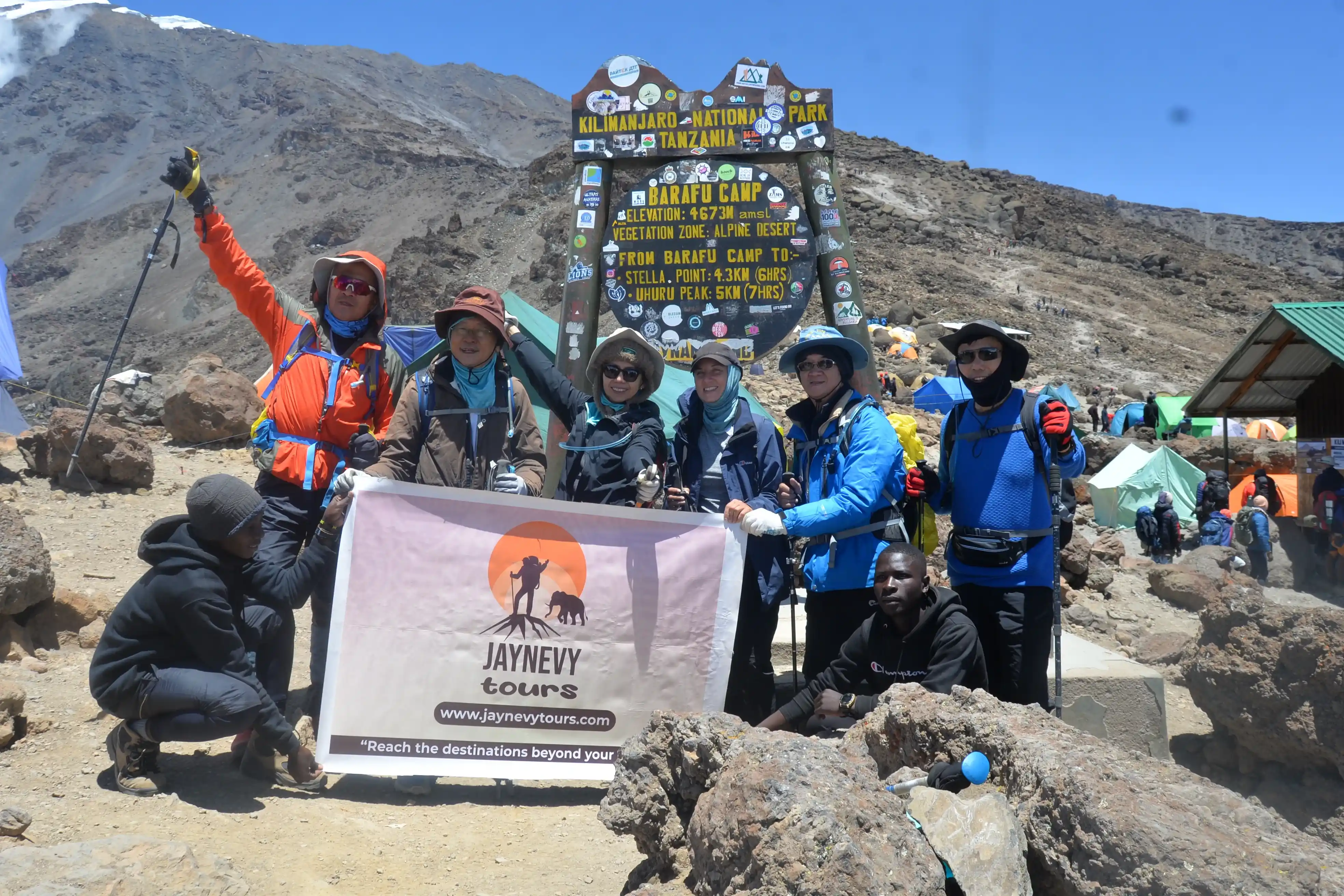
Quick Answer: Is the 9-Day Northern Circuit Worth Choosing?
Yes, for climbers who can afford the time and cost, the Northern Circuit is one of Kilimanjaro’s strongest itinerary choices. It gives you more nights to adapt, a quieter middle section around Kibo’s northern slopes, broad views toward Kenya and a gradual journey through several ecological zones.
It is not nine easy days. Summit night remains severe, School Hut creates a large sleeping-altitude jump, and the route’s length means more camping, cold exposure and crew-supported park days. Choose it for pacing and experience—not because an operator promises a guaranteed 95% or 98% summit rate.
First, Check What “9 Days” Actually Means
Package names are not standardized. Some operators mean nine days inside Kilimanjaro National Park; others count an arrival, briefing or hotel day as Day 1. This changes the camp sequence and the real acclimatization time.
Important Jaynevy package note
Jaynevy Tours’ current 9-day Northern Circuit package includes an arrival and hotel-rest day, followed by eight gate-to-gate mountain days. A full nine-mountain-day version normally adds a separate Shira 2 overnight before Moir. Before booking, count park nights and compare camps—not only the package title.
Why Is the Northern Circuit Called Kilimanjaro’s Longest Route?
The trail begins near Londorossi Gate on the west, follows the early Lemosho Route stages across Shira and then bends away from the busy southern circuit. Instead of heading toward Barranco, it crosses Moir Valley and circles Kibo through Buffalo and Third Cave before climbing to School Hut.
This long arc creates more horizontal distance than the direct Marangu, Machame or Rongai itineraries. The day-by-day distances in this guide total roughly 87 km; GPS tracks, road heads, camp locations and optional acclimatization walks can move published totals closer to 90–95 km.
| Claim | What is accurate | What needs context |
|---|---|---|
| Longest | It makes the broadest standard circuit around Kibo and commonly has the greatest gate-to-gate distance. | Package duration may include hotel days; count actual mountain stages. |
| Quietest | Moir, Buffalo and Third Cave are normally less congested than the southern circuit. | Early stages overlap Lemosho, while the summit and Mweka descent are shared. |
| Best acclimatization | More days and repeated nights near 3,500–4,200 m create a strong profile. | No route prevents altitude illness; School Hut still involves a large sleeping gain. |
| Easiest | Daily pacing can feel more manageable than compressed routes. | Nine days of trekking and a 12–16-hour summit day are physically demanding. |
| Highest success | Research supports more ascent days as one predictor of summit success. | There is no independent audited universal success percentage for this route. |
9-Day Northern Circuit Route: Day-by-Day Guide
The following is a common nine-mountain-day structure. Distances, elevations and walking times are rounded planning figures; operators may use slightly different camp coordinates or combine Shira stages.
| Day | Route | Approx. distance | Sleep altitude | Time | Difficulty* |
|---|---|---|---|---|---|
| 1 | Londorossi trailhead to Mti Mkubwa | ~7 km | ~2,820 m | 3–4 hrs | 2/5 |
| 2 | Mti Mkubwa to Shira 1 | ~8 km | ~3,500 m | 5–6 hrs | 3/5 |
| 3 | Shira 1 to Shira 2 | ~7 km | ~3,850 m | 3–4 hrs | 2/5 |
| 4 | Shira 2 to Moir via Lava Tower | ~14 km | ~4,200 m | 6–8 hrs | 4/5 |
| 5 | Moir to Buffalo Camp | ~12 km | ~4,020 m | 5–7 hrs | 3/5 |
| 6 | Buffalo to Third Cave | ~8 km | ~3,870 m | 5–7 hrs | 3/5 |
| 7 | Third Cave to School Hut | ~5 km | ~4,750 m | 4–5 hrs | 4/5 |
| 8 | School Hut to Uhuru Peak, then Mweka | ~16 km | ~3,100 m | 12–16 hrs | 5/5 |
| 9 | Mweka Camp to Mweka Gate | ~10 km | Exit ~1,640 m | 3–4 hrs | 2/5 |
*Difficulty scores are Jaynevy editorial planning ratings, not medical or scientific measurements.
Day 1: Londorossi Trailhead to Mti Mkubwa Camp
After registration and transport toward the western trailhead, the climb begins in humid montane forest. The path is often muddy after rain and gains roughly 600–700 metres before Mti Mkubwa. The walking is moderate, but the change from travel day to mountain routine can make it feel longer than the distance suggests.
Day 2: Mti Mkubwa to Shira 1 Camp
The forest thins into heath and moorland as the route climbs onto the western edge of the Shira Plateau. Sleeping altitude rises by about 680 m, the largest early increase, so pace and hydration matter even when the trail does not feel steep.
Day 3: Shira 1 to Shira 2 Camp
This shorter plateau day is one reason the complete nine-mountain-day itinerary is valuable. You gain about 350 m in sleeping altitude without a punishing distance. Optional afternoon walks can add a controlled climb-high-return-low stimulus before sleeping at Shira 2.
Day 4: Shira 2 to Moir Hut via Lava Tower
This is the first major acclimatization test. The route climbs toward Lava Tower at roughly 4,600 m before descending to Moir around 4,200 m. The high point exposes you to thinner air, while the lower sleep follows the classic “climb high, sleep lower” principle. It is a long day across open alpine desert and can trigger headache or appetite loss.
Day 5: Moir Hut to Buffalo Camp
The trail leaves the busier southern network and bends around Kibo’s northern flank. It crosses ridges and valleys rather than making a large net ascent. This is where the Northern Circuit begins to feel genuinely remote, with broad views toward Kenya when cloud permits.
Day 6: Buffalo Camp to Third Cave
Another long traverse maintains altitude before dropping slightly to Third Cave. The scenery is sparse and exposed, with alpine desert, wind-shaped terrain and long sightlines. The modest sleeping descent gives the body additional time before the final high-camp jump.
Day 7: Third Cave to School Hut
The distance is short, but sleeping altitude rises by roughly 880 m to about 4,750 m. This is the route’s most aggressive sleeping gain. The previous nights above 3,500 m are valuable, yet anyone whose symptoms worsen should not continue upward simply because summit night is close.
Day 8: School Hut to Uhuru Peak and Mweka Camp
Climbers usually leave around midnight and move slowly through cold, dark scree toward the crater rim, then continue to Uhuru Peak at 5,895 m. Reaching the sign is only half the day: the descent continues thousands of vertical metres to Mweka Camp. Twelve to sixteen hours of movement is common, making this the hardest physical and mental stage.
Day 9: Mweka Camp to Mweka Gate
The final descent returns to wet forest and lower oxygen stress, but knees and quadriceps may be tired from summit day. Trekking poles help on slippery steps. After park formalities at Mweka Gate, climbers transfer back to Moshi or Arusha.
Northern Circuit Camps and What Each One Adds
| Camp | Approx. elevation | Landscape | Planning value |
|---|---|---|---|
| Mti Mkubwa | ~2,820 m | Rainforest | First mountain night and transition from lowland travel. |
| Shira 1 | ~3,500 m | Heath/moorland | First sleep above 3,000 m; monitor headache and appetite. |
| Shira 2 | ~3,850 m | Open plateau | Creates a gradual step before Lava Tower and Moir. |
| Moir Hut | ~4,200 m | Alpine valley | High sleep after optional Lava Tower exposure. |
| Buffalo | ~4,020 m | Remote north | Quiet traverse and slight sleeping descent. |
| Third Cave | ~3,870 m | Northern alpine desert | Another lower sleep before high camp. |
| School Hut | ~4,750 m | High alpine desert | Summit base; short rest before midnight departure. |
| Mweka | ~3,100 m | Upper forest | Major post-summit descent and recovery night. |
Scenery: What You See Across the Long Circuit
- Western rainforest: giant ferns, moss, birds and possible colobus or blue monkey sightings.
- Shira Plateau: a broad remnant of Kilimanjaro’s older volcanic cone, with open views toward Kibo.
- Lava Tower and Moir Valley: stark volcanic formations and one of the route’s most useful high-altitude days.
- Northern slopes: open valleys, ridges, fewer groups and views toward the Kenyan plains when visibility is clear.
- High alpine desert: sparse vegetation, stronger wind, cold nights and dramatic views of Kibo.
- Summit zone: crater-rim terrain, glaciers and sunrise above the cloud layer.
- Mweka forest: a green, humid finish that contrasts sharply with the summit desert.
How Quiet Is the Northern Circuit?
The route deserves its quiet reputation, but not every day is secluded. Londorossi, Mti Mkubwa and Shira are shared with Lemosho climbers. The trail becomes quieter after Moir when groups turn north instead of heading to Barranco. Buffalo and Third Cave usually provide the strongest wilderness feeling.
Traffic increases again at School Hut, on the crater rim and during the Mweka descent. Therefore, “quietest route” is best understood as the quietest sustained middle traverse, not a private mountain from gate to gate.
Acclimatization: Why More Days Help—and Where the Profile Is Still Aggressive
The main benefit of the Northern Circuit is not simply rest. It is repeated exposure to altitude across multiple nights, including several sleeps near 3,500–4,200 m before the final high camp. Read the full Kilimanjaro acclimatization guide before choosing an itinerary.
| Night | Camp | Sleep altitude | Change from previous sleep | Interpretation |
|---|---|---|---|---|
| 1 | Mti Mkubwa | ~2,820 m | First mountain night | Below the 3,000 m threshold used in many general guidelines. |
| 2 | Shira 1 | ~3,500 m | +680 m | Large early gain; symptoms must be watched. |
| 3 | Shira 2 | ~3,850 m | +350 m | Conservative step. |
| 4 | Moir | ~4,200 m | +350 m | Good progression after a higher Lava Tower exposure. |
| 5 | Buffalo | ~4,020 m | −180 m | Lower sleep while remaining at altitude. |
| 6 | Third Cave | ~3,870 m | −150 m | Further recovery before high camp. |
| 7 | School Hut | ~4,750 m | +880 m | Large unavoidable jump; previous acclimatization does not make it risk-free. |
CDC guidance for unacclimatized travellers generally recommends keeping sleeping-altitude gains above 3,000 m to about 500 m per night and adding an acclimatization night for each 1,000 m gained. Kilimanjaro itineraries cannot follow this perfectly, which is why symptom-based decisions and descent protocols are essential.
Do not climb higher with worsening symptoms
Headache with nausea, unusual fatigue, dizziness or poor coordination should never be dismissed as a normal price of summiting. Mild symptoms should resolve before further ascent; severe or worsening symptoms require immediate descent and guide-led medical action. Use Jaynevy’s Kilimanjaro safety guide as a planning resource, not a substitute for medical advice.
What the Published Kilimanjaro Data Actually Shows
Research numbers worth using
- A prospective study included 1,237 recreational Kilimanjaro hikers. In that cohort, 87.9% reached Uhuru Peak, 8.6% developed severe altitude-illness symptoms and 1.1% were hospitalized.
- In the same study, climbing in more days predicted summit success. This supports longer schedules, but it does not prove a universal Northern Circuit percentage.
- CDC summaries cite acute mountain sickness prevalence of 75–77% in studies of rapid four- and five-day Kilimanjaro ascents.
- At roughly 3,050 m, inspired oxygen pressure is only about 69% of sea-level value; the effect becomes more severe as altitude increases.
- Acute acclimatization is most important during the first 3–5 days, which is one reason a long itinerary can be more sensible than a compressed climb.
Correct interpretation: longer itineraries improve the opportunity to acclimatize and more days were associated with summit success in a large cohort. They do not guarantee a summit, and they do not justify publishing 95–98% as a universal fact without an auditable operator dataset.
How Difficult Is the 9-Day Northern Circuit?
Overall difficulty is high, even though the itinerary is well paced. The challenge is cumulative: nearly 90 km of trekking, eight nights camping, repeated cold exposure, appetite changes at altitude and a long summit day. Fitness helps you manage distance and recovery, but it does not determine who develops altitude illness.
| Factor | Difficulty | Why it matters | Preparation |
|---|---|---|---|
| Daily walking | Moderate | Most days are 3–8 hours rather than very steep. | Train with consecutive hiking days. |
| Total duration | High | Nine days create cumulative fatigue and camping exposure. | Practice multi-day recovery, sleep and foot care. |
| Altitude | Very high | Every itinerary reaches 5,895 m. | Choose enough days and follow symptom rules. |
| Summit day | Very high | Cold, darkness, scree and 12–16 hours of movement. | Build endurance and test summit layers. |
| Technical climbing | Low | Standard trekking normally requires no ropes. | Use poles and stable hiking footwear. |
For practical preparation, review the common Kilimanjaro climbing challenges and the complete Kilimanjaro packing checklist.
Cost: Why the Northern Circuit Is Usually More Expensive
Every extra park day requires guide and porter time, park and camping charges, food, fuel, water treatment and mountain logistics. This is why the longest itinerary normally costs more than a six- or seven-day route.
As reviewed on 6 August 2026, Jaynevy Tours’ published 9-day Northern Circuit package starts from USD 2,600 per person. That page currently counts an arrival day plus eight mountain days. Price can change with group size, hotels, dates, private service and rentals, so use the written quotation as the final source.
Compare inclusions using the Kilimanjaro climbing cost guide and wider Kilimanjaro package levels. The cheapest quote is poor value when it removes mountain days, understaffs the crew or excludes essential fees.
Who Should Choose the Northern Circuit?
It is a strong match for:
- First-time Kilimanjaro climbers who can allocate a long itinerary.
- Travellers who prioritize acclimatization opportunity over the lowest price.
- People who enjoy remote landscapes and quieter trekking days.
- Photographers who want changing western, northern and summit views.
- Climbers comfortable with eight nights of tented mountain accommodation.
- Groups that prefer moderate daily stages before summit day.
It may not be the right choice for:
- Travellers with very limited holiday time.
- Anyone seeking the lowest Kilimanjaro price.
- People who strongly prefer hut accommodation.
- Climbers who dislike long camping expeditions.
- Anyone assuming a longer route removes the need for fitness, insurance or conservative medical decisions.
Northern Circuit vs Lemosho, Machame and Rongai
| Route | Common duration | Main strength | Main compromise | Best for |
|---|---|---|---|---|
| Northern Circuit | 8–9 mountain days | Longest pacing and quiet northern traverse | Highest time and cost commitment | Acclimatization opportunity and solitude |
| Lemosho | 7–8 days | Excellent scenery and strong southern acclimatization profile | Busier after joining Machame | Balanced scenery, time and pacing |
| Machame | 6–7 days | Dramatic scenery and classic climb-high-sleep-low stages | Popular and physically steeper | Strong trekkers with less time |
| Rongai | 6–7 days | Quiet northern ascent and Mawenzi views | Fewer strong acclimatization opportunities | Drier-side planning and solitude |
Explore the full Kilimanjaro route comparison, the Kilimanjaro route map, or compare the dedicated Machame and Rongai guides.
Best Time and Weather Considerations
January to early March and June to October are the most commonly selected climbing periods because they tend to offer drier conditions. The route’s northern side can feel dry and exposed, but the western forest and Mweka descent can still be wet. Wind chill at Moir, Buffalo, Third Cave and School Hut can be severe in any month.
Use the best time to climb Kilimanjaro guide for seasonal planning, then prepare for rain, sun, freezing temperatures and summit wind regardless of the month.
Booking Checklist for a True 9-Day Northern Circuit
- Ask how many actual nights are inside Kilimanjaro National Park.
- Confirm whether Shira 2 is a separate overnight or only a passing point.
- Request the exact camp sequence and planned sleeping altitudes.
- Check how morning and evening health observations are recorded.
- Ask what symptoms stop further ascent and trigger descent.
- Confirm oxygen, first-aid, communication and evacuation arrangements.
- Check whether park fees, rescue fees, hotels, airport transfers and camping equipment are included.
- Ask whether the quote is private or group-based and how group size affects pace.
- Verify guide, cook and porter staffing and crew-welfare standards.
- Do not accept a summit-rate claim without sample size, dates, itinerary and summit definition.
Final Verdict: Is Kilimanjaro’s Longest and Quietest Itinerary Right for You?
Choose the 9-day Northern Circuit when time, acclimatization opportunity and quieter wilderness matter more than finding the shortest or cheapest climb. Its separate Shira stages, Lava Tower exposure, northern traverse and repeated high-altitude nights create one of Kilimanjaro’s most thoughtful standard profiles.
The route is still a serious expedition. The School Hut altitude jump and summit day demand conservative decisions, strong support and realistic preparation. Review the current Jaynevy Northern Circuit package, then confirm whether its “nine days” are calendar days or genuine mountain days before booking.
Frequently Asked Questions
Is the Northern Circuit really Kilimanjaro’s longest route?
Yes, it is generally treated as the longest standard Kilimanjaro itinerary because it begins on the western Lemosho approach, crosses the Shira Plateau and then circles the remote northern side of Kibo before the summit. Exact distance varies by camp sequence and GPS measurement, but a full nine-mountain-day plan is commonly around 87 to 95 kilometres gate to gate.
Is the Northern Circuit the quietest Kilimanjaro route?
It is usually the quietest during the middle northern traverse between Moir, Buffalo and Third Cave. The first western stages share parts of the Lemosho approach, and climbers meet other groups near the summit and on the Mweka descent, so the entire route is not empty.
Does a 9-day Northern Circuit package always mean nine mountain days?
No. Some companies count arrival, briefing or a hotel night as Day 1. Ask for the camp list and count actual park nights. Jaynevy Tours’ current published nine-day package includes an arrival day followed by eight gate-to-gate mountain days.
How many camps are used on a full 9-day Northern Circuit climb?
A common full mountain itinerary uses Mti Mkubwa, Shira 1, Shira 2, Moir Hut, Buffalo, Third Cave, School Hut and Mweka Camp. Camp names, elevations and the exact sequence can vary by operator and park instructions.
Why is the Northern Circuit good for acclimatization?
It spreads the ascent across more days, includes several nights around 3,500 to 4,200 metres and can use Lava Tower as a climb-high-sleep-lower day. It still contains a large sleeping-altitude gain to School Hut, so the route reduces risk but does not remove altitude illness.
What is the hardest day on the Northern Circuit?
Summit day is the hardest. Climbers normally start around midnight, climb from School Hut toward the crater rim and Uhuru Peak at 5,895 metres, then descend to Mweka Camp. The combined day commonly lasts about 12 to 16 hours.
Is the Northern Circuit suitable for beginners?
It can suit first-time high-altitude trekkers who have good general fitness, enough time and a conservative guide team. The long duration helps pacing, but nine days of camping, cold, thin air and a severe summit day still require preparation.
What scenery does the Northern Circuit include?
The route includes western rainforest, Shira Plateau, Lava Tower, Moir Valley, remote northern slopes, views toward Kenya, alpine desert, summit glaciers and the Mweka rainforest descent. Its scenery changes steadily rather than depending on one landmark.
What summit success rate does the Northern Circuit have?
There is no independent, audited universal Northern Circuit success rate. Published Kilimanjaro research supports the value of more ascent days, but operator claims such as 95 or 98 percent should be checked for sample size, itinerary, summit definition and whether every starting climber was counted.
How much does a 9-day Northern Circuit climb cost?
Jaynevy Tours’ published nine-day Northern Circuit package starts from USD 2,600 per person as reviewed on 6 August 2026. Final cost depends on group size, travel dates, hotel level, private or group service, rentals and the exact inclusions in the written quotation.
When is the best time to climb the Northern Circuit?
January to early March and June to October are commonly chosen for drier conditions. Mountain weather is never guaranteed, and the exposed northern traverse can be windy and cold even in popular climbing months.
Research and Planning Sources
This guide was reviewed on 6 August 2026. Camp elevations, distances and walking times are rounded because route variants, GPS readings and trailhead access differ. Medical information is general and does not replace advice from a qualified clinician.
- TANAPA: Kilimanjaro National Park and official visitor information
- CDC Yellow Book 2026: High-Altitude Travel and Altitude Illness
- Prospective cohort study of 1,237 recreational Kilimanjaro hikers
- Jaynevy Tours: current nine-day Northern Circuit package, itinerary and starting price
- Jaynevy Tours: Northern Circuit route overview
- Google Search Central: helpful, reliable, people-first content
- Google Search Central: generative AI Search guidance