
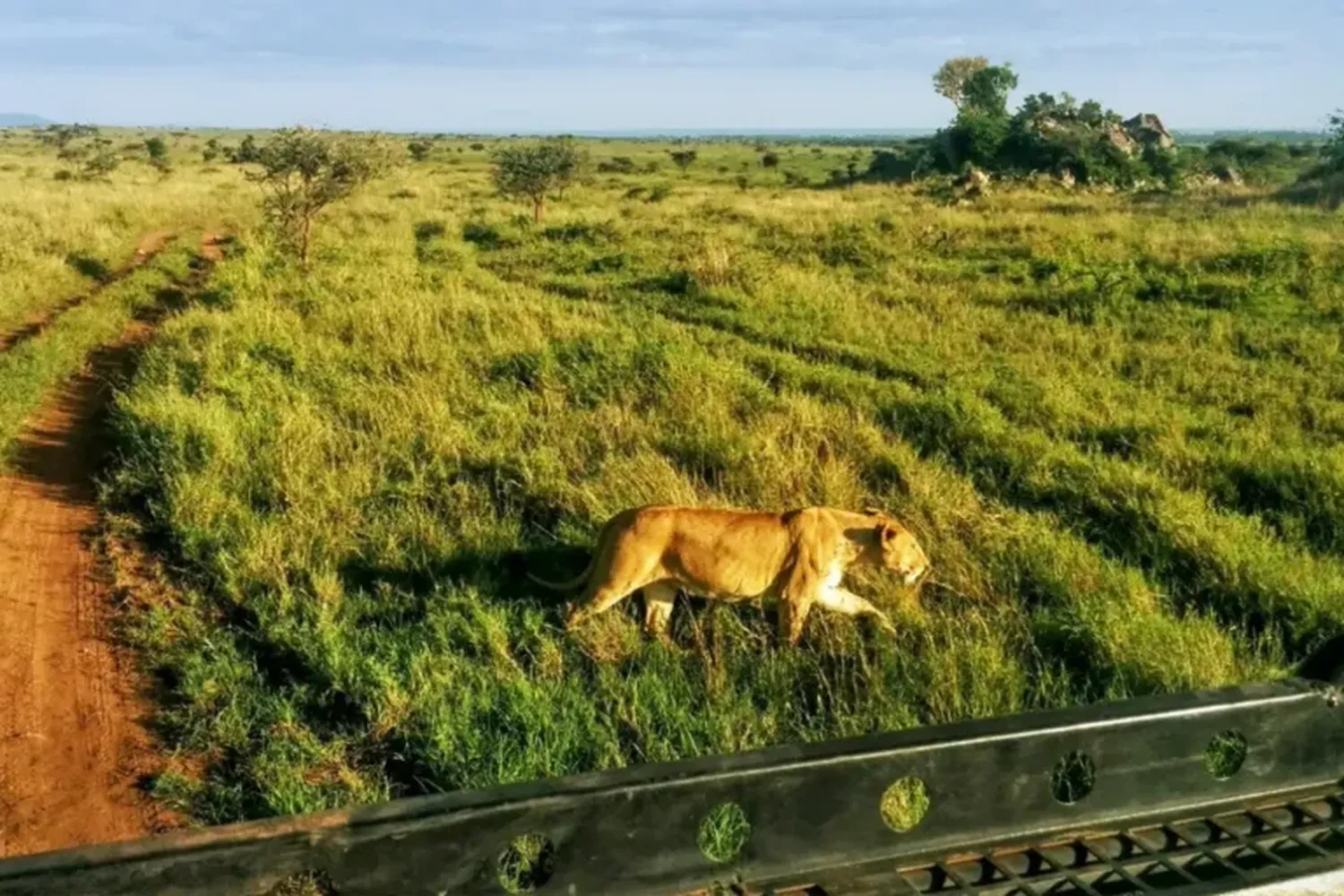
Quick answer: is northern or southern Tanzania better for safari?
Choose northern Tanzania for your first safari, the Serengeti migration, Ngorongoro Crater, easier road itineraries and the widest range of accommodation. Choose southern Tanzania for fewer vehicles, larger wilderness areas, African wild dogs, boat safaris, walking safaris and a more remote camp-based experience.
Neither circuit is automatically better. The northern circuit normally delivers more famous landmarks and stronger short-trip efficiency. The southern circuit often delivers more privacy and more ways to explore, but the best parks are spread farther apart and are commonly linked by bush flights.
| Decision point | Northern Tanzania | Southern Tanzania |
|---|---|---|
| Best overall for | First-time safari visitors | Repeat visitors and wilderness-focused travellers |
| Signature experience | Serengeti migration and Ngorongoro Crater | Nyerere boat safaris and Ruaha wilderness |
| Typical transport | Private 4x4 road safari | Bush flights plus camp vehicles, or selected road routes |
| Wildlife viewing style | Open plains, high densities and famous predator areas | River systems, miombo woodland, wild dogs and varied activities |
| Crowds | Higher around major sightings and peak-season zones | Usually lower, especially in Ruaha and remote Nyerere sectors |
| Budget flexibility | Strongest range from camping to ultra-luxury | Fewer low-cost choices in remote fly-in areas |
| Best trip length | 5–8 days for a complete road circuit | 3–4 days for one park; 7–10 days for Nyerere plus Ruaha |
What is Tanzania's northern safari circuit?
The northern circuit is the route around Arusha, Tarangire, Lake Manyara, Ngorongoro and Serengeti. Arusha and Moshi are the main road-safari gateways, while Arusha Airport and Kilimanjaro International Airport connect with domestic and international flights.
The parks form a practical chain. A traveller can drive from Arusha to Tarangire, continue to Karatu and Ngorongoro, then cross into Serengeti without returning to the city between parks. This geographic efficiency is a major reason northern itineraries dominate first-time safari planning.
- Serengeti National Park: vast savannah, resident predators and the Great Migration.
- Ngorongoro Conservation Area: high-density crater wildlife and dramatic highlands.
- Tarangire National Park: elephants, baobabs and dry-season concentrations.
- Lake Manyara National Park: groundwater forest, birds, wetlands and Rift Valley scenery.
- Arusha National Park: Mount Meru, forest, Momella Lakes and walking or canoe options.
See the dedicated northern Tanzania safari guide and northern safari camps and lodges.
What is Tanzania's southern safari circuit?
The southern circuit usually means Nyerere National Park, Ruaha National Park, Mikumi National Park and Udzungwa Mountains National Park. Dar es Salaam is the main gateway. Zanzibar also connects well to Nyerere and, on scheduled routes, to Ruaha.
The south is not one compact road loop in the same way as the north. Mikumi is accessible by road from Dar es Salaam, but Nyerere and Ruaha are separated by large distances. A high-quality Nyerere–Ruaha itinerary is therefore commonly fly-in, using light aircraft between bush airstrips.
- Nyerere National Park: Rufiji River, boat safaris, walking, wild dogs and big game.
- Ruaha National Park: huge landscapes, lions, elephants, buffalo, kudu and more than 570 recorded bird species.
- Mikumi National Park: accessible savannah wildlife and the easiest southern road-safari option.
- Udzungwa Mountains National Park: rainforest hiking, waterfalls, primates and endemic species rather than classic vehicle game drives.
Relevant route options include the 7-day Nyerere, Mikumi and Udzungwa safari, the Ruaha National Park guide and a 3-day Nyerere safari.
Northern vs southern parks: size, landscape and main appeal
| Park or area | Circuit | Published size | Main reason to visit |
|---|---|---|---|
| Serengeti National Park | North | About 14,763 km² / 1.5 million hectares | Migration, open plains, big cats and year-round resident wildlife |
| Tarangire National Park | North | About 2,850 km² | Elephants, baobabs and Tarangire River dry-season wildlife |
| Lake Manyara National Park | North | 648.7 km² | Forest, birds, wetlands and a compact habitat mix |
| Ngorongoro Conservation Area | North | More than 8,000 km² | Crater wildlife, highlands, archaeology and pastoral landscapes |
| Nyerere National Park | South | More than 30,000 km² | Rufiji waterways, wild dogs, boating and walking |
| Ruaha National Park | South | 20,226 km² | Remote big-game country, kudu, predators and birding |
| Mikumi National Park | South | About 3,230 km² | Accessible game viewing from Dar es Salaam |
| Udzungwa Mountains National Park | South | 1,990 km² | Rainforest hiking, Sanje Waterfalls and endemic biodiversity |
The numbers explain an important difference: the southern parks are enormous, but wildlife can be less concentrated and travel distances can be greater. A larger park does not always mean more sightings in one day. Guide quality, water availability, season and camp location matter more than area alone.
Which circuit has better wildlife?
Northern circuit wildlife strengths
The north is strongest for classic first-safari wildlife. Serengeti supports lions, leopards, cheetahs, elephants, buffalo, giraffes, hyenas and large herbivore herds. UNESCO describes an annual movement involving roughly two million wildebeest plus hundreds of thousands of zebras and gazelles across the wider ecosystem.
Ngorongoro adds a concentrated crater experience. NCAA estimates approximately 26,000–28,000 animals in the crater, including buffalo, wildebeest, zebra, hippo, lions, hyenas and endangered black rhinos. Tarangire adds major elephant value; TANAPA currently reports more than 2,500 elephants in the park.
Southern circuit wildlife strengths
The south is especially strong for African wild dogs, river wildlife, large elephant and buffalo populations, sable and kudu in suitable habitats, and low-density predator viewing. Nyerere's Rufiji River supports hippos, crocodiles, elephants and rich birdlife, while TANAPA describes the park as one of East Africa's wild-dog strongholds.
Ruaha offers both greater and lesser kudu, large buffalo herds, lions, leopards, elephants and more than 570 recorded bird species. Sightings may require more tracking than in Ngorongoro, but the reward is often a longer, quieter encounter.
Can you see the Big Five in both circuits?
The northern circuit gives the stronger practical chance of seeing the Big Five in one trip because Ngorongoro is Tanzania's most reliable black-rhino area and Serengeti supports the other four. Even there, leopard and rhino sightings are never guaranteed.
The southern circuit is excellent for lion, leopard, elephant and buffalo, but rhino is not a normal expectation on standard Nyerere, Ruaha or Mikumi itineraries. Travellers should choose the south for wilderness quality, wild dogs and diverse activities—not for a Big Five checklist.
Which circuit is better for the Great Migration?
The northern circuit is the only choice for a Serengeti Great Migration safari. The herds move through southern, central, western and northern Serengeti at different times, following rainfall and grazing conditions. River crossings are seasonal events, not scheduled performances.
For migration planning, use the best time to visit Serengeti for migration. Southern Tanzania has important local wildlife movements and seasonal concentrations, but not the Serengeti–Mara migration.
Activities: game drives, walking and boat safaris
| Activity | Northern circuit | Southern circuit |
|---|---|---|
| Day game drives | Core activity in every major park | Core activity in Nyerere, Ruaha and Mikumi |
| Boat safari | Limited; canoeing at Momella may be available | A signature Nyerere experience on Rufiji channels and lakes |
| Walking safari | Available in selected authorised areas | More central to the safari style, especially in Nyerere and Ruaha |
| Night game drive | Available in selected parks or concession areas | Available from selected camps and authorised areas |
| Balloon safari | Well established in Serengeti and Tarangire | Less central to standard southern itineraries |
| Mountain hiking | Arusha National Park and highland walks | Udzungwa is the circuit's major hiking destination |
Travellers who want every day to be a vehicle game drive usually prefer the north. Travellers who want to alternate between vehicle, boat and walking experiences often prefer Nyerere and Ruaha.
Travel time: which circuit is easier?
Northern circuit road times
Northern parks are arranged in a workable road sequence. Typical planning windows—not promises—are shown below. Rain, traffic, gate queues, road works and wildlife stops can change every transfer.
| Route | Typical planning time | What to know |
|---|---|---|
| Arusha to Tarangire | 2.5–3 hours | Mostly paved road before the park approach |
| Arusha to Lake Manyara | 2–2.5 hours | TANAPA cites about 125 km |
| Karatu to Ngorongoro entry | About 30 minutes | Rim and descent-road time comes after the gate |
| Karatu to Central Serengeti | 4.5–6 hours | Scenic protected-area transfer; sightings can extend the day |
| Central Serengeti to northern Serengeti | 4–6 hours | Should be treated as a relocation day, not a short game drive |
Southern circuit road and flight times
| Route | Typical planning time | Best use |
|---|---|---|
| Dar es Salaam to Mikumi | About 3–5 hours by road | Best southern option for a short road safari |
| Dar es Salaam to Nyerere | Long road day or about 45 minutes scheduled flight | Fly for a 2–4 day safari; road can suit slower overland routes |
| Zanzibar to Nyerere | About 1 hour 15 minutes on a published Coastal schedule | Efficient beach-to-bush combination |
| Dar es Salaam to Ruaha | About 625 km by road or roughly 2.5 hours scheduled flight | Flying is usually best for limited holiday time |
| Nyerere to Ruaha | About 1 hour on selected scheduled links | Creates the classic 7–10 day southern fly-in circuit |
Published airline schedules can change by season, routing and demand. Safari aircraft may make intermediate stops, so the time in the air can be longer than a direct-map estimate. Review fly-in safari planning in Tanzania.
Which circuit has fewer crowds?
The southern circuit usually has fewer safari vehicles. Nyerere and Ruaha cover immense areas with a lower concentration of camps than central Serengeti or the Ngorongoro Crater. At many southern sightings, one vehicle may stay alone or share the scene with only a few others.
The north is not crowded everywhere. Central Serengeti, major migration crossings and the crater floor can feel busy during high season, but quieter areas exist in eastern Serengeti, remote northern zones, Tarangire's less-used tracks and selected private concessions. Good itinerary design matters more than a simple north-versus-south label.
| Period | Northern crowd pattern | Southern crowd pattern |
|---|---|---|
| January–February | Busy around southern Serengeti calving zones | Green and quieter; some camps operate seasonally |
| March–May | Lowest general demand, but rains affect some roads | Some remote camps close; access can be limited |
| June–October | Peak demand in Serengeti and Ngorongoro | Best dry-season wildlife and highest southern demand, still generally quieter |
| November–December | Short-rain value season outside holiday dates | Green landscapes, good birds and lower occupancy in many camps |
Northern vs southern Tanzania safari costs in 2026/2027
Prices depend on travel dates, group size, accommodation, internal flights, vehicle exclusivity and whether park fees are included. The ranges below are planning estimates per person sharing, not fixed quotations.
| Safari style | Northern circuit planning range | Southern circuit planning range |
|---|---|---|
| Budget / joining | US$220–US$350 per person per day | US$250–US$450 for Mikumi road trips; limited in remote fly-in parks |
| Private mid-range | US$350–US$650 per person per day | US$500–US$850 per person per day |
| Luxury | US$700–US$1,300+ per person per day | US$850–US$1,500+ per person per day |
| Example 7-day trip | About US$1,700–US$4,500 mid-range market span | About US$4,500–US$8,500 for Nyerere and Ruaha with flights and stronger camps |
Why is the south often more expensive? Remote camps have higher logistics costs, fewer rooms and seasonal operations, while bush flights can add several hundred dollars per person. The north spreads vehicle and operational costs across a larger, more competitive accommodation market.
TANAPA's online tariff portal currently displays reference non-resident adult fees of US$70.80 for Serengeti, US$53.10 for Tarangire and Lake Manyara, and US$35.40 for Mikumi and Ruaha. The page is labelled with an earlier financial year, so use it as a reference and confirm the tariff applying to your travel date. Read the Tanzania park-fee guide and Tanzania safari cost guide.
Where your safari budget goes
- Park and conservation fees: charged by protected-area authorities and usually calculated by day or 24-hour period.
- Accommodation: remote camps may include meals, local drinks and shared activities.
- Vehicle and guide: private northern safaris price the Land Cruiser and guide across the group.
- Internal flights: a major southern-circuit cost, especially when linking Nyerere and Ruaha.
- Concession or camping fees: may apply to accommodation inside protected areas.
- Taxes and transfers: must be shown clearly in a reliable quote.
Compare quotations line by line. A lower total can exclude flights, park fees, drinks, airport transfers or a private vehicle.
Best time for northern and southern Tanzania
| Travel goal | Best northern window | Best southern window |
|---|---|---|
| Dry-season general wildlife | June–October | June–October |
| Serengeti calving | January–March | Not applicable |
| Lowest crowds and greener scenery | April–May and parts of November | November–March, subject to camp access and closures |
| Wild dogs | Possible but less central to standard trips | Nyerere and Ruaha are stronger choices |
| Birding | November–April | November–April, with Ruaha recording 570+ species |
| Walking and boating | Available selectively | Strongest when camps and water conditions support activities |
The best date depends on the experience, not simply the driest weather. Use the month-by-month Tanzania safari guide.
Which circuit is better for first-time visitors?
The north is the safer first choice for most travellers. It combines Tanzania's most recognisable parks, realistic Big Five potential, a broad range of lodges and a road route that works well in five to eight days.
The south can still be the right first safari for someone who dislikes crowds, is comfortable with small aircraft, values walking and boating, and has a budget for remote camps. Read what first-time safari travellers should expect.
Which circuit is better for families?
The north normally works better for families because private road vehicles offer flexibility, family rooms are widely available and routes can be adjusted around shorter game drives. Tarangire, Ngorongoro and central Serengeti are straightforward to combine.
Southern camps can be excellent for older children, but some walking and boating activities have minimum-age rules, remote medical access is slower and light-aircraft luggage limits require careful packing. Confirm each camp's age policy before payment.
Which circuit is better for photographers?
Choose the north for migration scale, open-plains action, cheetahs and the high wildlife density of Ngorongoro. Choose the south for uncluttered backgrounds, fewer vehicles, river scenes, wild dogs and the chance to stay with a sighting without a large gathering.
A private vehicle is more important than the circuit. Ask for one photographer per row, removable window panes or roof access where legal, charging options and a guide comfortable with positioning for light rather than simply collecting species.
Which circuit combines best with Zanzibar?
Nyerere is the easiest safari pairing with Zanzibar for a short trip. Published schedules show flights of roughly 1 hour 15 minutes between Zanzibar and Nyerere, making a two- or three-night safari practical without routing through Arusha.
For Serengeti, scheduled flights also connect Zanzibar with bush airstrips, but travel time is longer and may include stops. A fly-in Serengeti trip is stronger for migration and big cats; Nyerere is stronger for boating, privacy and a short beach-to-bush break.
Sample itineraries: northern versus southern
Best 7-day northern circuit itinerary
- Day 1: Arusha to Tarangire
- Day 2: Tarangire to Karatu or Lake Manyara
- Days 3–5: Serengeti, ideally three nights
- Day 6: Serengeti to Ngorongoro highlands
- Day 7: Ngorongoro Crater and return
This route is balanced for first-time visitors and can be adapted using the 7-day Serengeti, Ngorongoro and Tarangire itinerary.
Best 7-day southern fly-in itinerary
- Day 1: Fly Dar es Salaam or Zanzibar to Nyerere
- Days 2–3: Nyerere game drives, boat safari and optional walk
- Day 4: Fly Nyerere to Ruaha
- Days 5–6: Ruaha game drives and optional walking
- Day 7: Fly to Dar es Salaam or onward connection
This itinerary gives three nights in each major park. Travellers who dislike small aircraft should focus on Mikumi and Udzungwa by road rather than forcing a long overland Nyerere–Ruaha route.
Who should choose northern Tanzania?
- First-time safari travellers.
- Guests prioritising the Great Migration or Big Five.
- Families wanting a private road vehicle.
- Travellers with five to eight safari days.
- Guests needing the widest choice of budget, mid-range and luxury lodges.
- Photographers focused on plains, cheetahs and migration action.
Who should choose southern Tanzania?
- Repeat safari travellers seeking something less familiar.
- Guests who value privacy over a checklist.
- Wild-dog enthusiasts.
- Travellers who want boat and walking safaris.
- Couples and photographers comfortable with fly-in camps.
- Zanzibar visitors wanting a short Nyerere extension.
Can you combine northern and southern Tanzania?
Yes, but it is usually sensible only with at least 10–14 days and an adequate flight budget. Driving between the circuits wastes holiday time. A practical combination is five to seven nights in the north, a flight via Arusha or Dar es Salaam, then three to six nights in Nyerere or Ruaha.
Combining both makes sense for a second or longer African trip. First-time visitors with one week normally get more value by exploring one circuit properly.
Common planning mistakes
- Choosing by park size alone. Huge wilderness does not guarantee concentrated sightings.
- Underestimating southern flight costs. Compare a complete package, not only camp rates.
- Calling every southern itinerary “Selous”. Confirm whether the trip enters Nyerere National Park and which airstrip or sector is used.
- Expecting no crowds anywhere in the north. Peak sightings can be busy, but good guides can avoid the most congested areas.
- Booking two Serengeti nights and expecting three full days. Arrival and departure transfers reduce game-drive time.
- Driving Dar to Ruaha on a short trip. The distance is roughly 625 km; fly or allow a proper overland itinerary.
- Ignoring seasonal camp closures. Some southern camps close during the long rains.
- Expecting guaranteed Big Five or river crossings. Wildlife is free-ranging and sightings cannot be promised.
Booking checklist
- Confirm the exact parks, gates, airstrips and camp locations.
- Ask whether game drives are private or shared.
- Check every internal flight, luggage limit and possible intermediate stop.
- Request an itemised list of park, conservation, concession and vehicle fees.
- Confirm which activities—boat, walk, night drive or balloon—are included.
- Check minimum ages for walking and boating.
- Verify seasonal opening dates for southern camps.
- Leave a buffer before the international flight.
- Buy travel insurance suitable for remote medical evacuation.
- Compare the parks using the Tanzania national park selection guide.
Final verdict
For a first Tanzania safari, choose the northern circuit unless privacy, walking, boating or wild dogs are more important than the Serengeti and Ngorongoro. The north is easier to route by road, offers more accommodation choice and works well in five to eight days.
For a quieter and more varied safari style, choose southern Tanzania. Nyerere and Ruaha reward travellers who accept higher fly-in costs and allow enough nights for large wilderness areas. Mikumi is the exception: it is the accessible, lower-cost southern road option.
Neither circuit should be reduced to a slogan. The right choice depends on your dates, trip length, starting city, budget, desired activities and tolerance for road or light-aircraft travel.
Frequently asked questions
Is northern or southern Tanzania better for a first safari?
Northern Tanzania is better for most first-time visitors because it combines Serengeti, Ngorongoro and Tarangire in an efficient road route with a wide range of accommodation.
Which circuit is cheaper?
The northern circuit is usually cheaper at comparable comfort levels because road transport is practical and there are more camps and lodges. Remote southern fly-in safaris normally cost more.
Which circuit has fewer tourists?
Southern Tanzania generally has fewer vehicles, especially in Ruaha and remote Nyerere areas. Northern crowds are concentrated around famous sightings and peak-season zones rather than spread evenly across every park.
Where is the best place to see African wild dogs?
Nyerere and Ruaha are stronger choices than a standard northern itinerary. Wild dogs can occur in the Serengeti ecosystem, but they are not a reliable checklist sighting.
Can I see the Great Migration in southern Tanzania?
No. The famous Great Migration is part of the Serengeti–Mara ecosystem in northern Tanzania and Kenya.
How many days do I need for the northern circuit?
Five days covers a compressed Tarangire–Serengeti–Ngorongoro route. Seven or eight days gives better pacing and at least three Serengeti nights.
How many days do I need for southern Tanzania?
Three or four days work for Nyerere or Mikumi alone. Seven to ten days are better for a fly-in combination of Nyerere and Ruaha.
Can I drive the southern circuit?
You can drive to Mikumi and build longer overland routes, but Nyerere and Ruaha are far apart. Flights are usually more efficient for a one-week holiday.
Which circuit is best from Zanzibar?
Nyerere is the easiest short safari from Zanzibar. Serengeti is better when migration, cheetahs and open-plains wildlife are the priority.
Which circuit is best for luxury safari camps?
Both have excellent luxury camps. The north offers more choice, while the south often feels more exclusive because camps are smaller and farther apart.
Is the southern circuit safe for families?
Yes, with appropriate camp selection. Check age limits for walking and boating, family-room availability, flight luggage rules and the distance to medical support.
What is the best month to visit both circuits?
July through September gives reliable dry-season wildlife in both regions, but it is also peak season. June and October can offer a useful balance of conditions and demand.
Research and planning sources
This guide was reviewed on 29 July 2026. Park dimensions, wildlife figures, fees and flight schedules were checked against official protected-area and airline sources. Cost bands use current published market examples and should be treated as planning ranges because dates, group size and accommodation change the final quotation.
- TANAPA: Tarangire National Park
- TANAPA: Lake Manyara National Park
- TANAPA: Nyerere National Park
- TANAPA: Ruaha National Park
- TANAPA: Mikumi National Park
- TANAPA: park tariff portal
- NCAA: Ngorongoro wildlife census information
- UNESCO: Serengeti National Park
- UNESCO: Selous Game Reserve ecosystem
- Coastal Aviation: Nyerere published timetable
- Coastal Aviation: Ruaha published timetable
- Google Search Central: people-first content
- Google Search Central: generative AI search guidance