
What You Need to Know: The 7-day Machame route is the climb we recommend to most first-time Kilimanjaro climbers. It costs from US$2,090 per person (2 climbers, mid-range hotels), takes 6 nights on the mountain, and adds a night at Karanga Camp that the 6-day version skips. That extra night splits the hardest approach day in two and gives your body one more night to adjust before summit night. Choose the 8-day Lemosho instead if you want quieter trails and the most gradual ascent we offer.
Is the 7-Day Machame Right for You?
It is the right climb if this is your first high mountain, you are reasonably fit, and you want a camping route with varied scenery without adding a full extra day. It is not the right climb if you want to sleep in huts, avoid the busiest trail, or have the most time possible to acclimatize.
Machame is the most popular camping route on Kilimanjaro, and for good reason: in seven days you walk through rainforest, open moorland, the Shira Plateau, the alpine desert below Lava Tower and the cliffs of the Barranco Valley. The price of that popularity is company on the trail, especially from late June to September. If quiet matters more to you than the scenery, a different route will suit you better.
| The 7-day Machame suits you if… | Consider another climb if… |
|---|---|
| This is your first climb above 13,100 ft (4,000 m) | You have climbed above 16,400 ft (5,000 m) recently and are short of time: the 6-day Machame |
| You can walk 5–7 hours a day, several days in a row | You want the most gradual ascent and quieter first days: the 8-day Lemosho |
| You want varied scenery on a camping route | You would rather sleep in huts: the 6-day Marangu |
| You don't mind other groups on the trail | You are climbing in the rainy months: the drier north side on the Rongai route |
| You want a good balance of time, cost and summit chances | You want the most time and the fewest people: the 9-day Northern Circuit |
Still undecided between routes? Our guide to choosing the right Kilimanjaro route compares all six.
Why Seven Days Instead of Six?
Because time on the mountain is the biggest single factor in reaching the summit. The 7-day climb gives you one more night to adjust to the altitude than the 6-day version, at the point in the climb where it helps most: just before the summit base camp.
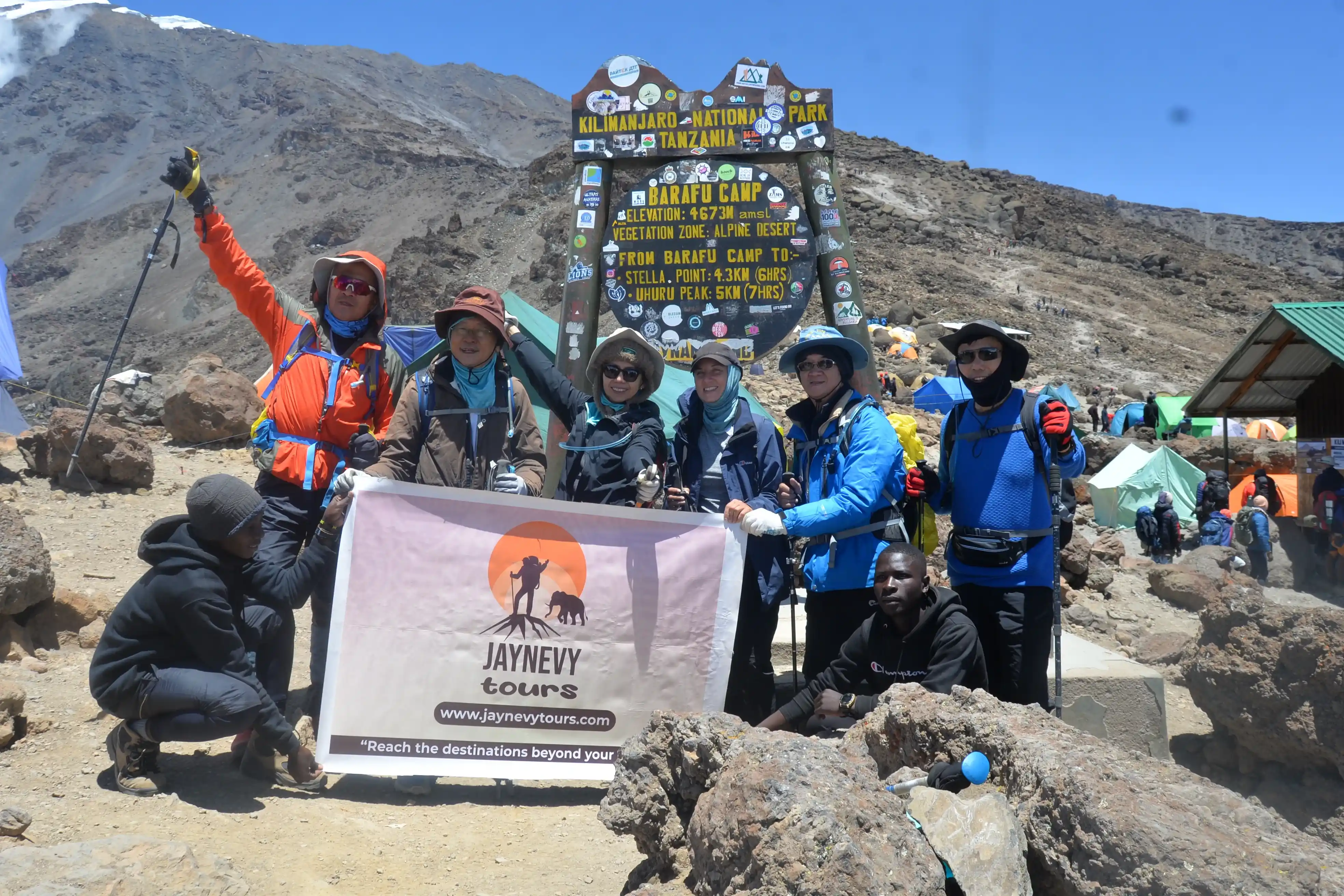
On the 6-day Machame, Day 4 runs from Barranco Camp over the Barranco Wall and all the way to Barafu Camp at 15,354 ft (4,680 m): about 6 miles (9 km) and 7–8 hours. A few hours later you start the summit push. On the 7-day climb that day is split in two, with a night at Karanga Camp (13,238 ft / 4,035 m) in between. You arrive at Barafu rested, after two short days, rather than tired from a long one.
The figures most often quoted for the effect of extra days come from Kilimanjaro National Park records collected in the early 2000s, across all routes. They are old, and every climber and operator is different, but the pattern is clear and matches what guides see today:
| Days on the mountain | Climbers who reached the summit (all routes) |
|---|---|
| 5 days | 27% |
| 6 days | 44% |
| 7 days | 64% |
| 8 days | 85% |
Source: Kilimanjaro National Park (KINAPA) statistics from the early 2000s, as published by several operators. Today's rates are higher across the board because climbers and crews know more about acclimatization, but the gap between short and longer climbs remains. A medical study of 181 climbers on 4- and 5-day Marangu climbs, published in Wilderness & Environmental Medicine in 2009, found that 77% developed acute mountain sickness and 61% reached the summit.
The Machame route also has a built-in acclimatization day. On Day 3 you climb to Lava Tower at about 15,100 ft (4,600 m), then descend to sleep at Barranco Camp at about 13,000 ft (3,960 m). Climbing high and sleeping lower lets your body respond to the higher altitude without spending the night there. Read more in our guide to acclimatization on Kilimanjaro.
The 7-Day Machame Route at a Glance
Machame Gate – Machame Camp – Shira Camp – Lava Tower – Barranco Camp – Karanga Camp – Barafu Camp – Uhuru Peak – Mweka Camp – Mweka Gate.
You go up the southwest side of the mountain and come down the southeast side on the Mweka trail, so you never walk the same path twice.
| Day | Sleep at | Altitude | Distance | Walking time |
|---|---|---|---|---|
| 1 | Machame Camp | 10,007 ft (3,050 m) | About 7 miles (11 km) | 5–6 hours |
| 2 | Shira Camp | 12,631 ft (3,850 m) | About 3 miles (5 km) | 4–5 hours |
| 3 | Barranco Camp (via Lava Tower, 15,100 ft / 4,600 m) | 12,992 ft (3,960 m) | About 6 miles (10 km) | 6–8 hours |
| 4 | Karanga Camp | 13,238 ft (4,035 m) | About 3 miles (5 km) | 4–5 hours |
| 5 | Barafu Camp | 15,354 ft (4,680 m) | About 2.5 miles (4 km) | 3–4 hours |
| 6 | Mweka Camp (via Uhuru Peak, 19,341 ft / 5,895 m) | 10,138 ft (3,090 m) | About 11 miles (17 km) | 10–14 hours |
| 7 | Hotel in Moshi (via Mweka Gate, 5,512 ft / 1,680 m) | — | About 6 miles (10 km) | 3–4 hours |
The altitudes and walking times are the ones our guides plan with. Your own pace and the weather decide the actual times.
7-Day Machame Itinerary: Why Each Day Matters
Each day below has a job in the climb. The first two days lift you gently out of the forest. Day 3 trains your body for altitude. Days 4 and 5 are deliberately short so you reach summit night with energy left.
-
Day 1: Machame Gate (6,004 ft / 1,830 m) to Machame Camp (10,007 ft / 3,050 m)
We collect you from your hotel in Moshi after breakfast for the drive of about an hour to Machame Gate. While your guide registers the climb with the park, the porters weigh and pack the loads. Then you walk about 7 miles (11 km), 5–6 hours, up a ridge through thick rainforest, with a packed lunch on the way.
The forest is warm and humid and the trail is often muddy, so gaiters and trekking poles help. Walk slower than feels necessary: the saying you will hear from every guide is pole pole, Swahili for "slowly, slowly". Your tent is up when you reach camp at the edge of the forest.
Purpose: an easy start; leave the forestRainforestLunch, dinner -
Day 2: Machame Camp to Shira Camp (12,631 ft / 3,850 m)
About 3 miles (5 km) and 4–5 hours up a steep, rocky path through heath and moorland, with giant heather and the first views across to Kibo's glaciers. You climb onto the edge of the Shira Plateau, a collapsed volcanic cone, and reach camp by early afternoon.
The short day matters. You gain 2,620 ft (800 m) of altitude, and the afternoon gives your body time to start adjusting. A short walk above camp before dinner helps. Some climbers feel a mild headache here; tell your guide at the evening health check.
Purpose: gain height gentlyHeath and moorlandBreakfast, lunch, dinner -
Day 3: Shira Camp to Lava Tower and down to Barranco Camp (about 13,000 ft / 3,960 m)
About 6 miles (10 km) and 6–8 hours, and the most important day for acclimatization. You climb east across alpine desert to Lava Tower, a 300 ft (90 m) volcanic plug at about 15,100 ft (4,600 m), and usually have lunch near it. Then you descend into the Barranco Valley, past giant groundsels, to sleep 2,100 ft (640 m) lower than your high point.
Many climbers feel the altitude at Lava Tower: a headache, breathlessness or a loss of appetite. That is the point of the day. Going high and coming down to sleep is the best preparation you can give your body for the summit.
Purpose: climb high, sleep lowAlpine desertBreakfast, lunch, dinner -
Day 4: Barranco Camp to Karanga Camp (13,238 ft / 4,035 m)
About 3 miles (5 km) and 4–5 hours. The day starts with the Barranco Wall, an 820 ft (250 m) rock face you climb on a trail of ledges and steps. It is a scramble, not a technical climb: you use your hands in a few places, but no ropes or climbing experience are needed, and your guide shows you each step. From the top you cross ridges and valleys to Karanga Camp, with the southern glaciers above you.
This is the night the 6-day climb doesn't have. You arrive by lunchtime and spend the afternoon resting at an altitude only slightly above Barranco.
Purpose: the extra acclimatization nightAlpine desertBreakfast, lunch, dinner -
Day 5: Karanga Camp to Barafu Camp (15,354 ft / 4,680 m)
About 2.5 miles (4 km) and 3–4 hours up a rocky ridge to the summit base camp. The walk is short on purpose: you will need your energy for the 10–14 hours that start in a few hours' time.
The afternoon has a routine. Your guide gives the summit briefing, checks your blood-oxygen and pulse, and goes through your clothing and equipment with you. Lay out your summit layers, fill your water bottles, put fresh batteries in your headlamp and keep bottles and phone inside your sleeping bag so they don't freeze. Dinner is early, and you sleep from about 7 pm. Most climbers sleep badly at this altitude; that is normal, and resting with your eyes closed still helps.
Purpose: arrive rested; prepareAlpine desertBreakfast, lunch, dinner -
Day 6: Barafu Camp to Uhuru Peak (19,341 ft / 5,895 m), then down to Mweka Camp (10,138 ft / 3,090 m)
About 11 miles (17 km) and 10–14 hours in total: summit night, then a long descent. You climb about 3,900 ft (1,200 m) to the summit and then descend about 9,200 ft (2,800 m) to Mweka Camp. The next section explains the night step by step.
Purpose: the summitArctic summit zoneSnacks, lunch, dinner -
Day 7: Mweka Camp to Mweka Gate (5,512 ft / 1,680 m), drive to Moshi
About 6 miles (10 km) and 3–4 hours down through the rainforest, on a trail that is often wet and slippery: poles help your knees. At Mweka Gate you sign out of the park and receive your summit certificate: a green certificate for Stella Point, gold for Uhuru Peak. This is usually where climbers thank and tip the crew. We drive you back to your hotel in Moshi for a shower and your night after the climb.
Purpose: descend; certificatesRainforestBreakfast
Summit Night on the Machame Route, Step by Step
Summit night is the hardest part of any Kilimanjaro climb. You walk slowly uphill in the dark and the cold for 6–8 hours, at altitudes where each breath holds about half the oxygen it would at sea level. Knowing what to expect makes it easier.
| Time (approximate) | What happens |
|---|---|
| 11 pm | Wake-up, tea and biscuits, health check, layers on |
| Midnight | Start from Barafu Camp by headlamp, in a slow line behind your guide |
| Midnight – 5 am | Steep zigzags on loose volcanic scree; short rests only, to stay warm |
| 5 – 6 am | Stella Point (about 18,900 ft / 5,756 m) on the crater rim, often at sunrise |
| 6 – 7 am | About an hour along the rim to Uhuru Peak (19,341 ft / 5,895 m); photos, then start down |
| 9 – 11 am | Back at Barafu: rest, food and drink |
| Midday – 4 pm | Descend to Mweka Camp (10,138 ft / 3,090 m); thicker air, and most climbers feel much better |
Temperatures on the upper mountain at night are usually well below freezing, and the wind makes it feel colder. Wear all your layers from the start, keep water in insulated bottles or close to your body so it doesn't freeze, and eat small snacks even if you are not hungry. Your guide watches each climber closely on this night; if anyone shows signs of serious altitude sickness, a guide takes them down at once while the rest of the group continues.
Plan for the descent too. Coming down 9,200 ft (2,800 m) in one afternoon is hard on the knees, and trekking poles make a real difference.
Altitude Sickness and How We Manage It on the Machame Route
Most climbers feel some effect of altitude above 11,500 ft (3,500 m): a headache, poor sleep, less appetite or breathlessness. That is normal. What matters is spotting the signs that it is getting worse, and going down when it does.
Your guide checks your blood-oxygen saturation and pulse with a pulse oximeter every morning and evening at camp, and asks how you feel: headache, nausea, dizziness, sleep, appetite. The readings alone don't decide anything; low oxygen readings are normal at altitude. What the guide looks for is the combination: readings falling day after day together with worsening symptoms, or any sign of confusion, loss of balance, or a cough with breathlessness at rest. Those signs mean descent, whatever the time of day.
- Pulse-oximeter health check morning and evening at every camp
- Emergency oxygen, a first-aid kit and a stretcher carried on every climb
- A climb-high, sleep-low profile via Lava Tower on Day 3
- A slow pace from the first hour, and a full day's walk between each altitude gain
- If you need to go down, a guide descends with you while the rest of the group continues
What you can do: walk slowly, drink 3–4 liters of water a day, eat even when you don't feel like it, and tell your guide honestly how you feel. Talk to your doctor before the trip about acetazolamide (Diamox), which many climbers take to help acclimatization, and about any medical conditions. If a climber can't walk down, the crew carries them on the stretcher to the park's rescue team, and for serious cases we arrange a helicopter evacuation through companies such as Pro Flight. Make sure your travel insurance covers trekking up to 19,700 ft (6,000 m) and helicopter evacuation.
How Hard Is the 7-Day Machame?
It is a hard trek, but not a technical climb. You need no ropes or climbing skills. You do need to walk several hours a day for six days in a row, sleep in a tent, cope with cold nights, and push through one very long summit day at high altitude.
| Challenge | What it means for you |
|---|---|
| Altitude | The real difficulty. Fitness doesn't protect you from altitude sickness; time and pace do |
| Summit night | 6–8 hours uphill in the dark and cold, then 6–8 hours down |
| Barranco Wall | An 820 ft (250 m) scramble with hands in places; exposed in short sections but not technical |
| Steep descents | Long downhill days on Days 6 and 7; hard on the knees |
| Camping | Six nights in tents, with temperatures near or below freezing at the higher camps |
To prepare, spend the 8–12 weeks before the climb walking hills or stairs with a loaded daypack, building up to two long walks of 5–6 hours on consecutive days. Wear in your boots on those walks. Our guide to how hard Kilimanjaro is and how to train has a fuller plan.
Your Kilimanjaro Guide and Crew
Every climber on our Kilimanjaro climbs has a crew of seven: one mountain guide, one cook and five porters. For two climbers that is a crew of 14. The crew carries the tents, food, water, a mess tent with table and chairs, a private portable toilet tent and the safety equipment, so you carry only a daypack with water, snacks, layers and a camera. Our tents and mountain gear come from major international outdoor brands such as Patagonia and The North Face.
Our mountain guides are certified through Tanzanian universities and have three years of guiding experience. They are licensed by Kilimanjaro National Park, as every guide on the mountain must be, and they make the decisions about pace, rest and safety. Our cooks prepare all meals on the mountain, and hot drinks are served at every camp.
Each porter carries no more than 18 kg (40 lb), which is why every climber needs five. We have been a KPAP partner since 2023: the Kilimanjaro Porters Assistance Project checks its partner companies for fair pay, proper equipment and fair load limits. We are also members of TATO, the Tanzania Association of Tour Operators. Our founder, Julius Nyange, worked as a tour guide for six years before starting the company, and our Kilimanjaro guides include Maneno Mtoka.
Food on the mountain
Your cook prepares three meals a day and doesn't repeat a meal during the climb, so the menu changes every day. Meals are built around filling staples such as potatoes, rice, spaghetti and chicken, and every lunch and dinner starts with a fresh soup, such as potato, pumpkin or cucumber. Soup matters more than it sounds: appetite drops with altitude, and a warm, salty starter helps you drink and eat enough. Vegan, vegetarian and allergy requirements are followed for every meal; tell us when you book.
A typical day on the mountain
Your guide wakes you in the morning with a hot drink, and breakfast is served in the mess tent. You set off with your daypack while the porters pack the camp, overtake you on the trail and have the tents up before you arrive. Lunch is packed or served at camp, depending on the day. Afternoons are for rest and short acclimatization walks. In the evening you have dinner in the mess tent, your guide does the health check and explains the next day's route, and most climbers are asleep by 8 pm.
How Much Does the 7-Day Machame Climb Cost?
The 7-day Machame climb costs from US$2,090 per person for 2 climbers with mid-range hotels in Moshi. It is US$1,915 with budget hotels and US$2,235 with luxury hotels. The price is for a private climb on your own dates.
| Climbers | Budget | Mid-range | Luxury |
|---|---|---|---|
| 1 | US$1,945 | US$2,130 | US$2,325 |
| 2 | US$1,915 | US$2,090 | US$2,235 |
| 3 | US$1,925 | US$2,125 | US$2,225 |
| 4 | US$1,915 | US$2,090 | US$2,235 |
| 5 | US$1,920 | US$2,110 | US$2,230 |
| 6 | US$1,915 | US$2,090 | US$2,235 |
Prices are per person and confirmed in your written quotation.
Where the money goes
Almost half the price is Kilimanjaro National Park fees, which are the same for every operator. For a 7-day Machame climb in 2026 the published non-resident rates add up as follows:
| Park fee (per climber) | Rate | 7-day Machame |
|---|---|---|
| Conservation fee | US$70 per day | US$490 |
| Camping fee | US$50 per night | US$300 |
| Rescue fee | US$20 per climb | US$20 |
| VAT | 18% | US$146 |
| Total park fees | About US$956 |
Park fees change from time to time; your quotation uses the rates on the day you book. Most of the rest pays the mountain crew of seven per climber (wages, food and equipment), the hotel nights in Moshi, transfers, meals, and the safety equipment.
That is also why very cheap Kilimanjaro offers are worth questioning. If the park fees are fixed, a much lower price can only come from somewhere else: fewer crew, underpaid porters, poor tents or sleeping gear, no emergency oxygen, or a shorter itinerary than advertised. Ask any operator how many crew come per climber, what safety equipment they carry, and whether they are KPAP members.
What the 7-Day Machame Price Includes, and What It Doesn't
Park fees, the full mountain crew, meals, camping equipment, safety kit, transfers and two hotel nights are included. Flights, insurance, tips and personal gear are not.
Included
- Kilimanjaro National Park fees, taxes and trekking permits
- A crew of seven per climber: mountain guide, cook and five porters
- Tents, sleeping mats, mess tent with table and chairs, and a private portable toilet tent
- All meals on the mountain, drinking water and hot drinks
- First-aid kit, emergency oxygen, pulse oximeter and stretcher
- Return airport transfers and transfers to and from the park gates
- One hotel night in Moshi before and one after the climb
Not included
- International and domestic flights, and visa fees
- Travel insurance that covers trekking up to 19,700 ft (6,000 m) and helicopter evacuation
- Personal climbing gear (rental available in Moshi)
- Tips for the mountain crew (tipping guide)
- Meals and activities in Moshi, drinks, laundry and personal items
- The card-processing fee when you pay the deposit online
Extra costs to budget for
Tips are the largest. Using the typical daily ranges in our tipping guide (US$20–30 for the guide, US$5–10 for each porter, and counting the cook at the assistant-guide rate of US$10–15), a crew of seven for seven days comes to about US$385–665 per climber. Add gear rental if you need warm items such as a sleeping bag or down jacket, and your visa and insurance.
When Is the Best Time to Climb the Machame Route?
Late May to October and January to March. We don't recommend April, early May, November or the late-December holiday period.
Machame is a camping route that starts on the wetter southern side of the mountain, so the season matters more than on the northern Rongai route. In the long rains of April and May the forest trail on Days 1 and 7 turns to deep mud, and wet tents and clothes make the high camps much colder. July to September brings the clearest skies and the most climbers; January to March is a little warmer and quieter.
| Months | Our advice |
|---|---|
| January – March | Recommended: warmer, quieter, clear mornings |
| April – early May | Not recommended: long rains |
| Late May – October | Recommended: dry season, busiest months |
| November | Not recommended: short rains |
| Late December | Not recommended: holiday crowds |
More detail: the best time to climb Kilimanjaro.
What to Pack for the Machame Route
Layers matter more than anything else, because you go from humid rainforest to temperatures well below freezing in five days. You can rent the bulky warm items in Moshi.
| Category | Essentials |
|---|---|
| Feet | Broken-in waterproof hiking boots, gaiters, hiking and thermal socks |
| Layers | Base layers, fleece, insulated down or synthetic jacket, waterproof jacket and pants |
| Summit night | Warm hat, thick gloves or mittens, buff, insulated water bottles |
| Sleeping | Sleeping bag rated to about 14 °F (−10 °C) (rental available) |
| Daypack | Headlamp and spare batteries, sunglasses, sunscreen, snacks, 3 liters of water capacity |
| Health | Personal medication, blister plasters, hand sanitizer |
If you don't own the warm items, renting them in Moshi costs far less than buying. These are the items 7-day Machame climbers rent most often, with our prices for the whole climb:
| Rental item | Price for the climb |
|---|---|
| Sleeping bag | US$25 |
| Down or synthetic jacket | US$20 |
| Hiking boots | US$25 |
| Gaiters | US$20 |
| Hiking poles | US$15 |
| Headlamp | US$15 |
| Thick waterproof gloves | US$10 |
A sleeping pad is included. We would rather you bring your own broken-in boots if you have them: blisters on Day 2 are a bigger problem than the cost of boots. See the full Kilimanjaro packing list and every price on our gear rental in Moshi page.
7-Day Machame Compared with the 6-Day Machame and 8-Day Lemosho
These are the three climbs first-timers most often choose between. The 7-day Machame sits in the middle on time and price.
| 6-day Machame | 7-day Machame | 8-day Lemosho | |
|---|---|---|---|
| Nights on the mountain | 5 | 6 | 7 |
| Night at Karanga | No | Yes | Yes |
| Barranco to Barafu | One long day (7–8 hours) | Two short days | Two short days |
| Start | Machame Gate, busy | Machame Gate, busy | Londorossi Gate, quiet western forest |
| Best for | Fit climbers with altitude experience | Most first-timers | First-timers wanting the most time |
| Price from (2 climbers, mid-range) | US$1,845 | US$2,090 | US$2,335 |
Full itineraries: the 6-day Machame and the 8-day Lemosho.
If you can afford the time and the extra US$245, the 8-day Lemosho gives you the most gradual ascent we offer. If your schedule allows seven days on the mountain but not eight, the 7-day Machame is the better choice than the 6-day.
Before and After the Climb: Your Nights in Moshi
Your package starts the day you land and ends the morning after you come off the mountain. Here is how the days either side of the climb usually run.
- Arrival day: we meet you at Kilimanjaro International Airport for the drive of about an hour to your hotel in Moshi.
- Gear check: arrival day is the time to try on anything you are renting, so items that don't fit can be swapped before the climb.
- Climb morning: pickup after breakfast; bring your passport, as the park registers every climber at Machame Gate.
- After the climb: a shower, a proper bed and a night in Moshi before your onward travel or safari.
Adding days after the climb
After the climb you have a night in Moshi to rest. If you have a spare day, our day trips around Moshi, such as the Materuni waterfalls and coffee farm or the Chemka hot springs, start from US$115 per person, with lunch, and are an easy way to rest your legs. Many climbers then add a wildlife safari to Tarangire, the Serengeti and the Ngorongoro Crater, or a few days on the beach in Zanzibar. See our Kilimanjaro, safari and Zanzibar combination tour, and where to stay before and after the climb.
Climb Mount Meru first: our own team also runs 3- and 4-day climbs on Mount Meru (4,566 m), from US$1,150 per person. Climbing Meru a few days before Kilimanjaro is the best acclimatization there is, and we quote the two climbs together, with a rest day in Moshi between them.
Booking and Cancellation Terms for Your Kilimanjaro Climb
Pay a 30% deposit to confirm, and the balance on arrival. You get a full refund if you cancel 60 days or more before arrival.
Deposits can be paid through Pesapal by card or mobile money, or by bank transfer in US dollars.
| When you cancel | Refund |
|---|---|
| 60 days or more before arrival | 100% |
| 30–59 days | 90% |
| 15–29 days | 60% |
| 10–14 days | 25% |
| Less than 10 days, or a no-show | No refund |
Full terms: our Kilimanjaro refund policy.
Common Questions About the 7-Day Machame
Can I join a group on the 7-day Machame?
Yes. Our 2027 group departures on the 7-day Machame start on June 22, August 23 and August 27, at the same per-person price as a private climb. See our Kilimanjaro group climbs.
What food is served on the climb?
Three cooked meals a day from your own cook, with soup before every lunch and dinner and no meal repeated during the climb. Vegan, vegetarian and allergy requirements are followed; tell us when you book.
What is the difference between the 6-day and 7-day Machame?
The 7-day climb adds a night at Karanga Camp (13,238 ft / 4,035 m) between Barranco and Barafu. The long Barranco-to-Barafu day becomes two short days, and you get one more night to acclimatize before the summit.
Can a beginner climb the 7-day Machame?
Yes. It is the climb we recommend most often to first-timers. You need good walking fitness and no climbing skills. Train with long hill walks for 8–12 weeks before the climb.
Is the Barranco Wall dangerous?
It is a steep scramble where you use your hands in places, but no ropes or climbing skills are needed. Your guide shows you every step, and porters cross it every day with full loads.
How cold is it on summit night?
Usually well below freezing near the summit, and colder with wind. Wear all your layers, thick gloves and a warm hat, and keep your water insulated. Warm items can be rented in Moshi.
What happens if I get altitude sickness?
Your guide monitors you morning and evening with a pulse oximeter and asks about symptoms. Mild symptoms are common and usually manageable with a slower pace. If signs become serious, a guide takes you down immediately, with oxygen if needed, while the rest of the group continues.
Are there toilets on the Machame route?
There are basic park long-drop toilets at the camps, but we carry a private portable toilet tent for your group on every climb.
Can I charge my phone on the mountain?
There is no electricity on the mountain. Bring a power bank, keep it warm inside your sleeping bag at night, and use airplane mode to save battery. Phone signal is available in some places on the route.
Is the 7-day Machame or the 8-day Lemosho better?
Both are excellent. The 8-day Lemosho has one more day, a quieter start through the western forest and the most gradual ascent. The 7-day Machame costs less and fits a shorter holiday.
Do I need travel insurance?
Yes. Your insurance must cover trekking up to 19,700 ft (6,000 m) and emergency evacuation by helicopter, which we arrange through companies such as Pro Flight when it is needed.
The Bottom Line
If this is your first Kilimanjaro climb and you have seven days for the mountain, the 7-day Machame is the climb we would choose for you. It has the varied scenery of Kilimanjaro's most popular camping route, a built-in acclimatization day at Lava Tower, and the extra night at Karanga that makes summit night more manageable. Choose the 8-day Lemosho if you want more time and quieter trails, and the 6-day Machame only if you have recent experience above 16,400 ft (5,000 m).
To plan your climb, send us your preferred dates, the number of climbers and your hotel level (budget, mid-range or luxury) through the booking form, on WhatsApp +255 678 992 599 or by email to jaynevytours@gmail.com. Our sales team in Moshi will confirm availability and send your written quotation.