
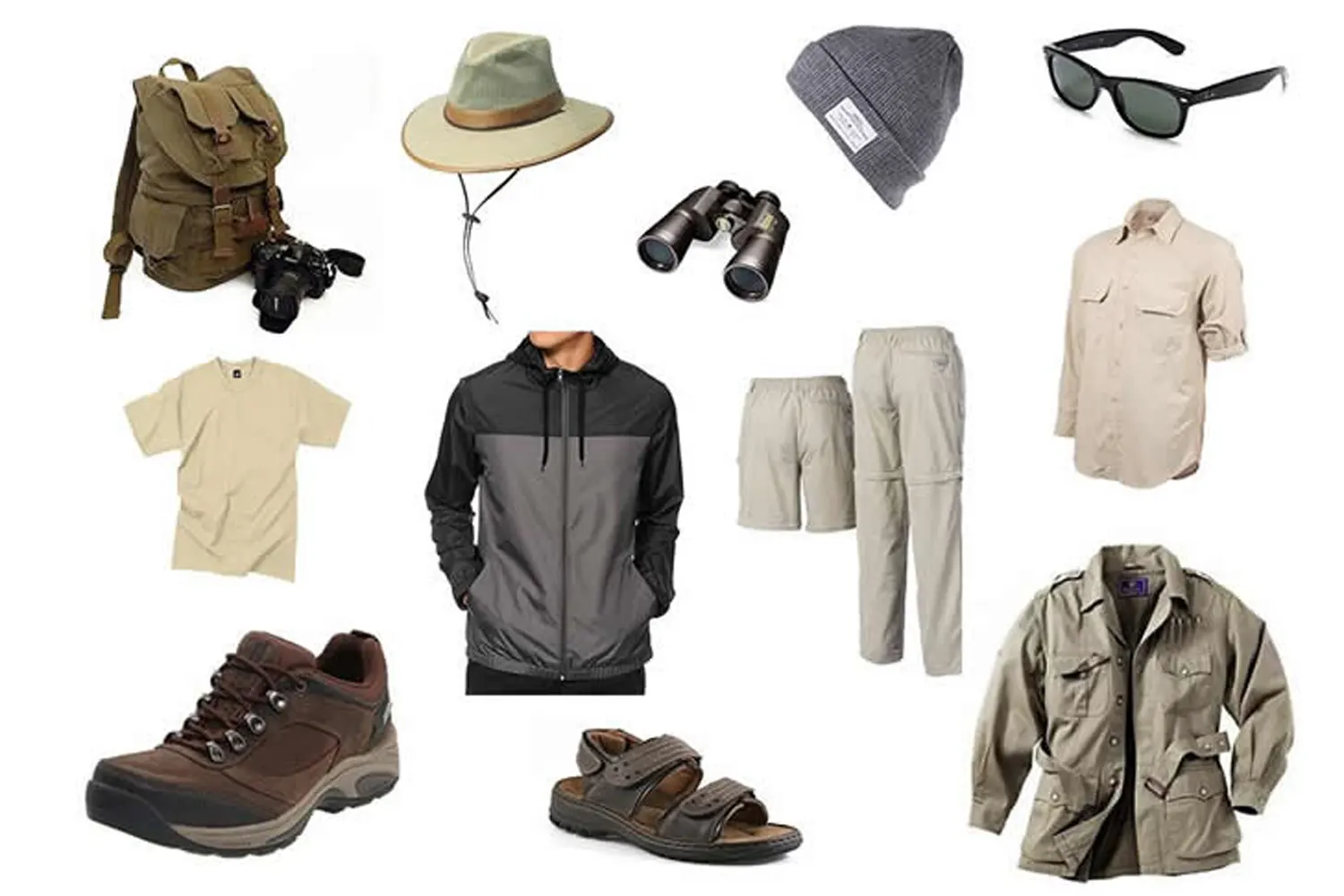
Quick answer: what should you pack for a Tanzania safari?
For a typical five-to-eight-day lodge safari, bring three or four lightweight tops, two safari trousers, one pair of shorts, a fleece or light insulated jacket, a packable rain jacket, comfortable closed shoes, sandals, a sun hat, sunglasses, insect repellent, sunscreen, prescription medicines, binoculars and a compact camera kit. Put travel documents, medicines, valuables, batteries and one change of clothes in your hand luggage.
If a scheduled bush flight is included, use a flexible duffel. Coastal Aviation currently permits 15 kg total per person, including carry-on items, while Auric Air publishes 20 kg total, also including hand luggage, cameras and personal items. Your confirmed airline's rule—not a generic safari list—must determine your final bag weight.
| Pack first | Recommended amount | Why it earns space |
|---|---|---|
| Lightweight shirts | 3–4 | Enough for rotation when laundry is available |
| Long safari trousers | 2 | Sun, dust and insect protection |
| Warm layer | 1 | Open vehicles can feel cold before sunrise and at high elevations |
| Rain shell | 1 compact jacket | Useful in green season and for unexpected showers |
| Closed shoes | 1 comfortable pair | Suitable for game drives, lodge paths and short walks |
| Day bag | 1 small backpack | Keeps water, camera, documents and layers close during drives |
| Binoculars | 1 per traveller or couple | Often more useful than adding another outfit |
| Refillable bottle | 1 | Reduces disposable waste and keeps water accessible |
The master Tanzania safari packing checklist
Use this as a starting point, then remove anything that does not match your itinerary. Travellers continuing to Kilimanjaro need a separate technical list; consult the Kilimanjaro packing checklist rather than trying to use a wildlife-safari list for a mountain climb.
| Category | Bring | Usually optional |
|---|---|---|
| Clothing | Quick-drying tops, long trousers, fleece, rain shell, underwear, socks, sleepwear | Shorts, swimsuit, smart-casual dinner outfit |
| Footwear | Comfortable closed walking shoes and sandals | Hiking boots unless your itinerary includes long walks |
| Sun and insects | Hat, sunglasses, sunscreen, insect repellent | Pre-treated clothing after professional advice |
| Health | Prescriptions, copies of prescriptions, personal first-aid basics, hand sanitiser | Travel medicines recommended by your clinician |
| Wildlife viewing | Binoculars, camera or phone, spare memory and protected batteries | Large tripod; a small beanbag is often easier in a vehicle |
| Documents | Passport, visa record where applicable, insurance, itinerary and emergency contacts | Printed copies in addition to secure digital copies |
| Comfort | Lip balm, tissues, earplugs, reusable bottle, small torch | Travel pillow and dust scarf |
| Bag system | Soft duffel, day bag and small organisers | Packing cubes if they do not add unnecessary weight |
Choose your safari bag before choosing your clothes
Your luggage allowance can change the whole packing strategy. A road-only safari has more space, although an overloaded vehicle is still inconvenient. A fly-in itinerary is stricter because small aircraft have limited payload and narrow baggage compartments.
Bush-flight baggage rules to plan around
| Airline example | Published total allowance | Important detail |
|---|---|---|
| Coastal Aviation | 15 kg / 33 lb | Includes carry-on luggage; soft bags strongly recommended |
| Coastal cargo opening | 76 × 48 × 29 cm | A bag too large for the cargo-pod door may not be accepted |
| Coastal premium option | Up to 30 kg when available | Must be arranged in advance and is subject to availability |
| Auric Air | 20 kg / 44 lb | Includes hand luggage, cameras, filming equipment and personal items |
Do not assume that an international airline's generous allowance carries over to a bush flight. Confirm the exact sector, airline and class before departure. The Tanzania fly-in safari guide explains how light-aircraft travel changes the itinerary as well as the luggage plan.
Best bag setup
- Main bag: one soft-sided duffel that can compress into an aircraft hold.
- Day bag: a small backpack for documents, camera, medicines, water and a warm layer.
- Organisation: lightweight pouches for cables, health items and clean or used clothing.
- Identification: name and contact information outside and inside the bag.
A seven-day safari capsule wardrobe that actually works
This example assumes two lodge laundry opportunities and no formal dress code. Most safari lodges are relaxed. Clean, practical clothes are more useful than specialised “safari fashion”.
| Item | Suggested quantity | Practical note |
|---|---|---|
| Short-sleeve or breathable tops | 2–3 | Choose fabrics that dry quickly |
| Long-sleeve shirts | 1–2 | Useful for sun, dust and evening insects |
| Long trousers | 2 | Neutral colours hide dust better than white |
| Shorts or lightweight skirt | 1 | Better for lodge time than exposed morning drives |
| Fleece or light insulated jacket | 1 | Wear at dawn, then remove as the day warms |
| Packable waterproof shell | 1 | Choose breathable rather than a heavy winter coat |
| Underwear | 5–7 | Small quick-drying pieces are easy to wash |
| Socks | 3–4 pairs | Include one warmer pair for cold mornings |
| Sleepwear | 1 set | Night temperatures vary by location |
| Swimsuit | 1 | Only when your lodge or beach extension has a pool |
Earth tones such as khaki, olive, tan, grey and muted green are practical, but matching safari outfits are not required. Avoid packing an entire wardrobe of white because dust shows quickly. Pack clothes you already know are comfortable when seated for several hours.
What to wear on an early-morning game drive
- Start with a breathable base layer.
- Add a long-sleeve shirt or fleece.
- Wear long trousers and closed shoes.
- Keep a light windproof or waterproof jacket in the vehicle.
- Use a hat and sunglasses after sunrise.
- Remove layers gradually rather than dressing only for the afternoon temperature.
Ngorongoro's rim and other highland areas can feel markedly cooler than the low plains. Open-sided or pop-up-roof vehicles also create wind chill. The answer is layering, not one bulky coat.
How the season changes your packing list
Review the best time for a Tanzania wildlife safari before finalising clothing. Calendar labels are helpful, but current local forecasts should still be checked close to departure.
| Travel period | Add to your bag | Main packing issue |
|---|---|---|
| June–October dry season | Extra lip balm, moisturiser, dust scarf, warm dawn layer | Dust, dry air and cold early starts |
| November–December short rains | Packable rain jacket and quick-drying shoes | Showers can be brief but roads and paths may be wet |
| January–February warmer period | High-priority sun protection and breathable clothing | Heat during the middle of the day |
| March–May longer rains | Reliable waterproof shell, spare socks, bag rain cover | Heavier rain and slower drying |
| Any month in Ngorongoro highlands | Fleece and windproof layer | Elevation makes mornings cooler than many travellers expect |
Footwear: most travellers need only two pairs
For a normal vehicle-based safari, one pair of broken-in trainers or light walking shoes and one pair of sandals is enough. Heavy mountaineering boots add weight and are unnecessary unless the itinerary includes serious trekking.
- Closed shoes: lodge paths, game drives, airstrips and guided walks.
- Sandals: lodge rooms, pool areas and relaxed evenings.
- Waterproof hiking shoes: useful for Udzungwa, chimp trekking or sustained wet-season walking.
- Avoid brand-new shoes: test footwear before travel to prevent blisters.
Check the exact activities in your chosen Tanzania safari package. A walking safari, chimp trek and standard Serengeti game drive require different footwear.
Sun, dust and insect protection
TANAPA's visitor guidance recommends neutral clothing, light layers, a warm layer, hat, sunglasses, rain jacket, binoculars, insect repellent, first-aid basics and a torch. That concise list covers the most common field needs.
- Broad-spectrum sunscreen and lip protection.
- Wide-brim or secure cap that will not blow away easily.
- UV-protective sunglasses with a hard case.
- Insect repellent suitable for your age and health needs.
- Long sleeves and trousers for dawn, dusk and insect-prone areas.
- Buff, scarf or mask for dusty roads if you are sensitive to dust.
CDC's Tanzania packing guidance lists alcohol-based hand sanitiser containing at least 60% alcohol and sunscreen of SPF 15 or higher among health supplies. Many travellers choose stronger sun protection for long outdoor days.
Medicines and health supplies: pack personal essentials, not a pharmacy
Arrange a travel-health appointment at least a month before departure when possible. Tanzania health recommendations depend on route, age, medical history, previous vaccinations and transit countries. Do not choose prescription medicines from a generic internet checklist.
CDC currently identifies malaria risk in Tanzanian areas below 1,800 metres and advises travellers to discuss suitable prevention with a clinician. Yellow-fever entry requirements can depend on the country you arrive from and long airport transits in a risk country.
- Prescription medicines in original labelled packaging.
- Enough medication for the whole trip plus a small delay margin.
- Copies showing generic medicine names.
- Spare glasses or contact lenses when needed.
- Small first-aid basics: plasters, antiseptic, pain relief you normally use and oral rehydration salts.
- Travel insurance details and emergency-assistance contact.
Travellers carrying syringes or controlled prescription medicines should confirm documentation and legality with the relevant airline and Tanzanian authorities before travel.
Documents and money to keep in your day bag
| Document or item | Best practice |
|---|---|
| Passport | Carry securely and check validity and blank-page requirements before travel |
| Visa or entry approval | Save an offline copy and print one copy |
| Travel insurance | Include medical evacuation and emergency contact details |
| Safari itinerary | Store lodge names, dates and operator contacts offline |
| Vaccination record | Carry proof when required by your route |
| Bank cards | Carry at least two methods separately and notify banks when appropriate |
| Cash | Use a modest amount for tips and small purchases; avoid displaying large amounts |
| Copies | Keep encrypted digital copies and one paper set separate from originals |
For broader preparation, read the first-time safari guide for Tanzania and the Tanzania safari cost guide.
Camera equipment: pack for the vehicle you will use
A phone can produce excellent landscapes and close wildlife images, but distant subjects benefit from an optical zoom lens. The most useful kit is one you can handle quickly without blocking other guests or changing lenses constantly in dust.
| Traveller | Practical kit | What not to overpack |
|---|---|---|
| Phone photographer | Phone, protective case, power bank and cleaning cloth | Multiple clip-on lenses of doubtful quality |
| Enthusiast | Camera body, versatile telephoto, wider lens, spare battery and cards | Every lens owned |
| Serious wildlife photographer | Two bodies, long lens, mid-range lens, beanbag and backup storage | Large tripod unless specifically needed outside the vehicle |
| Family | One shared camera plus phones and binoculars | Duplicated heavy equipment for every person |
Confirm vehicle seating and whether game drives are private or shared. Equipment that works in a private vehicle may be awkward with six guests. See the best Tanzania safaris for photography and Tanzania photography safari guide.
Protect electronics from dust
- Use a zipped camera bag rather than leaving equipment exposed.
- Carry a blower and microfibre cloth.
- Change lenses inside the vehicle with windows closed when practical.
- Back up photographs each evening when possible.
- Do not leave batteries or cameras in direct sun inside a parked vehicle.
Batteries, power banks and charging
IATA guidance states that spare lithium batteries and power banks belong in carry-on baggage, not checked luggage. Protect terminals from short circuits and confirm your airline's capacity limits. If a small-aircraft operator takes your day bag for hold loading, remove spare batteries and power banks first.
- Universal travel adaptor compatible with your devices.
- One compact multi-port charger instead of several bulky plugs.
- Power bank within airline limits.
- Spare camera batteries in protective cases.
- Charging cable for every device, clearly labelled.
- Small headlamp or torch for tented camps and power interruptions.
Some remote camps use solar systems and may limit high-power appliances. Hair dryers and other heating devices are often unnecessary or unsupported.
Binoculars may improve your safari more than another lens
Binoculars let you study distant cats, birds and animal behaviour without waiting for the vehicle to move. An 8× or 10× model with a comfortable neck strap is practical for most travellers. Children may find compact, lighter binoculars easier to hold.
Do not assume every safari vehicle supplies enough binoculars for all guests. Ask before departure and pack your own when wildlife observation is important.
What to pack in the game-drive day bag
- Camera or phone and binoculars.
- Passport or required park documentation only when advised.
- Prescription medicines and personal emergency items.
- Water bottle.
- Fleece or light jacket.
- Hat, sunscreen and insect repellent.
- Tissues, hand sanitiser and a small waste pouch.
- Power bank and protected spare batteries.
- Small snack when not supplied.
Keep the bag compact. Vehicle floors fill quickly with camera bags, lunch boxes, water and passenger belongings.
Packing for children on safari
Families need more preparation, not necessarily more luggage. Request age-appropriate child seats before booking because they may not be standard equipment. Read the Tanzania family safari guide for pacing and accommodation considerations.
- Familiar snacks for long drives and flight delays.
- Sun hat, sunglasses and age-suitable sunscreen and repellent.
- One quiet activity for transfer periods.
- Spare outfit in the day bag.
- Any essential medicine plus written dosing instructions from a clinician.
- Child-sized binoculars when appropriate.
- Reusable bottle that does not leak.
Avoid filling the vehicle with large toys. Wildlife, maps, a notebook and simple spotting games usually provide better entertainment.
Safari plus Zanzibar: add a separate small capsule
A beach extension needs swimwear, sandals and lighter clothing, but Stone Town and local villages call for modest dress. Pack shoulders-and-knees coverage that is comfortable in warm weather. Review available Zanzibar beach holidays to see whether the stay includes water activities or formal resort dining.
| Add for Zanzibar | Reason |
|---|---|
| 1–2 swimsuits | Allows one to dry while the other is used |
| Light modest outfit | Appropriate for Stone Town and community areas |
| Sandals or water shoes | Useful for beaches and some reef conditions |
| Small dry bag | Protects phone and documents on boat trips |
| Reef-conscious sun protection | Useful for prolonged coastal exposure |
Important Tanzania rules that affect your luggage
Plastic carrier bags
Tanzania bans plastic carrier bags for environmental reasons. Travellers may be asked to surrender them on arrival. Security zip-lock bags used for airline liquid procedures are treated differently, but disposable shopping bags should not be packed.
Drones
Do not arrive with a drone assuming it can be used casually. TCAA states that non-residents need an import permit, drone registration, operator registration and an operations permit. Applications should be started at least three weeks before arrival. National-park permissions may also be required.
Power banks
Carry power banks and spare lithium batteries in hand baggage, protected from short circuit. Do not put them in checked luggage.
What should you leave behind?
| Leave behind | Why | Better alternative |
|---|---|---|
| Rigid oversized suitcase for bush flights | May not fit the aircraft cargo opening | Compressible soft duffel |
| Too many outfits | Adds weight and rarely improves the trip | Small capsule wardrobe plus laundry |
| Heavy winter coat | Bulky for most safari routes | Base layer, fleece and light shell |
| Brand-new hiking boots | Risk of blisters and unnecessary weight | Broken-in walking shoes |
| Expensive jewellery | Easy to lose and draws unwanted attention | Simple watch and minimal valuables |
| Large hard tripod | Awkward inside a game-drive vehicle | Beanbag, monopod or stabilised lens when appropriate |
| Unpermitted drone | Can be confiscated and cannot be operated legally | Apply correctly or leave it home |
| Disposable plastic carrier bags | Restricted by Tanzanian environmental law | Reusable cloth or washable organiser bags |
| Power bank in checked baggage | Conflicts with lithium-battery safety rules | Protected power bank in hand luggage |
| Irreplaceable items | Loss or damage can disrupt the trip | Carry only what you need and insure valuable equipment |
Does lodge laundry mean you can pack less?
Yes. Laundry is one of the easiest ways to reduce weight, especially on a seven-to-ten-day itinerary. Ask whether it is included, chargeable or unavailable for certain personal items. Allow at least a day for clothes to dry, and do not send your only warm layer for washing before an early departure.
For route planning, compare the locations in the guide to combining Tanzania national parks. Moving every night gives less time for laundry than staying two or three nights in one camp.
Packing list by safari length
| Safari length | Clothing strategy | Laundry plan |
|---|---|---|
| 2–3 days | Two tops, one or two trousers, warm layer and rain shell | Usually unnecessary |
| 4–5 days | Three tops, two trousers and one lodge outfit | Optional once |
| 6–8 days | Three or four tops, two trousers, shorts and layered outerwear | Plan one or two washes |
| 9–14 days | Use the same capsule rather than doubling quantities | Schedule laundry every three to five days |
| Safari plus beach | Add a small coastal capsule rather than a second suitcase | Use hotel laundry between sections |
48-hour final packing check
- Reconfirm the smallest baggage allowance on your itinerary.
- Weigh the main bag and the day bag together when the airline counts total luggage.
- Move medicines, documents, valuables and batteries to hand luggage.
- Check the weather for every destination, not only Arusha or Zanzibar.
- Confirm lodge laundry, hair-dryer and charging arrangements.
- Download itinerary, insurance and contact details for offline access.
- Remove disposable plastic carrier bags.
- Verify any drone, medical-device or specialist-equipment permission.
- Pack one change of clothing in hand luggage.
- Leave spare space for comfort and souvenirs.
Frequently asked questions
What colours should I wear on a Tanzania safari?
Neutral, muted colours such as khaki, olive, tan and grey are practical because they suit the environment and hide dust. Special safari clothing is not compulsory.
Can I wear jeans on safari?
Yes, but jeans are heavier, dry slowly and can feel restrictive on long drives. Lightweight trousers are usually more comfortable.
Do I need hiking boots?
Not for a standard vehicle safari. Broken-in trainers or light walking shoes are normally enough. Bring hiking footwear for routes involving longer walks or trekking.
How much luggage can I take on a bush flight?
It depends on the airline. Coastal publishes 15 kg total including carry-on items, while Auric publishes 20 kg total including cameras and personal items. Confirm your actual booking.
Should I use a hard suitcase or soft duffel?
A soft duffel is safest when light aircraft are involved. A hard suitcase can work on a road-only safari but may be awkward in the vehicle.
Do safari lodges offer laundry?
Many do, but the price, turnaround time and items accepted vary. Confirm before relying on it and keep one complete outfit available.
Do I need binoculars?
They are strongly recommended. Binoculars improve distant wildlife and bird viewing and are often used more frequently than travellers expect.
Can I bring a drone to Tanzania?
Only with the required permissions. TCAA lists import, registration, operator and operations requirements for non-residents and advises applying at least three weeks ahead.
Can I pack a power bank in checked luggage?
No. IATA guidance places power banks and spare lithium batteries in carry-on baggage, with terminals protected against short circuit.
What should I pack for Ngorongoro?
Pack a fleece or light insulated layer and windproof shell for the cool rim and early crater descent, even when the plains are warm later in the day.
What should I pack during the rainy season?
Add a breathable waterproof jacket, bag cover, quick-drying footwear and spare socks. Avoid heavy cotton that remains wet for long periods.
How early should I prepare health items?
Arrange professional travel-health advice at least a month before the trip when possible, because recommendations depend on your route, health and transit history.
Official sources checked for this guide
This guide was reviewed on 29 July 2026 against current official or primary guidance. Airline policies, health advice and permit rules can change, so reconfirm them before departure.
- Coastal Aviation luggage policy
- Auric Air baggage policy
- TANAPA trip-planning and packing guidance
- TCAA drone permit procedures
- CDC Tanzania healthy travel packing list
- IATA portable electronics and battery guidance
Build the packing list around the itinerary—not the other way around
A traveller on a road safari through Tarangire, Serengeti and Ngorongoro can carry more than someone flying to a remote airstrip, but extra luggage still creates daily inconvenience. Start with the route, activities and strictest airline allowance, then add only items that solve a real need. Compare the available Tanzania safari itineraries, confirm the vehicle and lodge services, and send your operator any medical equipment, child-seat or camera-space requirements before arrival.