What You Need to Know: The 8-day Lemosho is the most gradual climb we run and the one we recommend to first-timers who can spare eight days. It costs from US$2,335 per person (2 climbers, mid-range hotels), with 7 nights on the mountain: a quiet western start, two days across the Shira Plateau, a high night near Moir Hut at 13,800 ft (4,200 m), then Lava Tower, the Barranco Wall and Karanga before the summit from Barafu. Choose the 7-day Machame if you have one day less.
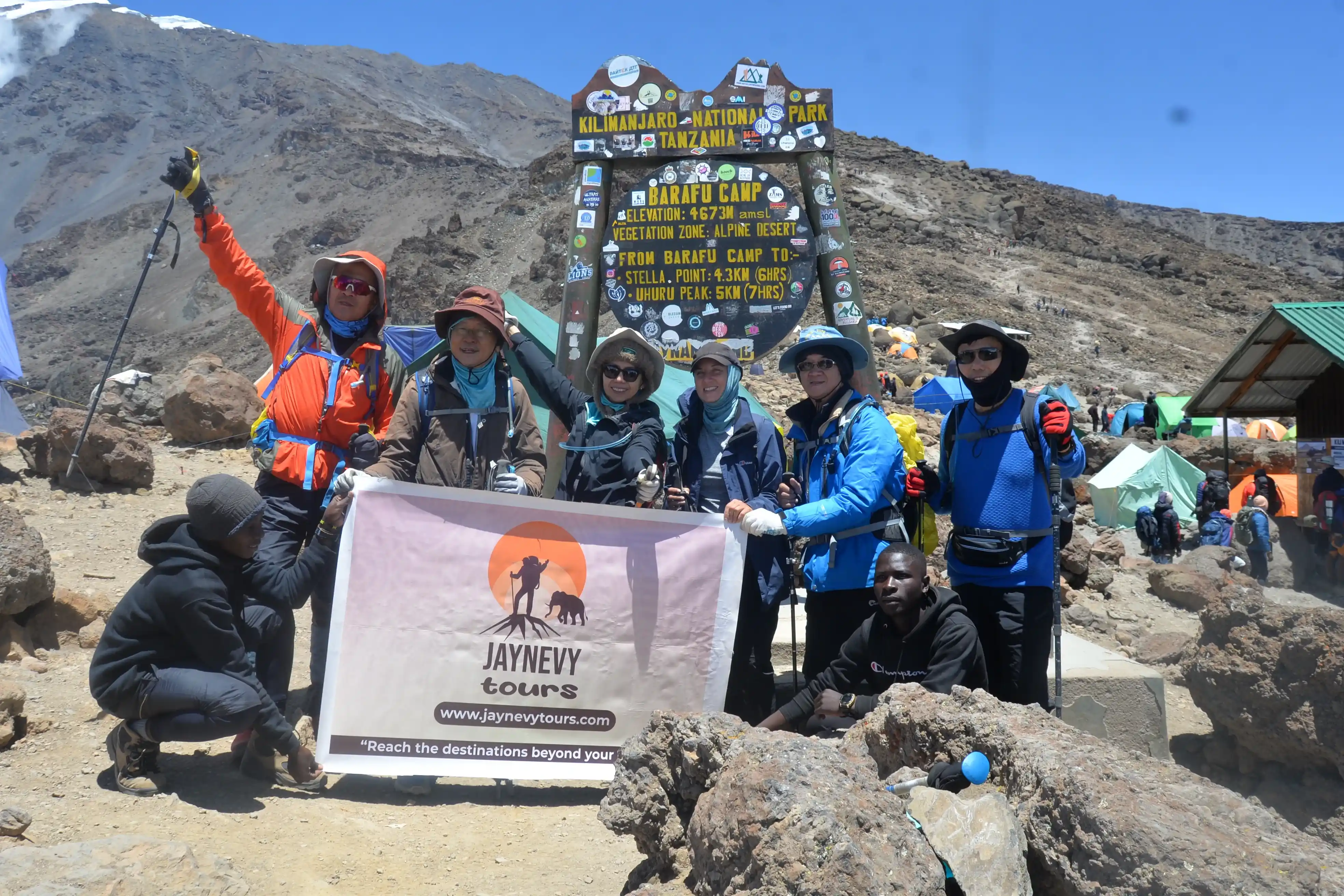
Our Lemosho route guide has the park's own distances from Lemosho Gate and Mti Mkubwa and an elevation profile of this 8-day plan.
Is the 8-Day Lemosho Climb Right for You?
It is the right climb if this is your first high mountain and you can give it eight days, you would like quiet trails for the first days, and you want the most comfortable acclimatization profile we offer. It is not the right climb if your holiday only allows six or seven days on the mountain, or if you would rather sleep in huts.
Lemosho starts on the far western side, where few climbers begin, and joins the busier southern circuit at Lava Tower. You get the quiet of the west, the scenery of the south and, on this version, an extra night that the 7-day Lemosho doesn't have.
| The 8-day Lemosho suits you if… | Consider another climb if… |
|---|---|
| This is your first climb above 13,100 ft (4,000 m) | You have seven days, not eight: the 7-day Lemosho or 7-day Machame |
| You are climbing on your honeymoon: see our honeymoon climb on this route | You want a honeymoon with a safari and beach too: the 19-day adventure honeymoon |
| You want the most gradual ascent we offer | You want to sleep in huts: the 6-day Marangu |
| You prefer quiet trails for the first days | You are climbing in the rainy months: the drier north side on the Rongai route |
| You can walk 5–7 hours a day, several days in a row | You want even more time and the fewest people: the 9-day Northern Circuit |
Comparing routes? Our route-choice guide puts them side by side, and the Kilimanjaro packages page lists every climb with its price.
Why Eight Days on Lemosho Gives You the Best Chance
Because every extra night lets your body adjust before summit night, and on this climb the extra nights come where they help most. Compared with the 7-day Lemosho, the long plateau crossing is split over two days, and you sleep near Moir Hut at 13,800 ft (4,200 m) before crossing to Lava Tower and down to Barranco.
Kilimanjaro National Park records from the early 2000s showed 64% of climbers reaching the summit on 7-day climbs and 85% on 8-day climbs, across all routes. The figures are old and today's rates are higher everywhere, but the pattern is what guides still see: the more time you give the mountain, the better you feel on summit night.
The 8-day climb costs US$245 more per person than the 7-day Lemosho, a small part of the cost of flying to Tanzania. If you can take the extra day, take it.
The 8-Day Lemosho Route at a Glance
Londorossi Gate – Mti Mkubwa – Shira 1 – Moir Hut – Lava Tower – Barranco – Karanga – Barafu – Uhuru Peak – Mweka Camp – Mweka Gate.
You go up the western side and come down the south-east on the Mweka trail, so you never walk the same path twice.
| Day | Sleep at | Altitude | Walking time |
|---|---|---|---|
| 1 | Mti Mkubwa Camp | About 8,700 ft (2,650 m) | 3–4 hours |
| 2 | Shira 1 Camp | 11,500 ft (3,500 m) | 5–6 hours |
| 3 | Moir Hut camp (via Shira 2) | 13,800 ft (4,200 m) | 5–7 hours |
| 4 | Barranco Camp (via Lava Tower, about 15,100 ft / 4,600 m) | About 13,000 ft (3,960 m) | 6–8 hours |
| 5 | Karanga Camp | 13,238 ft (4,035 m) | 4–5 hours |
| 6 | Barafu Camp | 15,354 ft (4,680 m) | 3–4 hours |
| 7 | Mweka Camp (via Uhuru Peak, 19,341 ft / 5,895 m) | 10,138 ft (3,090 m) | 10–14 hours |
| 8 | Hotel in Moshi (via Mweka Gate, 5,512 ft / 1,680 m) | — | 3–4 hours |
The altitudes and walking times are the ones our guides plan with; your pace and the weather decide the actual times.
8-Day Lemosho Itinerary: Why Each Day Matters
The first three days lift you slowly from the forest to a high night near Moir Hut. Day 4 is the climb-high, sleep-low day at Lava Tower. Days 5 and 6 are short on purpose, so you reach summit night with energy left.
-
Day 1: Londorossi Gate (about 6,900 ft / 2,100 m) to Mti Mkubwa Camp (about 8,700 ft / 2,650 m)
We collect you from your hotel in Moshi after breakfast for the drive west to Londorossi Gate, the longest transfer of any route. While your guide registers the climb, the porters weigh and pack the loads. Then you walk about 4 miles (6 km), 3–4 hours, through rainforest with giant ferns, birds and colobus monkeys.
Mti Mkubwa means 'big tree' in Swahili, and the camp sits under the forest canopy. It is a short first day: walk slower than feels necessary. Every guide on the mountain will tell you pole pole, 'slowly, slowly'.
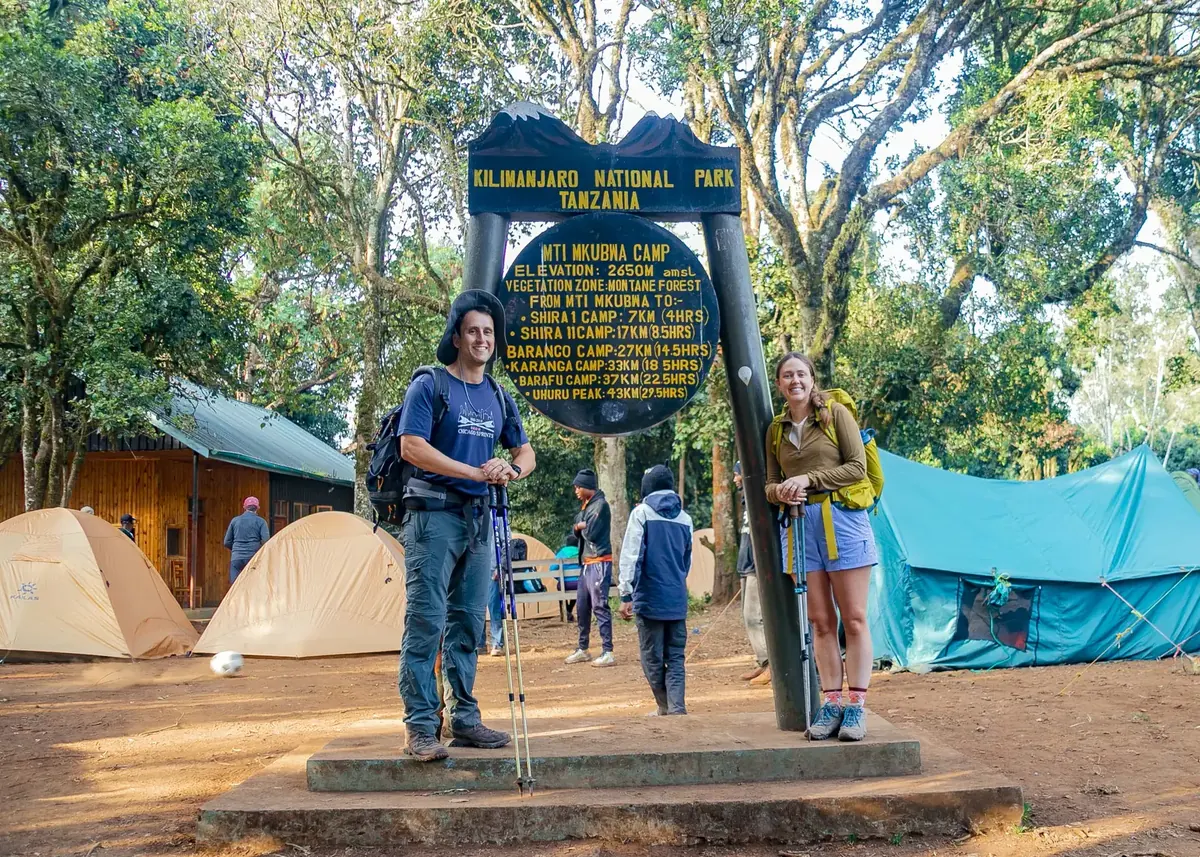 Purpose: an easy start in the forestRainforestLunch, dinner
-
Day 2: Mti Mkubwa to Shira 1 Camp (11,500 ft / 3,500 m)
About 5 miles (8 km) and 5–6 hours out of the forest, through giant heather and moorland, and up onto the western rim of the Shira Plateau. Kibo comes into view for the first time, and on clear afternoons you see Mount Meru to the west.
You gain about 2,790 ft (850 m) today, so a mild headache in the evening is common. Drink well and mention it at the health check.
Purpose: leave the forest; first views of KiboHeath and moorlandBreakfast, lunch, dinner -
Day 3: Shira 1 to Moir Hut camp (13,800 ft / 4,200 m) via Shira 2
About 6–7 miles (10–12 km) and 5–7 hours across the Shira Plateau, a collapsed volcanic caldera, past giant senecios to the camp near Moir Hut on the north-western side of Kibo. This is the day the 7-day Lemosho doesn't have.
Sleeping at 13,800 ft (4,200 m) on Day 3 is a strong acclimatization stimulus, and it makes the next day over Lava Tower easier. Moir Hut is off the main trail, so the camp is usually quiet.
Purpose: a high, quiet acclimatization nightAlpine desertBreakfast, lunch, dinner -
Day 4: Moir Hut to Lava Tower and down to Barranco Camp (about 13,000 ft / 3,960 m)
About 6 miles (10 km) and 6–8 hours. You climb to Lava Tower, a 300 ft (90 m) volcanic plug at about 15,100 ft (4,600 m), usually have lunch near it, then descend into the Barranco Valley past giant groundsels to sleep about 2,100 ft (640 m) lower.
Many climbers feel the altitude at Lava Tower. That is the point of the day: going high and sleeping lower is the best preparation for the summit.
Purpose: climb high, sleep lowAlpine desertBreakfast, lunch, dinner -
Day 5: Barranco Camp to Karanga Camp (13,238 ft / 4,035 m)
First thing, the Barranco Wall: some 820 ft (250 m) of rock ledges where you will use your hands now and then, never ropes. Beyond it the trail rolls across ridges and stream valleys below the southern glaciers to Karanga, about 3 miles (5 km) and 4–5 hours in all.
By lunch you are in camp at almost the height of Barranco: your sixth night on the mountain, and one more chance for your body to adjust.
Purpose: the Barranco Wall; rest at KarangaAlpine desertBreakfast, lunch, dinner -
Day 6: Karanga Camp to Barafu Camp (15,354 ft / 4,680 m)
A short, steep 2.5 miles (4 km), 3–4 hours, up the rocky ridge to Barafu, the highest camp of the climb. Walk it slowly; the summit push begins in a few hours.
Your guide briefs you, checks you and your gear, and serves an early dinner. Put tomorrow's water bottles, spare batteries and your phone in your sleeping bag overnight so they don't freeze, and rest even if you can't sleep.
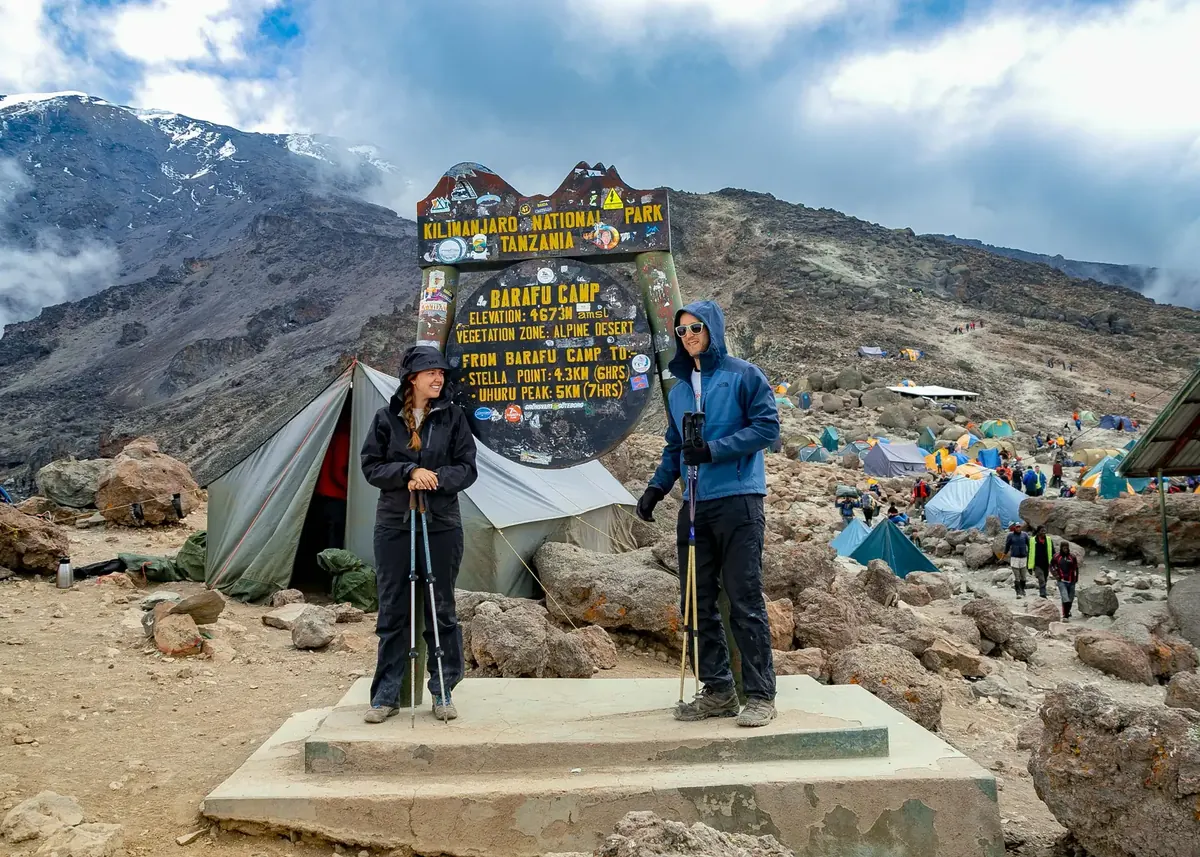 Purpose: arrive rested; prepareAlpine desertBreakfast, lunch, dinner
-
Day 7: Barafu Camp to Uhuru Peak (19,341 ft / 5,895 m), then down to Mweka Camp (10,138 ft / 3,090 m)
About 11 miles (17 km) and 10–14 hours: 3,900 ft (1,200 m) up to Uhuru Peak by headlamp and dawn, then 9,200 ft (2,800 m) down, via Barafu, to Mweka Camp. The night is described below.
Purpose: the summitArctic summit zoneSnacks, lunch, dinner -
Day 8: Mweka Camp to Mweka Gate (5,512 ft / 1,680 m), drive to Moshi
The last 6 miles (10 km), 3–4 hours, drop through wet forest to Mweka Gate; keep your poles out for the slippery sections. You collect your certificate, thank and tip your crew, and we drive you to Moshi.
Purpose: descend; certificatesRainforestBreakfast
Summit Night After Seven Nights on Lemosho
By the time you leave Barafu, around midnight, you have spent seven nights on the mountain, three of them between 11,500 ft and 13,800 ft (3,500 m and 4,200 m). That is what makes the difference on this itinerary: most climbers are slower but steadier on the scree than on shorter climbs.
The way up is the same as from any Barafu start: switchbacks on loose scree to Stella Point (about 18,900 ft / 5,756 m) on the crater rim, usually reached around dawn, then roughly an hour along the rim to Uhuru Peak. You are back at Barafu by late morning for food and rest, and reach Mweka Camp in the afternoon, where the thicker air makes everyone feel better. Expect temperatures well below freezing, with wind: start in all your layers and carry water in insulated bottles. An hour-by-hour plan of the night is on our 7-day Machame page; the two routes share it.
How the 8-Day Lemosho Handles Altitude
This itinerary spreads the height more evenly than any other climb we run on the south side: Shira 1, then a high night near Moir Hut at 13,800 ft (4,200 m), then Lava Tower and down to Barranco, and two short days before Barafu. Your guide checks your oxygen and pulse at each of the seven camps. Expect a mild headache around Moir Hut and Lava Tower; serious signs mean descending at once. Details in our acclimatization guide and the safety section of the Kilimanjaro packages page.
How Hard Is the 8-Day Lemosho Climb?
It is a hard trek, but not a technical climb, and of all our climbs it is the one where the altitude is spread most gently. You need to walk several hours a day for seven days in a row, sleep in a tent and push through one very long summit day.
| Challenge | What it means for you |
|---|---|
| Altitude | Still the real difficulty; the 8-day profile gives you the most time to adjust |
| Summit night | From Barafu after seven nights on the mountain: up by headlamp, down to Mweka Camp the same day |
| Barranco Wall | An 820 ft (250 m) scramble with hands in places; exposed in short sections but not technical |
| Length | Eight days and seven nights on the mountain, with seven nights in tents |
| Steep descents | Long downhill days on Days 7 and 8; hard on the knees |
Start training two or three months ahead: hill walks with a loaded pack every weekend, and a couple of back-to-back long days of 5–6 hours in your climbing boots before you fly. Our guide to how hard Kilimanjaro is has a full plan.
Eight Days with Your Crew on Lemosho
A crew of 14 for two climbers, for eight days and seven camps from Mti Mkubwa to Mweka. The porters keep to an 18 kg (40 lb) limit; we have been a KPAP partner since 2023 and are TATO members. The menu, the daily routine and our guides' training are on the Kilimanjaro packages page: our guides, crew, food and a typical day.
How Much Does the 8-Day Lemosho Climb Cost?
The 8-day Lemosho costs from US$2,335 per person for two climbers with a mid-range Moshi hotel; US$2,160 with budget and US$2,480 with luxury hotels.
| Climbers | Budget | Mid-range | Luxury |
|---|---|---|---|
| 1 | US$2,190 | US$2,375 | US$2,565 |
| 2 | US$2,160 | US$2,335 | US$2,480 |
| 3 | US$2,170 | US$2,370 | US$2,470 |
| 4 | US$2,160 | US$2,335 | US$2,480 |
| 5 | US$2,165 | US$2,355 | US$2,475 |
| 6 | US$2,160 | US$2,335 | US$2,480 |
Where the money goes on the 8-day Lemosho
The eighth day adds a conservation fee and a camping night:
| Park fee (per climber) | Rate | 8-day Lemosho |
|---|---|---|
| Conservation fee | US$70 per day | US$560 |
| Camping fee | US$50 per night | US$350 |
| Rescue fee | US$20 per climb | US$20 |
| VAT | 18% | US$167 |
| Total park fees | About US$1,097 |
Compared with seven days, that extra day costs US$245 per person in total, and it is the day that does most for summit night. Tips for eight days come to about US$440–760 per climber (tipping guide).
What the 8-Day Lemosho Includes
Eight days on the mountain, your crew and every transfer are in the price:
- Eight days of park fees, seven camping nights, rescue fee and VAT
- Tents, mats, mess tent and private toilet tent at all seven camps
- Guide, cook and five porters per climber; every meal from Mti Mkubwa to Mweka
- Oximeter checks, emergency oxygen, first aid and a stretcher
- Airport transfers, the drive to Londorossi Gate, the pickup at Mweka Gate and two nights in Moshi
Not included in the 8-day Lemosho price
Your own costs:
- International flights, visa (US$100 for US citizens) and the US$44 inbound insurance
- Your trekking insurance to 6,000 m with evacuation
- Sleeping bag and gear (rent in Moshi), tips, drinks and laundry
Best Months for the 8-Day Lemosho
January to March and late May to October. Our 2027 group climbs on this itinerary leave on July 8 and July 21. The two days across the Shira Plateau are most rewarding in clear, dry weather; in the rains the western forest is deep in mud. Month by month: the Lemosho route guide.
Packing for the 8-Day Lemosho Climb
Seven nights in a tent means more cold nights than on a shorter climb, so a sleeping bag rated to about 14 °F (−10 °C) is the item to get right; hire one from us for US$25 if yours isn't warm enough (rent in Moshi). The full list is our packing list.
8-Day Lemosho Compared with the 7-Day Lemosho and 9-Day Northern Circuit
These are the climbs people most often weigh against the 8-day Lemosho. All three start at Londorossi in the west.
| 7-day Lemosho | 8-day Lemosho | 9-day Northern Circuit | |
|---|---|---|---|
| Nights on the mountain | 6 | 7 | 8 |
| High night before Lava Tower | No | Near Moir Hut (13,800 ft / 4,200 m) | Moir Hut (13,800 ft / 4,200 m) |
| Day 2 | Long: forest to Shira 2 | Moderate: to Shira 1 | Moderate: to Shira 1 |
| Summit from | Barafu (south) | Barafu (south) | School Hut (north) |
| Crowds | Quiet start, busy south | Quiet start, busy south | Quietest |
| Price from (2 climbers, mid-range) | US$2,090 | US$2,335 | US$2,580 |
Full itineraries: the 7-day Lemosho and the 9-day Northern Circuit. If you also want to compare with the most popular route, see the 7-day Machame. Prefer to climb with others? The 8-day Lemosho has 2027 group departures on July 8 and July 21.
Before and After the 8-Day Lemosho Climb
Arrival day is for meeting your guide and checking gear in Moshi; the climb starts with the long drive west the next morning, and after Mweka Gate you have a night in Moshi before moving on. Hotel options are on our where to stay before and after page, and many climbers add a safari or Zanzibar: see Kilimanjaro, safari and Zanzibar. The 13-day climb and Serengeti safari pairs this climb with four days in the parks, and our full-moon Lemosho climb times summit night to the full moon.
Booking Your 8-Day Lemosho
Pay 30% to confirm your dates and the rest on arrival, by card or mobile money through Pesapal or by US-dollar bank transfer. Full refunds apply 60 days or more before arrival; see our refund policy for the rest.
Common Questions About the 8-Day Lemosho Climb
Is 8 days better than 7 days on Kilimanjaro?
For most first-time climbers, yes. The extra day means a more gradual ascent and a more comfortable summit night.
Where do you sleep on the 8-day Lemosho Route?
In tents at Mti Mkubwa, Shira 1, near Moir Hut, Barranco, Karanga, Barafu and Mweka camps.
Is the 8-day Lemosho suitable for beginners?
Yes. It needs good fitness but no climbing experience. The Barranco Wall is a scramble, not a technical climb.
Can I join a group on the 8-day Lemosho?
Yes. Our 2027 group departures start on July 8 and July 21, at the same per-person price as a private climb. See our Kilimanjaro group climbs.
Is the 8-day Lemosho worth the extra day?
For a first climb, yes. The extra day costs US$245 per person and splits the long plateau crossing, with a high night near Moir Hut before Lava Tower.
Are there toilets on the mountain?
The public camps have basic long-drop toilets, so on every camping climb we carry a private portable toilet tent for your group.
What do you eat on the climb?
Breakfast, lunch and dinner cooked at camp, a different menu every day and a hot soup to start lunch and dinner; tell us about any diet when you book.
Do I need travel insurance?
Yes: a policy that names trekking to 6,000 m (19,700 ft) and helicopter rescue. If an evacuation is ever needed, we organize it.
Should You Book the 8-Day Lemosho Climb?
If this is your first Kilimanjaro climb and you can give it eight days, the 8-day Lemosho is the climb we would choose for you: quiet first days, the full Shira Plateau, a high night near Moir Hut and the gentlest build-up to summit night we offer. Choose the 7-day Machame or 7-day Lemosho if you have one day less, and the Northern Circuit if you want nine days and the fewest people.
Message us with your dates, how many are climbing and your hotel choice, through the form, WhatsApp +255 678 992 599 or jaynevytours@gmail.com, and our team in Moshi sends a written quotation for the 8-day Lemosho, with the July group dates if they suit you.
For the quietest climb on the mountain, take the 9-day Northern Circuit; with a day less, the 7-day Machame follows the same upper trail.